38 Post-Purchase Survey Questions to Ask (and Why They Work)

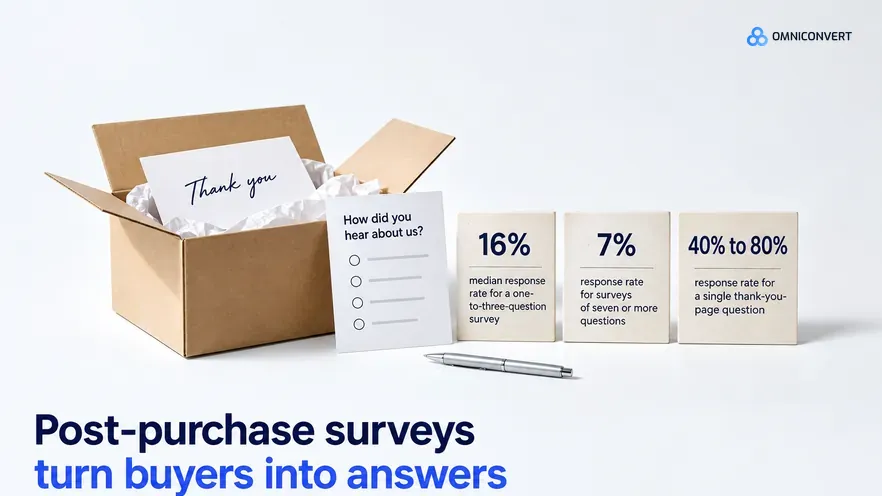
- Post-purchase surveys capture why customers buy and what nearly stopped them, the motivation a tracking pixel cannot see, which is why they still matter even though Google reversed third-party cookie deprecation in April 2025.
- Length decides response rate: one-to-three-question microsurveys earn about a 16% median response versus under 7% for seven or more questions [Survicate, 2025].
- Ask about behavior, not intent. Would-you-buy-again is worthless; what did you compare us against and what nearly stopped you reveal the objections that drive churn.
- Match the question to the moment: motivation and attribution on the thank-you page, product and delivery after arrival, repeat intent around day 30.
- The answers are only worth as much as what you do with them: tie each response to the customer's segment and fix the objection that costs the most revenue first.
A post-purchase survey is a short questionnaire shown right after checkout, on the thank-you page, in the confirmation email, or after the order arrives, that captures why someone bought, how they found you, and what nearly stopped them. It is the one moment you can ask a customer a question and expect a real answer, because attention and goodwill peak at purchase. Across the CROBenchmark dataset of 7,000+ websites in 15+ industries, brands that acted on structured voice-of-customer feedback closed the gap between a first order and a second faster than brands that relied on analytics alone [CROBenchmark Report 2026, Omniconvert].
This guide gives you 38 questions, grouped not by topic but by what each answer actually reveals: why they bought, what nearly stopped them, whether they will come back, where they found you, how the product and delivery landed, and how they score you. Nexus by Omniconvert is the AI eCommerce growth engine that captures these answers and ties each one to the customer who gave it. First, the two things most survey advice gets wrong.
Why do post-purchase surveys beat your analytics?
For years the standard pitch for these surveys was cookie panic: third-party cookies are dying, so you need zero-party data to survive. That reason is now wrong. Google reversed its third-party cookie deprecation in April 2025, and cookies remain in Chrome [Google, 2025]. The honest case for post-purchase surveys never depended on the cookie apocalypse anyway.
Zero-party data is defined as information a customer intentionally and proactively shares with a brand, such as their buying motivation, preferences, or the objection they had at checkout. It matters in ecommerce because it is the one data type no competitor can buy, model, or infer from behavior; it comes only from asking, and it is exactly what a purchase-time survey collects.
The reason to run these surveys is simpler and more durable than any privacy headline: your analytics stack can reconstruct every click in a session and still cannot tell you that the customer bought because a friend swore by you, hesitated because shipping looked slow, and almost bought a competitor whose returns policy was clearer. This is the Jobs-to-be-Done lens: customers do not buy a product, they hire it to make progress. A pixel sees the hire; only a question surfaces the job.
How many post-purchase survey questions should you ask?
Survicate's 2025 benchmark analyzed 4,332 surveys across 460 companies and found the pattern is not subtle: shorter wins, every time, with a median completion rate around 75% for the surveys people start [Survicate, 2025]. The lesson is not "surveys work"; it is "long surveys do not." A 38-question list is a menu to rotate through, not a form to deploy all at once.
| Survey length | Typical median response rate | Best use |
|---|---|---|
| 1 to 3 questions (microsurvey) | ~16% | Thank-you page, in-flow, one moment |
| 4 to 6 questions | ~10% to 13% | Post-delivery follow-up email |
| 7+ questions | Under 7% | Rarely; annual research only |
So treat the clusters below as a rotating bank. Pick one question for the thank-you page, one for the delivery follow-up, one for day 30, and change them as you learn. The Peak-End Rule is worth remembering here: people judge an experience by its peak and its end, and the survey itself is part of the end. A short, thoughtful question adds to the memory; a ten-field form subtracts from it.
Which questions reveal why customers bought?
These are the highest-value questions on the list, because the answer is language you can reuse everywhere. Ask on the thank-you page:
- 1. What problem were you hoping this would solve?
- 2. What finally made today the day you decided to buy?
- 3. What were you using before this?
- 4. What would you have done if we did not exist?
- 5. Who is this purchase for?
- 6. What convinced you we were the right choice?
- 7. What outcome are you hoping for in the next month?
- 8. How would you describe this product to a friend?
Questions 2 and 4 are the sharpest. "What made today the day?" surfaces the trigger event, the deadline, gift occasion, or the moment the old solution finally broke, that ads and retargeting can be timed against. "What would you have done otherwise?" reveals your real competition, which is often not another brand but doing nothing, a DIY workaround, or a substitute category entirely. Answers like these are raw material for ad creative from customer reviews.
Which questions reveal what nearly stopped them?
This is the churn-prevention half of the article, and it rests on a rule from The Mom Test: never ask customers to predict their future behavior or spare your feelings. "Would you buy again?" invites a polite yes that means nothing. Ask instead about what already happened:
- 9. What nearly stopped you from completing this order?
- 10. What did you compare us against before buying?
- 11. What almost made you choose someone else?
- 12. Was there anything you expected to find but did not?
- 13. What information did you have to search for during checkout?
- 14. What was the hardest part of deciding to buy?
- 15. What one thing would have made you buy sooner?
Question 10 is the one most brands never ask and most need: the set of alternatives a customer weighed is a map of your competitive positioning drawn by the person who just chose you. When the same competitor or the same missing detail, sizing, shipping speed, a certification, shows up across dozens of answers, you have found a fix with a revenue number attached rather than a hunch.
Nexus by Omniconvert clusters every "what nearly stopped you" answer by customer segment, so you fix the objection that costs the most revenue first, not the one that shouts loudest.
See how it works →Which questions predict churn versus repeat purchase?
Repeat behavior is won or lost between the first and second order. These questions are best asked after the product has arrived and been used, around the point a reorder becomes realistic:
- 16. Have you already told anyone about this purchase?
- 17. When do you expect to need or reorder this?
- 18. What have you replaced with this product?
- 19. What would have to be true for this to become a regular purchase?
- 20. What is the one thing that would make you not reorder?
- 21. How many other brands' versions of this have you tried?
Question 19 is deliberately conditional rather than a yes/no on intent, because it returns the specific condition, a subscription option, a lower per-unit price, a refill reminder, that stands between a one-time buyer and a repeat one. Read against your customer lifetime value data, these answers tell you which conditions are worth engineering for the segments that actually pay.
How do you ask "How did you hear about us?" for attribution?
Self-reported attribution catches what pixels cannot: the friend's recommendation, the podcast ad, the mention in a group chat. Fairing reports that this single question, placed on the thank-you page at the moment of purchase, earns 40% to 80% response rates, and that a response rate around 40% is already enough to attribute channel revenue reliably using extrapolation [Fairing, 2026]. Ask:
- 22. How did you first hear about us?
- 23. What made you visit the site today specifically?
- 24. Where did you most recently see us before buying?
- 25. Did anyone recommend us to you, and where?
Keep the answer options open-ended or lightly structured; a free-text "how did you hear about us" will surface channels you did not know you had. The gap between what your ad platforms claim and what customers report is where wasted spend hides.
Which product, delivery, and experience questions should you ask?
Once the box is open, the customer can tell you whether the experience matched the promise. Rotate through:
- 26. How was the checkout experience?
- 27. Was anything about ordering confusing?
- 28. What almost made you abandon your cart?
- 29. How clear was the delivery and shipping information?
- 30. Did the product page tell you everything you needed?
- 31. What is one thing we could improve about buying from us?
- 32. Was the price what you expected?
Question 30 is a direct line to your merchandising: when customers repeatedly report a detail they had to hunt for, that detail belongs on the product page, and adding it typically lifts conversion for every future visitor, not just the one who complained.
How do NPS and CSAT fit into a post-purchase survey?
Scores make good trend lines and poor to-do lists. Collect them, but never without the follow-up that explains them:
- 33. How likely are you to recommend us, from 0 to 10? (NPS)
- 34. What is the main reason for your score?
- 35. How satisfied are you with your purchase so far? (CSAT)
- 36. How much effort did it take to complete your order? (CES)
- 37. What is the one thing we could do to earn a higher score?
- 38. Is there anything else you would like us to know?
Question 34 is the one that matters. An NPS of 42 tells you nothing you can act on; a hundred answers to "why did you give that score" tells you exactly what to fix. The score is the headline; the reason is the article.
In our CVO audits across ecommerce brands, the ones that plateau at a 20% to 30% repeat rate consistently share one pattern: they collect scores and never read the reasons behind them [Omniconvert, 2026]. The benchmark gap closes fastest when operators treat the open-text "why" as the primary unit of measurement, not the average score on a dashboard. We repeatedly find that the recurring objection in free-text answers is already known to the customer service team and simply never reaches the roadmap.
Case study. AliveCor used Omniconvert to run a structured A/B testing programme, turning what customers reported into tested changes, and achieved a +21% conversion rate, +5% revenue per visitor, and 94% statistical relevance across their experiments [Omniconvert, AliveCor case study]. The lesson for surveys is the same: feedback only pays when it becomes a tested change, not a stored comment.
How do you sequence and time post-purchase survey questions?
The same question asked at the wrong moment returns a worse answer. Map the clusters to the customer's timeline:
| Moment | Ask about | Example question |
|---|---|---|
| Thank-you page (immediately) | Motivation, attribution | How did you hear about us? What made today the day? |
| Order confirmation email | Hesitation, checkout friction | What nearly stopped you? What did you compare us against? |
| After delivery (2 to 5 days) | Product, delivery, expectation | Did the product match the page? How clear was shipping? |
| Around day 30 | Repeat intent, loyalty, NPS | What would make this a regular purchase? Why that score? |
One question per moment is the whole discipline. It keeps each touchpoint a microsurvey, protects the response rate, and ensures the answer is about a fresh experience rather than a blurred memory. Rotate the specific question within each slot over weeks, and you assemble the full 38-question picture without ever asking one buyer to fill in a form.
Post-purchase survey questions FAQ
A post-purchase survey is a short questionnaire shown right after checkout, on the thank-you page, in the confirmation email, or after delivery, that captures why someone bought, how they found you, and what nearly stopped them. It records motivation and hesitation that no tracking pixel can see, because analytics show what a customer did but never why they did it. The best versions ask one to three questions per moment and rotate over time.
One to three. Survicate's 2025 benchmark of 4,332 surveys across 460 companies found microsurveys of one to three questions earn about a 16% median response rate, versus under 7% for surveys of seven or more questions. Ask one focused thing per moment, then rotate the question over time so you build a full picture without ever making a single buyer answer a long form.
On the thank-you page, shown immediately after purchase, a single-question post-purchase survey can reach a 40% to 80% response rate, far above the roughly 10% typical of delayed email surveys. Response is highest at the moment of purchase because attention and goodwill peak there. Even a partial response rate near 40% is enough to attribute channels and revenue reliably, so you do not need everyone to answer.
Match the question to the moment. Ask motivation and attribution on the thank-you page while intent is fresh; ask about the product and delivery after the order arrives, when the customer has actually used it; and ask about loyalty and repeat intent around day 30, once a reorder decision is realistic. One question per moment keeps every survey short and each answer tied to the experience it measures.
Ask about behavior, not intent. Instead of the near-useless would-you-buy-again, ask what nearly stopped them, what they compared you against, and what would have to be true for this to become a regular purchase. Those answers surface the recurring objection and the unmet expectation that drive customers away. Fix the objection that shows up most often and you close the gap between a first order and a second.
Nexus by Omniconvert captures post-purchase survey responses through its Pulse voice-of-customer surveys and ties each answer to the customer's transactions and RFM segment, so a reason to buy or a complaint is never a floating comment. It shows which objections cluster in which segments and maps them to predicted lifetime value, so you fix the hesitation that costs the most revenue first, rather than the one that happens to be loudest.
The most valuable answer a post-purchase survey returns is not a satisfaction score; it is the sentence that names what a customer compared you against and what nearly stopped them from buying. Collect that at scale, cluster it by segment, and the recurring objection stops being an opinion and becomes a prioritized fix. Start with one question on your thank-you page this week, and once the responses accumulate, tie them to who is answering with Nexus by Omniconvert so the loudest complaint and the most expensive one are never confused.
Turn survey answers into ranked action with Nexus
Nexus by Omniconvert runs Pulse voice-of-customer surveys and ties every response to the customer's transactions and segment, so you see which objections cost the most revenue and act on those first. Stop collecting comments you never read and start closing the gap between a first order and a second.