UK Food & Drinks Ads, September 2026: Bold Claim Opened 33.6% of Ads While Curiosity Gap Fell to 9.3%. One of Those Rows Still Has Room for You

Scope: Food & Drinks ads in the UK, as the eCommerceBenchmark Ad Library tracks them. 40 brands, 777 ads active in September 2026, compared with August 2026.
Most ad reports hand you a ranking. Then they walk off and leave you holding it.
This one tells you what to do with it.
For each of September's top three hooks, top three angles and top three concepts, from Bold claim's 33.6% down to Customer Testimonial Reel's 5.4%, you get the same five things: what it is, why it matters to you, what moved since August, which real brands ran it, and one thing to steal. Nine moves, and the ads behind them. Then the small rows that grew, Price anchor to 3.2% among them, and one ad to brief this week.
- A brief decides three things, not one. The hook, the argument and the shape of the ad are separate calls. Ask for a stronger hook and stop there, and the person making the ad picks the other two for you.
- The default in each group is the one every shopper has already met. A third of this cut's ads open the same way. Pick it without thinking and your ad has to blend in before it can stand out.
- Each default has a shelf life. Some rows keep ads on air for months, some turn over in weeks. That is what tells you where your creative time is worth spending.
But first, three words that most briefs mix up.
Hook, angle, concept: three different jobs
Mixing these three up is the most common reason an ad brief goes wrong. A brief that asks for a Bold Claim opening, the row behind 33.6% of September's ads, and stops there has decided one thing and left two to chance, so whoever shoots it picks Solution-Aware at 19.4% and Offer-First Banner at 13.6% for you.
| Word | In one line | Plain example |
|---|---|---|
| Hook | The first move an ad makes to stop a scroll: its first line or first seconds. | “Your kettle is about to get busy.” |
| Angle | The reason the ad gives a shopper to buy. | “It costs less per cup than the café on your corner.” |
| Concept | The shape of the creative: how it is filmed, laid out or staged. | A mug on a kitchen counter, filmed in one unbroken shot. |
The plain examples are made up to show the idea.
A hook is defined as the first move an ad makes to stop a scroll: its first line or first seconds. An angle is defined as the reason the ad gives a shopper to buy. A concept is defined as the shape of the creative: how it is filmed, laid out or staged. Three decisions, every time.
How to read a rise or a fall
Every item below shows its share of September's ads, how that compared with August, and how many brands ran it: Bold claim, for one, 33.6% against 29.6% on 26 brands.
- Rising. A bigger share of ads uses it, the way Social proof went to 13.3% from 10.4%. Brands may be copying each other or testing a gap, and either way the row is getting more crowded.
- Falling. A smaller share uses it, like Curiosity gap at 9.3% against 12.2% in August. That doesn't mean it failed, and nothing here records a brand stopping an ad.
- Flat. Its share held. Treat it as a stable baseline.
- Small. A move under half a point is small, as with Offer-first banner's 13.6% against 13.4%. Check the brand count, because Side-by-Side Comparison's rise sits on three brands, which can be one advertiser launching ads.
One more rule. A bigger share doesn't mean a row works better. The library holds no sales, spend or profit data, so it shows what brands ran, not what earned. Shares here count every ad active in the month, not only the ads launched in it. Each item also shows how many of its ads in a sample of long-running ads ran sixty days or more, and that sample is ranked by time on air, so the numbers read high. Read them as a staying-power hint.
Ready? Start with how ads open.
The top 3 hooks: how ads open
Together, these three open nearly half of September's ads. This section shows how crowded each one is and how long its ads stayed on air in the long-running sample.
Share of September 2026 ads by hook. Source: eCommerceBenchmark Ad Library, 2026.
Share of each hook's ads that ran sixty days or more, in a sample of long-running ads. Reads high: a staying-power hint, not a result. Source: eCommerceBenchmark Ad Library, 2026.
1. Bold Claim: it says the big thing before anything else
What it is. A Bold Claim opening puts the largest promise the brand will make into the first few words, ahead of the product, the price and the proof. brittsuperfoods.co.uk starts on “One small shot. One big impact.” and leaves the product name to its headline.
Why it matters to you. This is the busiest of the three hooks by a wide margin, at 33.6% of the month's ads, and it has the widest base of the three: 26 brands. In the long-running sample, 93.5% of its ads ran sixty days or more, second only to Curiosity Gap among these three. So it is the safe and busy one. Your next ad lands in a feed where a third of the ads open with the same move, which means the words have to do all of the separating.
What moved. 33.6% in September, 29.6% in August. The row got more crowded, not less, and it shows up in the movers chart further down. Our reading: more brands reaching for the same opening. The data records the share, not the reason.
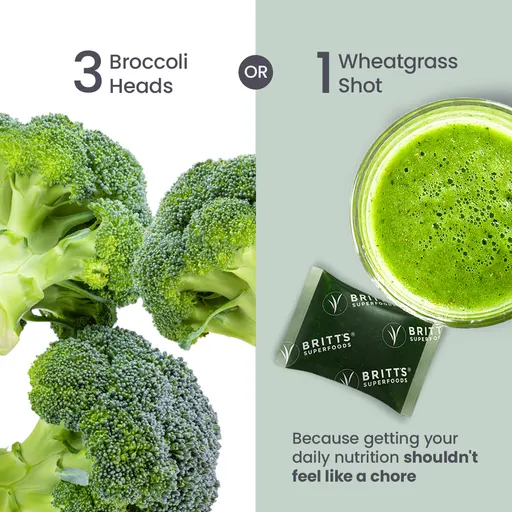
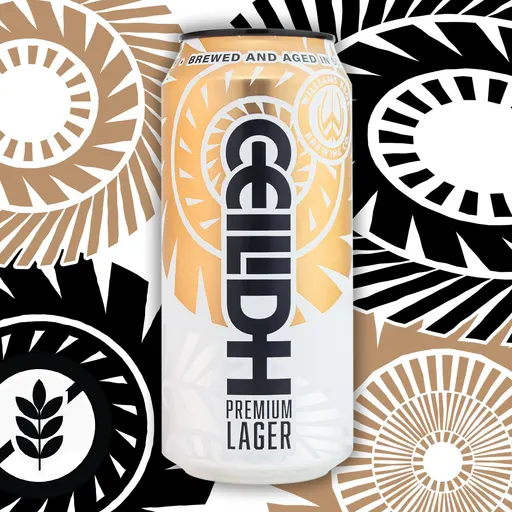
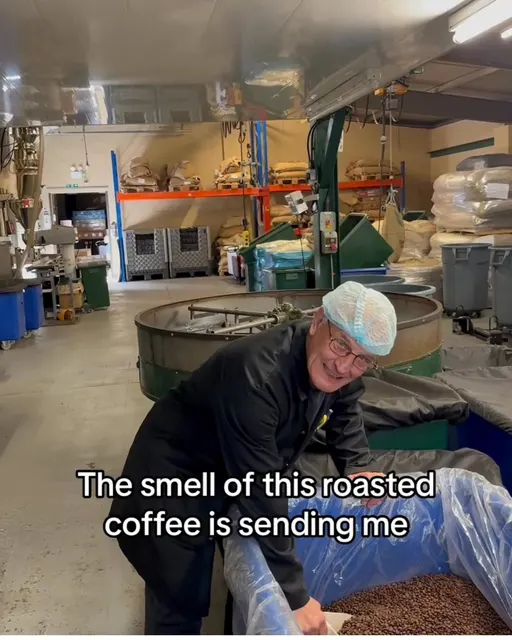
Three ads, three sizes of promise. brittsuperfoods.co.uk sets small against big in two short sentences, and that ad has 180 days on air. williamsbrosbrew.com names the thing in three words, “Gluten Free Helles”, and lets the category carry the claim. farrerscoffee.co.uk opens on “Our coffee roaster is LIT” and keeps its own boast, “Les Was Nominated”, for the headline. The one worth copying is the first: the claim arrives in two halves either side of a full stop, so a shopper has the whole argument before the second line.
That's the crowded one. Now the one that's shrinking.
2. Curiosity Gap: it names the thing and holds back the why
What it is. A Curiosity Gap opening names something and parks the reason somewhere the shopper has to go looking. kissthehippo.com starts on “KISS THE HIPPO AT HOME” and leaves the promise to its headline, “Brew Excellence at Home with Kiss The Hippo.”
Why it matters to you. At 9.3% of the month's ads it is far less crowded than Bold Claim, and fewer brands write it: 15. It also holds its ads on air longest of these three hooks, 98.6% of its sample past sixty days. Less crowded, and the ads that use it sit there. That makes it the hook with room in it.
What moved. 9.3% in September, 12.2% in August. Fewer of this cut's ads opened this way than a month earlier, which means the gap you can walk into got wider, not narrower.
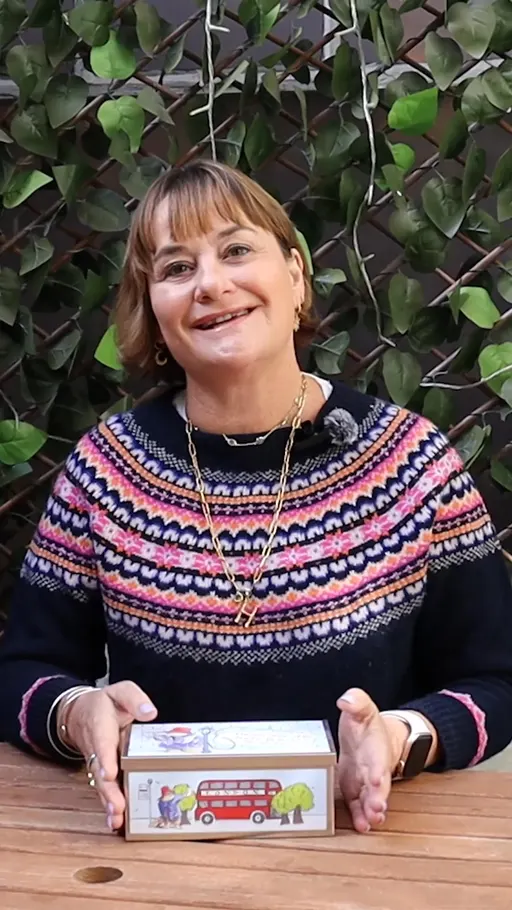
Two ads, two things held back. biscuiteers.com opens on its own category line, “This is original hand-iced biscuit company”, and keeps its code, “15% Off With Code: INTRO15”, out of the first line entirely. kissthehippo.com puts the brand and the place in capitals and lets the headline explain what you get. The biscuiteers.com order is the one to copy, because the shopper meets the claim first and the deal second, so the deal reads as a reason to act rather than the whole idea.
That's two hooks down. The third leans on somebody else's name.
3. Authority: it points at someone else's say-so
What it is. An Authority opening borrows standing from outside the brand: a judge, an award, a shortlist, a name the shopper already knows, before the ad asks for anything.
Why it matters to you. It is the quietest of the three, 6.8% of September's ads, on 17 brands, more brands than Curiosity Gap and fewer than Bold Claim. Its ads also turn over fastest of the three here: 83% of its sample ran sixty days or more, the lowest of the three hooks. Read that as a row you may need to rewrite more often, but with fewer ads already sitting in it.
What moved. 6.8% in September, 6.1% in August. It rose enough to appear in the movers chart below, so the quiet row is getting less quiet.
That's how ads open. But why would anyone buy?
The top 3 angles: why the shopper should buy
A bit under half of September's ads argue one of these three. Again: how crowded each one is, and how long its ads stayed on air in the long-running sample.
Share of September 2026 ads by angle. Source: eCommerceBenchmark Ad Library, 2026.
Share of each angle's ads that ran sixty days or more, in a sample of long-running ads. Reads high: a staying-power hint, not a result. Source: eCommerceBenchmark Ad Library, 2026.
4. Solution-Aware: it skips the problem and names the answer
What it is. A Solution-Aware ad talks to a shopper who already knows what they want. It spends its words on the answer and never sets up the ache first.
Why it matters to you. It is the most argued of the three, 19.4% of the month's ads, tied with Social Proof for the widest base at 22 brands. In the sample, 85.4% of its ads ran sixty days or more, between the other two of this section. So this is the argument your account probably already makes, and the one a shopper has met most often this month.
What moved. 19.4% in September, 16.1% in August. It is in the movers chart below. Our reading: the market leaned harder on talking to ready buyers. The data records the share, not the reason.
That's the busy argument. The next one is quieter and stickier.
5. Identity: it sorts the shopper in or out in one line
What it is. An Identity ad tells the shopper who the product is for and lets them decide whether that is them. williamsbrosbrew.com says it in three words, “Gluten Free Helles”, and nothing else needs to happen.
Why it matters to you. At 13.8% of the month's ads it sits just under Solution-Aware, on 21 brands, a shade fewer. It is the stickiest of the three here: 99.1% of its ads in the sample ran sixty days or more. Crowded, yes, but these are ads brands kept on air a long time.
What moved. 13.8% in September, 15.3% in August. Slightly fewer of the cut's ads argued this way, so the row eased while the other two of this section rose.
Four ads, four ways of saying who this is for. biscuiteers.com writes for the gift buyer: “This wise bear has been intricately hand-iced at the Ministry of Biscuits.” kissthehippo.com writes for the person who wants the cafe at home. williamsbrosbrew.com writes for one drinker and one need in three words. farrerscoffee.co.uk puts its roaster in the frame with “Our coffee roaster is LIT”, which sorts by the kind of buyer who cares who roasted it. The williamsbrosbrew.com line is the one to copy, because a shopper can sort themselves in or out before the second line arrives.
That's the sticky one. Now the argument that arrived in a hurry.
6. Social Proof: it lets other buyers make the argument
What it is. A Social Proof ad hands the reason to other people: counts of buyers, reviews, the sense that someone like you already did this.
Why it matters to you. It is level with Solution-Aware on the widest base, 22 brands, and it argued 13.3% of the month's ads. Its ads hold on air least of these three, 79.6% of its sample past sixty days. So: a busy row, filling fast, with the shortest stay of the three.
What moved. 13.3% in September, 10.4% in August. It shows in the movers chart below. The crowd is arriving in this row right now.
That's why a shopper should buy. Now the shape the ad arrives in.
The top 3 concepts: how the ad looks
Roughly 3 in 10 of September's ads are staged one of these three ways. A concept is the shape of the creative, and fewer ads carry a concept than carry a hook or an angle, so these shares look small: compare concepts only with each other, never with a hook or an angle share. The same two questions apply, how crowded and how long the ads stayed on air.
Share of September 2026 ads by concept. Source: eCommerceBenchmark Ad Library, 2026.
Share of each concept's ads that ran sixty days or more, in a sample of long-running ads. Reads high: a staying-power hint, not a result. Source: eCommerceBenchmark Ad Library, 2026.
7. Offer-First Banner: it puts the deal where the picture would go
What it is. An Offer-First Banner makes the deal the layout: the saving or the free thing is the biggest element on screen. farrerscoffee.co.uk runs “FREE DELIVERY” as the whole frame and pushes the choice into its headline, “Three bags. Your choice.”
Why it matters to you. It is the most used of the three concepts, 13.6% of the month's ads, on 21 brands, the widest base here. It also keeps its ads on air longest of the three, 98.1% of its sample past sixty days. This is the control shape of UK Food & Drinks.
What moved. 13.6% in September, 13.4% in August. That is a move under half a point, so treat it as small and look at it again next month: with 21 brands in the row, a handful of launches can account for it.
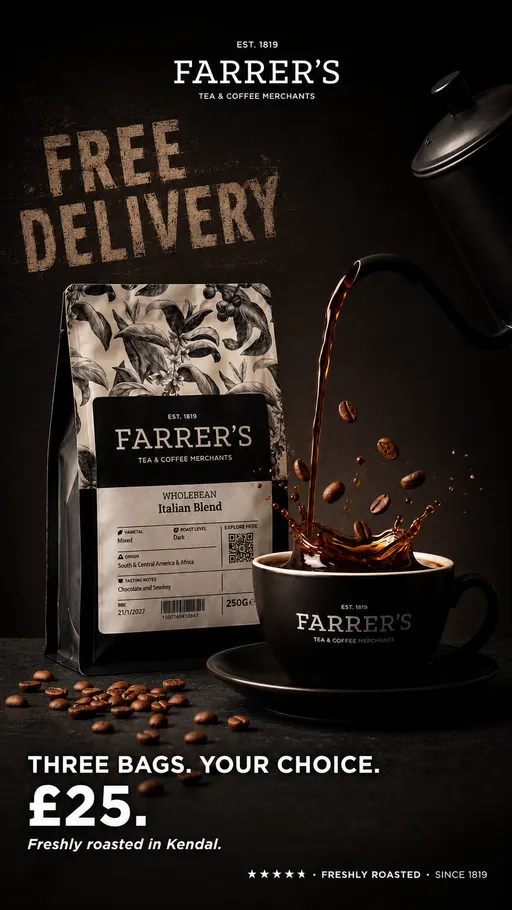
One ad, one layout. farrerscoffee.co.uk gives the two words of the offer the whole frame and makes the headline do the rest of the work. That order is the one to copy, because the shopper knows what is in it for them before they know what is in the bag.
That's the control. Now the shape that rose fastest here.
8. Cinematic B-Roll: it runs one line over filmed clips
What it is. A Cinematic B-Roll ad lets filmed clips carry the ad with one short line laid over them. williamsbrosbrew.com's is three words, “Gluten Free Helles”.
Why it matters to you. At 9.3% of the month's ads it sits between the other two concepts here, but on 13 brands, fewer than Offer-First Banner. In the sample, 68.1% of its ads ran sixty days or more, under the banner shape and over the testimonial one. Fewer brands and a rising share: that is the shape to test.
What moved. 9.3% in September, 7.2% in August. It is in the movers chart below.
One ad, one line over film. williamsbrosbrew.com writes the shortest possible line and lets the clips sit under it. Worth copying for the order it was built in: the words came first and the cuts answer to them.
That's the one with room. The last concept is the newest crowd and the smallest one.
9. Customer Testimonial Reel: it hands the ad to the people who bought
What it is. A Customer Testimonial Reel gives the ad over to buyers talking, and the brand's own words come second or not at all.
Why it matters to you. It is the smallest of these three, 5.4% of the month's ads, and it rests on six brands, a handful against the 21 in the banner row. Its ads hold on air least of the three: 50% of its sample past sixty days. So it is a one-test row, not a plan.
What moved. 5.4% in September, 3.1% in August. It is in the movers chart below, and with six brands carrying it, a batch from one or two advertisers can account for a move like that.
That's the nine. Now the rows that moved while nobody was looking.
What actually moved: the small stuff
Seven of the nine leaders rose by a fifth of a point or more, so this was not a quiet month at the top. Across the three rankings, eighteen rows rose by at least that much. Here they are.
Rows of the three rankings that rose by a fifth of a point or more, September 2026 against August 2026, in points. Source: eCommerceBenchmark Ad Library, 2026.
None of the nine leaders held exactly the share it had in August. Two eased, Curiosity Gap and Identity, and seven rose enough to show in the chart. Most of the other risers are small rows that few brands write for. The reason to care isn't any single one of them, it's that several rose in the same month. Let's look at three of them in real ads.
Objection Crusher: it clears the last worry before the tap
What it is. An Objection Crusher argument answers the thing that would stop the order, and farrerscoffee.co.uk answers it in two words: “FREE DELIVERY”.
Why people respond. Think of the basket where everything is fine until the postage line appears at the end. An ad that settles that before the shopper gets there removes the pause, not the price. That is our reading of the attention, not a claim about sales.
Only farrerscoffee.co.uk is carded here, and the headline beside it, “Three bags. Your choice.”, does the offer's second half. This row isn't resting on two advertisers either: 18 brands ran it in September, the widest base of the three risers below.
Comparison: it measures the product against something the shopper knows
What it is. A Comparison argument sizes the product against a thing the shopper can already picture, the way brittsuperfoods.co.uk does with “One small shot. One big impact.”
Why people respond. A shopper has no feel for a dose or a gram, but everybody knows what a small glass and a big promise look like side by side. Setting the two next to each other does the maths for them. That is our reading of the attention, not a claim about sales.
One brand is carded here, and the row is thinner than the one above it: nine brands ran it in September. So a handful of advertisers carry this argument across the cut.
Side-by-Side Comparison: it splits the frame and lets the shopper judge
What it is. A Side-by-Side Comparison stages the same argument as a shape, two things in one frame, which is how brittsuperfoods.co.uk's “One small shot. One big impact.” is filed on the concept side too.
Why people respond. It is the supermarket shelf move: two packs held up together and the choice makes itself. Nobody has to be told which is which. That is our reading of the attention, not a claim about sales.
One brand is carded, and a handful of brands carry the whole row: three of them. Read it as an idea with a lot of empty space in it rather than a trend.
Objection crusher at 8.2%, Comparison at 3.6% and Side-by-Side Comparison at 1.2% all rising in the same month hint at one ad nobody here has built yet.
One ad to brief this week: the Small-Shot Proof Ad
Objection Crusher went to 8.2% of the month's ads, Comparison to 3.6% and Side-by-Side Comparison to 1.2%, all in the same month. Put together, they point at one ad: it opens on a two-part size claim, the middle sets two options beside each other in one frame, and the close carries the delivery line, right where the shopper is adding up the cost. This is our suggestion built from the movers, not a finding. The library can't say it will work, and that is what the test is for.
The format. A fifteen-second vertical video of four or five clips, one line of text on each, no voice-over, so nothing like the Offer-first banner layout behind 13.6% of September's ads.
The hook. Model the first clip on brittsuperfoods.co.uk's “One small shot. One big impact.”: keep the two halves either side of a full stop, and nothing else on screen.
The middle. Model the second and third clips on brittsuperfoods.co.uk's “One small shot. One big impact.”: keep the split frame, the small thing on one side and the big thing on the other, and no words beyond those two short sentences.
The close. Model the last clip on farrerscoffee.co.uk's “FREE DELIVERY”: keep the two words alone in the frame, where the shopper is already deciding.
The test. Run it against your best Bold Claim ad, the row that opened 33.6% of September's ads, same audience and same budget split, for two weeks, judged on cost per purchase.
Two smaller tests can ride along, each as its own whole ad against the ad it replaces, never folded into the brief above and never a swap of the first line alone, because Price anchor at 3.2% and Identity at 13.8% are separate rows with separate answers. Test one: Price anchor climbed to 3.2% of September's ads from 2.2% in August, so write an offer line that carries a real calendar date instead of “limited time”, and take it down the day that date passes. Two: an ad written for one named shopper, modelled on williamsbrosbrew.com's “Gluten Free Helles”, which names exactly who it is for, run against your broadest Solution-Aware ad.
The eCommerceBenchmark Ad Library sorts your ads into the same hooks, angles, concepts and offers used in this report and shows your mix next to the market, so you can see which shapes you have never shipped.
Audit my creatives, freeOne catch before you run off. Everything above is the whole of UK Food & Drinks. Your corner of it might look nothing like it.
Why you need to know the hooks in your niche
A row that is crowded across UK Food & Drinks can be empty in your corner of it. Your product line, your price point, your shopper: none of those are the whole cut. And the row you think is yours alone can be the one all five of your competitors opened with last week.
- Shoppers tune out an opening they meet over and over. The tenth ad that opens the same way is read as the same ad.
- When every ad sounds the same, price is all that is left to compare. Bold claim opened 33.6% of September's ads, and that is a fight you win by giving money away.
- A different opening costs the same to write into the brief. Price anchor's 3.2% is no harder to ask for than Bold claim's 33.6%.
- Different isn't the same as right. That is why you brief one ad into an empty row instead of switching the whole account over.
Your 30-minute check
- Collect. Pull twenty current ads from your five closest competitors in the free Meta Ad Library.
- Label. Write down each ad's hook, angle and concept, one line per ad.
- Count. The row that shows up most is your niche's crowded row; across UK Food & Drinks, that's Bold claim.
- Find the gap. The row that shows up least, or never: check it against the movers above.
- Brief one test. One ad for the empty row, run against your control for two full weeks.
Want every number? Here are the full rankings.
The full rankings: hooks, angles and concepts
Use these three as worksheets, not scoreboards. Write your own count beside each row, from your last month of ads or your competitors' current ones. The rows where your count is highest are the ones you are actually competing in.
| Hook | September share | August share | Change |
|---|---|---|---|
| Bold claim | 33.6% | 29.6% | ▲ 4.0 |
| Curiosity gap | 9.3% | 12.2% | ▼ 2.9 |
| Authority | 6.8% | 6.1% | ▲ 0.7 |
| Visual reveal | 5.1% | 3.5% | ▲ 1.6 |
| Direct question | 4.1% | 3.9% | ▲ 0.2 |
| Relatability | 4% | 4.3% | ▼ 0.3 |
| Newness | 3.2% | 2.6% | ▲ 0.6 |
| Price anchor | 3.2% | 2.2% | ▲ 1.0 |
| Urgency / FOMO | 1.5% | 1.4% | ▲ 0.1 |
| Storytelling | 0.5% | 0.3% | ▲ 0.2 |
| Shocking statement | 0.3% | 0.3% | 0 |
| Contrarian | 0.3% | 0.2% | ▲ 0.1 |
| Angle | September share | August share | Change |
|---|---|---|---|
| Solution-aware | 19.4% | 16.1% | ▲ 3.3 |
| Identity | 13.8% | 15.3% | ▼ 1.5 |
| Social proof | 13.3% | 10.4% | ▲ 2.9 |
| Objection crusher | 8.2% | 7.6% | ▲ 0.6 |
| Problem-aware | 7.1% | 8.5% | ▼ 1.4 |
| Mechanism | 4.2% | 3.7% | ▲ 0.5 |
| Comparison | 3.6% | 3.4% | ▲ 0.2 |
| Concept | September share | August share | Change |
|---|---|---|---|
| Offer-first banner | 13.6% | 13.4% | ▲ 0.2 |
| Cinematic B-roll | 9.3% | 7.2% | ▲ 2.1 |
| Customer Testimonial Reel | 5.4% | 3.1% | ▲ 2.3 |
| Product Demo Close-Up | 5% | 7% | ▼ 2.0 |
| Montage | 4% | 3% | ▲ 1.0 |
| Listicle | 2.2% | 1.9% | ▲ 0.3 |
| Side-by-Side Comparison | 1.2% | 1% | ▲ 0.2 |
| Behind-the-Scenes | 0.8% | 0.8% | 0 |
| UGC Unboxing | 0.3% | 0.3% | 0 |
| Problem agitation | 0.1% | 0.1% | 0 |
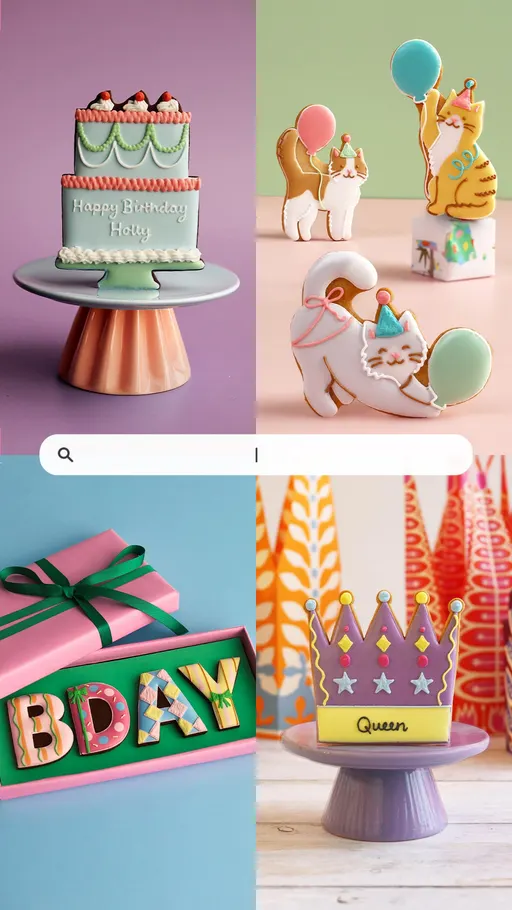
One row in the angle table eased while the top three rose. Problem-aware argued 7.1% of September's ads, against 8.5% in August. biscuiteers.com writes that argument as “The Perfect Birthday Gift”, an ad with 198 days on air: it names the moment the shopper is buying for, then lets the headline do the rest.
Your test card
Here is the Small-Shot Proof Ad from this article, set up the way a media buyer would run it. Fill in the blanks with your own numbers, and write them down before you launch.
| Hypothesis | A Small-Shot Proof Ad, run beside my best Bold Claim ad on the same audience and the same budget split, will hold or lower my cost per purchase over two full weeks. |
| Change only this | The whole creative: the Small-Shot Proof Ad as briefed, opening on a two-part size claim, two options beside each other in the middle, the delivery line at the close. |
| Keep the same | Product, offer, audience, placement and budget split. |
| Funnel stage | Say first whether this ad is for prospecting (cold) or retargeting (warm). A deal in the first line is often right for warm audiences and wrong for cold ones, so test it where the ad will really run. |
| Setup | One control and one variant, same audience, same placement, even budget split. Do not edit either ad while the test runs. |
| How long and how much | Until each version has about 50 purchases, or two full weeks, whichever comes later. This is general testing practice (Meta's own learning-phase guideline is about 50 results per ad set per week), not a library finding. |
| Success metric | Cost per purchase, not clicks. |
| Stop rule | Pause a variant that has spent about 3 times your target cost per purchase with no purchase. If it is close, keep it running. |
| What counts as a win | The variant beats the control on the metric by an amount you would act on, and still does in a second week. |
September 2026 UK Food & Drinks ads: what to brief next
- Bold Claim opened 33.6% of UK Food & Drinks ads in September 2026, Curiosity Gap 9.3% and Authority 6.8% [eCommerceBenchmark Ad Library, 2026]: this is the lane every brief lands in by default.
- Solution-Aware argued 19.4%, Identity 13.8% and Social Proof 13.3% of the month's ads: between them, a bit under half of the market's arguments.
- Offer-First Banner staged 13.6%, Cinematic B-Roll 9.3% and Customer Testimonial Reel 5.4%, read against each other only, never against a hook or an angle.
- Staying power differs: Curiosity Gap holds 98.6% of its long-running sample past sixty days, the most of the three hooks.
- Customer Testimonial Reel holds 50% of its sample past sixty days, the least of the three concepts, and it sits on six brands.
- Eighteen rows rose by a fifth of a point or more, Visual reveal, Price anchor, Montage, Objection crusher and Side-by-Side Comparison among them, and some sit on very few brands: three carry Side-by-Side Comparison.
UK Food & Drinks ad benchmarks: common questions
Keep one Bold Claim ad funded as your control, because that row opened 33.6% of the month's ads and it is the thing your next ad will be read against. Then brief exactly one Small-Shot Proof Ad: the two-part size claim in the first clip, the two options beside each other in the middle, the delivery line at the close. Run it on the same audience and the same budget split for two full weeks and judge it on cost per purchase. At the end of the fortnight you will have a decision you can defend, instead of another opinion about openings.