Hook vs Concept vs Angle: The Difference in Ad Creative

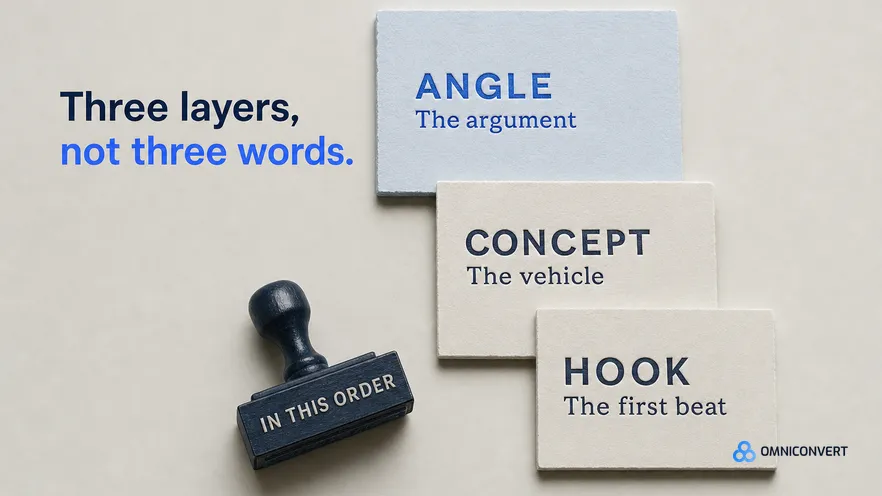
- The angle is the reason to buy, the concept is the vehicle that carries it, and the hook is the opening beat.
- A store can be strong on one layer and weak on the next, which is why the three are scored separately.
- One angle supports many concepts and one concept supports many hooks. The relationship never runs upward.
- Diagnose downward: angle first, then concept, then hook. Fixing the hook first is the most common wasted month.
- Teams argue about hooks because the hook is the only layer visible without watching the whole ad.
The angle is the argument you are making. The concept is the creative idea that dramatizes that argument. The hook is the first thing the viewer sees or hears. Three layers of one advertisement, not three words for the same thing, and each one is scored on its own, because a store can be strong on one and weak on the next. Last updated: September 2026.
Omniconvert has measured how storefronts acquire and convert customers across the CROBenchmark dataset of 7,000+ websites in 15+ industries, against 248+ audit criteria, over 13 years in eCommerce, and reads live advertising through the eCommerceBenchmark ad library. The pattern worth naming first is a vocabulary problem rather than a creative one. In most creative reviews the three words are used interchangeably, so two people can agree that "the hook is weak" while meaning entirely different repairs, and the meeting ends with a decision nobody can act on.
This piece fixes the vocabulary. It is deliberately definitional, because three other things worth measuring depend on these words meaning one thing each.
What do hook, concept and angle mean in ad creative?
Here are the three, in the shortest form that is still true.
- Angle. The reason to buy underneath the ad. Loss aversion, fear of a blind spot, relief from wasted effort, status. It is the persuasion strategy, not the words.
- Concept. The repeatable creative vehicle that carries the angle. A founder teardown, a side by side, a customer unboxing. Swap the product, keep the concept.
- Hook. The opening beat. The first three seconds of video, or four to nine words of text. The scroll stopper, and the thing that lives or dies on its own.
The nesting is the part that does the work. An angle is not a bigger hook and a concept is not a longer angle. They are different kinds of thing, in the way that a thesis, a chapter and a first sentence are different kinds of thing, and the direction of dependence never reverses. Change the angle and every concept and hook underneath it is now arguing for something else. Change the hook and nothing above it moves at all.
What is an ad angle?
Angles are arguments, and arguments can be listed. A short and unglamorous set covers most of eCommerce: you are losing money you cannot see, the thing you already bought is underperforming, your competitor is doing something you are not, this takes less effort than what you do now, and people like you already switched. Each of those is a claim about the buyer's situation, and a buyer either recognises the situation or does not. Reviews are where buyers describe that situation, as covered in ad creative from customer reviews.
That recognition test is what makes the angle the top layer. If the buyer does not recognise the situation, the argument has nowhere to land, and every downstream improvement is decoration on a sentence nobody agreed with. This is why angle testing feels slow and hook testing feels fast: the angle is testing whether you understand the buyer, and the hook is testing whether you can phrase something.
One practical marker separates a real angle from a restatement of the product. A real angle can be written without naming the product. "You are paying for returning customers twice" is an angle. "Our platform unifies your customer data" is a feature list with a verb in it, and it will read as one no matter how well it is shot.
What is an ad concept?
The substitution test is worth applying literally, because it is the fastest way to settle an argument about whether a team has three concepts or one concept and two edits. Take the ad, replace the product with a plausible competitor's, and read it again. A founder teardown survives the swap. A side by side survives it. A specific joke about one product's packaging does not, which does not make it bad, but it does mean it cannot be briefed again next quarter.
That reusability is the entire point of the layer. Concepts are the unit a creative team can actually plan with, because a concept can be commissioned repeatedly, handed to different editors, and produced at different budgets while remaining recognisably itself. An execution cannot. A library described as "twelve ads" is usually three or four concepts wearing twelve outfits, and knowing which is which changes what you brief next. The same split matters when you plan DTC ad creative at volume.
The healthy pattern is several concepts per angle. One angle expressed through a single concept is not a proven angle, it is an untested one, and it fatigues as a single unit rather than in parts. That relationship between concept variety and how long creative survives in market is the subject of creative longevity and days active.
What is an ad hook?
The hook is the only layer with a hard boundary, and that boundary is what makes it measurable. Everything before the viewer decides to keep watching is the hook. Everything after it is the rest of the ad. In video that decision lands somewhere around the third second, and in a text ad it lands inside the first line, which in practice is four to nine words. Treat both as working ranges rather than laws, and test at the edges of them.
Because the boundary is hard, the hook is also the layer most likely to be over-managed. It is cheap to change, it can be judged in a meeting without watching anything, and it produces immediate movement in a metric. All three of those are true, and none of them make it the right place to start. A hook that stops the wrong person has done its job and wasted the impression, and the account will show a healthy stop rate attached to nothing.
A useful discipline is to require every hook to name the angle it serves before it is written. Hooks briefed without an angle drift toward whatever is stopping scrolls this month, and a library of borrowed hooks with no argument underneath is one of the clearest signals in a creative audit that the store is following its category rather than competing in it.
How do hook, concept and angle stack in one ad?
The table below sets the three layers against the question each answers and the consequence of changing it.
| Layer | Question it answers | Example | What changes if you change it |
|---|---|---|---|
| Angle | Why should this matter to me? | You are paying to reacquire customers you already had | Every concept and hook underneath it now argues something else |
| Concept | How is the argument shown? | A founder walks through one store's numbers | The angle survives, the production brief is replaced |
| Hook | Why should I stay for this? | "Your best customers left nine months ago" | Nothing above it moves, only the cost of attention |
The third column is where most creative reviews actually happen, and the first column is where most of the outcome is decided. That gap is the reason the vocabulary is worth fixing before anything else.
Why are hook, concept and angle scored separately?
The diagnostic value comes from the drop off pattern, and it is unusually clean.
If nobody stops, the problem is the hook, and it is the only case where hook work is the right first move. If people stop and then leave within a few seconds, the hook wrote a cheque the concept did not honour, which is a mismatch between two layers rather than a weakness in either. If people watch the whole thing and do not act, the hook and the concept both worked and the argument did not persuade them, which is an angle problem and the most expensive of the three to fix.
Nexus by Omniconvert is the AI eCommerce growth engine: it unifies customer data, segments buyers by behavior and value, predicts churn, and ranks the next-best action, so the audience a given angle is aimed at can be defined by behaviour rather than by assumption. Getting the angle right is a question about who you are arguing with, and that is a segmentation question before it is a creative one.
The separation also protects the layers from each other in reporting. A single creative score averages a strong angle and a weak hook into a middling number, and a middling number produces a middling brief. Three scores produce one instruction.
Where do teams mix up hook, concept and angle?
The first confusion is counting executions as concepts, which inflates apparent variety. Twelve ads that fail the substitution test are one concept, and the library will fatigue all at once rather than in parts, which reads as a sudden collapse in performance with no obvious cause.
The second is treating a hook as an angle. "Stop wasting money" is a hook. The angle underneath it has to say which money, wasted on what, and why the reader has not noticed. When the hook is mistaken for the argument, the ad has an opening and no middle, and the drop off appears a few seconds in.
The third is the expensive one. An angle that everyone in your category runs is the price of admission rather than an edge, and an audit that only counts your own creative will never reveal it, because the ads look fine in isolation. Reading your angles against your category is a separate measurement, covered in saturation versus edge.
Hook, concept and angle FAQs
What is the difference between a hook, a concept and an angle?
The angle is the argument the ad makes, the concept is the creative idea that dramatizes that argument, and the hook is the first thing the viewer sees or hears. They sit in that order, from the deepest layer to the most visible one. One angle carries many concepts and one concept carries many hooks, so a change at the top rewrites everything below it while a change at the bottom rewrites nothing.
What is an ad angle?
An angle is the reason to buy that sits underneath the advertisement. Loss aversion, fear of a blind spot, relief from wasted effort and status are all angles. It is a persuasion strategy rather than a form of words, so two ads that share nothing visually can be running the same angle, and two ads that look like siblings can be arguing opposite things.
What is an ad concept?
A concept is the repeatable creative vehicle that carries an angle. A founder teardown, a side by side, a day in the life, a customer unboxing. The test of a real concept is substitution: swap the product for a different one in the same category and the concept still holds. If it collapses, what you had was a single execution rather than a concept.
What is an ad hook?
A hook is the opening beat of the advertisement, the first three seconds of a video or the first four to nine words of a text ad. It has one job, which is to buy the attention the rest of the ad needs. A hook is measured on its own because it lives or dies before anything else in the ad has been seen.
How long should a hook be?
In video, the working definition is the first three seconds, because that is roughly where the scroll decision is made. In text, four to nine words is the practical band: shorter tends to be too vague to earn a stop, and longer stops being an opening beat and becomes the argument itself. Treat both as working ranges rather than rules, and test at the edges.
Can two ads share an angle but not a concept?
Yes, and that is the normal case in a healthy account. One angle should support several concepts, because the angle is an argument and there are many ways to dramatize an argument. A library where every ad on an angle uses the same concept is not a strong angle, it is an untested one, and it fatigues as a single unit rather than in parts.
Which layer should you fix first when ads stop working?
Work downward, angle first. A sharp hook attached to an argument the buyer does not care about buys attention and then wastes it, and no amount of hook testing repairs that. Most teams do the opposite because hooks are cheap to change and easy to argue about, which is why hook testing is the most common wasted month in creative work.
How do you tell which layer is failing?
The drop off tells you. If nobody stops, the hook is failing. If people stop and leave within a few seconds, the concept is failing to deliver on what the hook promised. If people watch and do not act, the angle is failing, because they understood the argument and were not persuaded by it. Each layer has its own symptom, which is why they are scored separately.
What is the bottom line on hook, concept and angle?
Three words, three layers, one direction of travel. The angle is the argument, the concept is the vehicle that carries it, and the hook is the beat that buys the attention. Keep them distinct and a creative review becomes a diagnosis: the drop off names the layer, and the layer names the brief. Blur them and every review becomes a conversation about taste, because there is no shared object to disagree about. Start at the top when something is not working, even though the bottom is cheaper to change. A weak hook on a strong argument costs you reach. A strong hook on an argument nobody recognises costs you the whole quarter, and it does it while the stop rate looks fine.