7 Best Northbeam Alternatives for Ecommerce Attribution (2026)

- Omniconvert Commander comes first for brands whose real problem is customer value: RFM segmentation, customer lifetime value and ranked actions, with a free plan and paid plans from $49 a month.
- It is not a like-for-like attribution swap. For server-side POAS, incrementality or very high ad spend, this page names a better fit for each method.
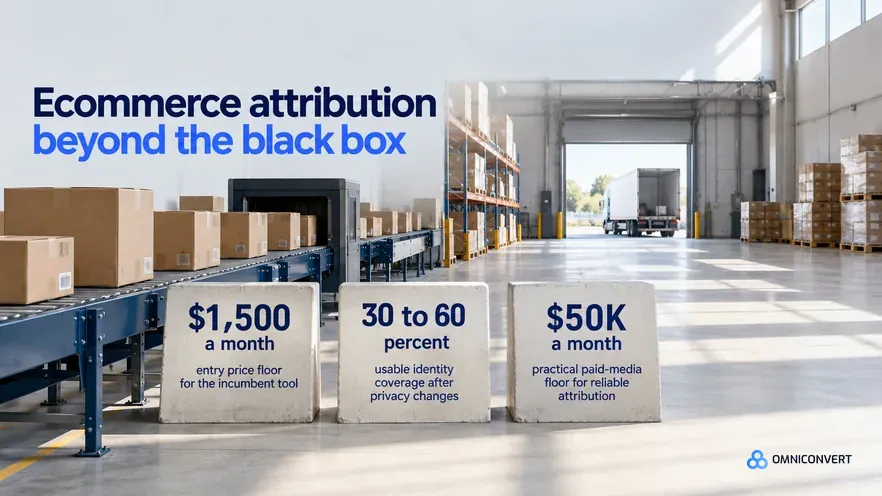
- Brands leave Northbeam over its roughly $1,500/mo price floor, Shopify-first integrations, no cost-of-goods or contribution margin in-platform, and no built-in incrementality testing.
- Attribution is degrading: usable identity coverage fell to about 30 to 60 percent after iOS ATT and cookie deprecation, so 2026 best practice triangulates attribution, MMM, and incrementality.
- Entry pricing runs from a free plan (Omniconvert Commander) and about $219/mo (Triple Whale) to about $2,000/mo (Rockerbox), versus Northbeam's roughly $1,500/mo floor.
If your growth is stuck on retention and profit rather than click credit, start with Omniconvert Commander (formerly Nexus). It segments customers by RFM and customer lifetime value, ranks the actions that grow profit, and has a free plan. If you need attribution or measurement itself, the best Northbeam alternatives are Admetrics for SKU-level profit on ad spend, Triple Whale for real-time profit on Shopify, Polar Analytics for mid-market BI, Rockerbox for enterprise incrementality, SegmentStream for very high ad spend and Fospha for paid social in Europe.
Marketing attribution is the discipline of assigning revenue to the marketing touchpoints that produced it, and Northbeam is one of its best-known tools, pairing multi-touch attribution with a marketing-mix-modeling layer for large paid-media budgets. It is a capable product, but capable is not the same as right for you. Across the CROBenchmark dataset of 7,000+ stores in 15+ industries, the brands that grow fastest treat incremental profit and retention, not attribution precision, as their primary lever [CROBenchmark Report 2026, Omniconvert].
This guide compares the seven best Northbeam alternatives for 2026 by the method each one uses, what it costs, and how it fits a real Shopify or paid-media stack. It also does what most listicles will not: it asks whether a more accurate attribution model is even the fix you need, because the metric attribution optimizes is quietly breaking for everyone.
What are the 7 best Northbeam alternatives?
The table gives the quick-pick view; the sections below add the verdict and the catch for each. Prices are entry points from public references and scale with usage. Verify each on the vendor's own pricing page before you buy, because listicle prices drift.
| Tool | Best for | Entry price | Method |
|---|---|---|---|
| Omniconvert Commander | Customer value and retention | Free plan; paid from $49/mo | Customer Value Optimization |
| Triple Whale | Real-time profit on Shopify | ~$219/mo | Attribution + profit |
| Admetrics | Server-side, SKU-level POAS | ~$399/mo | Attribution + margin |
| Polar Analytics | Mid-market BI with incrementality | ~$300/mo | Business intelligence |
| Rockerbox | Enterprise cross-channel, TV and offline | ~$2,000/mo | MMM + incrementality |
| SegmentStream | $100K+/mo ad spend | Quote-based | ML attribution |
| Fospha | Paid social, UK and Europe | Quote-based | Attribution + MMM |
1. Omniconvert Commander: best for customer value and retention
Best for: Shopify brands that want to optimize for profit and repeat revenue, and that cannot justify Northbeam's price floor.
Starting price: a free plan, with paid plans from $49 a month billed through Shopify (pricing page).
Why it is an alternative to Northbeam: this is the different job. Northbeam models where credit for a sale belongs. Omniconvert Commander tells you which customers are worth acquiring and keeping, which is the constraint most switchers actually hit. It runs RFM segmentation to sort customers into value tiers, tracks customer lifetime value and churn signals, and pushes high-value segments to Meta and Klaviyo as audiences. See Customer Intelligence in Omniconvert Commander.
Where it beats Northbeam:
- It measures on margin. Cost of goods, fees and returns do not enter Northbeam. Omniconvert Commander tracks true profit instead of ROAS.
- It moves past the report. Northbeam's dashboards inform but do not act. Omniconvert Commander ranks what to do next. In beta, it builds the campaign for you to approve.
- It costs less to start. It has a free plan and paid plans from $49 a month, versus Northbeam's roughly $1,500 a month floor.
Where it does not beat Northbeam:
- Not an attribution model. If your main question is which touchpoint earned the sale, keep an attribution tool.
- Not a measurement suite. For MMM, incrementality tests, or TV and offline measurement, look at Rockerbox.
- Fewer integrations. It connects Shopify, GA4, Meta, Google Ads, Klaviyo and Gorgias today.
- Some actions are in beta. Campaign packages and landing pages are in beta, and you approve each action before it goes live.
Pick this if you can read your attribution numbers, but you cannot say which customers earn the profit.
Skip this if paid acquisition is the whole game and your media budget makes attribution precision a real line item.
Omniconvert Commander segments your customers by RFM and predicted lifetime value so you can act on who is about to churn or ready to grow, without stitching another attribution dashboard into your stack.
Install free on Shopify →What are the other 6 Northbeam alternatives?
Each one fits a different method and spend level. They follow in method order, not from best to worst.
2. Triple Whale: best for real-time profit on Shopify
Triple Whale is the Shopify-native pick: real-time dashboards, first-party pixel tracking, and the Moby AI layer, from about $219 a month at the Foundation tier. It closes Northbeam's biggest usability gaps for a smaller store, surfacing blended and channel-level performance in one place. The catch is that its attribution is still pixel-based, so it inherits the same signal loss, and pricing scales on GMV as you grow. For a deeper look, see our Triple Whale alternatives comparison.
3. Admetrics: best for server-side, SKU-level POAS
Admetrics is the strongest answer to Northbeam's margin blindness. It uses server-side tracking to recover conversions that pixels lose and reports profit on ad spend net of cost of goods, fees, and returns at the SKU level, from around $399 a month. If your core complaint is that Northbeam shows attributed revenue but not profit, this is the closest direct upgrade. The catch is that it is a profit-and-attribution tool, not a full incrementality suite.
4. Polar Analytics: best mid-market BI with incrementality
Polar Analytics consolidates Shopify, ad platforms, and Klaviyo into one BI layer, with a dedicated data store per account and growing incrementality and MMM features, from roughly $300 a month. It suits a mid-market team that wants breadth and lighter-touch measurement rather than an enterprise attribution engine. The catch is that as a general BI tool, its attribution depth is shallower than a specialist like Rockerbox at the top end.
5. Rockerbox: best enterprise incrementality, TV and offline
Rockerbox is built for brands that spend across many channels, including TV, direct mail, and offline, and want calibrated MMM and incrementality alongside multi-touch attribution, typically from around $2,000 a month. It is the most complete triangulation stack on this list. The catch is the price and the setup: it earns its cost only once media budgets and channel complexity are large enough to need that rigor.
6. SegmentStream: best for very high ad spend
SegmentStream targets enterprise brands, typically spending upward of $100K a month, with machine-learning conversion modeling and automated budget optimization built for that scale. Pricing is quote-based. Unlike Northbeam, it acts on the analysis by reallocating budget, which is the automation Northbeam lacks. It is overkill for a five-figure-a-month store and right for one where attribution precision is a boardroom line item.
7. Fospha: best for paid social in Europe
Fospha focuses on full-funnel measurement for paid social, with particular strength in the UK and European market and an emphasis on upper-funnel channels that last-click models undercount. Pricing is quote-based. It is a strong fit for brands whose growth leans on Meta and TikTok prospecting. The catch is that its center of gravity is paid social, so it is less of an all-channel engine than Rockerbox.
Why are brands leaving Northbeam in 2026?
The frustrations cluster into four themes. The first is price and fit. Public references put Northbeam's Starter tier around $1,500 a month for brands under $250K a month in media, with a Professional tier near $2,500 a month and unpublished enterprise pricing above that, all scaling on pageviews and spend. Practically, the models need volume: guidance across comparison sources puts the reliable floor near $50K a month in paid media, and under roughly $20K a month the output turns noisy [Admetrics, 2026].
The second is margin blindness. Northbeam models where credit for a sale belongs, but cost of goods, shipping, fees, and returns do not enter the platform, so it cannot show contribution margin or profit on ad spend at the SKU level. A campaign can look efficient on attributed revenue and still lose money once the product costs come out, and the tool will not tell you.
The third is method. Northbeam is correlational: it models multi-touch attribution and marketing mix, but it does not run incrementality experiments, so it cannot prove that a channel caused sales rather than merely preceding them. The fourth is that its dashboards inform but do not act; there is no budget automation, so the analysis still lands as a task on someone's plate.
Why is attribution breaking, and what should you read before switching?
Start with the signal, because it changes the whole shopping decision. Apple's App Tracking Transparency alone cost Meta and Google an estimated 30 to 45 percent of iOS conversion tracking, and with cookie deprecation, usable identity coverage now sits around 30 to 60 percent, down from over 90 percent in the cookie era. Post-ATT, 71 percent of brands reduced their reliance on user-level tracking. A more accurate attribution model built on a shrinking signal is a sharper reading of a fading map.
That map metaphor is not decoration. The semanticist Alfred Korzybski warned that "the map is not the territory," and every attribution model is a map: a useful simplification that is never the ground truth. Northbeam's map is not wrong because it is Northbeam; all single-model maps are incomplete. Which is why the 2026 operating standard is triangulation, using more than one map at once.
Marketing mix modeling is defined as a statistical method that estimates each channel's contribution to sales from aggregate, privacy-safe data rather than user-level tracking. It matters in ecommerce because it survives the signal loss that breaks pixel attribution, which is why Google's own measurement reporting cites a 212 percent year-over-year rise in MMM adoption and free production libraries such as Google Meridian and Meta Robyn have removed the six-figure gate.
Incrementality is defined as the measurement of conversions that would not have happened without a given ad, isolated through holdout or geo experiments. It matters because attribution over-credits channels that harvest demand you already had, so incrementality is the only method that shows true causal lift, and the modern stack pairs it with MMM for strategy and platform metrics as directional signal only.
There is a deeper trap underneath the tooling, and it is the reason a tool swap alone disappoints. Goodhart's Law holds that "when a measure becomes a target, it ceases to be a good measure." Once a team optimizes to a single attributed-ROAS number, the number corrupts: creative is made to look attributable rather than to sell, budget flows to the channels easiest to credit, and the metric drifts from the profit it was supposed to proxy. Buying a more precise instrument for a corrupted target just measures the wrong thing more confidently.
The direct-to-consumer brands that plateau at a 1.5x to 2x blended return on ad spend consistently share one pattern: they instrument attribution to the decimal and never run a single holdout test, so they cannot tell demand harvesting from demand creation. The benchmark gap closes fastest when operators treat incremental profit by customer segment as the primary unit of measurement, not last-click or platform-reported ROAS. In our Customer Value Optimization work with ecommerce brands, we consistently see the top 20 percent of customers drive most of the revenue, yet receive the same acquisition-first treatment as everyone else.
One customer story shows what the customer-value job looks like in practice. AliveCor used Omniconvert to run a structured experimentation and optimization programme and achieved a +21% conversion rate, +5% revenue per visitor, and 94% statistical relevance across their tests [Omniconvert, AliveCor case study]. The lift came from acting on customer behavior and value, not from re-attributing existing sales, which is the distinction this whole comparison turns on.
How did we choose these Northbeam alternatives?
Ranking seven near-identical dashboards from best to worst triggers exactly the decision fatigue Daniel Kahneman describes in Thinking, Fast and Slow: faced with too many similar options, buyers default to the loudest brand or stall. So we did not rank the tools from best to worst. Omniconvert Commander comes first because it is ours. The other six follow in method order, each with a verdict and a catch, and a decision spine closes the page. The five criteria behind the selection:
- Measurement method: multi-touch attribution, marketing mix modeling, incrementality testing, or customer-value intelligence.
- Margin and COGS: whether cost of goods, fees, and returns enter the tool so it can show profit, not just attributed revenue.
- Incrementality: whether the tool can prove causal lift, or only model correlation.
- Spend fit: the paid-media range the tool is built for, from bootstrapped stores to $100K a month and up.
- Price transparency: whether there is a public rate card or only a book-a-demo flow.
How do you choose a Northbeam alternative by method and spend?
Read this as "if you are X, pick Y," and stop at the first line that fits:
- If your growth is stuck on retention and customer value, not channel mix: Omniconvert Commander.
- If Northbeam's margin blindness is the problem: Admetrics, for server-side, SKU-level profit on ad spend.
- If you want real-time profitability on a Shopify budget: Triple Whale.
- If you want broad BI with lighter-touch measurement: Polar Analytics.
- If you need calibrated incrementality across many channels, including offline: Rockerbox, or SegmentStream above $100K a month.
- If paid social in the UK and Europe is your engine: Fospha.
The decision that matters most is the first branch, and it is not on any feature comparison: are you optimizing the cost of acquisition or the value of the customer? The marketing professor Peter Fader argues in Customer Centricity that not all customers are worth the same, and the durable advantage is knowing which ones to acquire and keep, a question last-click attribution cannot answer. Settle that first and the shortlist collapses. Omniconvert Commander exists for that second branch, which is where more switchers belong than the attribution framing admits.
Northbeam alternatives FAQ
Start with Omniconvert Commander if your real problem is retention rather than ad attribution, because it answers the customer-value question no attribution dashboard does. For other questions, the pick changes. For server-side, SKU-level profit on ad spend, Admetrics. For real-time profitability on Shopify, Triple Whale. For enterprise incrementality plus TV and offline, Rockerbox. For machine-learning attribution at very high spend, SegmentStream. For paid-social measurement in Europe, Fospha.
Omniconvert Commander ingests behavioral and transactional data across your store and segments customers by RFM into groups that are at risk, growing, or ready for upsell, then maps them to predicted lifetime value. Instead of re-crediting the sales you already have, it tells you which customers are worth acquiring and keeping, so budget targets durable profit rather than the touchpoints easiest to attribute. It answers the customer-value question that sits underneath, and often outweighs, the attribution one.
Public references put Northbeam's Starter tier around $1,500 a month for brands under $250K a month in media, with a Professional tier near $2,500 a month and unpublished, quote-based enterprise pricing above that. Cost scales with pageviews and ad spend, so the bill climbs as the store grows. That price floor is the single most common reason smaller and mid-market brands look for an alternative.
Generally no. Northbeam's models need meaningful conversion volume to produce reliable output, and public guidance puts the practical floor around $50K a month in paid media. Under roughly $20K a month, or below about $1 million in annual revenue, the attribution becomes unreliable and the price is hard to justify. Smaller brands usually get more from a profit-first tool or a customer-value platform than from an enterprise attribution suite.
Privacy changes cut what pixel-based tools can see. Apple's App Tracking Transparency and cookie deprecation reduced usable identity coverage to roughly 30 to 60 percent, down from over 90 percent in the cookie era, so pixel-based tools miss a large share of conversions. That signal loss is why 2026 best practice triangulates attribution with marketing mix modeling and incrementality tests rather than trusting any single click-based model as the source of truth.
Attribution assigns credit for conversions that already happened, mapping each sale back to the touchpoints that preceded it. Incrementality measures the conversions that would not have happened without the ad, using holdout or geo tests. Attribution tends to over-credit channels that harvest existing demand, such as branded search and retargeting; incrementality reveals true causal lift. The two answer different questions, and mature teams in 2026 use both rather than choosing one.
Swapping dashboards while keeping attributed ROAS as the target metric changes very little, because that number is degrading for everyone as identity coverage falls toward 30 to 60 percent. The higher-leverage move is to change what you optimize for: incremental profit and customer value, not click credit. See how Customer Intelligence in Omniconvert Commander segments customers by value and ranks the actions that grow it, so the switch fixes the metric that moves profit, not just the tool you read it on. If paid acquisition is the whole game and you want a cheaper or more accurate attribution model, Admetrics or Rockerbox will do that well.
Switching for the right reason? Start with customer value
If the real problem behind leaving Northbeam is retention and profit rather than click attribution, Omniconvert Commander segments customers by RFM and predicted lifetime value, then ranks the actions that protect and grow revenue. Answer the customer-value question, not just the attribution one.