What Is True Profit in eCommerce? Definition and Formula

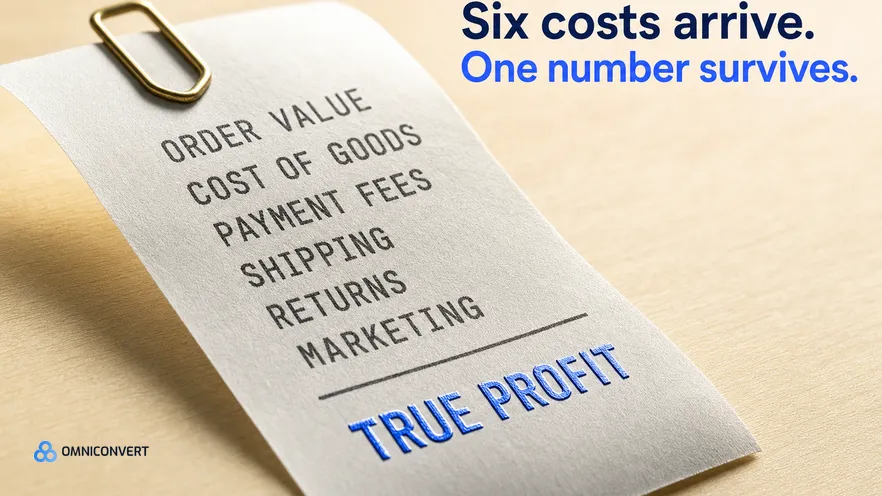
- True profit = order value after discounts − all variable costs − attributable marketing spend.
- It stops at variable costs, which is exactly what makes it usable for per-order and per-campaign decisions.
- Gross profit subtracts only cost of goods, so it can look healthy on an order that true profit shows to be a loss.
- A returns provision belongs in the formula. Leaving it out flatters high-return categories such as apparel.
- Use the discounted order value, never list price, or promotions disappear from the arithmetic.
- True profit is a single-order number. Read it beside predicted lifetime value before deciding what a customer is worth.
Most stores can tell you their revenue to the cent and their profit only to the nearest guess. The gap is not laziness. It is that the costs of an eCommerce order arrive from six different places, at six different times, and only some of them appear on the invoice. True profit is the number that puts them all back together. Here is the definition, the formula, exactly which costs belong in it, and the three mistakes that make most stores' version of it too flattering to trust.
What is the definition of true profit in eCommerce?
The word doing the work in that definition is variable. True profit deliberately stops at the costs that change when you win one more order. That boundary is not an accounting nicety; it is what makes the number usable. A metric that includes your office rent cannot tell you whether to bid on a keyword, because the rent does not move when you do.
What is the true profit formula?
| Step | Line | Result |
|---|---|---|
| Start | Order value after discounts | Revenue you actually received |
| − | Cost of goods sold | Gross profit |
| − | Payment processing fees | — |
| − | Pick, pack and fulfilment | — |
| − | Shipping paid by you | — |
| − | Returns provision | Contribution margin |
| − | Attributable marketing spend | True profit |
Divide true profit by order value for a true profit margin percentage, which is the form worth tracking over time. The absolute figure moves with order value; the percentage tells you whether the underlying economics changed.
Which costs count as variable costs in true profit?
| Cost | In or out | Why |
|---|---|---|
| Cost of goods | In | One more order, one more unit |
| Payment processing | In | Charged per transaction |
| Pick, pack, shipping | In | Scales per parcel |
| Returns and refunds | In | A predictable rate on every order |
| Discounts and promo codes | In | Reduce the revenue you actually received |
| Advertising | In | The cost of winning the order |
| Rent and salaries | Out | Unchanged by one more order |
| Software subscriptions | Out, usually | In only if genuinely usage-priced |
| Warehouse staff | Out, usually | In if you pay per parcel picked |
The two "usually" rows are where teams argue. The test is not what the cost is called, it is whether the invoice changes if tomorrow's order volume changes. A flat monthly platform fee is fixed. A per-order transaction fee on that same platform is variable, and belongs in the formula.
What is true profit not?
Three neighbours get confused with it constantly, and each confusion causes a specific error.
Gross profit subtracts only the cost of goods. A store reading gross margin will happily fund acquisition that true profit shows to be underwater, because fulfilment, returns and ad spend never entered the arithmetic.
Contribution margin goes further, through all fulfilment costs, but stops before advertising. It is the right number for deciding whether a product is worth selling. It is the wrong number for deciding whether a campaign is worth running.
Net profit continues past fixed overheads to what the business actually keeps. It is the right number for a board pack and the wrong one for a bidding decision, because it cannot be attributed to a single order.
The head-to-head, with a worked example and the break-even ROAS formula, is in ROAS vs true profit vs contribution margin.
What three mistakes inflate your true profit number?
How do you start measuring true profit?
The perfect version of this number requires per-SKU costs, real return rates and clean marketing attribution. The useful version does not. Start by grouping products into three or four categories, assign each an average cost of goods and an average return rate, use blended acquisition cost, and compute true profit per category. Even that rough cut usually reveals one group of products that has been quietly funded by the others.
Then improve inputs in the order of how much they move the answer. For most stores that is return rate first, cost of goods second, marketing attribution third. Chasing precision on shipping costs while your return rate is a guess is effort spent in the wrong place.
What are the limits of true profit, and what should you pair it with?
This is the honest boundary of the metric. Two customers with identical first-order true profit can be worth completely different amounts to the business, and nothing in the formula distinguishes them on the day they buy.
That is why brands that scale profitably read true profit beside predicted lifetime value. The first number tells you what today cost. The second tells you what tomorrow is likely to be worth. Acquisition decisions need both, and the teams that plateau are usually the ones making those decisions with only the first.
Omniconvert Commander (formerly Nexus) unifies purchase and behavior data into one customer view, segments customers by value, and predicts lifetime value, so a thin first-order margin becomes a decision rather than a guess.
See how it works →True profit in eCommerce: FAQs
True profit is what an order earns after every variable cost of winning and fulfilling it: product cost, payment fees, pick and pack, shipping, returns, discounts and the advertising spend that brought the customer in.
It is the money that reaches the business before fixed overheads such as rent, salaries and software. Subtract those too and you have net profit.
True profit = order value after discounts − cost of goods − payment fees − fulfilment and shipping − returns provision − attributable marketing spend.
The first five subtractions give contribution margin; subtracting marketing from that gives true profit. Divide by order value for a true profit margin percentage.
Gross profit subtracts only the cost of goods sold. True profit keeps going through payment fees, fulfilment, shipping, returns, discounts and advertising.
Gross profit can look healthy on an order that true profit shows to be a loss, which is why gross margin is a poor guide to how much you can afford to spend on acquisition.
No. True profit stops at variable costs, the ones that change with each extra order. Rent, salaries, software subscriptions and other fixed overheads are subtracted afterwards to reach net profit.
Keeping fixed costs out is what makes true profit usable for per-order and per-campaign decisions.
Three recur. Omitting a returns provision, which flatters categories with high return rates such as apparel. Using list price instead of the discounted order value, which hides the cost of promotions.
And attributing marketing spend with platform-reported figures that double-count the same order across channels, which understates real acquisition cost.
Omniconvert Commander unifies purchase and behavior data into one customer view, segments customers by value, and predicts lifetime value.
True profit tells you what one order earned; predicted lifetime value tells you whether that customer is worth acquiring at that margin, which is the decision the order-level number cannot make on its own.
True profit is not a sophisticated metric. It is an ordinary one that most stores calculate dishonestly, usually by forgetting returns, using list price instead of the discounted order value, or trusting platform-reported ad spend that counts the same order twice. Fix those three and the number becomes trustworthy enough to set acquisition budgets against. Then pair it with predicted lifetime value, because a thin first order from a customer who returns four times is a very different decision from a thin first order from a customer who never comes back.
Know what the customer is worth, not just the order
An honest true profit number tells you what today's order earned. It cannot tell you which buyers come back. Omniconvert Commander unifies purchase and behavior data into one customer view, segments by value, and predicts lifetime value, so acquisition budgets follow the customers who repay them.