Atria vs Icon.com vs Omniconvert Commander (2026): Research vs human UGC
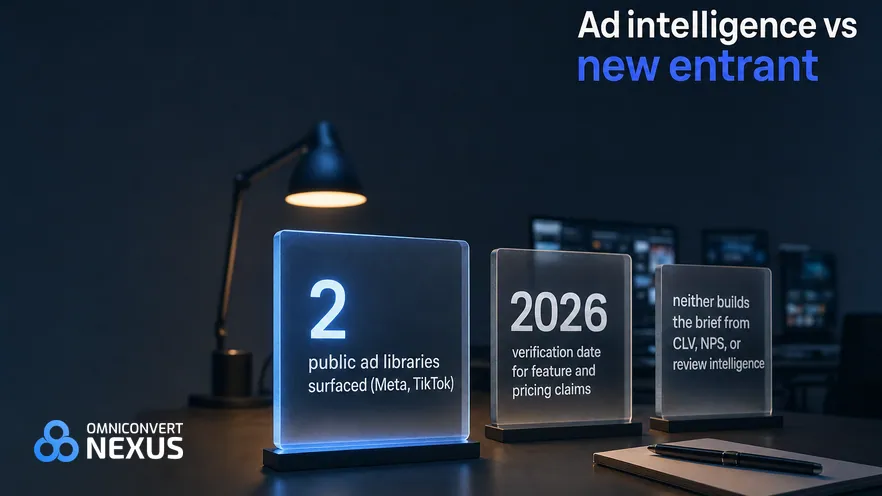
Atria combines a competitor ad library with own-account performance analytics. Icon.com is a done-for-you agency that ships 6 human UGC ads a month for $1,000, with real creators filming each one. Neither builds the brief from CLV, NPS, or review intelligence. Omniconvert Commander is built for that layer.
- Atria combines a searchable competitor ad library from Meta and TikTok with own-account performance analytics in one workflow, backed by 198 G2 reviews.
- Icon.com is a done-for-you agency that ships 6 human UGC ads a month for $1,000, with real creators filming each ad.
- The two tools sit in adjacent scopes of the creative stack, research versus production, and share the same blind spot: neither builds the brief from CLV, NPS, or review intelligence.
- Add Omniconvert Commander as the layer above either tool when ROAS looks fine but margin is not improving.
A DTC growth team comparing Atria vs Icon.com is usually choosing between two different jobs: a research and analytics platform with a documented G2 track record, or a done-for-you agency that ships 6 human UGC ads a month. Atria wins on combining competitor ad research with own-account performance tracking, backed by 198 G2 reviews. Icon.com delivers real creators filming UGC ads for $1,000 a month, with Admaker 2.0 software helping teams review and launch them. Neither tool tells you which customer segment to target, which angle to lead with, or whether the resulting creative moved True Profit. That decision layer is still human, and in 2026 it is the bottleneck above every ad execution tool. Omniconvert Commander is built for that layer.
What is Atria, and what is it actually good at?
Atria is an ad intelligence and creative analytics platform that combines a searchable competitor ad library with own-account performance tracking. Teams save inspiration from Meta and TikTok libraries alongside campaign results, so the creative workflow starts with research rather than guesswork. [Atria, 2026]
Atria's distinguishing move is putting competitor research and own-account performance in one place. Teams search the Meta Ad Library and TikTok Creative Center, save what is running for direct competitors, and layer their own account analytics on top. The output is a research-first creative brief, not a finished asset.
The category is ad intelligence and creative analytics. The buyer is a performance creative team or brand strategist that starts with what is working in market before writing the brief. The trade is scope: Atria surfaces what to make and scores it, but does not produce it, and the signals it reads are all ad-performance signals rather than customer behaviour signals.
Atria holds a 4.6 out of 5 rating on G2 across 198 reviews as of 2026. Reviews praise the speed of competitor research and the AI creative scoring. The recurring caveat: it makes you a better brief-writer, not a better acquirer of high-CLV customers.
Creative intelligence is defined as the practice of reading market and own-account signals to decide what creative to test next. Atria applies this to ad-performance data (competitor libraries plus your own account results). It does not read customer signals such as CLV, NPS, or review sentiment, so the brief it informs is based on what performs in market, not on what your best customers actually value.
Where Atria is genuinely strong
- Competitor library plus own-account analytics: the fastest way to research what is running in your category and cross-reference it with your own performance data.
- AI creative scoring: a quality signal on generated concepts before you commit to a full production cycle.
- Inspiration alongside performance: saved competitor ads and own-account results live in the same workflow, closing the research-to-brief loop.
Where Atria hits its ceiling
- Research-led, not customer-data-led: the whole workflow starts from competitor and ad-performance signals, not from CLV or segment data.
- No creative generation: Atria surfaces what to make and scores it, but does not produce the assets.
- Ad-performance signals only: no customer-behaviour layer, so a winning creative in market can still acquire a low-CLV segment.
Atria is a strong specialist for research-led creative teams. The ceiling shows up when the research produces a great brief for a segment that never converts to a profitable customer.
What is Icon.com, and what is it actually good at?
Icon.com is a done-for-you agency that makes human UGC ads. It ships 6 human UGC ads a month for $1,000 after a 3-day free trial, filmed by 2 real creators making 3 unique ads each. The team sources creators from a pool of 1,288+, writes the scripts, coaches on camera, and edits the videos; delivery is 12 to 16 days after creators receive the product. [icon.com, 2026]
Icon.com is a done-for-you production service for human UGC ads. The team sources creators, ships them the product, writes the scripts, coaches performances, and edits every video. The output is 6 ready-to-launch UGC ads a month, from 2 creators making 3 unique concepts each. [icon.com, 2026]
The category is managed human UGC production. The buyer profile is a brand that wants real people on camera and prefers a managed service to running creators in-house. A dedicated Creative Director works with each brand through the process.
Icon.com has no public G2 rating as of 2026. The low-risk framing is on the vendor page itself: 6 scripts arrive within 24 hours, there is no payment until the brand reviews them, and the full refund stands if the brand does not love the ads. Icon.com launched as The AI Admaker; older descriptions of an AI ad tool no longer apply.
UGC ads are short social videos in which a real person talks about a product in a native style. Human UGC means real creators film them.
Where Icon.com is genuinely strong
- Managed human UGC production: real creators film 6 UGC ads a month at $1,000, with no AI in the ads themselves.
- Low-risk entry: 6 scripts arrive within 24 hours, you only pay after you review them, and a full refund stands if you do not love the ads.
- Dedicated Creative Director: one point of contact runs creator sourcing, scripts, coaching and edits for each brand.
Where Icon.com hits its ceiling
- Not an in-house creative tool: Icon.com produces the ads for you rather than giving your team a generator or variant engine.
- No CLV or segment intelligence: Icon.com is not positioned as a customer intelligence platform.
- No public G2 coverage: there is no independent review coverage yet, so references and the free trial do the diligence work.
Icon.com is a legitimate option when a brand wants real human UGC without building creator operations in-house. The honest read in 2026 is that it sits in a different category from Atria, so a shortlist comparing the two is really a decision between research-first intelligence and done-for-you human production.
Atria vs Icon.com vs Omniconvert Commander: the capability comparison
Atria researches competitor ads and layers own-account performance data on top. Icon.com ships 6 human UGC ads a month, filmed and edited by its team. Omniconvert Commander handles the layer above both: which customer to target, which angle to brief, and whether the resulting creative drove True Profit, not just ROAS.
| Capability | Atria | Icon.com | Omniconvert Commander |
|---|---|---|---|
| Primary function | Research competitor ads and combine with own-account performance analytics | Done-for-you human UGC ads: creators, scripts, coaching and editing | Autonomous growth intelligence above any ad platform |
| Unified commerce data | Partial: tracks own-account performance but not full commerce data | No: not positioned as a unified data platform | Yes: single source of truth across the stack |
| AI-prioritised experiment queue | No: research library, not a prioritised action queue | No: not positioned as an experiment prioritisation layer | Yes: surfaces next best action by projected margin impact |
| Creative generation | Yes: Raya writes briefs, generates creative, grades ads, and batch-launches to Meta | Yes: real creators film 6 UGC ads a month and Icon.com edits them, no AI in the ads | Yes: creative variants ranked by CLV-weighted angle |
| True Profit tracking | No: ad-performance layer only, no margin signal | No: not positioned as a profit measurement platform | Yes: margin not ROAS, per campaign and per cohort |
| CLV and segment intelligence | No: no CLV or customer-behaviour data | No: not positioned as a CLV or segmentation platform | Yes: RFM, cohorts, churn prediction, NPS signal |
| Autonomous action layer | No: research surface, not an action layer | No: human briefs still drive each production cycle | Yes: removes the human middleware between data and action |
| AI creative briefing | Partial: suggests concepts from performance and competitor data, briefs are manual | No: brief is supplied by the marketer | Yes: brief is built from CLV, NPS, and review data |
| Pricing model | Core $129 a month billed annually ($219 monthly); Plus $343, Business $959 (tryatria.com, checked October 2026) | $1,000 a month for 6 human UGC ads after a 3-day trial (icon.com, checked November 2026) | Free plan; paid plans from $49/month, see Omniconvert Commander pricing |
| Best for | Performance creative teams that combine competitor research with own-account analytics | Brands that want real people on camera and a managed production service | eCommerce $1M+ ARR teams focused on margin, not just ROAS |
| Integrations | Meta · TikTok · Google | Admaker 2.0 helps your team review, launch and analyse ads; see icon.com for details | Shopify · Klaviyo · Meta · Google · TikTok · GA4 · Triple Whale |
| User rating | 4.6 out of 5 (G2, 198 reviews, as of 2026) | No public G2 rating | 5.0 out of 5 (Shopify App Store, 63 reviews, as of November 2026) |
Atria column reflects publicly available feature documentation and G2 data as of 2026. Icon.com column reflects icon.com as of November 2026.
What Atria and Icon.com cannot do
The shared blind spot is upstream of the asset. Atria tells you what is winning in market. Icon.com ships 6 human UGC ads a month for the product you send its team. Neither builds the brief from CLV data, NPS signals, review intelligence, or a margin loop. Neither closes the loop on whether the resulting ad improved True Profit, the metric the business actually keeps.
Atria tells you what is winning in your category. Omniconvert Commander tells you which of your customers to say it to, and which segment generates the highest CLV when they convert. The gap is not what to make. It is who you are making it for, and whether acquiring that customer at current CAC improves your margin or erodes it.
Icon.com sits in the execution layer alongside Atria, in a different scope. The gap it shares is structural, not vendor-specific: a done-for-you UGC agency produces the asset once the brand has decided which product and which audience to film for. It does not decide that. Omniconvert Commander is built for that upstream layer.
Both Atria and Icon.com are execution-side tools. Atria informs the brief from competitor and own-account performance data. Icon.com films 6 UGC ads a month once a brand has chosen the product and audience to film for. They are built on a shared assumption, that you already know which customer to target and which message is worth saying. They optimise the layers close to that assumption. Neither questions it.
What neither tool can tell you
- Which customers are worth acquiring more of. A 12-month CLV view, not last-click attribution, is what tells you which segments deserve the next round of paid spend.
- Which segments are 60 days from churning. The early signal lives in NPS scores, review sentiment, and support ticket patterns, not in any research library or generator UI.
- Whether the last campaign improved True Profit or just moved ROAS. ROAS can rise while net margin compresses; only a margin-first measurement loop catches the gap.
- What your highest-value customers actually respond to. Their own reviews, NPS verbatims, and support transcripts hold the angle that converts; pulling and synthesising them is still manual in an Atria-plus-Icon.com stack.
Platforms like Omniconvert Commander are built for this layer. Omniconvert Commander synthesises CLV data, NPS signals, review intelligence, and competitor creative data into a ranked action queue, before a brief is written or creative produced. The optimisation target is True Profit, not ROAS.
True Profit is defined as the net margin remaining after subtracting CAC, COGS, return rates, and the cost of customer acquisition from each cohort, not gross revenue or ROAS. It is what the business actually keeps. Omniconvert Commander tracks this as the primary optimisation metric across all experiments.
AliveCor used Omniconvert to run a structured A/B testing programme and achieved +21% conversion rate, +5% revenue per visitor, and 94% statistical relevance across their experiments. [Omniconvert, AliveCor case study]
This is not a replacement for Atria or Icon.com. Atria still runs the research. Icon.com still produces the ad. Omniconvert Commander is the strategic layer above them that decides which brief to send and whether the result moved the metric the business actually keeps.
Which tool is right for you?
Pick Atria if your bottleneck is combining competitor ad research with own-account performance in one workflow, with proven third-party validation. Pick Icon.com if the bottleneck is UGC production itself, and you want real creators filming 6 ads a month without building creator ops in-house. Add Omniconvert Commander when ROAS looks fine but margin is not improving, and your team is spending hours assembling CLV, NPS, and review data before any brief can be written.
Choose Atria if
- Research leads your creative process: your team starts with what competitors are running and layers own-account performance on top before writing any brief.
- Competitor library matters: you want a searchable Meta and TikTok library alongside your own account analytics, not two separate tools.
- Pre-launch scoring matters: you want AI creative scoring on concepts before you commit to a full production cycle.
Choose Icon.com if
- You want real people on camera: your creative mix needs human UGC that AI generators cannot produce, filmed by real creators.
- You want production handled for you: Icon.com runs creator sourcing, scripts, coaching and editing, so your team reviews and launches rather than coordinates a shoot.
Add Omniconvert Commander if
- Data assembly eats your day: your team spends more than 2 hours a day pulling data from separate tools before a single decision is made.
- You optimise paid spend without a margin view: you are spending on paid media but have no reliable view of which customer segments drive the highest margin.
- You want experiments ranked before sprint planning: you want to know which tests are worth running before dev or creative sprints are assigned.
- ROAS hides a margin problem: ROAS looks fine but net margin is not improving quarter on quarter.
What each tool cannot do, honestly
Atria, Icon.com, and Omniconvert Commander each have real limits. Treating them as competing for the same job hides those limits. The honest framing is that the three sit at different layers of the same stack: two execution-side tools in adjacent scopes and one intelligence layer. Each is replaceable, none is a complete answer alone.
Where Atria will not stretch
- Not a strategy tool: Atria will not tell you which segment to target or which angle is most likely to convert for your customers.
- Not a generator: for finished ad production at scale, a dedicated generation tool is still required after the research.
- Not a margin tool: Atria has no visibility into return rates, COGS, or CAC at cohort level.
Where Icon.com will not stretch
- Not a benchmarked platform yet: without independent review coverage, buyer diligence relies on live demo and references rather than published data.
- Not a CLV system: Icon.com is not positioned as a customer intelligence layer; creative direction remains manual.
- Not a profit measurement layer: Icon.com produces the asset but does not track True Profit at cohort level.
Where Omniconvert Commander has real prerequisites
- Data unification is the first 4 to 6 weeks: an intelligence layer is only as good as the data feeding it. Fragmented inputs produce unreliable ranked queues.
- Strategy and brand judgment remain human: Omniconvert Commander automates execution coordination, not category positioning or brand voice.
- Revenue stage threshold: the ROI compounds above $1M ARR, where data volume is sufficient and manual coordination cost is measurable. Earlier brands typically benefit more from a single execution tool first.
See where your store stands against real competitors in your category and country. Ecommerce Benchmark scores six areas free: Creative & Ads, Reviews & UGC, AI Visibility, Agentic Commerce, Competitor Synthesis, and CRO.
Benchmark Your Store FreeFrequently Asked Questions
The verdict
Atria is the specialist when combining competitor ad research with own-account analytics is the bottleneck: a searchable Meta and TikTok library layered with your own performance data. Icon.com is a done-for-you human UGC agency that ships 6 real-creator ads a month for $1,000. Neither builds the brief from CLV, NPS, or review intelligence. Add Omniconvert Commander above the tool you choose.
Atria and Icon.com sit in adjacent scopes of the creative stack. If the primary need is combining competitor ad research with own-account analytics to inform the brief, Atria is the specialist. If the need is real human UGC without building creator ops in-house, Icon.com is worth a 3-day free trial.
The harder question is whether your team has a reliable way to know who to target, what to say, and whether it worked at the margin level. That is a different question, and it is what the third tool on this page, Omniconvert Commander, is built to answer.
Stop assembling data.
Start supervising growth.
Omniconvert Commander unifies your entire eCommerce data layer, detects revenue anomalies and generates a prioritized action queue, so your team stops being human middleware and starts running the P&L.
5.0 out of 5 across 63 reviews, Shopify App Store , as of November 2026