Celtra vs Icon.com vs Omniconvert Commander (2026): Enterprise scoring vs human UGC agency
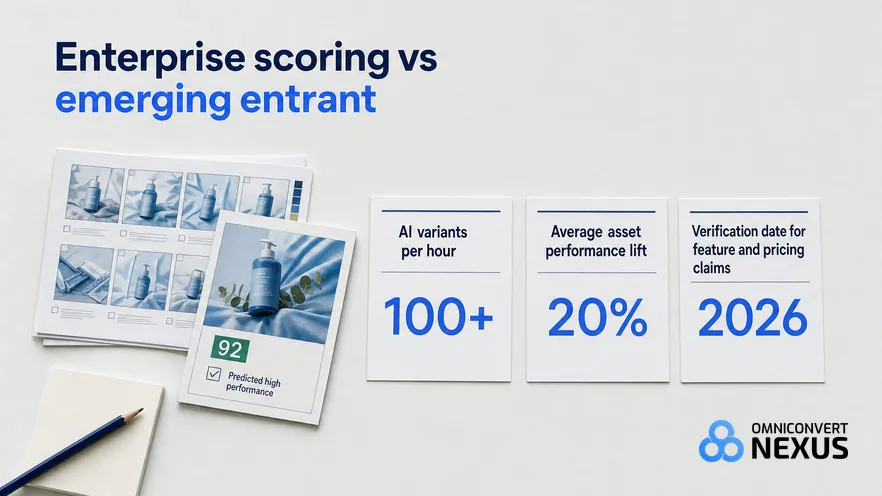
Celtra is an enterprise creative management platform with AI asset scoring that predicts creative performance before launch across markets and formats. Icon.com is a done-for-you agency that films and edits 6 human UGC ads a month for $1,000. CLV modeling and True Profit measurement are absent from both tools. Omniconvert Commander supplies the customer margin layer that both tools lack.
- Celtra is an enterprise creative management platform with AI asset scoring that predicts creative performance before launch across markets and formats.
- Icon.com is a done-for-you agency that films and edits 6 human UGC ads a month for $1,000, with no AI in the ads themselves.
- The tools sit at very different operating models, enterprise CMP versus managed human UGC production, and they share the same blind spot: neither builds the brief from CLV, NPS, or review intelligence.
- Use Omniconvert Commander as the layer above Celtra or Icon.com when ROAS numbers look healthy but margin is not following.
A DTC growth team comparing Celtra vs Icon.com is choosing between two very different operating models: Celtra is enterprise creative production infrastructure with AI asset scoring that predicts performance before launch, and Icon.com is a done-for-you agency that films and edits 6 human UGC ads a month for a flat $1,000. Celtra scores and scales creative across formats, languages, and markets for large brand portfolios, integrating with the existing media buying stack rather than replacing it. Icon.com finds vetted creators, writes the scripts, ships the product, coaches the shoot, and edits the final cuts, with no AI in the ads themselves [icon.com, 2026]. Neither tool reads customer signals to decide which segment is worth targeting, and that decision layer is what Omniconvert Commander is built to hold.
What is Celtra, and what is it actually good at?
Celtra is an enterprise creative management platform for large brands and agencies producing high volumes of ads across formats, markets, and channels. Its AI asset scoring predicts creative performance before launch, and it integrates with the media buying stack rather than replacing it. [Celtra, 2026]
Celtra's distinguishing move is combining enterprise creative production with AI asset scoring that predicts performance before launch. Teams build a master creative once, adapt it across every required format, market, and language, and each asset carries a predicted performance score before the media buy runs. The platform integrates with existing media partners for activation, rather than replacing the media stack.
Celtra operates in the creative management platform space. The buyer is a large brand or in-house agency running high-volume creative production across many markets, with a design and localisation team already in place. The trade is scope: Celtra is enterprise production and prediction infrastructure, not a self-serve generator for mid-market or SMB brands, and pricing is enterprise-only.
On G2, Celtra sits at 4.4 out of 5 based on 60 reviews as of 2026. Users consistently highlight the format automation across markets, the AI asset scoring, and the clean separation between production and media execution. The common limitation: the platform is built for enterprise scale, so teams without high creative volume across markets rarely get full value from it.
An enterprise creative management platform is production infrastructure for large brands and agencies. It centralises master creatives, adapts them across formats, languages, and markets, and can score assets against a predictive model before launch. A CMP optimises production and distribution across a global creative portfolio; it does not read customer signals or model CLV.
Where Celtra is genuinely strong
- AI asset scoring before launch: predicts which creative will perform against a training pattern, so budget goes to likely winners rather than untested variants.
- High-volume production across markets: automates format, language, and market variations for enterprise brand portfolios without re-briefing each round.
- Production separated from media buying: integrates with the existing media stack rather than forcing a replacement of the buying and trafficking layer.
Where Celtra hits its ceiling
- Enterprise pricing only: not accessible for mid-market or SMB brands, and there is no self-serve tier.
- Production and intelligence tool, not campaign management: no media buying or bid management built in; media activation happens elsewhere.
- Asset scoring, not customer intelligence: the predictive model reads creative attributes, not CLV cohorts, NPS signals, or which segment the winning asset should target.
Celtra serves enterprise creative teams well within its defined scope. The gap appears when the production pipeline and pre-launch scoring are both working but paid spend still flows toward the wrong customer segments.
What is Icon.com, and what is it actually good at?
Icon.com is a done-for-you agency that makes human UGC ads: 6 ads filmed and edited each month for a flat $1,000 after a 3-day free trial. Its team finds the creators, writes the scripts, ships the product, coaches the shoot, and edits the final videos. Delivery runs 12 to 16 days after the creators receive the product. [icon.com, 2026]
Icon.com launched as The AI Admaker, but has since repositioned around done-for-you human UGC. Older third-party summaries that describe an AI ad generator no longer apply. Buyers evaluating Icon.com in 2026 should treat it as a managed production service, not a self-serve creative tool.
The category is done-for-you human UGC ad production. The buyer profile is DTC teams that want real people on camera and a managed production service, rather than a self-serve generator. The pitch is 6 unique UGC concepts a month from 2 vetted creators making 3 ads each, with a dedicated Creative Director attached to every brand.
Icon.com does not yet appear on G2 with a public rating. Pricing is $1,000 a month after a 3-day free trial, with custom pricing available for agency, whitelabel, and volume work. Scripts arrive within 24 hours and you only pay once you have reviewed them, with a full refund if the ads do not land. [icon.com, 2026]
UGC ads are short social videos where a real person discusses a product in a native, conversational style. Human UGC means actual creators film the content rather than AI generating it.
Where Icon.com is genuinely strong
- Real creators on camera, not AI: 6 human UGC ads a month from 2 vetted creators making 3 unique concepts each, with no AI in the ads [icon.com, 2026].
- Managed production end to end: Icon.com finds the creators, ships the product, writes the scripts, coaches the shoot, and edits the final videos, with a dedicated Creative Director per brand.
- Low-risk commitment: 6 scripts arrive within 24 hours, you only pay after reviewing them, and a full refund is offered if the ads do not land.
Where Icon.com hits its ceiling
- Not a generation tool: no prompt-to-ad workflow, no variant engines, and no AI scoring; speed is tied to the 12 to 16 day shoot cycle.
- No visible CLV or segment intelligence: like every ad creative service, Icon.com is not positioned as a customer intelligence platform.
- No public G2 rating: Icon.com does not yet have a mature G2 review profile, so references and the free trial carry more weight than published data.
Icon.com is a legitimate option when you want real people on camera and a managed production service. The honest read in 2026 is that it is an agency, not a generator, and the comparison with software tools has to reflect that.
Celtra vs Icon.com vs Omniconvert Commander: the capability comparison
Celtra scores enterprise creative production with AI before launch and adapts assets across every market. Icon.com is a done-for-you agency that films and edits 6 human UGC ads a month, with no AI in the ads themselves. Both optimise creative production within their scope. Omniconvert Commander operates as the intelligence layer sitting above either: it handles CLV, the brief, and the margin feedback loop.
| Capability | Celtra | Icon.com | Omniconvert Commander |
|---|---|---|---|
| Primary function | Enterprise creative production with AI asset scoring predicting performance before launch | Human UGC ads produced end-to-end: creators, scripts, coaching and editing | Margin intelligence beyond creative production tools |
| Unified commerce data | No: creative production and scoring only, no commerce layer | No: not positioned as a unified data platform | Yes: unified data layer covering every part of the stack |
| AI-prioritised experiment queue | Partial: AI asset scoring predicts which creatives will perform before launch, but the team still determines what to scale | No: not positioned as an experiment prioritisation layer | Yes: recommended action ranked by forecast margin gain |
| Creative generation | Partial: takes existing creative and adapts it across formats and markets, rather than generating new assets from scratch with AI | Yes: 6 UGC ads per month filmed by real creators and fully edited by Icon.com, no AI involvement in the final ads | Yes: creative angles ordered by CLV score per customer segment |
| True Profit tracking | No: production and scoring metrics only, no margin signal | No: not positioned as a profit measurement platform | Yes: margin reporting per campaign and cohort, not ROAS |
| CLV and segment intelligence | No: no CLV or customer-behaviour data, scoring is based on creative attributes | No: CLV modeling and customer segmentation are outside its scope | Yes: churn prediction, NPS signal, RFM segmentation, cohort analysis |
| Autonomous action layer | No: human design and trafficking teams control the production process | No: creator-driven production with human oversight at every stage | Yes: data flows directly into action without a human analyst coordinating between tools |
| AI creative briefing | No: the platform handles production; humans write and supply the briefs | No: the marketer writes and owns the brief | Yes: creative brief generated from CLV, NPS, and review data signals |
| Pricing model | Enterprise only; contact celtra.com for a quote | Flat monthly fee of $1,000 covers 6 filmed and edited human UGC ads, with a 3-day trial period (icon.com, checked November 2026) | A free plan is available; paid plans begin at $49/month, details at Omniconvert Commander pricing |
| Best for | Large brands and enterprise agencies managing high-volume creative production across multiple markets and portfolios | Brands that need actual people on screen and a fully managed production workflow | eCommerce 1M dollar plus ARR teams focused on margin, not just ROAS |
| Integrations | Connects to Meta, Google, Trade Desk, various DSPs, and product feeds | Icon.com's Admaker 2.0 is where your team reviews, launches and analyses ads; visit icon.com for full details | Shopify, Klaviyo, Meta, Google, TikTok, GA4 |
| User rating | G2 score: 4.4 / 5 based on 60 reviews (2026) | No public G2 rating | 5.0 out of 5 (Shopify App Store, 63 reviews, as of November 2026) |
Celtra column reflects publicly available feature documentation and G2 data as of 2026. Icon.com column reflects icon.com positioning as of November 2026.
What Celtra and Icon.com cannot do
One scores enterprise creative production before launch and adapts it across markets. The other is a done-for-you agency filming and editing human UGC ads for a flat monthly fee. Both optimise creative production within their scope. Customer lifetime value modeling is absent from both. Omniconvert Commander covers exactly that gap.
Celtra applies AI scoring to enterprise creative assets and scales them across markets. What it cannot provide is the customer intelligence layer that Omniconvert Commander adds: linking predicted creative performance to the specific customer segments with the highest CLV. Knowing which assets will perform across channels is a separate problem from knowing which customer segments those assets should reach, and what margin those conversions actually produce.
Icon.com sits in the adjacent category of done-for-you human UGC production. The gap it shares with Celtra is structural, not vendor-specific: a production service, software or agency, delivers the ad once the brief has been decided. It does not decide the brief. Omniconvert Commander works at that upstream, pre-brief stage.
Both Celtra and Icon.com are built around a shared assumption: that you already know which customers to target and which message to use. Both tools refine how well that assumption is executed. Neither questions it.
What neither tool can tell you
- Identifying which customers merit further acquisition spend. A 12-month CLV view tells you which segments should receive the next round of paid budget, not a pre-launch asset score from Celtra or a monthly UGC delivery count from Icon.com.
- Which segments are 60 days out from churning. That early signal lives in NPS scores, review sentiment, and support ticket patterns, not in a creative management platform or a human UGC production service.
- Whether recent campaigns grew True Profit or simply shifted ROAS. A strong predicted-performance score from Celtra can rise while net margin falls; only a margin-first measurement loop catches that divergence.
- The message angle that resonates with your top-value customers. Neither a Celtra AI-scored asset nor an Icon.com UGC deliverable carries the signal about what your highest-CLV cohort actually responds to.
Platforms like Omniconvert Commander are built for this layer. Omniconvert Commander synthesises CLV data, NPS signals, review intelligence, and competitor creative data into a ranked action queue, before a brief is written or a creative produced. The optimisation target is True Profit, not ROAS.
True Profit is the net margin that remains after removing CAC, COGS, return rates, and customer acquisition costs from each cohort. It is not gross revenue or ROAS. It is what the business actually retains. Omniconvert Commander uses this as the primary optimisation metric across every experiment it runs.
One desktop test within a 60-test programme, run through Omniconvert, evaluated changes to product imagery and benefit descriptions for AliveCor and delivered +21% conversion rate, +5% revenue per visitor, and 94% statistical relevance. [Omniconvert, AliveCor case study]
Which tool is right for you?
Pick Celtra if your bottleneck is enterprise creative production across many markets and you want AI to score assets before launch. Pick Icon.com if you want real people on camera and a managed production service that handles creators, scripts, coaching, and editing. Bring in Omniconvert Commander when ROAS looks acceptable but margin is not moving, and your team is spending hours pulling CLV, NPS, and review data together before a brief can even start.
Choose Celtra if
- Enterprise creative production is the bottleneck: you manage creative at scale across multiple markets and portfolios, and format and language variation is a daily workflow.
- Pre-launch scoring matters: you want AI to score creative assets against a predictive model before the media buy runs.
- You keep your media buying stack: you want a platform that integrates with existing media partners for activation rather than replacing the buying layer.
Choose Icon.com if
- You want real creators, not AI: Icon.com films 6 human UGC ads a month with 2 vetted creators making 3 unique concepts each, and no AI in the ads themselves.
- You want a managed production service: Icon.com handles creators, scripts, coaching, and editing, with a dedicated Creative Director per brand.
Add Omniconvert Commander if
- Data assembly eats your day: your team is consuming more than 2 hours each day extracting data from disconnected tools before any decision can move forward.
- Paid spend optimised without margin visibility: ad budgets run on paid media, but no signal tells you which customer segments generate the highest margin.
- You want experiments ranked before sprint planning: you need to know which tests deserve dev or creative time before sprints are assigned, not after.
- ROAS hides a margin problem: reported ROAS holds steady while net margin fails to grow quarter-on-quarter.
What each tool cannot do, honestly
Every honest comparison starts with what each tool cannot do. Celtra is enterprise production and pre-launch AI asset scoring with no CLV layer. Icon.com is a done-for-you agency producing human UGC ads, not a customer intelligence layer. Omniconvert Commander does not run enterprise CMP scoring or film UGC shoots; it supplies the missing CLV and margin layer above whichever execution tool you pick.
Where Celtra will not stretch
- Not a self-serve tool: enterprise pricing only, with no mid-market or SMB tier.
- Not a media buying platform: production and scoring only, with no bid management or campaign activation built in.
- Not a CLV system: the predictive model reads creative attributes, not customer-behaviour data or cohort margin.
Where Icon.com will not stretch
- Not a generator: Icon.com does not produce ads from prompts, score creative, or spin up variants at pace; speed is tied to real shoots.
- Not a CLV system: Icon.com does not read customer data or model lifetime value; the brief comes from the brand.
- Not a profit measurement layer: like every ad creative service, Icon.com does not track True Profit at cohort level.
Where Omniconvert Commander has real prerequisites
- The first 4 to 6 weeks cover data unification: a ranked action queue produces reliable output only when the underlying data is clean and connected. Fragmented inputs produce unreliable outputs.
- Strategy and brand judgment remain human: Omniconvert Commander handles execution coordination automatically, not category positioning or brand voice decisions.
- Revenue stage threshold: above $1M ARR, data volume reaches the point where coordination costs become visible and returns compound. Brands that have not yet reached that level usually gain more from one focused execution tool first.
See where your store stands against real competitors in your category and country. Ecommerce Benchmark scores six areas free: Creative & Ads, Reviews & UGC, AI Visibility, Agentic Commerce, Competitor Synthesis, and CRO.
Benchmark Your Store FreeFrequently Asked Questions
Should you add Omniconvert Commander to your Celtra or Icon.com stack?
Bring in Omniconvert Commander if your enterprise creative production or your human UGC ad pipeline is running well but margin is flat. Celtra scores and adapts creative across markets and formats before launch. Icon.com is a done-for-you agency that films and edits 6 human UGC ads a month for a flat $1,000. Which customers are worth acquiring, and whether spend shifted True Profit, are questions neither tool can answer. Omniconvert Commander ranks the next action by its forecast margin contribution and then tracks the result.
Celtra and Icon.com are built on very different operating models. If your primary need is enterprise creative production with AI asset scoring across markets, Celtra is the specialist. If you need real people on camera with a managed production service handling creators, scripts, and editing, Icon.com is worth a live demo.
The more important question is whether your team can reliably identify who to target, what to say to them, and whether the result improved margin. That is a distinct problem from creative production or UGC delivery, and it is precisely what Omniconvert Commander on this page exists to solve.
Stop assembling data.
Start supervising growth.
Omniconvert Commander connects your full eCommerce data stack, surfaces revenue anomalies, and produces a prioritized action queue, so your team operates on the P&L rather than acting as a relay between data sources.
5.0 out of 5 across 63 reviews, Shopify App Store , as of November 2026