Creatify vs The Brief vs Omniconvert Commander (2026): Video vs formats.
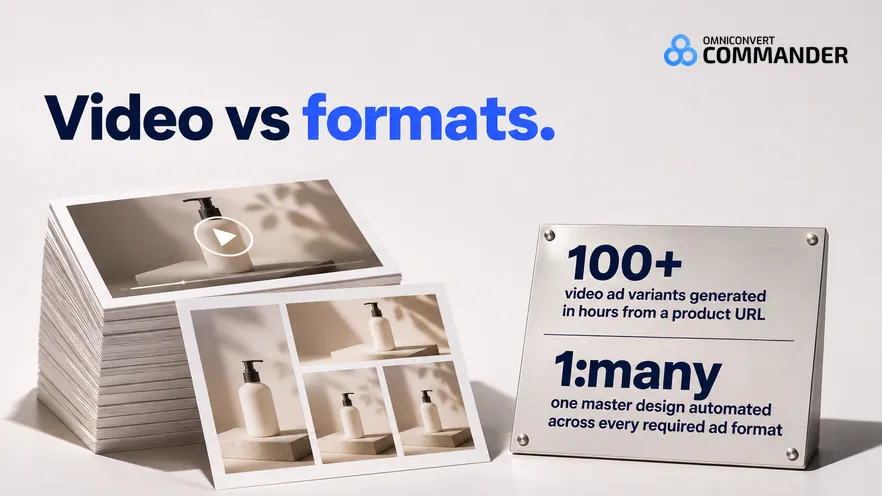
Creatify and The Brief (formerly Creatopy) are both AI creative production tools. Creatify generates 100+ UGC-style video ad variants from a product URL in hours, with AI avatars and voiceovers. The Brief automates one master design across every required ad format and size inside a built-in design editor. CLV modelling and True Profit measurement are missing from both. Omniconvert Commander sits above both and supplies the margin layer.
- Creatify is an AI video ad platform that generates 100+ UGC-style video variants from a product URL in hours, with AI avatars and voiceovers.
- The Brief (formerly Creatopy) is a creative automation platform that automates a master design across every required ad format and size inside a built-in editor.
- Creatify generates DTC video volume; The Brief automates static formats across placements; neither models customer lifetime value or performance from customer data.
- True Profit measurement and customer-segment prioritisation at the margin level are outside the scope of both platforms.
- Omniconvert Commander contributes the CLV segmentation, True Profit measurement, and ranked action queue that sit above what either platform provides.
A DTC growth team comparing Creatify vs The Brief is picking between two AI creative production tools that solve different scale problems: one generates UGC-style video ads from a product URL, the other automates a single master design across every required ad format and size. Creatify serves DTC brands needing rapid video ad volume without a film crew, drawing on a library of AI avatars and voiceovers. The Brief serves marketing teams and agencies producing on-brand static ads across many formats with a built-in design editor and format automation. Neither reads customer signals to decide which segment is worth chasing at margin, and that decision layer is what Omniconvert Commander is built to hold.
What is Creatify, and what is it actually good at?
Creatify is an AI video ad generation platform for DTC eCommerce brands. It generates 100+ UGC-style video ad variants featuring AI avatars and voiceovers from a product URL or brief, reducing the time from brief to video asset from weeks to hours. [Creatify, 2026]
Creatify automates video ad production from a product URL or script. The platform draws on a library of AI avatars and voiceovers to generate UGC-style video ads at volume, and a direct Shopify integration pulls product data automatically for ad generation. Performance marketers use it to compress the video production cycle from weeks to hours.
Creatify sits in the AI video ad generation category. The buyer is a DTC brand or performance agency that needs high volumes of video ad variants without a production crew. The pitch is generation speed and volume: dozens of video variants per campaign, ready to run on Meta, TikTok, and YouTube. Boreal and Boreal-H3 are Creatify Labs' own video generation models, optimised for ads; both are accessible via the Creatify API, Model Playground, and AdFlow. The Performance Agent claims one-click connections to Shopify and GA4 across six ad platforms. It pulls in revenue and performance data from Shopify and Google Analytics, then shifts creative rotation and budget allocation toward the ads generating the strongest return.
Creatify holds a 4.5 out of 5 rating on G2 across roughly 445 reviews as of 2026. Reviews praise the volume, the AI avatar realism, and the Shopify integration. They also flag the ceiling: no CLV context, and no way to tell which generated video is likely to win before you spend — though its Performance Agent now ingests Shopify and Google Analytics revenue and performance data to rotate creative and reallocate ad budget.
AI video ad generation is the use of large models to produce short-form video ad variants from a product URL or brief, typically featuring AI avatars, generated voiceovers, and stock or product footage. It is a production layer, not a briefing or measurement layer.
Where Creatify is genuinely strong
- Video volume: generates 100+ video ad variants in hours from a single product URL, no film crew required.
- Avatar and voiceover library: a range of realistic AI avatars and voice options for UGC-style content at speed.
- Shopify integration: pulls product data directly for ad generation without manual asset preparation.
Where Creatify hits its ceiling
- Generation only: Creatify produces video assets but does not decide what angle to generate based on customer data.
- No analytics layer: the Performance Agent ingests Shopify and Google Analytics revenue and performance data and reallocates budget toward whatever is driving the best return, but Creatify still does not tell you up front which generated video is likely to perform best.
- No CLV intelligence: creative decisions still sit with the marketing team, without lifetime value or segment context.
Creatify is a strong specialist for one job: DTC brands producing large volumes of UGC-style video ads at speed for Meta, TikTok, and YouTube. The ceiling appears when the question shifts from how fast you can produce a variant to which angle deserves the production and which customer segment it should target.
What is The Brief, and what is it actually good at?
The Brief is a creative automation platform built around a design editor and format automation. One master design becomes every required ad size across channels. It fits marketing teams and agencies that need to scale static creative across many formats without reaching for a separate design tool. [The Brief, 2026]
Design-to-automation is The Brief's central function: start with one master ad and let the platform generate every size and format required for Meta, Google, LinkedIn, and display networks. Because the editor is built into the platform, teams no longer need Canva or Photoshop for the design step. Copy and image tools powered by AI are available inside that editor to accelerate ideation.
The category is creative automation. The buyer is an in-house marketing team or an agency producing on-brand static ads for many campaigns, formats, and clients. The trade is scope: The Brief is stronger on production scale than on generative AI from scratch, so it fits teams that already have a creative strategy and need to execute it across every placement.
The Brief holds a 4.4 out of 5 rating on G2 across roughly 130 reviews as of 2026. Reviews praise the format automation, the editor, and the multi-brand workflow for agencies. The recurring caveat: the design-first workflow works best when teams already have a creative direction, not when they need that direction to come from customer data.
Master-to-formats automation is the workflow where a single master design is built once, then a rules engine and templates produce every required ad size, aspect ratio, and format automatically. It removes the manual resize step but does not decide what the master design should say, or which customer segment it should reach.
Where The Brief is genuinely strong
- Master to every format: start with one design and let the platform output every required ad size and aspect ratio automatically, with no manual resizing required.
- Built-in design editor: the design step stays inside The Brief, so teams are not dependent on Canva or Photoshop to build their master creative.
- AI copy and image assist: headline generation and image editing tools built into the editor help teams move from brief to concept faster.
Where The Brief hits its ceiling
- Static creative focused: video ad generation is limited compared to dedicated video production tools like Creatify.
- Design-first approach: works best for teams that arrive with a creative strategy in place, not for teams that need customer data to shape the strategy itself.
- No CLV or segment layer: without customer data informing what the master design says, the same creative goes to every audience regardless of value or fit.
For teams focused on creative production scale, The Brief is a capable and focused tool. Its limit becomes visible when formats are flowing correctly but no data exists to tell the master design which customer it is addressing.
Creatify vs The Brief vs Omniconvert Commander: the capability comparison
Creatify generates 100+ UGC-style video ad variants from a product URL in hours. The Brief automates a master design across every required ad format and size. Both optimise creative production within their scope. Omniconvert Commander sits above either as the intelligence layer, covering CLV, the creative brief, and the margin loop.
| Capability | Creatify | The Brief | Omniconvert Commander |
|---|---|---|---|
| Primary function | AI video ad generation from a product URL at volume | Take one master design and distribute it automatically across every required ad format and size | Autonomous growth intelligence above any creative tool |
| Unified commerce data | No: its Performance Agent ingests Shopify and Google Analytics revenue and performance data for ad buying, but there is no unified commerce data | No: design and creative production data only | Yes: one unified data layer across the entire stack |
| AI-prioritised experiment queue | No: generation tool with a Performance Agent that buys media off Shopify and Google Analytics data, no ranked action queue | No: production automation, not experiment prioritisation | Yes: recommended actions ranked by projected margin contribution |
| Creative generation | Yes: 100+ video variants produced in hours from a product URL, using Creatify's own Boreal and Boreal-H3 ad-optimised video models. | Partial: takes a single master design and outputs every required format variant; AI tools support copy and image work but do not generate ads from scratch | Yes: creative variants scored by CLV-weighted message angle |
| True Profit tracking | No: no margin layer | No: creative output metrics only, margin signal absent | Yes: targets margin growth instead of ROAS, tracked at both campaign and cohort level |
| CLV and segment intelligence | No: no customer data informs the generated variant | No: CLV and customer-behaviour data not present | Yes: churn prediction, RFM, cohorts, NPS signal |
| Autonomous action layer | Partial: humans still choose what goes into a run, but its Performance Agent rotates creative and reallocates budget toward whatever is driving the best return | No: designers and marketers still run the workflow | Yes: removes the manual handoff between data and execution |
| AI creative briefing | No: generation only, no briefing from CLV or NPS | No: master design is supplied by humans | Yes: brief generation draws directly from CLV, NPS, and review data |
| Pricing model | creatify.ai offers a free plan with 10 credits per month (watermark applied); paid plans start at $10 per month on annual billing, or $15 per month billed monthly (checked October 2026) | SaaS, Pro $29 a month billed annually, at thebrief.ai (checked October 2026) | Free plan available; paid plans from $49/month, details at Omniconvert Commander pricing |
| Best for | DTC brands and performance agencies producing large volumes of video ad content quickly | In-house marketing teams and agencies that need to scale on-brand static ad output across many formats and placements | eCommerce brands past $1M ARR that prioritise margin over top-line revenue |
| Integrations | Shopify, Meta, TikTok, YouTube, GA4 (revenue and performance data from Shopify and GA4 power the Performance Agent) | Meta, Google, LinkedIn, Zapier | Klaviyo, Shopify, Meta, Google, TikTok, GA4, Triple Whale |
| User rating | G2 rating: 4.5/5, based on 445 reviews (2026) | G2 rating: 4.4/5, based on 130 reviews (2026) | 5.0 out of 5 (Shopify App Store, 63 reviews, as of November 2026) |
Feature data for competitor columns is drawn from publicly available documentation as of September 2026. G2 ratings are sourced as cited in s1 and s2.
What Creatify and The Brief cannot do
Creatify generates UGC-style video ads at volume from a product URL. The Brief automates a master design across every required ad format and size. Both optimise creative production. Customer lifetime value modelling is absent from both tools. Whether the spend improved margin still sits with a human. Omniconvert Commander covers exactly that layer.
Creatify generates the video. Omniconvert Commander determines which product angle should drive the script, using CLV data to identify the customer segment with the highest lifetime value and lowest churn risk. That brief is what Creatify cannot produce on its own. Without it, teams generate volume but not direction.
Static ad production from a master design is what The Brief handles. Omniconvert Commander generates the brief that precedes any master design work in The Brief, drawing on CLV and NPS data to pinpoint the right segment and the message most likely to convert them at the highest margin.
What neither tool can tell you
- Which existing customers are worth targeting with more acquisition spend. Last-click attribution offers no visibility there. A 12-month CLV view reveals which segments merit the next round of paid budget.
- Buyer segments approaching churn go undetected. That 60-day warning appears in NPS data, review sentiment, and support ticket patterns, not in a video ad generator or a format-scaling design tool.
- Did your last Creatify or The Brief campaign grow True Profit, or did it only move ROAS? ROAS can rise while net margin shrinks. A measurement loop anchored to margin is the only way to catch that gap.
- What messaging angle resonates with your highest-value customers. Creatify reads a product URL to generate video; The Brief reads a master design to produce formats. Neither reads what your top-CLV cohort actually responds to.
This layer is where Omniconvert Commander operates. It ingests CLV data and NPS signals, layers in review intelligence alongside competitor creative data, and assembles a ranked action queue before any brief is written or creative produced. True Profit, not ROAS, is what Omniconvert Commander optimises for.
True Profit means the net margin that remains once CAC, COGS, return rates, and customer acquisition costs have been deducted from each cohort. Gross revenue and ROAS both ignore these deductions. That remaining figure is what the business actually keeps. Omniconvert Commander treats it as the primary metric when evaluating every experiment it runs.
AliveCor's one desktop A/B test, testing a lead collection overlay with a discount via Omniconvert, returned +16.74% conversion rate, +12.98% revenue per user and a 98.1% chance to win. [Omniconvert, AliveCor case study]
Which tool is right for you?
Choose Creatify for high-volume AI video ad generation from a product URL. Choose The Brief to automate one master design across every required static ad format. If the creative pipeline runs well but margin is flat, the missing layer is CLV, and that is Omniconvert Commander.
- Choose Creatify if you need to produce 50+ video ad variants per week for DTC campaigns without a film crew or production budget.
- Choose The Brief if your team needs to take one master design and push it to every required ad format and size automatically, using a built-in editor rather than Canva or Photoshop.
- Add Omniconvert Commander if the creative and production stack runs efficiently but the open question is which segment is worth acquiring and whether it improved True Profit.
Creatify and The Brief occupy different positions in the creative stack: one produces UGC-style video ad variants at volume from a product URL, the other takes a master design and distributes it across every required static format inside a built-in editor. Both improve creative production. Omniconvert Commander operates above them, determining which customers are worth chasing with that spend and whether the campaign moved margin. These are problems at a different layer of the stack entirely.
What each tool cannot do, honestly
Creatify generates UGC-style video volume from a product URL but has no briefing intelligence and no analytics on which variant will win. The Brief automates a master design across every static format with AI copy and image assist, but the master is still supplied by humans. Omniconvert Commander does neither production job; it supplies the CLV and margin layer both are missing.
- Creatify: volume video generation and in-platform media buying, with no analytics on which variant is likely to win before launch and no customer intelligence informing the angle or the script.
- The Brief: format automation with a built-in editor, limited video generation, and no CLV or segment intelligence informing the master design.
- Omniconvert Commander: not a UGC-style video generator or a format automation engine. It defines and measures the margin goal; it relies on tools like either one to run the creative production.
The honest read: use an AI video generator for UGC video volume, use a format automation platform for static ads across every placement, and use Omniconvert Commander for the CLV signal and the margin loop. Together the three cover what no single one of them can close independently.
See where your store stands against real competitors in your category and country. Ecommerce Benchmark scores six areas free: Creative & Ads, Reviews & UGC, AI Visibility, Agentic Commerce, Competitor Synthesis, and CRO.
Benchmark Your Store FreeFrequently Asked Questions
Should you add Omniconvert Commander to your Creatify or The Brief stack?
Add Omniconvert Commander if your creative and production pipeline runs efficiently but margin is flat. Creatify generates 100+ UGC-style AI video ad variants per hour from a product URL for DTC performance marketing. The Brief automates one master static design across every required ad format and size inside a built-in editor. Neither platform models which customers are worth acquiring or tracks whether the campaign moved True Profit. Omniconvert Commander determines the highest-margin next action and completes the loop.
Creatify and The Brief are strong at execution within their jobs: high-volume UGC-style AI video generation from a product URL on one side, master-to-formats static ad automation with a built-in editor on the other. If generating video volume or scaling static creative across every placement is your live need, keep the tool that fits.
The harder question is whether your team can reliably identify who to target, what to say to them, and whether the spend worked at the margin level. That is the specific question Omniconvert Commander is designed to answer.
Stop assembling data.
Start supervising growth.
Omniconvert Commander connects your full eCommerce data layer, surfaces revenue anomalies, and produces a prioritised action queue. Your team runs the P&L instead of acting as the coordinator between data and execution.
5.0 out of 5 across 63 reviews, Shopify App Store , as of November 2026