The Brief vs HeyGen vs Omniconvert Commander (2026): Automation vs AI video.
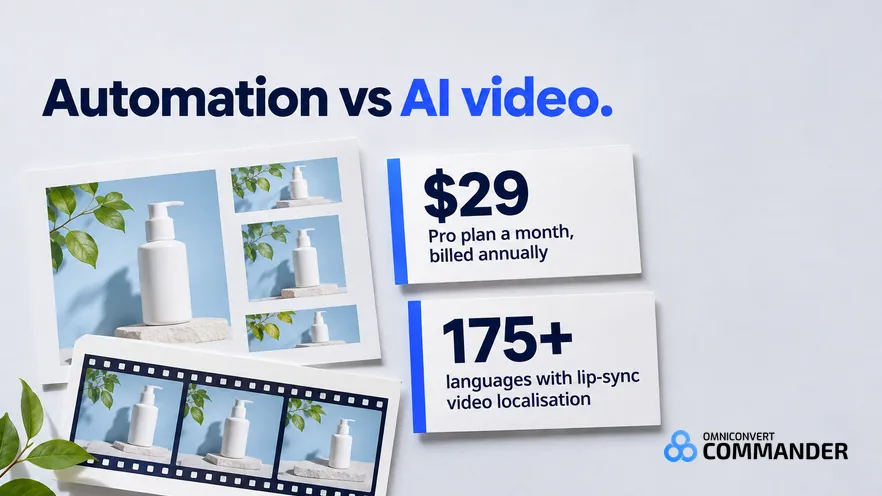
The Brief (formerly Creatopy) and HeyGen are both AI creative tools. The Brief automates one master design across every required ad format and size, inside a built-in editor. HeyGen produces realistic AI avatar video, applying voice cloning to reach audiences in 175+ languages. Neither builds the brief that decides which segment or angle to target. Omniconvert Commander covers that strategic layer.
Compare and choose: Omniconvert Commander Omniconvert Commander pricing Omniconvert Commander customer intelligence The Brief vs Omniconvert Commander HeyGen vs Omniconvert Commander
- The Brief (formerly Creatopy) is purpose-built for static ad format automation: one master design produced across every required size and format inside a built-in editor.
- HeyGen renders realistic AI avatar video with voice cloning and lip-sync localisation across 175+ languages.
- The tools sit in adjacent creative categories, but they share the same blind spot: neither builds the brief from CLV, NPS, or review intelligence.
- Bring Omniconvert Commander in above either production tool once ROAS looks stable but margin is not following.
A DTC growth team comparing The Brief vs HeyGen is usually choosing between two AI creative formats: automated static ad production across every required size and format, or realistic AI avatar video across many languages. The Brief wins on static ad format automation from a single master design with AI copy and image assist. HeyGen wins on avatar realism and 175-language lip-sync localisation. No answer comes from either tool on which segment to focus on, what creative angle to run first, or whether the ads moved True Profit. In 2026, that strategic layer stays manual, and it sits above every AI creative tool as the main constraint on growth.
What is The Brief, and what is it actually good at?
The Brief is a creative automation platform. It combines a design editor with ad production automation and AI copy and image assist, so a marketing team can build one master design and automatically produce every required ad format and size across channels. [The Brief, 2026]
The Brief is built around a simple idea: design the master once, produce every format automatically. A marketer builds a design in the editor, then the platform generates the same layout across every ad size the campaign needs, from square social to leaderboard display.
The Brief sits in the creative automation and ad production space. Its buyers are marketing teams and agencies that ship large volumes of on-brand static ad creative across dozens of formats. The core promise is scale without design bottlenecks: one master design, every required size, on brand, without a designer touching each resize.
On G2, The Brief scores 4.4 out of 5 across 130 reviews as of 2026. Users consistently praise the editor, the format library, and the automated resize workflow. The recurring caveat is the same one that follows every automation tool: The Brief ships what you design, and the strategy behind that design remains entirely in your hands.
Master-to-formats automation is the workflow where a designer builds one canonical creative in a specified ad format, then the platform automatically produces every other required size and format for the campaign, keeping brand elements, copy, and layout consistent across each output.
Where The Brief is genuinely strong
- Master-to-all-formats automation: build a design once and automatically produce every required ad size and format without a manual resize pass.
- Built-in design editor: marketing teams can produce creative in-app without a separate Canva or Photoshop dependency.
- AI copy and image assist: generative tools inside the editor speed up copy variation and image ideation during the design pass.
Where The Brief hits its ceiling
- Static-first tool: The Brief is strongest on static creative; for realistic AI avatar or spokesperson video at scale, HeyGen is the sharper specialist.
- Design-first, not data-first: the workflow starts with a creative brief; the tool does not derive that brief from customer signals.
- Customer intelligence absent from creative production: ad output is generated without a CLV or segment input; the marketer decides who and what to target based on judgement.
The Brief is a strong specialist for one specific job. The ceiling shows up when teams realise that faster format production does not, by itself, improve True Profit.
What is HeyGen, and what is it actually good at?
Talking-head video and voice cloning are what HeyGen is built for. The platform renders spokesperson content at studio quality, matches lip movement to cloned audio across 175+ languages, and lets teams build a custom avatar from uploaded photos or footage. [HeyGen, 2026]
Corporate training teams, explainer content producers, and multilingual localisation projects were HeyGen's first customers. By 2026, DTC brands have adopted it too, drawn by the ability to generate realistic spokesperson video at a fraction of filming costs. A single master video reaches every market through localisation, with no re-filming and no talent re-booking.
HeyGen operates in the AI avatar and video generation space. Its typical buyer is a brand that needs professional spokesperson video across many markets, especially multilingual ones. The pitch centres on realism and reach: 500+ presenters available on the free plan, voice cloning for brand consistency, and one-click localisation across 175 languages with accurate lip-sync.
HeyGen carries a 4.8 out of 5 score on G2 from 1977 reviews as of 2026. Reviewers highlight avatar realism and the quality of localised output. The consistent ceiling noted in reviews: the tool renders whatever you put in the brief, and writing that brief remains your problem.
From a short recording, voice cloning produces a digital replica of a chosen voice. That replica reads any new script in any supported language while keeping the original tone and cadence. HeyGen adds lip-sync to the mix, so mouth movements stay accurate for the cloned audio in every localised output.
Where HeyGen is genuinely strong
- 500+ presenters on the free plan: a substantial presenter library alongside custom avatar creation built from your own uploaded photos or video footage.
- 175-language lip-sync localisation: take one master video and distribute it across every market without re-filming a single frame or re-engaging talent.
- Voice cloning for brand spokesperson: a persistent digital copy of a specific voice that keeps spokesperson content consistent however many videos you produce.
Where HeyGen hits its ceiling
- General-purpose video tool: not purpose-built for ecommerce ad workflows, product URL scraping, or paid social testing; The Brief is closer to the static ad production workflow.
- No ad analytics loop: HeyGen outputs video but carries no connection to ad account data or campaign performance results.
- No CLV or segment intelligence: the tool has no view of customer value or segment data; it renders whatever creative direction you supply.
HeyGen is a focused specialist that does one job well. Its ceiling mirrors The Brief's, expressed in a different format: producing more realistic video does not, on its own, move True Profit.
The Brief vs HeyGen vs Omniconvert Commander: the capability comparison
The Brief covers static ad format automation from a single master design. HeyGen covers realistic AI avatar video with multilingual lip-sync. Omniconvert Commander works at the layer above both: it determines which customer to target, which angle belongs in the brief, and whether the resulting creative actually moved True Profit rather than just ROAS.
| Capability | The Brief | HeyGen | Omniconvert Commander |
|---|---|---|---|
| Primary function | Design-to-automation for producing and scaling static ad creative across all formats | Spokesperson video via AI avatar, with voice cloning and lip-sync across 175 languages | Growth intelligence that works above ad generators and video tools |
| Unified commerce data | No: data from paid, email, CRO, and retention sits in separate silos with no unified layer | No: data from paid, email, CRO, and retention sits in separate silos with no unified layer | Yes: unified data foundation across the full stack |
| AI-prioritised experiment queue | No: no prioritized list of what to act on next | No: no prioritized list of what to act on next | Yes: orders every potential action by projected margin contribution |
| Creative generation | Partial: generates static variants from a master design across formats; AI assists copy and image, not full generative video | Yes: AI avatar video rendered in 175+ languages with voice cloning built in | Yes: ad angles scored and ordered by CLV-weighted priority |
| True Profit tracking | No: no profitability layer, no return rate visibility | No: no profitability layer, no return rate visibility | Yes: tracks margin per campaign and per cohort, not just ROAS |
| CLV and segment intelligence | No: no lifetime value input, no churn risk signal | No: no lifetime value input, no churn risk signal | Yes: RFM segmentation, cohort analysis, churn prediction, NPS signal |
| Autonomous action layer | No: human briefs every run | No: human briefs every run | Yes: removes the manual handoff between customer data and creative execution |
| AI creative briefing | No: the marketer writes and supplies the brief manually | No: the marketer writes and supplies the brief manually | Yes: briefs are generated from CLV, NPS scores, and customer review data |
| Pricing model | Pro tier: $29 per month on annual billing; full details at thebrief.ai (checked October 2026) | Subscription SaaS, Creator plan from $29/month, full pricing at heygen.com | Start free; paid plans begin at $49/month, full details on the Omniconvert Commander pricing page |
| Best for | Marketing teams and agencies that need to scale on-brand static ad creative production across multiple formats and sizes | Brands that need professional spokesperson video at scale, with a particular focus on multilingual markets | eCommerce teams above $1M ARR that measure margin, not just ROAS |
| Integrations | Meta · Google · LinkedIn · Zapier | Zapier · HubSpot · API | Meta · Google · Shopify · Klaviyo · TikTok · GA4 · Triple Whale |
| User rating | G2 rating: 4.4 / 5, from 130 reviews (2026) | 4.8 out of 5 (G2, 1,977 reviews, checked November 2026) | 5.0 out of 5 (Shopify App Store, 63 reviews, as of November 2026) |
The Brief and HeyGen columns are based on publicly available feature documentation as of 2026. G2 ratings sourced as cited in s1 and s2.
What The Brief and HeyGen cannot do
With The Brief and HeyGen, the gap sits before the asset exists. Both tools take a brief and produce creative output from it. What neither tool can do is construct that brief using CLV data, NPS signals, review intelligence, or competitive angle research. Neither closes the loop on whether the finished creative improved True Profit, the metric the business actually keeps.
The Brief handles static ad production from one master design. Before that design is opened, Omniconvert Commander can supply the brief itself, drawn from CLV and NPS data, naming the segment to target and the message most likely to convert them at the highest margin.
Among AI video tools, HeyGen sets the bar for realism. The gap it cannot fill is the brief that should come before production starts. Omniconvert Commander covers that gap: CLV segmentation and NPS signals feed into a recommended brief that names which customer segment needs addressing, which pain point should open the script, and then tracks whether the finished video drove True Profit.
Both The Brief and HeyGen are execution tools. Across two different formats, they perform the same core function: converting a brief into finished creative at speed. Each does that well. Underlying both is the same assumption: that the right customer and the right message are already known. They make acting on that assumption faster. Neither tests whether it is correct.
What neither tool can tell you
- Pinpointing which customers are worth pursuing further. Last-click attribution cannot answer this. A 12-month CLV view is what shows which segments should receive the next round of paid spend.
- Spotting the segments approaching churn at 60 days. That signal arrives first in support ticket patterns, NPS scores, and review sentiment. No generator's UI surfaces it.
- Did your most recent campaign grow True Profit, or did it only push ROAS higher? Net margin can fall even as ROAS climbs. Only a measurement loop built around margin catches that divergence.
- The messages that move your highest-value customers. Their reviews, NPS verbatims, and support transcripts hold the angles that convert at the highest margin. Pulling and synthesising that data is still a manual step in any stack built on The Brief plus HeyGen.
This layer is where Omniconvert Commander operates. It combines competitor creative data, CLV data, NPS signals, and review intelligence into a ranked action queue, all before a brief is written or a pixel of creative is produced. The metric it optimises against is True Profit, not ROAS.
True Profit measures the net margin each cohort retains after subtracting CAC, COGS, and return rates. This is not a gross revenue figure, and it is not ROAS. What remains is the actual amount the business retains. Omniconvert Commander treats True Profit as the primary optimisation metric for every experiment it runs.
PRISM+ ran one A/B test on Omniconvert: a listing page redesign that grouped TVs, tested across all devices, delivered a +40.74% conversion rate, +14.81% revenue per user, and a 99.48% chance to win. [Omniconvert, PRISM+ case study]
This is not a case for replacing The Brief or HeyGen. Both still do the creative production. Omniconvert Commander operates above them, deciding which brief to issue and tracking whether the finished asset moved the metric that matters to the business.
Which tool is right for you?
Pick The Brief when the bottleneck is producing on-brand static ad creative across every required format and size. Pick HeyGen when the need is realistic avatar video at scale, especially for multilingual markets. Bring in Omniconvert Commander when ROAS appears healthy but margin stays flat, and the team is burning hours gathering CLV, NPS, and review data before a brief can take shape.
Choose The Brief if
- Format automation is the bottleneck: you need one master design produced across every required ad size and format without manual resizing.
- Design tooling is a dependency you want removed: your marketing team needs a built-in editor without relying on Canva or Photoshop separately.
- Agency workflow at scale: you are an agency producing on-brand creative for multiple clients who need format automation at scale.
Choose HeyGen if
- Multilingual localisation is the bottleneck: a single video must reach 10+ languages with accurate lip-sync, and re-booking talent for every market is not an option.
- Spokesperson consistency matters: you need a reusable AI avatar tied to one specific spokesperson for consistent brand video output at scale.
- Explainer or training video leads: your primary output is explainer, training, or corporate video content rather than performance ad testing.
Add Omniconvert Commander if
- Data assembly eats your day: your team is spending more than 2 hours daily pulling information from separate tools before a single decision can be reached.
- Paid spend runs without a margin view: budget is flowing into paid channels but no reliable picture exists of which customer segments produce the highest margin.
- You want experiments ranked before sprint planning: you need a prioritised list of tests to run before dev or creative sprints are scoped and resourced.
- ROAS hides a margin problem: Quarter-on-quarter margin stays flat even as ROAS figures appear strong.
What each tool cannot do, honestly
The Brief, HeyGen, and Omniconvert Commander each carry genuine limits. Framing the three as rivals for the same role obscures what each one actually does. The accurate picture is a stack: a static ad production tool, an AI video tool, and an intelligence layer above both. All three can be swapped out, and none of them alone is a complete answer.
Where The Brief will not stretch
- Not a video specialist: for realistic AI avatar video, voice cloning, and 175-language lip-sync localisation, HeyGen is the stronger pick.
- Not a creative analytics layer: The Brief does not surface which format or variant will perform best in a live campaign.
- Not a CLV system: creative direction in The Brief is entirely manual, with no customer intelligence input.
Where HeyGen will not stretch
- Not an ecommerce ad workflow: HeyGen is a general-purpose video platform; it does not pull data from product URLs or connect natively to paid social campaign setup.
- Not a paid-social testing tool: HeyGen does not surface which video will perform best in a Meta or TikTok campaign.
- Not a margin tool: Return rates, COGS, and cohort-level CAC fall outside what HeyGen can measure.
Where Omniconvert Commander has real prerequisites
- Data unification occupies the first 4 to 6 weeks: every ranked recommendation is only as reliable as the data behind it. Fragmented data produces unreliable outputs.
- Strategy and brand judgment remain human: Omniconvert Commander coordinates execution automatically, but category positioning and brand voice are still human decisions.
- Revenue stage threshold: the return compounds above $1M ARR, where data volume and coordination overhead are high enough to make the intelligence layer pay for itself. A brand under that threshold will typically see stronger returns from one execution tool before adding an intelligence layer.
More on The Brief and HeyGen
Best tools in this category
See where your store stands against real competitors in your category and country. Ecommerce Benchmark scores six areas free: Creative & Ads, Reviews & UGC, AI Visibility, Agentic Commerce, Competitor Synthesis, and CRO.
Benchmark Your Store FreeFrequently Asked Questions
The verdict
The Brief is the specialist when the bottleneck is producing one master design automatically across every required ad format and size for high-volume static campaigns. HeyGen wins for realistic AI avatar video with voice cloning and 175-language lip-sync localisation. The brief that informs what to produce still has to come from somewhere else. Add Omniconvert Commander above either generator.
The Brief and HeyGen are both capable AI creative tools within their categories. If the primary need is static ad format automation from a single master design, The Brief is the specialist. If the need is realistic avatar video with multilingual localisation, HeyGen wins.
The more important question is whether your team has a dependable way to know who to target, what message to put in front of them, and whether the result actually improved margin. That question sits outside what either production tool can answer. Omniconvert Commander is built specifically to address it.
Stop assembling data.
Start supervising growth.
Omniconvert Commander pulls your complete eCommerce data into one layer, identifies revenue anomalies, and produces a prioritised action queue, so your team operates on the P&L instead of acting as the connection point between data sources.
5.0 out of 5 across 63 reviews, Shopify App Store , as of November 2026