The Brief vs Madgicx vs Omniconvert Commander (2026): Production vs optimisation, same blind spot.
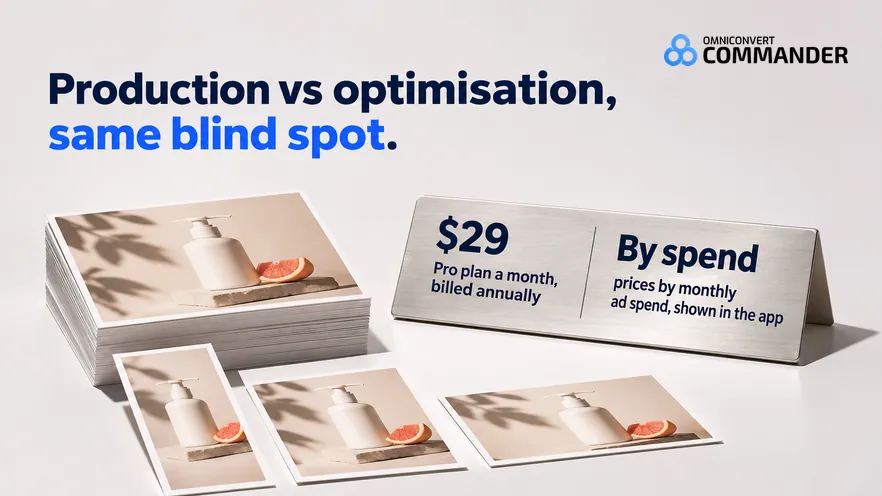
The Brief (formerly Creatopy) and Madgicx both sit inside the Meta paid stack, from opposite ends. The Brief automates static ad production, one master design across every required format. Madgicx reviews your Meta account daily and recommends what to pause, scale, or test. Neither decides which customer segment is worth the impression. That segment-selection layer is exactly where Omniconvert Commander operates.
- The Brief (formerly Creatopy) is purpose-built for static ad production and format automation: one master design, every required ad size and format, with a built-in editor and AI copy and image assist.
- Madgicx wins on daily AI recommendations across a Meta ad account: pause, scale, test, with audience targeting automation, priced by monthly ad spend.
- The two tools have a shared gap: The Brief builds creative from templates, not CLV or NPS signals, and Madgicx optimises Meta spend without any True Profit view.
- When ROAS appears healthy but margin stays flat, Omniconvert Commander works as the intelligence layer sitting above The Brief and Madgicx.
A DTC team evaluating The Brief vs Madgicx is usually solving two different Meta bottlenecks at once: not enough on-brand static ad variants, and not enough time to interpret the Meta reports those ads produce. The Brief wins on master-to-formats static ad automation from a single design. Madgicx wins on daily AI recommendations across a Meta ad account. Neither tool decides which customer segment to target, what message your highest-CLV buyers respond to, or whether the resulting campaign improved True Profit. That decision layer is still human, and in 2026 it is the bottleneck above every AI execution tool.
What is The Brief, and what is it actually good at?
The Brief is a creative automation platform that pairs a design editor with ad production automation and AI copy and image assist. A marketing team builds one master design and the platform automatically produces every required ad format and size across channels. [The Brief, 2026]
The Brief is built around a simple idea: design the master once, produce every format automatically. A marketer builds a design in the editor, then the platform generates the same layout across every ad size the campaign needs, from square social to leaderboard display, without a manual resize pass.
Ad creative production and automation is the category. The buyer is a marketing team or agency shipping large volumes of on-brand static ads across many formats. The pitch is format scale without designer bottlenecks: one master design, every required size, on brand, with no designer needed for each resize.
On G2, The Brief carries a 4.4 out of 5 rating across 130 reviews as of 2026. Reviews praise the format automation and the built-in editor. They flag the same ceiling every production tool hits: the platform produces what you brief, and the brief is still yours.
Master-to-formats automation is defined as the workflow where a designer builds one canonical creative in a single ad format, then the platform automatically produces every other required size and format for the campaign, keeping brand elements, copy, and layout consistent across each output.
Where The Brief is genuinely strong
- Master-to-all-formats automation: build one design and automatically produce every required ad size and format, with no manual resize per channel.
- Built-in design editor: marketing teams produce creative in-app, with no separate Canva or Photoshop dependency.
- AI copy and image assist: generative tools inside the editor speed up copy variation and image ideation during the design pass.
Where The Brief hits its ceiling
- Static-first tool: The Brief is strongest on static creative; video ad generation is limited compared with specialist video tools.
- Design-first, not data-first: the workflow starts with a human creative brief; the tool does not derive that brief from customer signals.
- Customer intelligence is absent from the production layer: ad formats get automated, but deciding which audiences to target and what message fits them remains a manual human decision.
The Brief is a strong specialist for one job: static ad production and format automation. The ceiling appears when teams realise more variants, by themselves, do not improve True Profit.
What is Madgicx, and what is it actually good at?
Madgicx is an AI Meta advertising platform that pairs an AI Marketer agent with audience targeting automation and creative analytics. It is built for DTC brands running significant Meta budgets who want daily, specific recommendations rather than another dashboard. [Madgicx, 2026]
Madgicx connects to a Meta ad account and runs an AI Marketer that reviews performance daily. The output is not a chart. It is a short list of specific calls: pause this ad, redistribute budget here, test that angle. Audience targeting automation builds and refines Meta audiences from account data without manual setup, and the creative analytics layer surfaces which existing ads carry the volume. Madgicx MCP is a Model Context Protocol server that gives AI assistants (Claude and ChatGPT among them) direct access to a Madgicx account. From a chat interface, they can retrieve campaign performance data, audit the full account, and execute changes such as pausing underperforming ads, reallocating budgets, or relabeling ad sets.
Meta campaign intelligence and optimisation is the category. The buyer is a Meta-first DTC marketer or agency media buyer who wants an AI co-pilot over the account, not another analytics tab. Pricing is set by monthly ad spend, aimed at SMB and lower mid-market teams.
G2 users give Madgicx a score of 4.5 out of 5, drawn from 180 reviews published by 2026. Reviewers highlight the daily recommendation cadence and the audience targeting automation. The recurring criticism is the Meta-only scope: TikTok, Google, and other channels fall outside what it can touch.
Madgicx's AI Marketer is an agent that reviews a Meta ad account on a daily cadence and returns specific recommendations: which ads to pause, which to scale, which to test next. The recommendations are grounded in Meta ad performance data; the operator approves each call before Madgicx acts on the account.
Where Madgicx is genuinely strong
- Daily specific recommendations: the AI Marketer reads your Meta account every day and ships a short list of calls, not another dashboard to interpret.
- Audience targeting automation: Meta audiences are built and refined from account data without manual segment setup, saving a media buyer hours a week.
- Priced by ad spend: the price scales with the Meta spend it manages, so Madgicx is aimed at SMB and lower mid-market DTC budgets. [Madgicx, 2026]
Where Madgicx hits its ceiling
- Meta-first by design: limited capability for TikTok, Google, and the rest of the paid mix means multi-channel brands still coordinate elsewhere.
- Ad-performance only: recommendations are grounded in Meta ad data, not CLV, NPS, or customer lifetime signal.
- Image-only generation: the AI Ad Generator covers image ads; for high-volume static format automation, The Brief is the specialist.
Madgicx is a strong specialist for one job: translating Meta ad data into daily specific actions. The ceiling is a Meta-shaped ceiling: the moment TikTok, Google, or customer-lifetime data enters the decision, Madgicx is working blind.
The Brief vs Madgicx vs Omniconvert Commander: the capability comparison
The Brief handles static ad production and format automation from a master design. Madgicx handles daily Meta campaign optimisation with an AI Marketer. Omniconvert Commander handles the layer above both: which customer to target, which angle to brief, and whether the resulting campaign drove True Profit, not just ROAS.
| Capability | The Brief | Madgicx | Omniconvert Commander |
|---|---|---|---|
| Primary function | Creative automation and static ad production across formats | AI-driven daily Meta campaign optimisation with specific recommendations | Autonomous growth intelligence above any execution tool |
| Unified commerce data | No: paid, email, CRO, and retention data each sit in their own silo, with nothing to unify them | No: Meta ad data only, no retention or CRO signal | Yes: one unified data layer across the full stack |
| AI-prioritised experiment queue | No: no prioritised list of recommended next steps | Partial: daily Meta ad recommendations, not customer segment prioritisation | Yes: ranks each next action by its projected impact on margin |
| Creative generation | Partial: automates static variants from a master design across formats, AI assists copy and image | Partial: AI Ad Generator produces image ad variants from existing creative | Yes: ad creative options ordered by CLV-weighted message angle |
| True Profit tracking | No: margin visibility is absent, as is any return rate signal | No: Meta ROAS and ad metrics, not margin | Yes: measures margin instead of ROAS, across campaigns and cohorts alike |
| CLV and segment intelligence | No: CLV data is not factored in, and churn risk goes untracked | No: Meta audience data, not customer lifetime value | Yes: RFM analysis, cohort tracking, churn prediction, NPS signal |
| Autonomous action layer | No: human briefs every design | Partial: AI Marketer recommends, operator approves each action; Madgicx MCP lets connected AI assistants pause ads, adjust budgets and rename ad sets from the chat | Yes: data flows directly to action without a human coordinating between them |
| AI creative briefing | No: the creative brief comes from the marketer, not the platform | No: no segment-driven brief, Meta data only | Yes: CLV, NPS, and review data feed the brief automatically |
| Pricing model | Pro plan: $29 per month on annual billing. SaaS product. Pricing source: thebrief.ai (checked October 2026) | Subscription priced by monthly ad spend; current tiers displayed inside the app (checked October 2026) | Omniconvert Commander starts at no cost; paid tiers begin at $49/month. Full details at Omniconvert Commander pricing |
| Best for | Marketing teams and agencies producing on-brand static ads across many formats | Meta-first DTC brands and agencies wanting daily AI recommendations | eCommerce teams above $1M ARR who measure success by margin, not just ROAS |
| Integrations | Meta · Google · LinkedIn · Zapier | Meta · Google · Shopify | Shopify · Klaviyo · Meta · Google · TikTok · GA4 |
| User rating | G2: 4.4 out of 5, 130 reviews, as of 2026 | G2: 4.5 out of 5, 180 reviews, as of 2026 | 5.0 out of 5 (Shopify App Store, 63 reviews, as of November 2026) |
The Brief and Madgicx columns reflect publicly available feature documentation as of October 2026. G2 ratings are sourced from the listings referenced in s1 and s2.
What The Brief and Madgicx cannot do
Both tools leave the same gap unaddressed, and it sits upstream of what either one does. The Brief formats a brief it never wrote. Madgicx acts on Meta data it never reconciles against margin. Neither has visibility into CLV, cohort churn, or whether the campaign moved True Profit, the number the business actually keeps.
The Brief handles production: it converts a master design into every required static ad format. Omniconvert Commander operates one step earlier, generating the creative brief itself from CLV and NPS data, so the segment to target and the message most likely to convert at the highest margin are defined before The Brief is opened.
Madgicx's AI Marketer monitors your Meta account daily and flags which campaigns to pause, scale, or test. What it cannot supply is CLV-level segmentation showing which customer groups are worth acquiring in the first place, or a margin-level read on whether those campaigns are actually moving True Profit. That is the layer Omniconvert Commander adds.
The Brief and Madgicx are both execution tools, from opposite ends of the paid Meta workflow. The Brief builds the asset. Madgicx governs the account. Both are built on a shared assumption, that you already know which customer to target and which message to lead with. Both tools work within the bounds of that assumption without questioning it.
What neither tool can tell you
- Knowing which customers merit further acquisition spend. Last-click attribution and the Meta pixel won't answer that. A 12-month CLV view across segments is what shows where the next round of paid budget belongs.
- Which segments are 60 days away from churning. The early signal lives in NPS scores, review sentiment, and support ticket patterns, not in a design editor or a Meta ad metric.
- Whether the last campaign improved True Profit or only pushed ROAS higher. A rising Meta ROAS figure can coincide with shrinking net margin; catching that gap requires a measurement loop built around margin, not ad-platform metrics.
- What actually resonates with your most valuable customers. The angles that convert are buried in their reviews, NPS verbatims, and support transcripts. In a The Brief plus Madgicx stack, surfacing and synthesising that signal remains a manual task.
Omniconvert Commander is designed specifically for this layer. It pulls CLV data, NPS signals, review intelligence, and competitor creative data into a single ranked action queue, before any brief is written or any campaign is optimised. True Profit, not ROAS, is what the system optimises toward.
True Profit is what remains after revenue is reduced by cohort-level acquisition costs, CAC, COGS, and return rates. True Profit excludes gross revenue figures and ROAS. That net margin is what the business keeps. Omniconvert Commander treats True Profit as the primary metric against which every experiment in the platform is evaluated.
From a programme of 60 tests, one desktop test on product thumbnails and benefits gave AliveCor a +21% conversion rate, +5% revenue per visitor, and 94% statistical relevance with Omniconvert. [Omniconvert, AliveCor case study]
This is not a replacement for The Brief or Madgicx. The Brief still ships the formats. Madgicx still works the Meta account. Omniconvert Commander is the strategic layer above them that decides which brief to send, which segment to serve, and whether the result moved the metric the business actually keeps.
Which tool is right for you?
Pick The Brief if your bottleneck is on-brand static ad production across every required format from one master design. Pick Madgicx if Meta is your dominant channel and you want daily specific AI recommendations across the account. Add Omniconvert Commander when ROAS looks fine but margin is not improving, and your team spends hours assembling CLV, NPS, and review data before any decision gets made.
Choose The Brief if
- Format automation is the bottleneck: you need to automate the production of one master design across every required ad format and channel size.
- You want the editor in-platform: your team needs a built-in design editor for creative production without a separate Canva or Photoshop dependency.
- You run on-brand creative for many clients: you are an agency producing on-brand creative for multiple clients that need format automation at scale.
Choose Madgicx if
- Meta is your primary channel: Meta is your main or only paid social channel and you want daily AI-driven campaign recommendations on the account.
- You want targeting plus analysis in one tool: audience targeting automation and creative analysis in a single Meta-focused platform at an accessible price point.
- Data to action is the gap: your current bottleneck is translating campaign data into specific daily actions, not producing more creative.
Add Omniconvert Commander if
- Data assembly eats your day: before a single decision can be made, your team is spending more than 2 hours pulling figures out of disconnected tools.
- Paid spend runs without a margin view: budget is going to paid media while no reliable signal shows which customer segments actually produce the highest margin.
- You want experiments ranked before sprint planning: you need a prioritised list of what is worth testing before creative or development sprints are scoped and assigned.
- ROAS hides a margin problem: Meta ROAS looks fine but net margin is not improving quarter-on-quarter.
What each tool cannot do, honestly
The Brief, Madgicx, and Omniconvert Commander each have real limits. Treating them as competing for the same role misrepresents what each one does. The honest view is three tools at different layers of the same stack: two execution tools in separate roles, and one intelligence layer sitting above both. Each does a job none of the others fully covers.
Where The Brief will not stretch
- Not a strategy tool: The Brief will not tell you which segment to target or which angle is most likely to convert for your customers.
- Not a campaign optimiser: The Brief produces the asset; it does not read your Meta account or recommend budget calls.
- Not a margin tool: The Brief has no visibility into return rates, COGS, or CAC at cohort level.
Where Madgicx will not stretch
- Not multi-channel: Madgicx is Meta-first by design; TikTok, Google, and the rest of the paid mix sit outside its decision loop.
- Not a format automation tool: the AI Ad Generator covers image ads, not high-volume master-to-formats production at The Brief's output.
- Not a CLV system: recommendations are grounded in Meta ad data, not customer lifetime value or cohort churn.
Where Omniconvert Commander has real prerequisites
- Data unification occupies the first 4 to 6 weeks: the quality of any intelligence layer depends entirely on the inputs it receives. When inputs are fragmented, the prioritised action list loses reliability.
- Strategy and brand judgment remain human: Omniconvert Commander handles execution automatically. Category positioning and brand voice are decisions that stay with your team.
- Revenue stage threshold: returns compound most clearly above $1M ARR, once data volume is high enough and manual coordination cost is visible and measurable. Brands below that threshold usually get more from a single execution tool first.
See where your store stands against real competitors in your category and country. Ecommerce Benchmark scores six areas free: Creative & Ads, Reviews & UGC, AI Visibility, Agentic Commerce, Competitor Synthesis, and CRO.
Benchmark Your Store FreeFrequently Asked Questions
The verdict
The Brief is the specialist when static ad production and format automation are the bottleneck, one master design across every required ad size. Madgicx wins when the need is daily AI recommendations across a Meta ad account at an SMB price point. Neither assembles the brief itself. Omniconvert Commander belongs in the layer above both The Brief and Madgicx.
The Brief and Madgicx are both capable AI tools within their categories. If the primary need is static ad production and master-to-formats automation, The Brief is the specialist. If the need is daily AI-driven Meta campaign optimisation at an accessible price point, Madgicx wins.
The more important question is whether your team has a consistent, reliable method for knowing which segments to target, what message to use, and whether the result held up at the margin level. That question sits outside what The Brief and Madgicx answer, and it is exactly what Omniconvert Commander, the third tool on this page, is designed to address.
Stop assembling data.
Start supervising growth.
Omniconvert Commander connects your full eCommerce data layer, surfaces revenue anomalies, and delivers a prioritised action queue, so your team operates on the P&L instead of coordinating data between tools.
5.0 out of 5 across 63 reviews, Shopify App Store , as of November 2026