Fidras vs Lifetimely vs Omniconvert Commander (2026): Sender, Scorekeeper, or Growth Engine
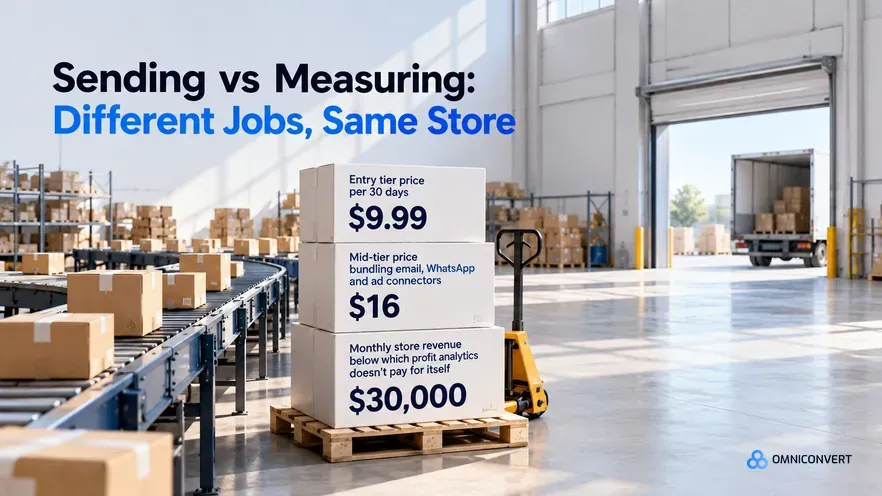
These two tools do not compete, and the name of the query hides that. Fidras is a cheap multichannel sender: email, SMS, and WhatsApp, with RFM scoring attached. Lifetimely is a profit and lifetime-value analyst: a daily P&L after COGS and fees, predictive LTV, and CAC payback by channel, with no sending at all. Fidras ships messages without profit truth. Lifetimely reports profit truth without shipping anything. Omniconvert Commander sits above both as the decision layer: it ranks which customer segment the next dollar belongs to, pushes that segment to your channels, and reports True Profit after COGS, shipping, returns, and fees.
Compare and choose: Omniconvert Commander Omniconvert Commander pricing Omniconvert Commander customer intelligence Lifetimely alternatives
- These two products barely overlap. Fidras is a multichannel sender with analytics attached; Lifetimely is a profit and LTV analyst that sends nothing. A store running only one of them has an obvious hole, and Omniconvert Commander is the decision layer above both.
- The track records are not comparable, and that is the single most useful fact for a buyer. Fidras launched on 13 January 2026 and holds 5.0 out of 5 from 2 Shopify App Store reviews, with no G2 or Capterra listing and fewer than ten WooCommerce installs. Lifetimely has been listed since 19 February 2019 and holds 4.9 out of 5 from 561 reviews.
- Fidras has no profit layer. Nothing in its listing or documentation reports COGS, margin, or net profit, and its predictive analytics and attribution sit behind the $49 Enterprise tier, so an RFM score is a proxy for value rather than a measure of it.
- Lifetimely measures and then waits. It has no RFM segmentation, no NPS or surveys, and no A/B testing, and its Profit Agent recommends a next move for a merchant to approve rather than executing anything.
- Neither tool reports CLV-weighted True Profit per campaign or ranks what to do next. Omniconvert Commander adds RFM into six named segments, CLV by segment, channel and cohort, NPS flags on high-CLV detractors, and audiences pushed to Meta and Google, ranked from 13 years of experiment data across 7,000+ websites and 70,000 experiments.
A buyer who types this comparison is usually mid-way through a different question. Fidras is a marketing app with analytics attached; Lifetimely is an analytics app with no marketing. One sends, the other counts, and a store running only one of them has an obvious hole. It is also worth knowing before you read further that the two products are nowhere near the same age or scale: Fidras launched in January 2026 and has two public reviews, while Lifetimely has been on the Shopify App Store since February 2019 and has 561. This page states what each one genuinely does, where each stops, and what neither of them answers.
What is Fidras, and what is it actually good at?
Fidras is an all-in-one AI marketing app for Shopify and WooCommerce stores. It sends segmented email, WhatsApp, and SMS, scores customers with real-time RFM, projects CLV, and syncs audiences to Meta and Google. Tiers run from $9.99 to $49 per 30 days, each with a three-day trial. It launched on the Shopify App Store on 13 January 2026 and is built by CatalystIQ in Dubai. [Fidras, 2026]
Fidras is a sender first. The thing you buy is the ability to reach a segment: cart reminders, broadcast campaigns, and multi-step automations on the Pro tier, delivered through email, WhatsApp, and SMS. The RFM scoring, CLV figures, retention cohorts, and AI store summaries exist to tell the sender who to reach next.
The category is owned-channel marketing automation for small, owner-operated stores, and the pricing says exactly who the buyer is. A $16 Plus tier that bundles email, WhatsApp, RFM scoring, and Meta plus Google ad connectors is unusually cheap for that combination. WhatsApp as a first-class channel is rarer still, since most tools built for US merchants treat it as an afterthought.
On ratings, the honest answer is that there is almost nothing to read. Fidras holds 5.0 out of 5 from 2 reviews on the Shopify App Store, both five-star, both posted in May 2026, one of them written by a merchant who had used the app for three minutes. The WordPress.org plugin has no ratings at all and fewer than ten active installs. There is no G2 listing and no Capterra listing. That is not a criticism of the product; it is simply the amount of outside evidence available, and a buyer should price that in. [Shopify App Store, 2026]
RFM-triggered messaging scores every customer on recency, frequency, and monetary value, then uses the resulting segment as the trigger for an email, SMS, or WhatsApp send. It decides who hears from you and when. It does not measure what the send earned after product cost, shipping, returns, and platform fees, because the score is built from order counts and order values alone.
Where Fidras is genuinely strong
- Price against capability: a $16 Plus tier carries email, WhatsApp, 500 SMS, full behaviour tracking, and the Meta and Google ad connectors, which is cheap for that bundle.
- WhatsApp as a first-class channel: 2,000 WhatsApp messages on Plus and 10,000 on Pro, with cart reminders built in, which matters in markets where WhatsApp is the default inbox.
- WooCommerce as well as Shopify: the only product on this page that runs outside Shopify, which settles the question for a WooCommerce store on its own.
Where Fidras hits its ceiling
- No profit layer: nothing in its listing or documentation reports COGS, margin, or net profit, so it can tell you a segment responded and not whether the response was profitable.
- The useful analytics are paywalled to the top tier: predictive analytics and multichannel attribution sit on the $49 Enterprise plan only.
- No evidence it holds up at volume: two App Store reviews, fewer than ten WooCommerce installs, no independent review coverage, and send limits that are low by design. The WooCommerce route also needs a separate Fidras server you host or buy as a managed service, plus WordPress 5.8 and PHP 7.4 or newer, which is an engineering project rather than an install.
Fidras is a reasonable first marketing app for a small store that wants WhatsApp and does not yet have one. The ceiling arrives the moment someone asks what the campaigns earned after costs, because the product was never built to answer that.
What is Lifetimely, and what is it actually good at?
Lifetimely is a profit and lifetime-value analytics app for Shopify, now marketed as the AI profit analyst behind a Profit Agent that detects a change, explains it, recommends a next move, and waits for merchant approval. It builds a daily P&L after COGS, marketing, fees, and opex, projects LTV at 30, 60, 90 days and 12 months, and reports CAC payback by channel. There is a free plan, then $49, $149, and $299 a month by order volume, with Amazon data at $75 a month extra. [Shopify App Store, 2026]
Lifetimely does one hard thing well: it replaces the profit spreadsheet. Order data, product costs, ad spend, payment fees, and operating costs land in one daily statement, so the number a founder checks in the morning is margin rather than revenue. CAC payback by channel is the companion metric, and it is the one that changes media decisions.
The category is eCommerce profit and LTV analytics, and the buyer is a DTC brand with meaningful ad spend and a real cohort history. Cohort depth is the part practitioners single out: LTV by segment, by acquisition channel, and by monthly cohort, projected forward, is repeatedly described as the strongest implementation on Shopify. It was founded in 2019 in Helsinki and has had seven years to get those reports right.
Lifetimely holds 4.9 out of 5 from 561 reviews on the Shopify App Store. Praise concentrates on cohort depth and on support. Complaints concentrate on three things: cost once you leave the free tier, the Amazon add-on's price and bugs, and data that refreshes every few hours rather than in real time. One reviewer's free-tier complaint is worth quoting as written, because it is the most common objection: "It says FREE up to 50 orders, but you cannot do anything without starting to pay." Independent reviewers make a related point, that a store under roughly $30,000 a month will not get $49 a month of value out of it. [Shopify App Store, 2026]
Predictive LTV projects how much a customer cohort will spend over a future window, usually 30, 60, 90 days or 12 months, from the purchase behaviour of earlier cohorts that looked the same. It is a forecast of revenue per customer by acquisition source, which is what makes CAC payback calculable. It is a measurement, not an instruction: it does not name the segment to act on next, and it does not deliver the message.
Where Lifetimely is genuinely strong
- Automated daily P&L: net profit after COGS, marketing, fees, and opex, assembled every day without a spreadsheet, is the clearest reason brands keep it.
- Cohort LTV depth: LTV by segment, channel, and monthly cohort, projected at 30, 60, 90 days and 12 months, with CAC payback attached per channel.
- Seven years and 561 reviews: live on the Shopify App Store since 19 February 2019, with a genuine free plan and a 14-day trial on the paid tiers, so the risk of trying it is close to zero.
Where Lifetimely hits its ceiling
- No RFM segmentation, no NPS, no A/B testing: it measures what a cohort is worth without telling you which customers to act on, how they feel, or what to change.
- Measurement only, no execution: the Profit Agent recommends and waits for approval; nothing is sent, no audience is built, no campaign is launched.
- Shopify-centric, and the price step is steep: no WooCommerce, BigCommerce, Magento, or headless support, Amazon only as a $75 add-on, and a jump from free to $49 to $149 that smaller stores argue they cannot justify. Data refreshes every few hours, not in real time, and setup runs one to two hours plus up to 24 hours of historical import.
Lifetimely is the better product of the two by every available measure of track record, and it is the one more buyers should be comparing. Its ceiling is not accuracy. It is that knowing the margin does not, by itself, tell anyone what to do on Monday.
Fidras vs Lifetimely vs Omniconvert Commander: the capability comparison
Read the table as three jobs rather than three scores. Fidras sends the message. Lifetimely counts the money. Omniconvert Commander decides which customer the next dollar belongs to, pushes that decision into your channels, and reports the margin it produced. Almost nothing overlaps, which is why the rows are mostly Yes in one column and No in another.
| Capability | Fidras | Lifetimely | Omniconvert Commander |
|---|---|---|---|
| Primary function | Email, SMS, and WhatsApp marketing with RFM and CLV dashboards attached | Automated daily P&L, predictive LTV, and CAC payback reporting | Autonomous growth intelligence above any ad platform |
| True Profit tracking | No: no COGS, margin, or net-profit reporting in its listing or docs | Yes: daily P&L after COGS, marketing, fees, and opex | Yes: margin not ROAS, per campaign and per cohort |
| Predictive CLV and cohort retention | Partial: CLV and basic retention cohorts in-app, predictive analytics only on the $49 Enterprise tier | Yes: 30, 60, 90-day and 12-month LTV projection with cohorts by segment and channel | Yes: RFM cohorts, CLV projection, and churn prediction |
| RFM segmentation and churn win-back | Partial: real-time RFM and churn-risk scoring from the Plus tier | No: no RFM segmentation | Yes: six named RFM segments with CLV-tiered win-back |
| NPS and voice-of-customer signal | No: no survey or NPS layer | No: no survey or NPS layer | Yes: NPS split by RFM segment, with real-time flags on high-CLV detractors |
| Owned-channel sending (email, SMS, WhatsApp) | Yes: segmented email, WhatsApp, and SMS, with cart reminders and multi-step automations on Pro | No: reporting only | No: pushes audiences to Meta, Google, and Klaviyo instead |
| Ad-platform audience sync | Yes: Meta and Google audience sync from the Plus tier | No: reports ROAS and attribution, does not build audiences | Yes: lookalike, retargeting, and suppression lists pushed to Meta and Google |
| A/B testing and experimentation | No: not offered | No: not offered | Yes: web experiments run through Omniconvert Explore |
| Platforms supported | Shopify and WooCommerce, the WooCommerce route needing a self-hosted Fidras server | Shopify and Shopify Plus, Amazon as a paid add-on | Shopify-first |
| Pricing model | $9.99 to $49 per 30 days by tier and send volume, three-day trial | Free plan, then $49, $149, or $299 a month by order volume, Amazon data $75 extra | Revenue-based, see Omniconvert Commander pricing |
| Best for | Small owner-operated Shopify or WooCommerce stores that want cheap multichannel sending, WhatsApp included | DTC Shopify brands with real ad spend that need a daily P&L and cohort LTV they can trust | eCommerce 1M dollar plus ARR teams focused on margin |
| Integrations | Shopify Checkout, Flow, and Admin, DeepSeek AI, SendGrid, Twilio, GA4, Google Ads, Meta Ads, public API | Shopify Checkout, Google Ads, Meta Ads, Klaviyo, Recharge, Skio, TikTok, Slack | Shopify, Klaviyo, Meta, Google, TikTok, GA4, Triple Whale |
| User rating | 5.0 out of 5 (Shopify App Store, 2 reviews, as of October 2026) | 4.9 out of 5 (Shopify App Store, 561 reviews, as of October 2026) | 5.0 out of 5 (Shopify App Store, 60 reviews, as of October 2026) |
Competitor columns reflect publicly available product and pricing documentation as of October 2026. Both ratings are Shopify App Store figures read on 15 October 2026; neither product has a verifiable G2 score, so none is quoted here.
What Fidras and Lifetimely cannot do
One sends campaigns without knowing what they earned. One knows what everything earned without sending anything. Neither closes the gap between the two, and that gap is where the decision lives: which segment justifies the next dollar, what message it responds to, and whether the result improved margin. Omniconvert Commander operates in that gap.
Fidras gets a message to a segment cheaply, across three channels. What it cannot supply is profit truth. With no COGS, margin, or net-profit reporting anywhere in the product, an RFM score is a proxy for value rather than a measure of it, and a campaign that lifts order count can still compress margin. Omniconvert Commander adds the layer underneath the send: CLV by segment, channel, and monthly cohort, and True Profit after COGS, shipping, returns, and fees, so the segment Fidras messages is one that was chosen on margin.
Lifetimely gets the margin right and stops there by design. It has no RFM segmentation, no NPS or survey layer, and no A/B testing, so it can tell you a cohort is worth $180 over twelve months without naming the customers to act on, how they feel about you, or what to change on the site. Its Profit Agent recommends and then waits. Omniconvert Commander adds the action layer above the measurement: ranked segments, audiences pushed to Meta and Google, win-back built from churn risk and CLV tier, and web experiments run through Omniconvert Explore.
What neither tool can tell you
- Which segment justifies the next dollar. Fidras scores recency, frequency, and spend without a margin view. Lifetimely models cohort value without a segment to act on. Neither produces a ranked list of customers worth acquiring more of.
- Which customers are weeks from leaving, and how they feel. The early signal sits in NPS scores and review sentiment split by segment. Neither product collects it, so neither can flag a high-CLV detractor before the churn shows up in the cohort chart.
- Whether the last campaign improved True Profit. Fidras reports sends and responses. Lifetimely reports business-level margin. Neither reports CLV-weighted margin per campaign, per ad, and per product, which is the number that decides whether to run it again.
- What to change, in what order. Neither offers A/B testing or a queue of next actions ranked by projected profit impact, so the sequencing stays a judgement call made in a weekly meeting.
Omniconvert Commander is built for that layer. It maintains RFM scoring into six named segments, CLV by segment, channel, and monthly cohort across 12, 24, and 36 months, NPS split by segment with flags on high-CLV detractors, and churn risk with CLV-tiered win-back. The Customer Intelligence layer reads your order history rather than your ad accounts, then pushes lookalike, retargeting, and suppression audiences to Meta and Google. The optimisation target is True Profit, not ROAS, and the ranking behind the queue is drawn from 13 years of eCommerce experiment data across 7,000+ websites and 70,000 experiments. [Omniconvert, 2026]
True Profit is defined as the net margin remaining after subtracting CAC, COGS, return rates, and the cost of customer acquisition from each cohort, not gross revenue or ROAS. It is what the business actually keeps. Omniconvert Commander tracks this as the primary optimisation metric across all experiments.
AliveCor used Omniconvert to run a structured A/B testing programme and achieved +21% conversion rate, +5% revenue per visitor, and 94% statistical relevance across their experiments. [Omniconvert, AliveCor case study]
Which tool is right for you?
Match the tool to the thing you cannot currently do. If you cannot reach a segment, you need a sender. If you cannot see your margin, you need an analyst. If you can do both and still cannot say which customer deserves the next dollar, you need the decision layer.
- Choose Fidras if you run a small Shopify or WooCommerce store with no marketing app yet, WhatsApp matters in your market, and a $16 tier bundling email, WhatsApp, and RFM scoring is the right amount of risk for a product with two public reviews.
- Choose Lifetimely if you are a DTC Shopify brand with real ad spend, you are assembling profit in a spreadsheet, and the questions you cannot answer are what a cohort is worth at twelve months and how long CAC takes to pay back by channel.
- Add Omniconvert Commander if the sending works and the margin is visible, and the open question is which segment to act on next, what message its highest-value customers respond to, and whether the last campaign improved True Profit.
Most stores at the size Lifetimely targets end up running two of the three, and the pairing is rarely Fidras and Lifetimely. A brand with $50,000 a month of ad spend already has an email platform it will not rip out for a $16 app, so the real choice is between measurement alone and measurement plus a decision layer. Below roughly $30,000 a month of revenue, reviewers argue a spreadsheet still beats $49 a month, and at that size a cheap sender is the better first purchase.
What each tool cannot do, honestly
A fair comparison names the limits, ours included. Fidras has no profit layer and almost no track record. Lifetimely measures and does not act. Omniconvert Commander does not send your email or your WhatsApp messages; it supplies the customer and margin layer that decides what gets sent.
- Fidras: no COGS, margin, or net-profit reporting; predictive analytics and attribution paywalled to the $49 tier; two App Store reviews, fewer than ten WooCommerce installs, no G2 or Capterra listing and no independent coverage, so every claim traces to its own marketing; the WooCommerce route needs a self-hosted server.
- Lifetimely: no RFM segmentation, no NPS or surveys, no A/B testing; measurement only, with a Profit Agent that recommends and waits for approval; Shopify-centric, with Amazon at $75 a month extra and App Store complaints about that add-on; data refreshes every few hours rather than in real time; free-to-$49-to-$149 steps that smaller stores argue they cannot justify.
- Omniconvert Commander: not an email, SMS, or WhatsApp platform, and not a retargeting platform. It does not send the message. It supplies the CLV, NPS, and True Profit layer, then pushes the segment to the channels you already run. It is Shopify-first, so a WooCommerce-only store is not a fit today, and nothing launches without a human approving it.
The honest read: a small store buys a sender, a scaling brand buys the profit analyst, and the brand that has both buys the layer that decides which customer the next dollar belongs to. For the wider field, see the best Lifetimely alternatives and profit analytics tools for Shopify.
More on Fidras and Lifetimely
Best tools in this category
See where your store stands against real competitors in your category and country. Ecommerce Benchmark scores six areas free: Creative & Ads, Reviews & UGC, AI Visibility, Agentic Commerce, Competitor Synthesis, and CRO.
Benchmark Your Store FreeFrequently Asked Questions
A caveat belongs at the top of this section: we found no Reddit or Shopify Community thread discussing either product, and four targeted searches returned only vendor pages and App Store listings. That is a measurement gap rather than a clean bill of health, and it is worth saying plainly instead of inventing consensus. What exists is the App Store record and a handful of practitioner reviews.
On Lifetimely, the 561 reviews cluster around two themes. Praise concentrates on cohort depth and on support, which is what you would expect from a product that has had seven years to get those reports right. Complaints concentrate on price after the free tier, on the Amazon add-on's cost and bugs, and on data that refreshes every few hours rather than live. One one-star review states the free-tier objection as bluntly as anyone has: it says free up to 50 orders, but you cannot do anything without starting to pay. Independent reviewers make the same point from the other direction, arguing that below roughly $30,000 a month a spreadsheet still wins.
On Fidras there is almost nothing to report, and that is the finding. Two App Store reviews, both five-star, both from May 2026, one written by a merchant who had used the app for three minutes. No forum discussion, no G2 listing, no Capterra listing, no independent coverage. Every claim about the product traces back to its own marketing, and a buyer evaluating a four-month-old app should weigh that the way they would weigh any other unknown.
Which should you choose?
Choose Fidras if you have no way to reach a segment yet, you run WooCommerce or want WhatsApp, and a $16 tier is the right amount of risk for a product with two public reviews. Choose Lifetimely if you have real ad spend and no trustworthy daily P&L or cohort LTV. Add Omniconvert Commander if the sending works and the margin is visible, and the open question is which customer the next dollar belongs to.
The comparison resolves faster than the query suggests, because the two products answer different questions. Fidras answers how the message gets out. Lifetimely answers what the business kept. Neither answers which segment justifies the next dollar, what message its highest-value customers respond to, or whether the last campaign improved margin rather than order count.
If you are choosing between them on evidence, Lifetimely is the safer purchase by a wide margin: seven years on the Shopify App Store, 561 reviews, a genuine free plan, and the deepest cohort LTV implementation most practitioners will name. Fidras is cheap and genuinely multichannel, and it is four months old with two reviews. Both of those statements are facts about the products rather than opinions about them.
Omniconvert Commander is onboarding founding brands. If the gap you recognise is the decision layer rather than the sender or the scorekeeper, start with the Customer Intelligence layer to see what the ranking is built on, or read the wider field in the best Lifetimely alternatives.
Stop renting the growth loop.
Start owning it.
Omniconvert Commander unifies your entire eCommerce data layer, ranks the next action by profit impact, generates the creative, and reports True Profit after COGS, shipping, returns and fees, so the capability stays inside the business instead of leaving with a retainer.
5.0 out of 5 across 66 reviews, Shopify App Store , as of November 2026