Lifetimely vs Triple Whale: Which Profit Analytics Tool Fits Your DTC Brand (2026)

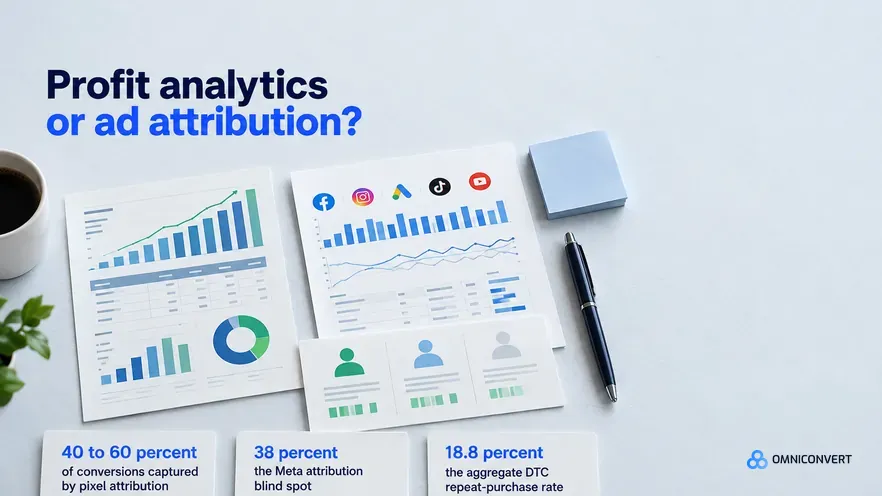
- Lifetimely is a profit and lifetime-value tool (P&L, cohorts, CAC payback); Triple Whale is an attribution and marketing-measurement tool built on its first-party Triple Pixel. The split, not the feature list, decides the fit.
- Pricing models differ: Lifetimely scales with monthly order volume from about $49 with a free plan, while Triple Whale scales with annual GMV from roughly $179 to $219 on 12-month contracts.
- Attribution alone is no longer a complete answer: in 2026 pixels capture only 40 to 60 percent of conversions, so attributed ROAS must be triangulated with cohort and retention data.
- The larger profit lever is retention: a 5 percent lift in retention can raise profits 25 to 95 percent, yet the aggregate DTC repeat-purchase rate sits near 18.8 percent.
- Both tools report profit; neither turns which customers are profitable into ranked action. Omniconvert Commander adds the RFM, predictive CLV, and True-Profit layer on top.
Profit analytics is the practice of measuring what a direct-to-consumer business actually keeps after product cost, fees, shipping, returns, and ad spend, rather than the revenue it books. Lifetimely and Triple Whale are the two tools DTC operators most often weigh against each other for this job, but they answer different questions. Across the CROBenchmark dataset of 7,000+ websites in 15+ industries, brands that steered by profit per customer rather than attributed revenue grew repeat purchase rate measurably faster, drawing on 13 years in conversion rate optimization [CROBenchmark Report 2026, Omniconvert].
This guide compares Lifetimely and Triple Whale on what each is built for, pricing, attribution, lifetime value, and AI, then names the question both leave open: what to do about which customers are profitable. That is the profit-per-customer layer where Omniconvert Commander (formerly Nexus), the AI eCommerce growth engine, adds RFM segmentation and predictive CLV on top of whichever dashboard you run.
Lifetimely vs Triple Whale at a glance
The verdict table below is the short version. Each row is a decision axis, not a feature count, because the two tools are strong at different jobs and a feature-by-feature tally hides that.
| Decision axis | Lifetimely | Triple Whale |
|---|---|---|
| Built for | Profit, LTV, cohorts, P&L | Attribution and marketing measurement |
| Attribution engine | Shopify-based, lighter | First-party Triple Pixel, multi-touch |
| Pricing basis | Monthly order volume | Annual GMV, 12-month terms |
| Entry price | Free plan, then from ~$49/mo | Free dashboard, then ~$179 to $219/mo |
| AI assistant | Profit Agent (retention, upsell) | Moby (conversational, agents) |
| Best fit | Smaller or profit-focused brands | Multi-channel, higher-spend brands |
Read the table as a fork, not a scoreboard. Lifetimely wins the profit-and-lifetime-value column; Triple Whale wins the spend-measurement column. The rest of this article walks each axis, then returns to the one row neither tool fills.
What each tool is actually built for
Lifetimely, owned by AMP since late 2022, is a profit and lifetime-value platform. Its core surfaces are automated profit and loss statements, cohort analysis, LTV by acquisition source, and customer acquisition cost payback. It answers the operator question: are we making money, per customer, over time [useamp, 2026].
Triple Whale is an attribution and marketing-operations platform. Its core is the Triple Pixel, a first-party tracking layer feeding multi-touch attribution, a real-time ad dashboard, and creative analytics. In January 2026 it acquired Anteater, an AI-visibility platform, extending further into commerce intelligence [PR Newswire, 2026]. Its founding question is: which channel earned this sale, and where should the next dollar go.
This difference is not cosmetic. A tool built to answer "which channel gets credit" optimizes toward attributed ROAS; a tool built to answer "did we keep money per customer" optimizes toward margin and retention. As April Dunford argues in her work on positioning, the frame of reference a product is compared against decides which of its strengths the buyer even sees, so naming the real job you are hiring the tool for matters more than matching feature lists.
Pricing: order volume vs GMV
The pricing models are structurally different, which matters more than any single sticker number because they scale on different axes. Figures below are approximate and vary by source, plan, and the billing cycle you choose.
| Plan aspect | Lifetimely | Triple Whale |
|---|---|---|
| Free tier | Yes, plus 14-day trial | Free Founders Dashboard |
| Entry paid plan | From ~$49/mo | From ~$179 to $219/mo |
| Mid / upper tiers | Up to ~$499/mo | Advanced ~$259, Custom from ~$539 |
| Scales with | Monthly order volume | Annual GMV |
| Commitment | Monthly available | 12-month contracts (~17% annual saving) |
The practical read: a low-GMV brand with modest order counts pays little on Lifetimely and can spike into higher Triple Whale tiers purely because revenue, not usage, crossed a GMV threshold. A high-spend brand buying across many paid channels gets more from Triple Whale's attribution and often accepts the GMV model as the cost of that signal. Price the tool against the axis your business actually grows on.
Attribution and tracking
If attribution is the job, Triple Whale is the stronger engine. The Triple Pixel is designed to recover first-party signal that platform pixels lost after iOS privacy changes, and it feeds multi-touch models that Lifetimely's Shopify-based attribution does not attempt. Lifetimely reads channel-level attribution well enough to attach profit to a source, but it is not trying to win the multi-touch argument [useamp, 2026].
The caution applies to both, and to the whole category. Post-iOS, pixel-based attribution commonly captures only 40 to 60 percent of conversions, with Meta blind spots near 38 percent being typical [segwise, 2026]. This is where loss aversion quietly distorts budgets: teams pour effort into recovering the attribution credit they feel they lost, a vivid, painful gap, while under-investing in the larger and safer retention upside. Recovering a few points of attributed ROAS feels urgent; the bigger money is usually in the customers you already have.
That bias has a formal name. Goodhart's Law warns that when a measure becomes a target, it stops being a good measure. Attributed ROAS optimized in isolation is the textbook case: the moment every campaign is tuned to it, it drifts from the thing it was meant to proxy, which is profit. Contribution margin per customer is the harder target to game, which is exactly why it is the better one.
LTV, cohorts, and retention: where the profit signal lives
Lifetimely's home turf is lifetime value and cohorts. It groups customers by the month they first bought and tracks each cohort's value over time, which is the view that reveals whether newer customers are becoming more or less valuable, something a blended all-time average hides entirely. For a profit-analytics buyer, this is the signal that actually predicts the business.
The economics explain why. A 5 percent increase in retention can raise profits by 25 to 95 percent, repeat buyers spend around 67 percent more than first-timers, and acquiring a new customer costs 5 to 25 times more than keeping one [digitalapplied, 2026]. Yet a February 2026 analysis of 156,110 DTC customers found an aggregate repeat-purchase rate of just 18.8 percent, meaning roughly four in five customers buy once and leave, while about 60 percent of DTC revenue comes from returning customers [taylorsicard, 2026].
The DTC brands that plateau at an 18.8 percent repeat-purchase rate consistently share one pattern: they measure attribution obsessively and customer economics barely, so they keep buying first orders from a channel their dashboard credits, without ever designing the second purchase that would make those orders pay. The benchmark gap closes fastest when operators treat profit per customer segment as the primary unit of measurement, not attributed ROAS.
Omniconvert Commander turns cohort and RFM data into a ranked queue, so you act on the segments about to churn before the repeat-rate gap widens.
See how it works →AI features: Moby vs Profit Agent
Triple Whale's Moby is a conversational and increasingly agentic layer over its attribution data: ask it why ROAS dipped, and it reasons across campaigns and creative. The Anteater acquisition points at extending this into AI-driven commerce visibility [PR Newswire, 2026]. Lifetimely's Profit Agent is narrower and aimed squarely at its strength: analyzing retention and upsell opportunities inside the profit model [useamp, 2026].
The ceiling on both is the same: an AI can only reason over the data its tool ingests. A marketing-attribution AI will keep framing growth as a spend-allocation problem; a profit AI will frame it as a margin problem. Neither, by design, owns the cross-cutting question of which specific customers to act on next and in what order.
The question both tools leave open
Here is the row the verdict table could not fill for either tool. Lifetimely tells you a cohort's LTV is sliding; Triple Whale tells you a channel's ROAS is sliding. Neither tells you which 200 customers to win back this week, which segment is one nudge from a second purchase, or which "high-ROAS" audience is actually unprofitable once returns and cost of goods come out. That is a different job: not reporting profit, but acting on it, customer by customer.
Omniconvert Commander is built for that layer. It ingests behavioral and transactional data across the store, applies RFM segmentation and predictive customer lifetime value, and surfaces which segments are growing, at risk, or ready for upsell in real time. It then ranks every opportunity by True Profit, the margin that survives discounts, returns, and cost of goods, so budget targets the customers worth retaining rather than the ones easiest to attribute. It is complementary intelligence, sitting on top of a profit dashboard or an attribution tool, not a drop-in replacement for either.
In our customer value optimization work with ecommerce brands through 2026, we consistently see the top 20 percent of customers by RFM drive the majority of profit, while blended dashboards treat every customer as the same line item [Omniconvert, 2026]. That is the gap the action layer closes.
Case study. AliveCor used Omniconvert to run a structured A/B testing programme and achieved a +21% conversion rate, +5% revenue per visitor, and 94% statistical relevance across their experiments [Omniconvert, AliveCor case study]. The lesson for a profit-analytics buyer is that measurement only pays once it drives a structured sequence of actions, which is the layer that sits above any single dashboard.
Which fits your brand
A decision guide by situation, since the right answer depends on your stage and channel mix:
- Early-stage or profit-first brand: Lifetimely. Order-based pricing, a free plan, and native LTV and P&L answer the question that decides survival: are we profitable per customer.
- Multi-channel, high-spend brand: Triple Whale. The Triple Pixel and multi-touch attribution earn their GMV-based price once you are allocating budget across several paid channels.
- Brand running both tools: Common and sensible, given how little they overlap, attribution on one side and profit economics on the other.
- Any brand stuck on action: Add Omniconvert Commander on top. RFM segments, predictive CLV, and opportunities ranked by True Profit turn either dashboard's report into a prioritized queue of work.
The tool you pick should match the question you are stuck on. But keep the deeper point from the retention data in view: once you can see profit, the lever that moves it most is what you do next, per segment, which is a job that sits above the reporting layer entirely.
Frequently Asked Questions
Lifetimely is purpose-built for profit tracking: profit and loss, lifetime value, cohorts, and CAC payback are its core. Triple Whale adds profit onto a marketing-attribution foundation built around its first-party Triple Pixel. Choose by your bottleneck. If you need to understand customer economics and margin over time, Lifetimely fits. If you need to measure and allocate ad spend across channels, Triple Whale fits. Many brands run both because the overlap is small.
Yes, and many DTC brands do, because the two tools overlap very little. Triple Whale handles attribution and marketing measurement, while Lifetimely handles profit, lifetime value, and cohort retention. Running both gives you spend measurement and customer economics side by side. The gap that remains is action: neither tool turns which customers are profitable into a ranked plan of what to do about it, which is a separate customer-intelligence layer.
Lifetimely starts around $49 a month and scales with monthly order volume, with a free plan and higher tiers toward $499 a month. Triple Whale offers a free Founders Dashboard, then paid plans from roughly $179 to $219 a month, scaling with annual GMV on 12-month contracts. Lifetimely's order-based model usually suits smaller brands, while Triple Whale's GMV-based model suits higher-spend, multi-channel operators.
Lifetimely usually fits smaller or early-stage brands better. Its pricing scales with monthly order volume rather than annual GMV, it has a free plan, and its focus on profit and lifetime value answers the question young brands most need answered: are we making money per customer. Triple Whale's value grows with spend and channel complexity, so its attribution engine pays off once a brand is buying across several paid channels at scale.
Only partly. After iOS privacy changes, pixel-based attribution captures roughly 40 to 60 percent of conversions, and brands commonly see a Meta blind spot near 38 percent. First-party pixels like Triple Whale's recover some of that signal, but no pixel sees everything. The practical response is triangulation: read attribution alongside cohort retention and profit-per-customer data rather than trusting any single attributed-ROAS number on its own.
Omniconvert Commander ingests behavioral and transactional data across your store, applies RFM segmentation and predictive customer lifetime value, and surfaces which segments are growing, at risk, or ready for upsell. It then ranks opportunities by True Profit, not attributed ROAS, so budget targets the customers worth retaining. It complements a profit dashboard like Lifetimely or an attribution tool like Triple Whale by adding the action layer: what to do about which customers are profitable.
The honest tie-breaker is not which dashboard is prettier, it is which question your brand is stuck on. If you cannot see margin and lifetime value, Lifetimely answers that. If you cannot see where spend is working, Triple Whale answers that. But both stop at the report, and the number that actually changes the decision is profit per customer segment, because a 5 percent lift in retention can raise profits 25 to 95 percent while the average DTC brand still sees only 18.8 percent of customers buy again. That is the layer Omniconvert Commander turns into ranked action.
See profit per customer, then act on it with Omniconvert Commander
Omniconvert Commander sits on top of your profit and attribution data, segmenting customers with RFM, predicting lifetime value, and ranking opportunities by True Profit rather than attributed ROAS. Stop reporting which customers are profitable and start acting on it.