AB Smartly vs Webtrends Optimize vs Explore (2026): The Shopify Blind Spot
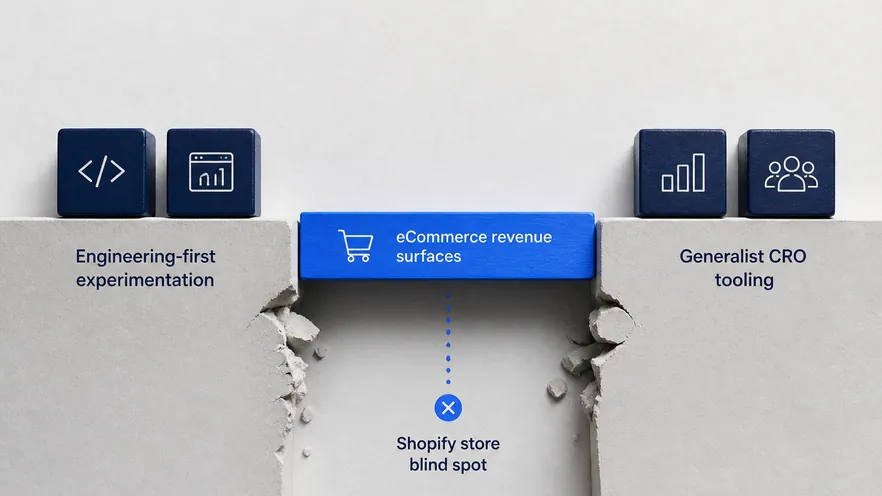
AB Smartly is a developer-first experimentation platform built by former Booking.com engineers for engineering teams running server-side tests through an SDK. Webtrends Optimize is an all-inclusive CRO suite with visual A/B testing, multivariate testing, heatmaps, and personalization. Omniconvert Explore runs product page, cart, and checkout experiments natively on Shopify, measured in revenue per visitor rather than generic conversion rate.
- AB Smartly is a developer-first server-side experimentation platform built by former Booking.com engineers, with a 4.8 out of 5 G2 rating across 45 reviews. [G2, 2026]
- Webtrends Optimize is a top-rated all-inclusive CRO suite with visual testing, multivariate testing, personalization, heatmaps, and session recordings, at 4.8 out of 5 on G2 across 212 reviews. [G2, 2026]
- AB Smartly and Webtrends Optimize sit at opposite ends of the operator spectrum, engineer-led versus marketer-led, and rarely serve the same buyer directly.
- Neither is built around the Shopify checkout or measures results in revenue per visitor, the surfaces and metric where store revenue is actually decided.
- Omniconvert Explore runs experiments on product, cart, and checkout natively and reports the result in revenue per visitor: pick it for the Shopify revenue path.
Teams comparing AB Smartly vs Webtrends Optimize are choosing between two very different testing operators: a developer-first server-side specialist versus a generalist CRO suite. AB Smartly ships an SDK, real-time results, and a data warehouse connector, built by the practitioners behind Booking.com's experimentation program. Webtrends Optimize gives marketers visual A/B testing, multivariate testing, heatmaps, and personalization in one session-based bill. Neither is built around the surfaces where a Shopify store actually wins or loses revenue. This page covers what each does well, the gap they share, and when Omniconvert Explore is the right layer.
What is AB Smartly, and what is it actually good at?
AB Smartly is a developer-first A/B testing and experimentation platform built by former Booking.com engineers. It ships an SDK, real-time experiment results, and a direct data warehouse connector, and it is priced and scoped for engineering-led experimentation programs. [AB Smartly, 2026]
AB Smartly holds a 4.8 out of 5 rating on G2 across 45 reviews. [G2, 2026] It was built by the team who ran Booking.com's experimentation program, and that heritage shows up in the product: heavy emphasis on statistical rigour, real-time results a data team can trust, and direct connections into a data warehouse for post-experiment analysis.
The category AB Smartly sits in is developer-led server-side experimentation at product-team scale. It is designed for engineering organizations that own experimentation as an internal discipline, not for marketers running independent tests on a store. That focus is the point of the product.
Server-side experimentation assigns variants and applies logic on the server before the page is rendered, avoiding flicker and covering flows a client-side script cannot reach: signup, cart, checkout, API responses. AB Smartly is built for this pattern through an SDK and a warehouse connector. It is a rigorous engineering approach, distinct from a marketer opening a visual editor to change a product page and reading the result in revenue per visitor.
Where AB Smartly is genuinely strong
- Practitioner heritage: built by the engineers behind Booking.com's experimentation program, one of the most cited in the industry.
- Real-time results: results update live, not on a batch cycle, so engineering teams can iterate at high velocity.
- Warehouse-grade statistics: advanced statistical methods and a direct data warehouse connector for rigorous downstream analysis.
- Server-side and SDK-first: covers flows the visual layer cannot reach, from signup to API responses, without flicker.
Where AB Smartly hits its ceiling for an eCommerce store
- No visual editor: a marketer cannot open the tool and change a product page without a developer sprint.
- No native Shopify integration: reaching the Shopify catalog or checkout is manual engineering work, not out-of-the-box.
- No native revenue metric: results come as engineering events, not as store-native revenue per visitor outcomes.
- Priced for engineering teams: contact-sales pricing scoped to product-team programs, not to a single store budget.
What is Webtrends Optimize, and what is it actually good at?
Webtrends Optimize is a general-purpose conversion rate optimization platform with A/B testing, multivariate testing, personalization, heatmaps, and session recordings in one product. Pricing is session-based, a free trial is available, and its support scores are consistently cited as a differentiator. [Webtrends Optimize, 2026]
Webtrends Optimize holds the highest G2 rating in the A/B testing category at 4.8 out of 5 across 212 reviews. [G2, 2026] Customer support is consistently rated as a key differentiator, and its all-inclusive session-based pricing is transparent enough that a mid-market team can plan around it.
The category Webtrends sits in is generalist CRO tooling. It combines experiments, behavioral analytics, and personalization in one bill for teams running conversion programs across many pages and channels. That combination is genuinely useful for a marketing team optimizing a broad website; it is not aimed at the store-specific work of testing on the Shopify product page, cart, and checkout.
All-inclusive CRO tooling means one platform bundles the tests, the behavioral analytics that suggest what to test, and the personalization that acts on the result. Webtrends Optimize takes this shape: A/B, multivariate, personalization, heatmaps, and session recordings together in one bill. It is a general-website approach, distinct from an eCommerce CRO platform that runs the experiment on the Shopify checkout and reports the outcome in revenue per visitor.
Where Webtrends Optimize is genuinely strong
- Highest G2 rating in the category: 4.8 out of 5, with support cited as a key differentiator by reviewers.
- Full CRO stack in one bill: A/B, multivariate, personalization, heatmaps, and session recordings together.
- Transparent session-based pricing: predictable costs a mid-market team can plan against, with a free trial available.
- Multi-page and multi-channel scope: capable across broad websites, not just landing or product pages.
Where Webtrends Optimize hits its ceiling for an eCommerce store
- No Shopify checkout templates: integration exists, but the checkout flow is not treated as a purpose-built experiment surface.
- Revenue per visitor is not native: eCommerce measurement must be configured through custom events rather than read off the shelf.
- Smaller eCommerce-first ecosystem: less commonly deployed by store-first teams, and fewer templates for store workflows.
- Broad scope, not store depth: the platform's fluency is general websites, not the product-to-checkout revenue path.
What AB Smartly and Webtrends Optimize cannot do for an eCommerce store
AB Smartly and Webtrends Optimize are built for different jobs, developer-led experimentation and generalist CRO, but they share one gap for a store. Neither is designed around the surfaces where eCommerce revenue is decided, product pages, cart, and checkout, or around the metric that matters there: revenue per visitor.
AB Smartly is engineered for high-velocity server-side testing at product-team scale. It has no native Shopify integration and cannot run product page or checkout experiments through a visual interface accessible to non-technical users. For a Shopify store, that means the growth team is waiting on an engineering sprint before the first experiment ships, and results arrive as engineering events rather than store-native revenue outcomes.
Webtrends Optimize is a general-purpose CRO platform, not specifically designed around eCommerce revenue workflows. It does not have purpose-built Shopify checkout experiment templates or native revenue-per-visitor metrics. Teams using it for a Shopify store get solid A/B testing but must configure eCommerce-specific measurement themselves, from event tracking to reporting.
The two sit at opposite ends of the operator spectrum, one for engineers, one for generalists. They miss the same layer in the middle: a platform built around eCommerce revenue surfaces rather than a generic page or a generic conversion event.
Most experimentation tools optimize the execution of a test on a generic web page. They do not read the Shopify catalog and checkout flow natively, and they do not report the result in revenue per visitor. They also do not answer the Customer Value Optimization question: whether the win holds for repeat, high-value buyers.
That is the layer Omniconvert Explore is built for. For the wider debate behind the developer-versus-marketer testing split, see Has personalization replaced A/B testing?
eCommerce conversion rate optimization (CRO) is the practice of running controlled experiments on the revenue surfaces of an online store, product pages, cart, and checkout, and measuring the result in revenue per visitor and order rate rather than generic conversion rate. Omniconvert Explore is defined as an eCommerce conversion rate optimization platform for product, cart, and checkout experiments, native to Shopify and priced for store traffic.
What neither tool can tell an eCommerce team
- Did the win move revenue and margin. Whether a winning variant raised revenue per visitor and order rate, and held its margin once discounts and returns are counted, not just lifted a click or an engineering event.
- Which surface to test first. Which pages in the funnel (product, cart, checkout) carry the highest revenue impact if tested next, ranked by real store data rather than intuition.
- How it behaves in Shopify checkout. How an experiment interacts with the Shopify catalog, variants, and checkout flow natively, without engineering glue work or custom event schemas.
- Whether it holds for high-value customers. Whether the result holds for repeat, high-CLV buyers, the Customer Value Optimization question, not just first-session visitors on a general page.
Omniconvert benchmarks more than 7,000 eCommerce websites in its CROBenchmark Report 2026, across 248+ audit criteria. The data shows where stores actually lose orders: 99.6% fail to make guest checkout visible and prominent, and 85.1% do not show the full order cost before the final step. [CROBenchmark Report 2026, Omniconvert]
These are checkout-surface problems, the exact surfaces a developer-first SDK and a generalist CRO suite are not built to experiment on. Explore runs the experiment on the store's real revenue surfaces and reports the outcome in revenue per visitor, so the team acts on the number that lands in the bank rather than on a click somewhere upstream.
This is what the title means by Shopify blind spot. A higher click rate or a lifted micro-conversion can leave the bank balance flat; what moves it is order rate and average order value along the product-to-checkout path, read as revenue per visitor. Explore optimizes for that number directly, and because Customer Value Optimization ties each result back to repeat, high-value buyers, the lift it confirms is margin the store keeps rather than traffic it rents. Explore also reaches Shopify-specific levers most testing tools cannot touch, including price testing; see Explore 3.0: pricing testing on Shopify.
AB Smartly vs Webtrends Optimize vs Explore: the capability comparison
Side by side, the three tools serve different layers. AB Smartly gives engineering teams server-side control and warehouse-grade statistics. Webtrends Optimize gives generalists a full CRO suite in one bill. Explore adds native Shopify experiments on the product-to-checkout path, with revenue per visitor as the outcome metric. See A/B testing with Explore for how those experiments run natively on the Shopify funnel.
| Capability | AB Smartly | Webtrends Optimize | Omniconvert Explore |
|---|---|---|---|
| Primary function | Developer-led server-side experimentation | All-inclusive CRO on general websites | eCommerce CRO on product, cart, and checkout |
| A/B testing | Yes SDK only, no visual editor | Yes visual editor and server-side | Yes visual plus code editor |
| Multivariate testing | No | Yes | Yes |
| Server-side testing | Yes warehouse-connected | Yes | Yes |
| Visual editor | No SDK-first only | Yes | Yes |
| On-site surveys and overlays | No not in scope | Partial personalization, not on-site surveys | Yes surveys and overlays built in |
| Built-in behavioral analytics | No engineering events, warehouse-side | Yes heatmaps and session recordings included | Partial surveys and overlays built in, no native heatmaps |
| Shopify integration | Low no native, engineering setup | Medium integration but not checkout-native | Yes native |
| eCommerce focus | Low engineering and product-team scale | Medium general websites, some eCommerce use | High built for store revenue workflows |
| Revenue per visitor measurement | No engineering event metrics | No generic conversion metrics | Yes revenue per visitor and order rate native |
| Pricing model | Custom, contact sales | Session-based, contact sales, free trial | Session-based, built for store traffic, free trial |
| Best for | Engineering and data teams wanting real-time experimentation at scale | Teams wanting all-inclusive CRO tooling in one platform | Shopify and eCommerce teams optimizing for revenue |
| User rating | 4.8 out of 5 (G2, 45 reviews, as of 2026) | 4.8 out of 5 (G2, 212 reviews, as of 2026) | 4.6 out of 5 (G2, 191 reviews, as of 2026) |
AliveCor used Omniconvert Explore to run a structured A/B testing program and achieved +21% conversion rate, +5% revenue per visitor, and 94% statistical relevance across their experiments. [Omniconvert, AliveCor case study]
Competitor ratings, pricing, and plan details reflect publicly listed figures as of 2026 and can change. AB Smartly and Webtrends Optimize both quote pricing on request. Explore uses session-based pricing; see the Omniconvert pricing page for current plans.
Get the full CROBenchmark data behind these stats: 7,000+ websites, 15+ industries, 248+ audit criteria, 100+ CRO experts. See exactly where eCommerce growth teams are losing margin in 2026.
Get the CROBenchmark ReportFrequently Asked Questions
Should you choose Explore over AB Smartly or Webtrends Optimize?
Start with where the order closes. If your engineering team wants server-side rigour at product-team scale, AB Smartly is the specialist. If your marketing team wants an all-inclusive CRO suite for general web pages, Webtrends Optimize is capable. For a Shopify store, run the next test on the product-to-checkout path in Explore, measured in revenue per visitor. The three complement more than they compete: only Explore is built for the checkout.
AB Smartly and Webtrends Optimize are both capable tools in their categories. AB Smartly is the specialist for engineering teams that want real-time server-side experiments backed by warehouse data. Webtrends Optimize is a top-rated all-inclusive CRO suite with visual editing, personalization, heatmaps, and session recordings in one bill. Neither claim is in dispute.
The question for a Shopify store is narrower: can your team run a controlled experiment on the product page, cart, and checkout, and read the result in revenue per visitor rather than a click or an engineering event. That is the surface Explore is built for, and the reason it earns a place alongside, not against, either tool for the right team.
Stop guessing.
Start testing what moves revenue.
Explore runs A/B, multivariate, and personalization experiments on your product pages, cart, and checkout, then measures the outcome in revenue per visitor, not just clicks.
4.6 out of 5 across 191 reviews, G2 , as of 2026