Adobe Target vs Crazy Egg vs Explore (2026): Two Extremes, One Gap
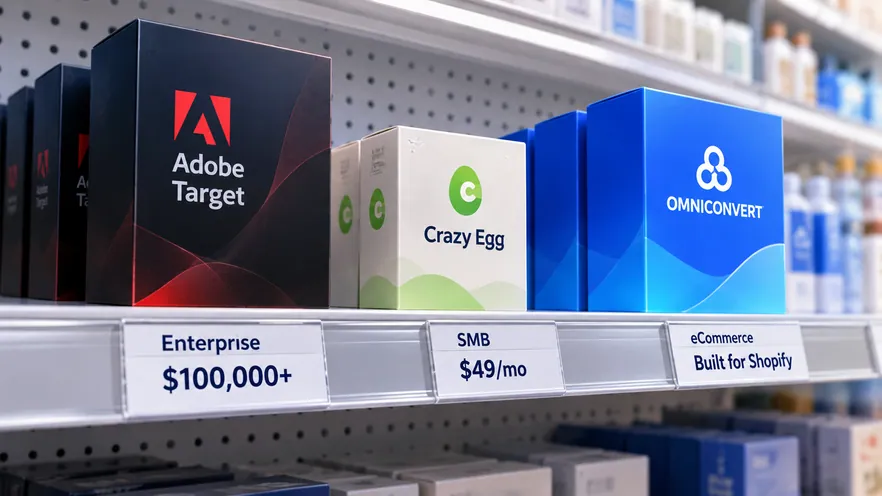
Adobe Target is Adobe's enterprise personalisation and A/B testing platform for organisations running on Adobe Experience Cloud. Crazy Egg is a heatmap and session recording tool with basic two-variant testing. Omniconvert Explore is the Shopify-native eCommerce CRO platform: it runs experiments on product, cart, and checkout, and measures the result in revenue per visitor.
- Adobe Target is Adobe's enterprise personalisation and A/B testing platform, priced for Adobe Experience Cloud customers, 4.2 out of 5 on G2 across 560 reviews. [G2, 2026]
- Crazy Egg is a heatmap and session recording tool with basic two-variant A/B testing from $49 per month, 4.2 out of 5 on G2 across 144 reviews. [G2, 2026]
- The two products sit at opposite ends of the market, enterprise suite and small-business diagnostic, but neither is accessible or complete for a mid-market Shopify store.
- Neither runs native Shopify checkout experiments or measures outcomes in revenue per visitor, the metric that decides store margin.
- Omniconvert Explore runs A/B, multivariate, and personalisation experiments on product, cart, and checkout, measured in revenue per visitor: pick it for a Shopify store.
Teams comparing Adobe Target vs Crazy Egg are usually choosing between two extremes: an enterprise suite on one side, a lightweight heatmap tool on the other. Adobe Target leads with AI personalisation, multivariate testing, and tight integration across Adobe Experience Cloud. Crazy Egg leads with heatmaps, session recordings, and a basic two-variant test at a small-business price. This page covers what each does well, the gap they share for a mid-market store, and when Omniconvert Explore is the right layer.
What is Adobe Target, and what is it actually good at?
Adobe Target is an enterprise personalisation and A/B testing platform inside Adobe Experience Cloud. It supports AI-driven personalisation through Adobe Sensei, multivariate testing, and server-side testing. It is the natural pick for organisations already running Adobe Analytics, Campaign, and Experience Manager. [G2, 2026]
Adobe Target is a testing platform first and a personalisation engine second, and both live inside Adobe's broader ecosystem. It holds a 4.2 out of 5 rating on G2 across 560 reviews. It is priced for enterprise contracts, typically in the six-figure annual range. [G2, 2026]
Its strength is depth of feature and integration with the rest of Adobe. Teams that have already made the Adobe bet get testing, personalisation, and analytics running against one shared identity and audience layer. Implementation usually needs Adobe consulting resources, so the value proposition rests on the wider Adobe commitment.
Enterprise personalisation is real-time content adaptation across a large brand's web, mobile, and email surfaces, driven by a shared identity and audience layer. Adobe Target does this well for organisations running on Adobe Experience Cloud. It is a delivery layer for that stack, distinct from running a controlled revenue experiment on Shopify product, cart, and checkout pages.
Where Adobe Target is genuinely strong
- Enterprise-grade personalisation: real-time content adaptation at organisation scale, tuned to Adobe audiences.
- Adobe Sensei AI: automated personalisation that picks winning experiences per visitor.
- Multivariate and server-side testing: a full experimentation surface, not a light editor tool.
- Deep Adobe integration: shared data with Analytics, Campaign, and Experience Manager as one identity layer.
Where Adobe Target hits its ceiling for an eCommerce store
- Adobe-only value: full value requires the wider Adobe Experience Cloud commitment.
- Six-figure enterprise pricing: not accessible to a mid-market DTC brand on a marketing budget.
- Consulting-led implementation: typically deployed with an Adobe partner, not self-serve.
- No native Shopify integration: no purpose-built product, cart, or checkout experiment templates.
What is Crazy Egg, and what is it actually good at?
Crazy Egg is a heatmap and session recording tool with lightweight A/B testing. It shows where users click, scroll, and engage on a page. It includes a basic two-variant test in every plan at a low entry price, and is accessible to non-technical marketers. [G2, 2026]
Crazy Egg is a behavior analytics tool first and a testing tool second. It holds a 4.2 out of 5 rating on G2 across 144 reviews. Entry pricing starts around $49 per month, with a free trial. [G2, 2026]
The A/B testing it includes is deliberately simple: single-page, two-variant tests. That suits a marketer who wants to try one headline against another. It is not built for a program of experiments across a funnel.
A heatmap aggregates where visitors click, move, and scroll on a page into a visual overlay, so a team can see attention and friction at a glance. Crazy Egg does this well and pairs it with session recordings. It is a diagnosis layer, distinct from running a controlled revenue experiment on product, cart, and checkout pages.
Where Crazy Egg is genuinely strong
- Heatmaps and scroll maps: a clear, visual read on where clicks and attention land.
- Session recordings: watch real sessions to see where users hesitate.
- Low entry price: accessible plans that small businesses can start on quickly.
- Basic A/B testing included: a simple two-variant test in every plan for light experiments.
Where Crazy Egg hits its ceiling for an eCommerce store
- Testing is basic: no multivariate testing, server-side testing, or advanced audience targeting.
- No checkout experiments: it cannot run tests on Shopify product, cart, or checkout flows.
- Analytics first: teams serious about CRO outgrow its experiment features quickly.
- Generic conversion focus: no concept of revenue per visitor as a tested outcome.
What Adobe Target and Crazy Egg cannot do for an eCommerce store
Adobe Target and Crazy Egg sit at opposite ends of the market: enterprise personalisation and small-business heatmaps. They share one gap. Neither is built around the surfaces where a Shopify store wins or loses revenue, product pages, cart, and checkout, or around the metric that decides store margin: revenue per visitor.
Adobe Target is an enterprise platform designed for organisations running personalisation and testing on Adobe Experience Cloud. It is not accessible to a mid-market Shopify brand, and it has no native Shopify integration or self-serve eCommerce templates. Teams outside the Adobe ecosystem cannot use it cost-effectively for eCommerce CRO.
Crazy Egg sits at the other extreme. It is primarily a heatmap and session recording tool, and its A/B testing is limited to simple two-variant tests on single pages. It cannot run experiments on Shopify checkout flows, product pages, or cart sequences, so a team can diagnose problems visually but cannot run the revenue-focused experiments needed to fix them.
The two products sit at opposite ends of the market, but they share one gap. One requires a six-figure Adobe commitment; the other stops at a cheap diagnostic. A mid-market DTC store has budget for neither extreme, and neither optimises against the metric that decides a store's margin: revenue per visitor on the product-to-checkout path. For the wider debate behind acting on behavior data, see Has personalization replaced A/B testing?
Omniconvert Explore is built for this layer. Explore runs A/B, multivariate, and personalisation experiments on the store's real revenue surfaces, exposes them through a marketer-accessible visual editor, and reads the outcome in revenue per visitor and order rate. It sits next to Shopify natively, so a checkout experiment does not need an Adobe consulting engagement or a code-only workaround to launch.
eCommerce conversion rate optimization (CRO) is the practice of running controlled experiments on the revenue surfaces of an online store, product pages, cart, and checkout, and measuring the result in revenue per visitor and order rate rather than generic conversion rate. Omniconvert Explore is defined as an eCommerce conversion rate optimization platform for product, cart, and checkout experiments, native to Shopify and priced for store traffic.
What neither tool can tell an eCommerce team
- Did the win move revenue and margin. Whether a change raised revenue per visitor and order rate, and held its margin once discounts and returns are counted, not just lifted a personalisation KPI or a click.
- Which surface to test first. Which page in the funnel (product, cart, checkout) carries the highest revenue impact if tested next.
- How it behaves in checkout. How an experiment interacts with the Shopify catalog, variants, and checkout flow natively, without engineering glue work or an Adobe partner sprint.
- Whether it holds for valuable customers. Whether the result holds for repeat, high-value buyers, the Customer Value Optimization question, not just first-session visitors.
Omniconvert benchmarks more than 7,000 eCommerce websites in its CROBenchmark Report 2026, across 248+ audit criteria. The data shows where stores actually lose orders: 99.6% fail to make guest checkout prominent, 94.2% never show checkout progress steps, and 85.1% never show the full order cost before the final step. [CROBenchmark Report 2026, Omniconvert]
Adobe Target can personalise a homepage banner across brand surfaces, and Crazy Egg can show a clickmap on the cart page. Neither can run and price the fix on those checkout steps for a Shopify store. That is the surface Explore is built for, read in revenue per visitor, so a lift in a variant is a lift a merchant recognises on the P&L rather than a metric an analyst has to translate.
Adobe Target vs Crazy Egg vs Explore: the capability comparison
Side by side, the three tools sit at very different points in a stack. Adobe Target runs enterprise personalisation across Adobe. Crazy Egg runs heatmaps with a light test. Explore runs A/B, multivariate, and personalisation experiments on the Shopify product-to-checkout path, measured in revenue per visitor. See A/B testing with Explore for how those experiments run natively on the Shopify funnel.
| Capability | Adobe Target | Crazy Egg | Omniconvert Explore |
|---|---|---|---|
| Primary function | Enterprise personalisation and A/B testing on Adobe Experience Cloud | Heatmaps and session recordings with basic A/B testing | eCommerce CRO on product, cart, and checkout |
| A/B testing | Yes visual editor and full-stack in Adobe | Partial basic two-variant, single page | Yes visual plus code editor, Shopify-native |
| Multivariate testing | Yes | No | Yes |
| Server-side testing | Yes | No | Yes |
| Visual editor | Yes | No | Yes |
| On-site surveys and overlays | Partial personalisation delivery, no dedicated survey suite | No heatmaps and recordings only | Yes surveys and overlays built in |
| Shopify integration | Medium installable, no native store templates | Medium installs but no checkout testing | Yes native |
| eCommerce focus | Medium enterprise scope, not store-first | Low small-business diagnostics | High built for store revenue workflows |
| Revenue per visitor measurement | No session and personalisation KPIs | No behavioral metrics only | Yes revenue per visitor and order rate native |
| Pricing model | Custom enterprise, contact sales | Session-based, from $49/mo, free trial | Session-based, built for store traffic, free trial |
| Best for | Enterprise brands on Adobe Experience Cloud | Small teams wanting heatmaps and light tests | Shopify and eCommerce teams optimizing for revenue |
| User rating | 4.2 out of 5 (G2, 560 reviews, as of 2026) | 4.2 out of 5 (G2, 144 reviews, as of 2026) | 4.6 out of 5 (G2, 191 reviews, as of 2026) |
AliveCor used Omniconvert Explore to run a structured A/B testing program and achieved +21% conversion rate, +5% revenue per visitor, and 94% statistical relevance across their experiments. [Omniconvert, AliveCor case study]
Competitor ratings, pricing, and plan details reflect publicly listed figures as of 2026 and can change. Adobe Target pricing is enterprise-only and quoted per contract; Crazy Egg plans start at a low entry price for small teams. Explore uses session-based pricing; see the Omniconvert pricing page for current plans.
Get the full CROBenchmark data behind these stats: 7,000+ websites, 15+ industries, 248+ audit criteria, 100+ CRO experts. See exactly where eCommerce growth teams are losing margin in 2026.
Get the CROBenchmark ReportFrequently Asked Questions
Should you choose Explore over Adobe Target or Crazy Egg?
Decide by scale and surface. If you run an Adobe-committed enterprise and already pay for the stack, Adobe Target is a reasonable pick. If you only need light heatmaps and a cheap starter test, Crazy Egg fits. But most Shopify stores sit between those extremes: priced out of Adobe and outgrown by Crazy Egg. For a mid-market store, run your next test on the Shopify funnel in Explore, measured in revenue per visitor.
Adobe Target and Crazy Egg are both capable tools inside their own markets. Adobe Target is a serious enterprise testing and personalisation suite for brands already running Adobe Experience Cloud. Crazy Egg is a well-priced heatmap and recording tool with a light test for small teams.
The question for a Shopify store is narrower: once you can see where shoppers struggle, can you run a controlled experiment on the product, cart, and checkout and read the result in revenue per visitor, without a six-figure Adobe contract or the ceiling of a two-variant single-page test. That is the surface Explore is built for.
Stop guessing.
Start testing what moves revenue.
Explore runs A/B, multivariate, and personalization experiments on your product pages, cart, and checkout, then measures the outcome in revenue per visitor, not just clicks.
4.6 out of 5 across 191 reviews, G2 , as of 2026