Adobe Target vs Croct vs Explore (2026): Scale or Code, Not Shopify
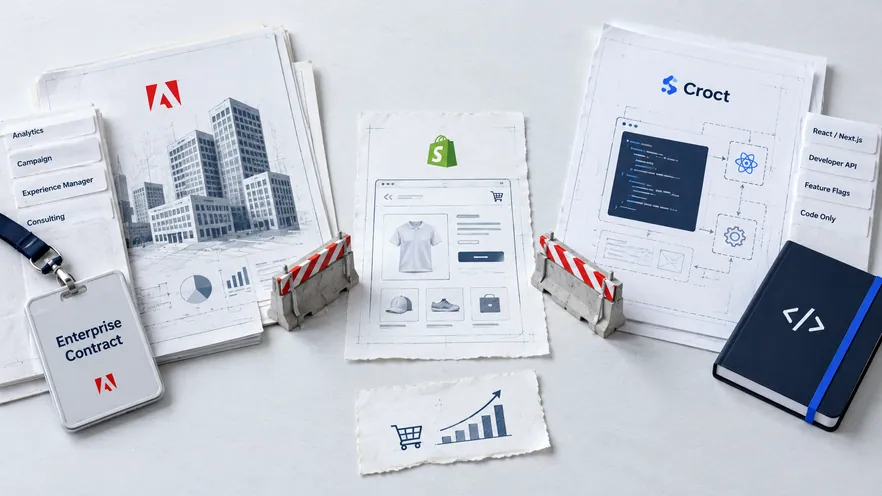
Adobe Target is an enterprise A/B testing and personalisation platform inside Adobe Experience Cloud, priced for six-figure contracts. Croct is a React and Next.js personalisation platform for engineering teams, with no visual editor and no Shopify Liquid support. Neither is Shopify-native. Omniconvert Explore is the eCommerce CRO platform for product, cart, and checkout, measured in revenue per visitor.
- Adobe Target is an enterprise A/B testing and personalisation platform inside Adobe Experience Cloud, with a 4.1 out of 5 G2 rating across 71 reviews. [G2, 2026]
- Croct is a React and Next.js personalisation and A/B testing platform for engineering teams, with a 4.7 out of 5 G2 rating across 47 reviews. [G2, 2026]
- The two sit at opposite ends of the market: Adobe Target is enterprise-priced and Adobe-ecosystem-locked; Croct is React-only and developer-owned.
- Neither works for a classic Shopify Liquid store with a marketer-accessible visual editor, and neither reports outcomes in revenue per visitor.
- Omniconvert Explore is a Shopify-native eCommerce CRO platform: it runs A/B, multivariate, and checkout experiments through a visual editor and measures the result in revenue per visitor.
Teams comparing Adobe Target vs Croct are choosing between two very different testing platforms built for two very different buyers. Adobe Target is enterprise-first: a visual editor, multivariate testing, and Adobe Sensei personalisation inside Adobe Experience Cloud, priced in six-figure contracts. Croct is developer-first: component-level personalisation and A/B testing for React and Next.js applications, with no visual editor and no support for standard Shopify Liquid themes. This page covers what each does well, the Shopify gap they share, and when Omniconvert Explore is the right layer for a mid-market store.
What is Adobe Target, and what is it actually good at?
Adobe Target is an enterprise A/B testing and personalisation platform inside Adobe Experience Cloud. It combines a visual editor, full-stack server-side testing, multivariate testing, and Adobe Sensei-powered automated personalisation, wired into Analytics, Campaign, and Experience Manager. It is the natural pick for organisations already committed to the Adobe stack. [Adobe Target, 2026]
Adobe Target is one of the most powerful testing and personalisation platforms available for enterprise use. It holds a 4.1 out of 5 rating on G2 across 71 reviews. [G2, 2026] Its strength is depth inside an ecosystem: Sensei-driven Automated Personalisation and Auto-Target pick a winning variant per audience segment, and every experiment can share definitions with Adobe Analytics and Adobe Audience Manager.
Full-stack server-side testing sits alongside the visual editor, so both marketing and engineering can ship variants from the same platform. Pricing is custom and typically lands in the six-figure annual range, and implementation runs through Adobe consulting or a certified partner.
Enterprise personalisation is the practice of tailoring experiences per audience segment at scale, coordinated across analytics, campaign, and content platforms. Adobe Target does this well inside Adobe Experience Cloud, with Sensei-powered variant selection. It is an enterprise personalisation and testing suite, distinct from running a controlled revenue experiment on Shopify product, cart, and checkout pages without an ecosystem contract or a consulting engagement.
Where Adobe Target is genuinely strong
- Adobe Sensei personalisation: AI-driven Automated Personalisation and Auto-Target pick the winning variant per audience segment.
- Deep Experience Cloud integration: shared audiences and metrics with Adobe Analytics, Campaign, and Experience Manager.
- Full-stack testing: server-side and client-side experiments in one platform, with a visual editor for marketers.
- Multivariate testing: tests multiple element combinations in a single experiment, native to the platform.
Where Adobe Target hits its ceiling for an eCommerce store
- Requires the Adobe stack: most of the value depends on Adobe Analytics, Campaign, and other Experience Cloud modules.
- Six-figure contracts: custom pricing designed for enterprise buyers, not a mid-market Shopify budget.
- Consulting-led implementation: Adobe partner or in-house consulting is effectively required to launch and run the programme.
- No native Shopify connector: product, cart, and checkout have to be wired up as custom implementations rather than as store-native templates.
- Generic outcome model: no concept of revenue per visitor as a first-class metric on the store funnel.
What is Croct, and what is it actually good at?
Croct is a personalisation and A/B testing platform built specifically for React and Next.js applications. It integrates at the component level with a developer-first API, supports feature flags alongside testing, and is popular with headless eCommerce teams. Every experiment is configured in code. [G2, 2026]
Croct holds a 4.7 out of 5 rating on G2 across 47 reviews, a small sample that reflects its narrow React/Next.js footprint. [G2, 2026] Its strength is the fit with a modern React stack: variants are component-level swaps, so a frontend engineer adds a test where they already work, without a separate delivery layer or tag manager.
Its category is React-native personalisation and testing. Variants are driven through a developer API, feature flags share the same model as experiments, and a free tier lets a team validate the fit before committing to usage-based pricing. That focus is what draws headless eCommerce teams building on Next.js.
Component-level testing wraps a React or Next.js component so a variant can be swapped inside the rendered component tree, driven by a developer-first API. Croct does this for React applications. It is a delivery model for frontend engineers on a headless stack, distinct from a marketer-accessible visual test on a standard Shopify Liquid theme.
Where Croct is genuinely strong
- Native to React and Next.js: tests and personalisation live inside the component tree where engineers already work.
- Developer-first API: a clean interface for frontend engineers, without a heavy tag or delivery layer.
- Testing plus feature flags: variants and rollouts share one model, which suits a headless deployment workflow.
- Free tier for exploration: teams can validate the fit before committing to usage-based pricing.
Where Croct hits its ceiling for a Shopify store
- Requires React or Next.js: it cannot run on standard Shopify Liquid themes without a headless rebuild.
- No visual editor: every experiment is configured in code, so marketing teams cannot ship a test alone.
- No multivariate testing: the platform focuses on A/B and personalisation rather than combinatorial variants.
- Narrow stack coverage: non-React applications and classic Shopify stores are outside the supported surface.
- Generic outcome model: results are read as component-level metrics, not revenue per visitor.
What Adobe Target and Croct cannot do for an eCommerce store
Adobe Target and Croct come at experimentation from opposite ends. One is enterprise-priced and Adobe-locked; the other is React-only and developer-owned. Neither is built around standard Shopify product, cart, and checkout, and neither reports the result in revenue per visitor.
Adobe Target is an enterprise platform designed for organisations running personalisation and testing within Adobe Experience Cloud. It is not accessible to mid-market Shopify brands and has no native Shopify integration or self-serve eCommerce experiment templates. Teams outside the Adobe ecosystem cannot use it cost-effectively for eCommerce CRO.
Croct is built for React and Next.js developers and cannot be used on standard Shopify Liquid themes without significant development work. It has no visual editor and every experiment ships through code. Teams running a classic Shopify store cannot use Croct without migrating to a headless architecture first.
The gap they share is the same one. Both are generic testing platforms at opposite ends of the market: one enterprise-priced with an Adobe consulting dependency, one React-priced with an engineering dependency. Neither treats the product-to-checkout path as the primary surface, and neither reports the result in revenue per visitor. For the wider context on how testing programmes actually move revenue, see Has personalization replaced A/B testing?
Beneath the different price points and interfaces, the ownership problem is identical: the person who owns the store's revenue number cannot self-serve either tool. Adobe Target routes through a consulting engagement and a segment strategist; Croct routes through a React engineering ticket. Omniconvert Explore collapses the loop: a visual editor for product page and checkout variants, native Shopify integration, on-site surveys and overlays in the same platform, and the outcome measured in revenue per visitor. The person who owns the store's growth number owns the test.
eCommerce conversion rate optimization (CRO) is the practice of running controlled experiments on the revenue surfaces of an online store, product pages, cart, and checkout, and measuring the result in revenue per visitor and order rate rather than generic conversion rate. Explore is defined as an eCommerce conversion rate optimization platform for product, cart, and checkout experiments, native to Shopify and priced for store traffic.
What neither tool can tell an eCommerce team
- Did the win move revenue and margin. Whether a variant raised revenue per visitor and order rate, and held its margin once discounts and returns are counted, not just moved a click or a component-level metric.
- Which surface to test first. Which pages in the store funnel (product, cart, checkout) carry the highest revenue impact if tested next.
- How it behaves in checkout. How an experiment interacts with the Shopify catalog, variants, and checkout flow natively, without an Adobe consulting implementation or a React rebuild.
- Whether it holds for valuable customers. Whether the result holds for repeat, high-value customers, the Customer Value Optimization question, not just for first-session visitors or a Sensei-picked segment.
Omniconvert benchmarks more than 7,000 eCommerce websites in its CROBenchmark Report 2026, across 248+ audit criteria. The findings show where stores actually lose orders: 94.2% do not show checkout progress, and 99.6% fail to make guest checkout prominent. [CROBenchmark Report 2026, Omniconvert]
Those are fixes a CRO lead can hypothesise, mock up, and want to test today. In Adobe Target the same fix is a custom implementation gated by an Experience Cloud contract and a consulting engagement. In Croct the fix is a React component story, deployable only once the store has already moved off a classic Liquid theme. Explore runs the experiment on the real revenue surfaces and reports the outcome in revenue per visitor, without an enterprise contract or a headless rebuild between the hypothesis and the result.
This is what the title means by scale or code, not Shopify. Two capable testing tools, at opposite ends of the market, and both looking past the surface where a store's revenue is actually decided. Explore optimizes for revenue per visitor directly, and because Customer Value Optimization ties each result back to repeat, high-value buyers, the lift it confirms is margin the store keeps rather than traffic it rents. Explore also reaches Shopify-specific levers most generic testing tools cannot touch, including price testing; see Explore 3.0: pricing testing on Shopify.
Adobe Target vs Croct vs Explore: the capability comparison
Side by side, the three tools sit at different points on the experiment lifecycle. Adobe Target is the enterprise personalisation layer for organisations committed to Adobe Experience Cloud. Croct is the React-native testing layer for headless engineering teams. Explore is the eCommerce CRO layer for the store team that owns product, cart, and checkout, and is judged on revenue per visitor. See A/B testing with Explore for how those experiments run natively on the Shopify funnel.
| Capability | Adobe Target | Croct | Omniconvert Explore |
|---|---|---|---|
| Primary function | Enterprise personalisation and A/B testing inside Adobe Experience Cloud | Component-level A/B testing and personalisation for React and Next.js | eCommerce CRO on product, cart, and checkout |
| A/B testing | Yes visual editor and full-stack | Yes React component-level, no visual editor | Yes visual editor plus code |
| Multivariate testing | Yes | No | Yes |
| Server-side testing | Yes full-stack, inside Adobe stack | Yes server-side on React/Next.js | Yes |
| Visual editor | Yes mature Adobe editor | No code and APIs only | Yes WYSIWYG for marketers |
| On-site surveys and overlays | Partial personalisation, no native survey tool | No | Yes surveys and overlays built in |
| Shopify integration | Medium possible via custom implementation, not native | Medium only on headless Next.js, not classic Shopify | Yes native |
| eCommerce focus | Medium enterprise-oriented, not store-native | Low built for React developers | High built for store revenue workflows |
| Pricing model | Custom enterprise, typically six figures annually, no free trial | Usage-based, free tier available, no fixed starting price listed | Session-based, built for store traffic, free trial |
| Best for | Enterprises committed to Adobe Experience Cloud personalisation | Frontend engineering teams building React or Next.js eCommerce apps | Shopify and eCommerce teams optimizing for revenue |
| User rating | 4.1 out of 5 (G2, 71 reviews, as of 2026) | 4.7 out of 5 (G2, 47 reviews, as of 2026) | 4.6 out of 5 (G2, 197 reviews, as of 2026) |
AliveCor used Explore to run a structured A/B testing program and achieved +21% conversion rate, +5% revenue per visitor, and 94% statistical relevance across their experiments. [Omniconvert, AliveCor case study]
Competitor ratings, pricing, and plan details reflect publicly listed figures as of 2026 and can change. Adobe Target is enterprise-priced and tied to Adobe Experience Cloud. Croct is React/Next.js-only and developer-owned. Explore uses session-based pricing; see the Omniconvert pricing page for current plans.
Get the full CROBenchmark data behind these stats: 7,000+ websites, 15+ industries, 248+ audit criteria, 100+ CRO experts. See exactly where eCommerce growth teams are losing margin in 2026.
Get the CROBenchmark ReportFrequently Asked Questions
Should you choose Explore over Adobe Target or Croct?
Decide by scale and by stack. If your enterprise is committed to Adobe Experience Cloud and can absorb a six-figure contract with implementation consulting, Adobe Target fits that stack. If your engineering team is building a headless React or Next.js store and wants component-level personalisation, Croct serves them well. For a standard Shopify store where product, cart, and checkout decide revenue, run your next test in Explore and measure the outcome in revenue per visitor, not clicks.
Adobe Target and Croct are both strong at what they do. Adobe Target brings deep personalisation and multivariate testing inside Adobe Experience Cloud, powered by Sensei and coordinated with Analytics, Campaign, and Experience Manager for organisations already running on that stack. Croct brings component-level personalisation and A/B testing inside React and Next.js applications, with a developer-first API that suits frontend engineers on a headless build.
The question for a classic Shopify store is narrower: once you have a hypothesis about the cart or checkout, can a CRO lead ship the variant, measure the result in revenue per visitor, and answer whether the win holds for high-value repeat customers, without a six-figure Adobe contract or a headless rebuild. That is the surface Explore is built for.
Stop guessing.
Start testing what moves revenue.
Explore runs A/B, multivariate, and personalization experiments on your product pages, cart, and checkout, then measures the outcome in revenue per visitor, not just clicks.
4.6 out of 5 across 197 reviews, G2 , as of 2026