Adobe Target vs Dynamic Yield vs Explore (2026): Enterprise or Store CRO
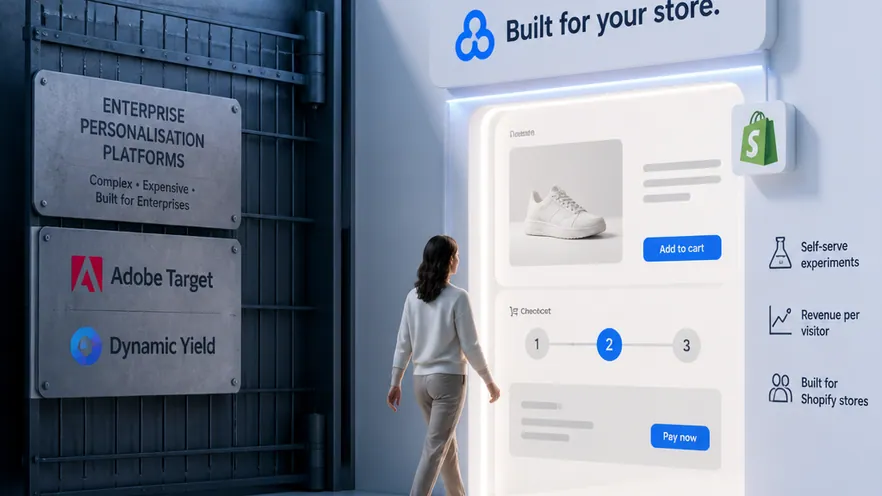
Adobe Target is an enterprise personalisation and A/B testing platform inside the Adobe Experience Cloud. Dynamic Yield is an enterprise personalisation engine used by large retailers like IKEA and McDonald's. Both are priced and built for enterprise contracts. Omniconvert Explore is the Shopify-native eCommerce CRO platform, accessible to mid-market stores, measuring results in revenue per visitor.
- Adobe Target is an enterprise A/B testing and personalisation platform inside the Adobe Experience Cloud, with a 4.2 out of 5 G2 rating across 560 reviews. [G2, 2026]
- Dynamic Yield is an enterprise personalisation and recommendations engine owned by Mastercard, with a 4.5 out of 5 G2 rating across 200 reviews. [G2, 2026]
- Both are custom-priced enterprise contracts with heavy implementation: six-figure budgets and dedicated teams are the norm.
- Neither is self-serve for a mid-market Shopify brand, and neither is packaged around native Shopify checkout experiments measured in revenue per visitor.
- Omniconvert Explore is the Shopify-native eCommerce CRO platform for mid-market stores, with session-based pricing and outcomes measured in revenue per visitor and order rate.
Teams comparing Adobe Target vs Dynamic Yield are usually enterprise organisations choosing a personalisation and A/B testing platform to run at scale. Adobe Target leans on the Adobe Experience Cloud and its Sensei AI. Dynamic Yield leans on its recommendation engine and its Mastercard-owned data stack. Both are strong inside their intended fit, but neither is accessible to a mid-market Shopify brand without a six-figure contract and a dedicated implementation team. This page covers what each does well, the gap they share, and when Omniconvert Explore is the right layer.
What is Adobe Target, and what is it actually good at?
Adobe Target is an enterprise A/B testing and personalisation platform inside the Adobe Experience Cloud. It supports visual and full-stack testing, multivariate and server-side experiments, and Sensei-driven automated personalisation. It suits large organisations already committed to the Adobe stack. [Adobe, 2026]
Adobe Target's core strength is its integration with Adobe Analytics, Campaign, and Experience Manager, which makes it the natural pick for teams already invested in the Adobe Experience Cloud. It holds a 4.2 out of 5 rating on G2 across 560 reviews. [G2, 2026] Sensei's automated personalisation can serve tailored experiences at scale across web, mobile, and email.
Pricing is custom and typically lands in the six-figure annual range, and most implementations pull in Adobe consulting resources. That posture fits a large enterprise buyer, not a mid-market store choosing tools on a growth budget.
Enterprise personalisation is the practice of serving individually tailored content at scale, driven by a unified customer profile and machine learning, typically deployed by large brands with a customer data platform and a dedicated technology team. Adobe Target delivers this inside the Adobe Experience Cloud. It is an execution and delivery layer, distinct from running a controlled revenue experiment on a Shopify product, cart, and checkout.
Where Adobe Target is genuinely strong
- AI personalisation via Sensei: automated targeting that scales across web, mobile, and email.
- Multivariate and server-side testing: full experimentation depth for enterprise engineering teams.
- Deep Adobe Experience Cloud integration: shared audiences, analytics, and content with the rest of the Adobe stack.
- Enterprise governance and support: role management, SLAs, and consulting fit large-org compliance needs.
Where Adobe Target hits its ceiling for an eCommerce store
- Requires the Adobe Experience Cloud: the value depends on Analytics, Campaign, and AEM sitting alongside it.
- Priced for six-figure contracts: cost-prohibitive for mid-market Shopify brands under $50M ARR.
- No native Shopify integration: connecting to a store catalog and checkout takes engineering glue.
- No self-serve eCommerce templates: no purpose-built experiments for product page, cart, or checkout.
What is Dynamic Yield, and what is it actually good at?
Dynamic Yield is an enterprise personalisation and A/B testing platform owned by Mastercard since 2022, used by major retailers including IKEA and McDonald's. It supports product recommendations, experience optimisation, and testing across web, mobile, and email. It holds a 4.5 out of 5 G2 rating across 200 reviews. [G2, 2026]
Dynamic Yield's core strength is real-time personalisation tied to customer data at retail scale. Its recommendation engine, experience APIs, and multivariate testing suit brands running dedicated personalisation programs on large catalogs. The Mastercard acquisition brought additional payment and behaviour data resources for retail applications.
Pricing is custom and typically starts in the five-figure annual range, with implementations that need a dedicated internal team. That fits an enterprise retail buyer, not a mid-market Shopify store looking for self-serve CRO.
A recommendation engine surfaces products or content to individual visitors based on behaviour, catalog signals, and machine-learned intent. Dynamic Yield's engine is one of the most mature in retail. It is an execution and delivery layer, distinct from running a controlled revenue experiment on the Shopify product, cart, and checkout surfaces.
Where Dynamic Yield is genuinely strong
- Recommendation engine: mature product recommendations tuned for retail catalogs.
- Cross-channel personalisation: a single engine serving web, mobile, and email.
- Enterprise retail scale: proven at IKEA, McDonald's, and other high-traffic brands.
- Mastercard-linked data resources: additional signals for large retail personalisation programs.
Where Dynamic Yield hits its ceiling for an eCommerce store
- Enterprise pricing: custom contracts, typically five to six figures annually.
- High implementation effort: setup and integration expects a dedicated internal team.
- Not self-serve for mid-market Shopify: a growth lead cannot spin up a checkout test in a week.
- Over-specified for straightforward testing: a heavy stack for teams that mainly need A/B on the funnel.
What Adobe Target and Dynamic Yield cannot do for an eCommerce store
Adobe Target and Dynamic Yield are both enterprise personalisation platforms built for large organisations with dedicated teams. They share the same gap for a mid-market Shopify store: neither is priced, packaged, or self-serve enough for a growth team to run its own product-page and checkout experiments without a six-figure contract and an implementation project.
Adobe Target is designed for organisations running personalisation and testing inside the Adobe Experience Cloud. It is not accessible to mid-market Shopify brands, and it has no native Shopify integration or self-serve eCommerce experiment templates. Teams outside the Adobe ecosystem cannot use it cost-effectively for eCommerce CRO.
Dynamic Yield is built for large retail organisations with dedicated personalisation teams. It is not designed for mid-market Shopify brands running self-serve CRO experiments. The implementation complexity and pricing put it out of reach for eCommerce teams that need to test on product pages and checkout flows without a six-figure contract and a developer team.
The shared pattern is that both are enterprise procurement products, not self-serve testing tools. A mid-market Shopify brand doing $1M to $50M in ARR does not have the budget cycle, the contracting timeline, or the dedicated implementation team either one expects. That is the layer Omniconvert Explore is built for: eCommerce experimentation and personalization priced and packaged for a store, with native Shopify integration and outcomes measured in revenue per visitor. For the framing that connects testing to customer value, see Has personalization replaced A/B testing?
eCommerce conversion rate optimization (CRO) is the practice of running controlled experiments on the revenue surfaces of an online store, product pages, cart, and checkout, and measuring the result in revenue per visitor and order rate rather than generic conversion rate. Omniconvert Explore is defined as an eCommerce conversion rate optimization platform for product, cart, and checkout experiments, native to Shopify and priced for store traffic.
What neither tool can give a mid-market Shopify team
- A self-serve test without procurement. A growth lead cannot buy either tool on a growth budget or launch a checkout experiment without a formal contracting cycle and an implementation partner.
- Native Shopify experimentation. Neither ships with a Shopify-native connection to the catalog, variants, and checkout flow; connecting the store takes engineering work in both cases.
- Revenue-per-visitor outcomes on the store funnel. Both report personalisation and testing metrics that skew to click and engagement lifts rather than order rate and revenue per visitor on the product-to-checkout path.
- A result that holds for high-value repeat customers. Neither is framed around the Customer Value Optimization question, whether a variant protects margin from repeat, high-CLV buyers, rather than one-off first-session traffic.
Omniconvert benchmarks more than 7,000 eCommerce websites in its CROBenchmark Report 2026, across 248+ audit criteria. The data shows where stores actually lose orders: 99.6% fail to make guest checkout visible and prominent, 94.2% never show checkout progress, and 85.1% never show the full order cost before the final step. [CROBenchmark Report 2026, Omniconvert]
An enterprise personalisation engine can rank the right product for the right visitor, but it does not tell a Shopify store which of those checkout defects is bleeding orders this quarter or price the fix in revenue per visitor. Explore runs the experiment on the store's real revenue surfaces and reports the outcome in revenue per visitor and order rate.
This is what the title means by enterprise or store CRO. Adobe Target and Dynamic Yield are built to serve the largest brands, tightly coupled to a broader Adobe or retail data stack, and they earn their price at that scale. For a mid-market Shopify store, the operative question is narrower: can a growth lead ship a controlled test on the product-to-checkout path this week, read the result in revenue per visitor, and confirm the lift holds for high-CLV buyers. Explore is built for that operating cadence, with native Shopify hooks and session-based pricing that matches store traffic rather than enterprise procurement. See A/B testing with Explore for how experiments run natively on the Shopify funnel, including Shopify price testing.
Adobe Target vs Dynamic Yield vs Explore: the capability comparison
Side by side, the three tools sit at different points on the enterprise-to-store axis. Adobe Target is the Adobe Experience Cloud testing and personalisation layer. Dynamic Yield is the enterprise retail personalisation engine. Explore adds native Shopify experiments and revenue-per-visitor measurement, priced and packaged for a mid-market store.
| Capability | Adobe Target | Dynamic Yield | Omniconvert Explore |
|---|---|---|---|
| Primary function | Enterprise personalisation and A/B testing in Adobe Experience Cloud | Enterprise personalisation and recommendations at retail scale | eCommerce CRO on product, cart, and checkout |
| A/B testing | Yes visual and full-stack, Adobe ecosystem | Yes visual editor and personalisation engine | Yes visual plus code editor |
| Multivariate testing | Yes | Yes | Yes |
| Server-side testing | Yes | Yes | Yes |
| Visual editor | Yes | Yes | Yes |
| On-site surveys and overlays | Partial overlays yes, no native surveys | Partial overlays yes, no native surveys | Yes surveys and overlays built in |
| Shopify integration | Medium not native, needs engineering | High connector available, but heavy setup | Yes native |
| eCommerce focus | Medium general enterprise, not store-first | High built for enterprise retail | High built for mid-market store revenue |
| Pricing model | Custom enterprise, six-figure annual, contact sales | Custom enterprise, five to six figures, contact sales | Session-based, built for store traffic, free trial |
| Best for | Enterprise Adobe Experience Cloud teams | Enterprise retail personalisation teams | Mid-market Shopify and eCommerce growth teams |
| User rating | 4.2 out of 5 (G2, 560 reviews, as of 2026) | 4.5 out of 5 (G2, 200 reviews, as of 2026) | 4.6 out of 5 (G2, 191 reviews, as of 2026) |
AliveCor used Omniconvert Explore to run a structured A/B testing program and achieved +21% conversion rate, +5% revenue per visitor, and 94% statistical relevance across their experiments. [Omniconvert, AliveCor case study]
Competitor ratings, pricing, and plan details reflect publicly listed figures as of 2026 and can change. Adobe Target and Dynamic Yield both publish custom pricing with contact-sales models; typical contract ranges reflect market observation, not published rate cards. Explore uses session-based pricing; see the Omniconvert pricing page for current plans.
Get the full CROBenchmark data behind these stats: 7,000+ websites, 15+ industries, 248+ audit criteria, 100+ CRO experts. See exactly where eCommerce growth teams are losing margin in 2026.
Get the CROBenchmark ReportFrequently Asked Questions
Should you choose Explore over Adobe Target or Dynamic Yield?
Decide by whether you are enterprise or mid-market. If you are already committed to Adobe Experience Cloud, Adobe Target belongs on the stack. If you run a large retail personalisation program with a dedicated team, Dynamic Yield fits. But for a mid-market Shopify store, book Explore for your next test on the product-to-checkout path, measured in revenue per visitor and priced for store traffic, not enterprise procurement.
Adobe Target and Dynamic Yield are both strong enterprise platforms inside their intended fit. Adobe Target compounds value with the rest of Adobe Experience Cloud. Dynamic Yield ships a mature recommendations engine used at retail scale. Neither is designed, priced, or packaged for a mid-market Shopify brand doing $1M to $50M in ARR.
The question for a store is narrower: can a growth lead ship a controlled experiment on the Shopify product, cart, and checkout this week and read the result in revenue per visitor. That is the surface Explore is built for, natively on Shopify, with session-based pricing that matches store traffic rather than an enterprise procurement cycle.
Stop guessing.
Start testing what moves revenue.
Explore runs A/B, multivariate, and personalization experiments on your product pages, cart, and checkout, then measures the outcome in revenue per visitor, not just clicks.
4.6 out of 5 across 191 reviews, G2 , as of 2026