Adobe Target vs VWO Testing vs Explore (2026): Enterprise vs Shopify
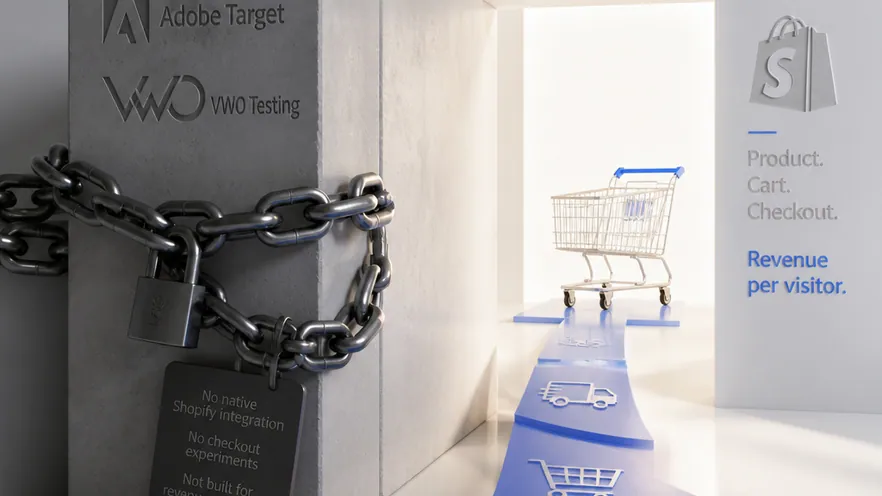
Adobe Target is Adobe's enterprise personalisation and testing platform, native to the Adobe Experience Cloud and priced for six-figure contracts. VWO Testing is a broad web A/B testing platform with heatmaps, recordings, and MTU-based pricing. Omniconvert Explore is the Shopify-native eCommerce CRO platform: it runs product, cart, and checkout experiments measured in revenue per visitor.
- Adobe Target is Adobe's enterprise personalisation and A/B testing platform, native to the Adobe Experience Cloud and priced for six-figure contracts, and holds a 4.2 out of 5 G2 rating. [G2, 2026]
- VWO Testing is a broad web A/B testing platform with a mature visual editor, heatmaps, and recordings, priced on unique visitors from $314/mo (Pro from $972/mo), and holds a 4.4 out of 5 G2 rating. [G2, 2026]
- The two tools sit at opposite ends of the testing spectrum: Adobe Target is enterprise Adobe-stack personalisation; VWO is a general-purpose web tester for marketing and product teams.
- Neither has native Shopify integration, native checkout experiment templates, or revenue per visitor as a native metric, which is where a store's revenue is actually decided.
- Omniconvert Explore runs A/B, multivariate, and personalisation experiments natively on Shopify product, cart, and checkout, measured in revenue per visitor: pick it when the goal is store revenue, not an enterprise personalisation programme or a generic web test.
Teams comparing Adobe Target vs VWO Testing are usually choosing between two different testing profiles: one Adobe-stack enterprise personalisation, the other a broad, marketing-friendly web experimentation tool. Adobe Target leads with AI-driven personalisation through Adobe Sensei and deep Adobe Experience Cloud integration. VWO Testing leads with a mature visual editor, heatmaps, and recordings in a single platform that scales on unique visitors. Both are credible testing platforms, but neither is built around the surfaces where a Shopify store wins or loses revenue: the product page, the cart, and the checkout, which is what Omniconvert Explore is built for.
What is Adobe Target, and what is it actually good at?
Adobe Target is an enterprise personalisation and A/B testing platform inside the Adobe Experience Cloud. It runs AI-driven personalisation through Adobe Sensei, multivariate tests, and server-side experiments, and integrates natively with Adobe Analytics, Campaign, and Experience Manager. It holds a 4.2 out of 5 rating on G2 across 560 reviews. [G2, 2026]
Adobe Target is a testing and personalisation tool built for enterprise organisations already committed to the Adobe stack. Adobe Sensei automated personalisation ranks variants against visitor profiles at scale, and audience data flows in from Adobe Analytics and the Adobe Real-Time CDP without custom pipelines. [Adobe, 2026]
The trade-off is scope, cost, and setup. Adobe Target is sold as part of Adobe Experience Cloud contracts typically in the six-figure annual range, and full value requires other Adobe products alongside it. Implementation usually runs through Adobe consulting or a certified partner, and there is no free trial.
Enterprise personalisation uses machine learning to serve the best-performing variant of a page to each visitor segment, drawing on a unified customer profile stitched across many properties. Adobe Target does this well inside the Adobe Experience Cloud, backed by Adobe Sensei. It is an execution layer for personalised delivery, distinct from running a controlled revenue experiment on the Shopify product, cart, and checkout surfaces.
Where Adobe Target is genuinely strong
- Adobe Sensei personalisation: automated ranking of variants against visitor profiles, at enterprise scale.
- Deep Adobe stack integration: native links to Analytics, Campaign, Experience Manager, and the Real-Time CDP.
- Full-stack and server-side testing: tests reach beyond page markup into product logic and back-end services.
- Enterprise governance: mature permissions, approvals, and audience controls trusted at Fortune 500 scale.
Where Adobe Target hits its ceiling for an eCommerce store
- Requires the Adobe ecosystem: most of the value depends on Analytics, Campaign, or the Real-Time CDP alongside it.
- Six-figure procurement: priced for enterprise contracts, with no self-serve trial and no published rate card.
- No native Shopify integration: installs by tag or script, with no checkout-level testing built in.
- No eCommerce templates: product, cart, and checkout experiments have to be built from scratch, without revenue per visitor as a native metric.
What is VWO Testing, and what is it actually good at?
VWO Testing is a broad A/B testing and experimentation platform for web and full-stack optimization. It pairs a mature visual editor with heatmaps, session recordings, and a well-regarded statistical engine, and it supports multivariate and server-side testing. It holds a 4.4 out of 5 rating on G2 across 913 reviews. [G2, 2026]
VWO is one of the most widely adopted testing tools on the market. Its strength is breadth: front-end and server-side testing, multivariate support, heatmaps, and recordings in a single platform used by marketing and product teams alike. The visual editor is stable, and the Bayesian statistical engine is one CRO practitioners generally trust.
Pricing is MTU-based and starts at $314 per month, but advanced features such as multivariate testing and behavioral targeting sit on the Pro plan from $972 per month. [VWO, 2026] For high-traffic stores, monthly costs can move fast and unpredictably as unique visitors climb.
Shopify integration is limited: installation is manual and native checkout experiment support is not there. VWO treats a store like any other website rather than a purpose-built commerce funnel.
Full-stack A/B testing runs experiments on the server rather than in the browser, so a variant can change back-end logic, pricing rules, or API responses without a flicker. VWO Testing offers this alongside its front-end tools. It is a general web and application testing layer, distinct from running a Shopify-native experiment on product, cart, and checkout that reports the outcome in revenue per visitor.
Where VWO Testing is genuinely strong
- Mature visual editor: a stable, widely used interface for front-end variant building.
- Statistical engine: Bayesian analysis that CRO practitioners generally trust.
- Heatmaps and recordings built in: diagnosis and testing in one platform.
- Full-stack and multivariate testing: deeper capability than most no-code testers, on the Pro plan.
- Broad integrations: connects to most analytics, CRM, and CDP tools.
Where VWO Testing hits its ceiling for an eCommerce store
- MTU-based pricing: costs scale sharply with traffic, and Black Friday spikes hit the bill.
- Advanced features gated by plan: multivariate and behavioral targeting require the Pro tier from $972/mo.
- Shopify integration is manual: no native app, no checkout-level experiment support.
- Generic web focus: the platform is built for any website, not for a store's product-to-checkout path.
- No revenue per visitor as a first-class metric: outcomes come back as clicks and conversions.
What Adobe Target and VWO Testing cannot do for an eCommerce store
Adobe Target and VWO Testing are both credible testing platforms, and they share the same gap for a Shopify store. Both run competent A/B tests, but neither is built around the surfaces where eCommerce revenue is won or lost, product pages, cart, and checkout, or around the metric that matters to a store: revenue per visitor, not a click or a generic personalisation lift.
Adobe Target is a platform designed for organisations running personalisation and testing inside the Adobe Experience Cloud. It is not accessible to a mid-market Shopify brand, has no native Shopify integration, and has no self-serve eCommerce experiment templates. Teams outside the Adobe ecosystem cannot use it cost-effectively for eCommerce CRO, and the checkout surface has to be built in by a partner.
VWO Testing is optimised for front-end web testing across any website type. It also lacks native Shopify integration and eCommerce-specific templates, and teams running store CRO on it end up wiring checkout experiments themselves without purpose-built commerce tooling. The tool sees a store the way it sees any other website.
The two ceilings differ in tone but share the same shape. Adobe Target stops at a personalisation programme that lives inside the Adobe stack, priced and staffed for a Fortune 500. VWO stops at a generic web test that never quite reaches the Shopify checkout, on a bill that moves with MTU. Neither is built around the Customer Value Optimization question: whether a result holds for repeat, high-value buyers rather than a first-session visitor. For the wider debate on how to interpret behavioural data before choosing a testing platform, see Has personalization replaced A/B testing?
The deeper issue is that both platforms optimise the execution of a generic test. They can prove a variant moved, but they cannot say whether the store actually made more money. Omniconvert Explore is built on the other side of that gap: experiments run natively on the Shopify product, cart, and checkout, and outcomes are measured in revenue per visitor and order rate. The insight, the experiment, and the revenue metric live in one platform, on the surfaces that carry the store's revenue.
eCommerce conversion rate optimization (CRO) is the practice of running controlled experiments on the revenue surfaces of an online store, product pages, cart, and checkout, and measuring the result in revenue per visitor and order rate rather than generic conversion rate. Omniconvert Explore is defined as an eCommerce conversion rate optimization platform for product, cart, and checkout experiments, native to Shopify and priced for store traffic.
What neither tool can tell an eCommerce team
- Did the win move revenue and margin. Whether a change raised revenue per visitor and order rate, and held margin once discounts and returns are counted, not just moved a click or a personalisation lift.
- Which surface to test first. Which pages in the funnel (product, cart, checkout) carry the highest revenue impact if tested next.
- How it behaves in checkout. How an experiment interacts with the Shopify catalog, variants, and checkout flow natively, without engineering glue work.
- Whether it holds for valuable customers. Whether the result holds for repeat, high-CLV buyers, the Customer Value Optimization question, not just first-session visitors.
Omniconvert benchmarks more than 7,000 eCommerce websites in its CROBenchmark Report 2026, across 248+ audit criteria. The data shows where stores actually lose orders: 99.6% fail to make guest checkout visible and prominent, 94.2% never show checkout progress, and 85.1% never show the full order cost before the final step. [CROBenchmark Report 2026, Omniconvert]
An enterprise personalisation programme in Adobe Target or a broad web test in VWO can prove a variant moved a click, but neither reaches that checkout step, prices the loss, or reads the fix in revenue per visitor. Explore runs the experiment on the store's real revenue surfaces and reports the outcome in the metric a store actually cares about.
This is what generic testing platforms leave on the table. A variant that lifts a personalised hero or a headline in a marketing template can leave the bank balance flat; what moves it is order rate and average order value along the product-to-checkout path, read as revenue per visitor. Explore optimises for that number directly, and because Customer Value Optimization ties each result back to repeat, high-CLV buyers, the lift it confirms is margin the store keeps rather than traffic it rents. A variant that wins on revenue per visitor and holds for high-CLV customers protects profit; a variant that only lifts a personalised click often does not. Explore also reaches Shopify-specific levers most generic testing platforms cannot touch, including price testing; see Explore 3.0: pricing testing on Shopify.
Adobe Target vs VWO Testing vs Explore: the capability comparison
Side by side, the three tools sit at different points on the testing spectrum. Adobe Target is an enterprise personalisation platform tied to the Adobe stack. VWO Testing is a broad web experimentation tool with heatmaps and recordings, priced on MTU. Explore adds native Shopify experiments on product, cart, and checkout, and measures the outcome in revenue per visitor. See A/B testing with Explore for how those experiments run natively on the Shopify funnel.
| Capability | Adobe Target | VWO Testing | Omniconvert Explore |
|---|---|---|---|
| Primary function | Enterprise personalisation and A/B testing in the Adobe stack | Broad web A/B testing with heatmaps and recordings | eCommerce CRO on product, cart, and checkout |
| A/B testing | Yes visual editor and full-stack | Yes visual editor and full-stack | Yes visual plus code editor |
| Multivariate testing | Yes | Partial Pro plan only, from $972/mo | Yes |
| Server-side testing | Yes Adobe stack native | Yes full-stack module | Yes |
| Visual editor | Yes enterprise workflow, technical staff help | Yes mature, marketer-friendly | Yes built for marketers |
| On-site surveys and overlays | Partial personalisation widgets, no dedicated surveys | Partial heatmaps and recordings, surveys via VWO Insights | Yes surveys and overlays built in |
| Shopify integration | Medium installs, no checkout testing | Limited manual, no native checkout | Yes native |
| eCommerce focus | Medium works for stores, not built for them | Medium generic web, not eCommerce-first | High built for store revenue workflows |
| Revenue per visitor measurement | No generic conversion metrics only | No generic conversion metrics only | Yes revenue per visitor and order rate native |
| Pricing model | Custom enterprise, contact sales, no free trial | MTU-based, from $314/mo, Pro from $972/mo, free trial | Session-based, built for store traffic, free trial |
| Best for | Enterprise Adobe Experience Cloud customers | Marketing and product teams running front-end and full-stack tests | Shopify and eCommerce teams optimising for revenue |
| User rating | 4.2 out of 5 (G2, 560 reviews, as of 2026) | 4.4 out of 5 (G2, 913 reviews, as of 2026) | 4.6 out of 5 (G2, 191 reviews, as of 2026) |
AliveCor used Omniconvert Explore to run a structured A/B testing program and achieved +21% conversion rate, +5% revenue per visitor, and 94% statistical relevance across their experiments. [Omniconvert, AliveCor case study]
Competitor ratings, pricing, and plan details reflect publicly listed figures as of 2026 and can change; Adobe Target is sold through sales without a published rate card, and VWO's Pro-plan gating of multivariate and advanced targeting is reflected here. Explore uses session-based pricing; see the Omniconvert pricing page for current plans.
Get the full CROBenchmark data behind these stats: 7,000+ websites, 15+ industries, 248+ audit criteria, 100+ CRO experts. See exactly where eCommerce growth teams are losing margin in 2026.
Get the CROBenchmark ReportFrequently Asked Questions
Should you choose Explore over Adobe Target or VWO Testing?
Decide by shape and scale. If an enterprise organisation is already committed to the Adobe Experience Cloud, Adobe Target fits. If a marketing or growth team wants a broad, visual web testing tool with heatmaps and recordings, VWO Testing fits. For a Shopify store below a six-figure procurement, run your next test on the product-to-checkout path in Explore, measured in revenue per visitor. That is the surface neither platform is built to touch.
Adobe Target and VWO Testing are both credible testing platforms with real strengths. Adobe Target is the personalisation engine of the Adobe Experience Cloud, backed by Adobe Sensei. VWO is a mature, marketer-friendly web tester that bundles heatmaps and recordings alongside A/B tests and full-stack experiments.
The question for a Shopify store is narrower: once the visual test is designed, can it run natively on the product, cart, and checkout, and can it read the outcome in revenue per visitor rather than a generic click or a personalisation lift. That is the surface Explore is built for, at pricing that tracks store sessions rather than MTU spikes or Adobe procurement.
Stop guessing.
Start testing what moves revenue.
Explore runs A/B, multivariate, and personalization experiments on your product pages, cart, and checkout, then measures the outcome in revenue per visitor, not just clicks.
4.6 out of 5 across 191 reviews, G2 , as of 2026