Apptimize vs Croct vs Explore (2026): SDK vs React vs Shopify
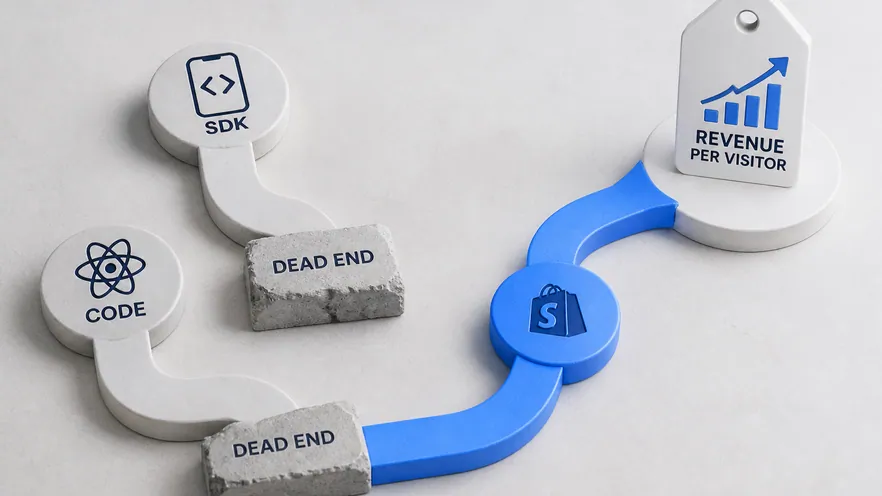
Apptimize is a mobile-first cross-platform A/B testing tool with SDKs for iOS, Android, and web, built for app product teams. Croct is a developer-first personalization platform for React and Next.js applications, used by headless eCommerce teams. Omniconvert Explore is the Shopify-native eCommerce CRO platform: it runs product-page, cart, and checkout experiments measured in revenue per visitor.
- Apptimize is a cross-platform mobile A/B testing and feature management SDK for iOS, Android, React Native, and web, with a 4.3 out of 5 G2 rating. [G2, 2026]
- Croct is a React and Next.js personalization and A/B testing platform configured in code, with a 4.7 out of 5 G2 rating. [G2, 2026]
- Both are developer tools: Apptimize requires SDK implementation and Croct requires React, so a marketing team on a standard Shopify store cannot run a product-page test in either without engineering.
- Neither tool runs multivariate experiments, offers a visual editor, or measures results in revenue per visitor on the Shopify checkout funnel.
- Omniconvert Explore runs product, cart, and checkout experiments on standard Shopify with a visual editor and session-based pricing, measured in revenue per visitor: pick it when the marketing team needs to ship tests this quarter.
Teams comparing Apptimize vs Croct are usually not shopping for an eCommerce testing tool at all. Apptimize is built for mobile app product teams who want A/B testing and feature flags across iOS, Android, and web through a single SDK. Croct is built for frontend engineers running React and Next.js applications who want component-level personalization in code. Both are legitimate choices for their audiences, but neither is designed to run product-page or checkout experiments on a standard Shopify store, which is where Omniconvert Explore sits.
What is Apptimize, and what is it actually good at?
Apptimize is a cross-platform A/B testing and feature management platform built for mobile product teams. It runs the same experiment across iOS, Android, React Native, and web through one SDK, keeping variant logic consistent on every surface a mobile-first business ships. [Apptimize, 2026]
Apptimize is a specialist in mobile product experimentation. It holds a 4.3 out of 5 rating on G2 across 35 reviews. [G2, 2026] Its market presence is narrow relative to generalist testing tools, which reflects a product that solves one problem for one audience rather than a wide swing at the testing market.
The single-SDK model is what distinguishes it. A feature flag or A/B test defined once runs the same logic on iOS, Android, React Native, and the web, which is unusual in the mobile testing market. Server-side testing and feature management sit beside the testing layer in the same workflow.
Pricing is custom through sales, which signals an enterprise or mid-market mobile organization. There is no free trial. On eCommerce, Apptimize is explicit about its focus: mobile apps first, web second, standard Shopify not at all.
Cross-platform mobile A/B testing runs the same experiment across native iOS, Android, React Native, and web through a single SDK, so a product team can keep variant logic consistent on every surface. Apptimize does this well for app-first businesses. It is a mobile product capability, distinct from running a controlled revenue experiment on a Shopify product page, cart, or checkout.
Where Apptimize is genuinely strong
- One SDK across platforms: the same experiment runs on native iOS, Android, React Native, and web.
- Server-side testing and feature flags: engineering teams release and experiment on one platform.
- Mobile product focus: variant logic shaped around app shipping cycles.
- Consistency across surfaces: useful when a mobile app and a web experience must behave the same.
Where Apptimize hits its ceiling for an eCommerce store
- No visual editor: all experiments go through the SDK, which locks out marketing teams.
- No native Shopify integration: the Shopify checkout funnel is not a first-class surface.
- Low eCommerce focus: the product is built for mobile product teams, not store merchandising.
- Narrow market presence: smaller user base and ecosystem than the generalist testing platforms.
What is Croct, and what is it actually good at?
Croct is a personalization and A/B testing platform designed for React and Next.js applications. It integrates at the component level, so a frontend engineer can swap or test variants of a single component without reshaping the surrounding page. It is popular with headless eCommerce teams. [G2, 2026]
Croct is a developer-first platform. It holds a 4.7 out of 5 rating on G2 across 47 reviews, [G2, 2026] which is high for the category and consistent with a tool that solves one audience's problem well. Pricing is usage-based with a free tier and a free trial, which is unusual at this level of enterprise capability.
The product is built around React and Next.js. A frontend engineer wires Croct into components, defines a feature flag or variant in code, and the SDK handles the rest. Feature flags, segments, and personalization share one API with A/B testing.
Headless eCommerce teams on composable commerce or Next.js storefronts are its natural fit. On a standard Shopify Liquid theme, it cannot be used at all without rebuilding the storefront as a React app, which is a project most stores never plan to run.
React component personalization lets a frontend team swap or vary React or Next.js components based on segments, feature flags, or experiment arms, configured in code. Croct does this well for headless and composable architectures. It is a developer workflow, distinct from running a marketer-accessible test on the Shopify storefront a standard store already uses.
Where Croct is genuinely strong
- React and Next.js native: component-level personalization and testing built for the modern frontend stack.
- Developer-first API: feature flags, segments, and variants defined in code with type safety.
- Usage-based pricing: free tier and trial, pay as traffic scales.
- Headless eCommerce fit: popular on composable commerce stacks running Next.js.
Where Croct hits its ceiling for an eCommerce store
- Requires React or Next.js: unusable on a standard Shopify Liquid theme without rebuilding the storefront.
- No visual editor: every experiment and personalization is configured in code.
- Marketer-inaccessible: non-technical teams cannot ship a test without opening a pull request.
- Narrow stack fit: no path for a store on standard Shopify, Magento, or WooCommerce.
What Apptimize and Croct cannot do for an eCommerce store
Apptimize and Croct come at experimentation from opposite ends: one from mobile SDKs, one from React code. For a standard Shopify store, they share one gap. Neither offers a marketer-accessible interface for product, cart, and checkout testing with results read in revenue per visitor.
Apptimize was built around a mobile app product organization. Its SDK, variant logic, and release workflow are shaped by the question of how an iOS or Android team ships a feature-flagged variant. On a standard Shopify storefront, those shapes do not match: no visual editor, no native checkout integration, no path for a marketer to ship a product-page test without pulling in engineering.
Croct comes at the same job from the opposite side, as a React and Next.js library for frontend engineers. On a headless storefront, that is a strength. On a standard Shopify Liquid theme it is unusable without rebuilding the storefront as a Next.js app, which few stores plan to run.
Both are legitimate for their primary audiences. The question for an eCommerce store is narrower: can the marketing team move Shopify checkout friction down this quarter without hiring a React team or an SDK developer. For that specific question, both tools reach the wrong surface at the wrong layer.
Omniconvert Explore is built for exactly that surface. It pairs a visual editor and a code editor on the Shopify storefront with native Shopify integration and session-based pricing matched to store traffic. The marketing team ships the test, and the result is read as revenue per visitor rather than an event log entry. For the deeper argument on acting on behavior, not just observing it, see Has personalization replaced A/B testing?
eCommerce conversion rate optimization (CRO) is the practice of running controlled experiments on the revenue surfaces of an online store, product pages, cart, and checkout, and measuring the result in revenue per visitor and order rate rather than generic conversion rate. Omniconvert Explore is defined as an eCommerce conversion rate optimization platform for product, cart, and checkout experiments, native to Shopify and priced for store traffic.
What neither tool can tell an eCommerce team
- Did the win move revenue and margin. Whether a change raised revenue per visitor and order rate, and held its margin once discounts and returns are counted, not just moved a mobile event or a React render count.
- Which surface to test first. Which pages in the funnel (product, cart, checkout) carry the highest revenue impact if tested next on the Shopify storefront, not on an app screen.
- How it behaves in the Shopify checkout. How an experiment interacts with the Shopify catalog, variants, and checkout flow natively, without SDK wiring or a React migration.
- Whether it holds for valuable customers. Whether the result holds for repeat, high-value customers, the Customer Value Optimization question, not just first-session visitors on any surface.
Omniconvert benchmarks more than 7,000 eCommerce websites in its CROBenchmark Report 2026, across 248+ audit criteria. The data shows where stores actually lose orders: 99.6% fail to make guest checkout prominent, and 94.2% never show checkout progress steps. [CROBenchmark Report 2026, Omniconvert]
Neither Apptimize nor Croct is built to run that fix on a standard Shopify store. Explore does, and it reads the result in revenue per visitor rather than event counts, which is the number that moves a store's bank balance rather than a dashboard. For how those experiments ship natively on Shopify, see A/B testing with Explore, and for Shopify-specific levers like price testing most tools cannot touch, see Explore 3.0: pricing testing on Shopify.
Apptimize vs Croct vs Explore: the capability comparison
The three tools cover different jobs. Apptimize handles mobile app experimentation at the SDK layer. Croct handles React component personalization at the code layer. Explore handles Shopify-storefront testing at the marketing-team layer, with experiments scored in revenue per visitor rather than event logs.
| Capability | Apptimize | Croct | Omniconvert Explore |
|---|---|---|---|
| Primary function | Cross-platform mobile and web A/B testing with feature flags | Personalization and A/B testing for React and Next.js | eCommerce CRO on product, cart, and checkout |
| A/B testing | Yes SDK-based cross-platform (iOS, Android, web) | Yes React component-level in code | Yes visual editor plus code editor |
| Multivariate testing | No | No | Yes |
| Server-side testing | Yes | Yes | Yes |
| Visual editor | No SDK only | No code only | Yes visual plus code editor |
| On-site surveys and overlays | No mobile product focus | Partial personalization yes, no built-in surveys | Yes surveys and overlays native |
| Shopify integration | Low no native integration | Medium only on React/Next.js builds, not standard Shopify themes | Yes native |
| eCommerce focus | Low mobile product focus | Low developer tooling for engineers | High built for store revenue workflows |
| Pricing model | Custom, contact sales, no free trial | Usage-based, free tier available, free trial | Session-based, built for store traffic, free trial |
| Best for | Mobile app product teams across iOS, Android, and web | Frontend engineers on React or Next.js storefronts | Shopify and eCommerce teams optimizing for revenue |
| User rating | 4.3 out of 5 (G2, 35 reviews, as of 2026) | 4.7 out of 5 (G2, 47 reviews, as of 2026) | 4.6 out of 5 (G2, 191 reviews, as of 2026) |
AliveCor used Omniconvert Explore to run a structured A/B testing program and achieved +21% conversion rate, +5% revenue per visitor, and 94% statistical relevance across their experiments. [Omniconvert, AliveCor case study]
Competitor ratings, pricing, and plan details reflect publicly listed figures as of 2026 and can change. Apptimize is a mobile-first platform without native Shopify checkout testing; Croct requires React or Next.js. Explore uses session-based pricing; see the Omniconvert pricing page for current plans.
Get the full CROBenchmark data behind these stats: 7,000+ websites, 15+ industries, 248+ audit criteria, 100+ CRO experts. See exactly where eCommerce growth teams are losing margin in 2026.
Get the CROBenchmark ReportFrequently Asked Questions
Should you choose Explore over Apptimize or Croct?
Decide by stack and team. Apptimize if your mobile app team wants one SDK across iOS, Android, and web. Croct if your engineers are building a headless React or Next.js storefront and want component-level personalization in code. For a standard Shopify store with a marketing team running experiments, Explore is the fit: product, cart, and checkout testing with a visual editor and session-based pricing, measured in revenue per visitor.
Apptimize and Croct are both capable tools for their primary audiences. Apptimize is the right pick for a mobile product organization that needs consistent experiment logic across iOS, Android, and web. Croct is the right pick for a frontend engineering team on React or Next.js that wants personalization and feature flags configured in code.
The question for a Shopify store is narrower: once the merchandising team has an idea for the product page or checkout, can it ship a test on the real revenue surface this quarter, without hiring an SDK developer or migrating the storefront to React. That is the surface Explore is built for, and the result is read in revenue per visitor rather than clicks or event counts.
Stop guessing.
Start testing what moves revenue.
Explore runs A/B, multivariate, and personalization experiments on your product pages, cart, and checkout, then measures the outcome in revenue per visitor, not just clicks.
4.6 out of 5 across 191 reviews, G2 , as of 2026