Eppo vs Instapage vs Explore (2026): Both Miss the Shopify Checkout
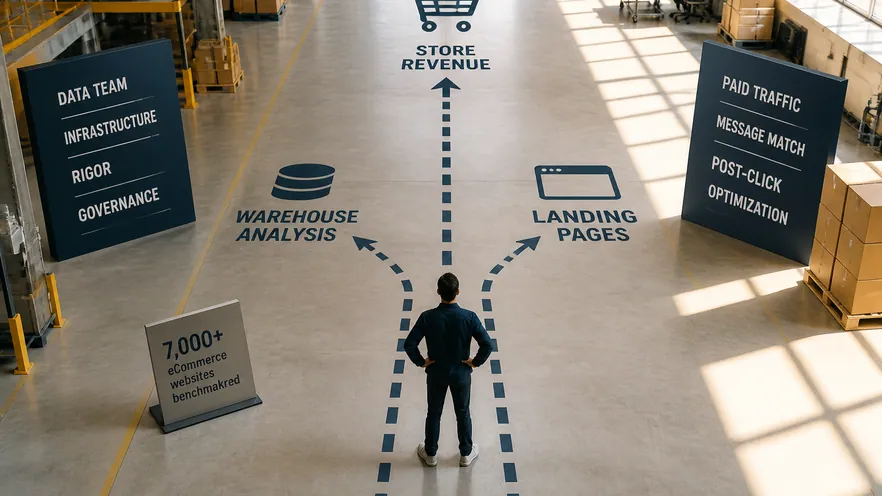
Eppo is a warehouse-native experimentation platform for data teams with mature Snowflake or BigQuery infrastructure. Instapage is a dedicated landing page builder for post-click optimization on paid traffic. Omniconvert Explore is the Shopify-native eCommerce CRO platform: it runs experiments on product pages, cart, and checkout, and measures the result in revenue per visitor rather than generic conversion rate.
- Eppo is a warehouse-native experimentation platform built for data engineering teams with mature Snowflake or BigQuery infrastructure, holding a 4.7 out of 5 G2 rating. [G2, 2026]
- Instapage is a dedicated landing page platform for post-click optimization on paid traffic, with a 4.3 out of 5 G2 rating across 426 reviews. [G2, 2026]
- Eppo and Instapage solve completely different jobs, warehouse-native analysis and paid-traffic landing pages, and are not substitutes for each other.
- Neither runs experiments on Shopify product pages, cart, or checkout, the surfaces where store revenue is actually decided.
- Omniconvert Explore runs experiments on product, cart, and checkout natively and measures results in revenue per visitor: pick it for Shopify revenue surfaces.
Teams comparing Eppo vs Instapage are choosing between two very different jobs. Eppo runs warehouse-native experiment analysis for a mature data team; Instapage is a dedicated landing page platform for paid traffic. Neither reaches the surfaces where a Shopify store actually wins or loses revenue, product pages, cart, and checkout. That is the layer Omniconvert Explore is built for.
What is Eppo, and what is it actually good at?
Eppo is a warehouse-native A/B testing and experimentation platform. It connects directly to Snowflake, BigQuery, Redshift and other data warehouses, running experiment analysis on the metrics your data team already defines. It is built for data-engineering-led programs at scale. [Eppo, 2026]
Eppo holds one of the highest ratings in the experimentation category, at 4.7 out of 5 on G2 across 80 reviews. [G2, 2026] The audience is clear: data and engineering teams inside organizations with mature warehouse infrastructure, running high-velocity experimentation programs under strong data governance.
The category Eppo sits in is warehouse-native experimentation. Its edge is statistical rigor and reuse of existing metrics definitions rather than a marketer-facing visual editor. That focus is deliberate, and the point of the product.
Warehouse-native experimentation analyzes tests on the warehouse (Snowflake, BigQuery, Redshift), using metrics the data team already defines, without moving data to a separate tool. Eppo is one of the most rigorous implementations. It is an analysis and governance layer for a data-team-led program, distinct from running a revenue experiment on product, cart, and checkout.
Where Eppo is genuinely strong
- Warehouse-native architecture: connects to Snowflake, BigQuery, Redshift and uses your existing metrics definitions.
- Advanced statistical methods: sequential testing, CUPED, and rigorous approaches built for a mature data team.
- Strong data governance: centralized metric definitions and audit trails for high-velocity programs.
- Server-side experimentation: built for engineering teams shipping feature flags and API-level experiments.
Where Eppo hits its ceiling for an eCommerce store
- No visual editor: marketers cannot ship a variant without engineering time.
- Requires warehouse infrastructure: a Snowflake or BigQuery deployment most Shopify stores do not run.
- Enterprise pricing: custom quotes aimed at data teams, not $1M-$50M ARR eCommerce brands.
- Not Shopify-native: no store-level templates for product, cart, or checkout experiments.
What is Instapage, and what is it actually good at?
Instapage is a dedicated landing page platform for post-click optimization on paid traffic. It offers a drag-and-drop builder, A/B testing, personalization at the audience-segment level, and AdMap for connecting specific ads to specific landing pages. Heatmaps and analytics are built in. [Instapage, 2026]
Instapage holds a 4.3 out of 5 rating on G2 across 426 reviews, one of the largest review pools in the landing page category. [G2, 2026] The audience is performance marketing: teams running paid campaigns who need a dedicated post-click destination for each ad, with built-in testing and personalization.
The category is post-click landing page optimization. Its edge is a purpose-built page builder plus AdMap, delivering 1:1 ad-to-page matching at scale. That focus, on paid traffic optimization, is the point of the product.
Post-click landing page optimization builds and tests dedicated landing pages for paid ad traffic, matching a specific ad to a specific page. Instapage is one of the leading tools for this workflow, with AdMap connecting ads to pages. It is a paid-traffic delivery surface, distinct from running a controlled experiment on a store's product, cart, and checkout.
Where Instapage is genuinely strong
- Dedicated landing page builder: drag-and-drop, purpose-built for post-click, with fast page load and mobile responsiveness.
- AdMap for 1:1 message match: connects specific ads to specific landing pages, aligning paid campaigns and landing experiences.
- Testing and personalization on landing pages: built-in variant testing and audience-segment personalization for paid traffic.
- Heatmaps and analytics built in: post-click behavioral analysis without stitching in a third-party tool.
Where Instapage hits its ceiling for an eCommerce store
- Landing pages only: cannot test on Shopify product pages, cart flows, or the checkout sequence.
- No native Shopify integration: not built for a store's catalog, variants, or checkout data.
- Premium price for a single surface: $199/mo starting point for a landing-page-only tool that many stores outgrow.
- Split funnel: optimizes the click that lands on a page, not the order that closes in checkout.
What Eppo and Instapage cannot do for an eCommerce store
Eppo and Instapage sit in different categories, warehouse-native experimentation and post-click landing pages, but they share the same gap for a store. Neither runs experiments on the surfaces where eCommerce revenue is actually decided, product pages, cart, and checkout, or measures the outcome in revenue per visitor.
Eppo is a warehouse-native tool built for organizations with mature data engineering. It has no visual editor and requires Snowflake or similar infrastructure. It cannot run experiments on Shopify product pages or checkout flows through a marketer-accessible interface, and it is not designed for self-serve eCommerce CRO.
Instapage is a post-click landing page platform for paid traffic. It cannot run experiments on your Shopify product pages or checkout flows. Teams using Instapage for eCommerce optimization improve post-click landing pages, but miss the highest-revenue surfaces: the product page, add-to-cart, and checkout.
The two gaps differ in nature but point to the same missing layer. Eppo optimizes the analysis of a test at the warehouse; Instapage optimizes the ad-to-page destination. Neither runs the experiment on the store's actual revenue surface or reports the outcome in revenue per visitor.
Platforms like Omniconvert Explore are built for that layer. Explore runs the experiment on the product-to-checkout path natively and measures the result in revenue per visitor.
eCommerce conversion rate optimization (CRO) is the practice of running controlled experiments on the revenue surfaces of an online store, product pages, cart, and checkout, and measuring the result in revenue per visitor and order rate rather than generic conversion rate. Omniconvert Explore is defined as an eCommerce conversion rate optimization platform for product, cart, and checkout experiments, native to Shopify and priced for store traffic.
What neither tool can tell an eCommerce team
- Did the win move revenue and margin. Whether a variant raised revenue per visitor and order rate, and held its margin after discounts and returns, not just lifted a click.
- Which surface to test first. Which pages in the store funnel (product, cart, checkout) carry the highest revenue impact if tested next.
- How it behaves in checkout. How an experiment interacts with the Shopify catalog, variants, and checkout flow natively, without engineering glue work.
- Whether it holds for valuable customers. Whether the result holds for repeat, high-value customers, the Customer Value Optimization question, not just first-session visitors from paid traffic.
Omniconvert benchmarks more than 7,000 eCommerce websites in its CROBenchmark Report 2026, across 248+ audit criteria. Data shows where stores lose orders: 99.6% fail to make guest checkout prominent, and 85.1% never show full order cost before the final step. [CROBenchmark Report 2026, Omniconvert]
These are checkout-surface problems, the exact surfaces a warehouse-native analysis tool and a landing page builder are not built to experiment on. Explore runs the experiment on the store's real revenue surfaces and reports the outcome in revenue per visitor.
Eppo vs Instapage vs Explore: the capability comparison
Side by side, the three tools serve different layers. Eppo runs warehouse-native analysis, Instapage builds paid-traffic landing pages, Explore runs native Shopify experiments on product, cart, and checkout with surveys and overlays. See A/B testing with Explore.
| Capability | Eppo | Instapage | Omniconvert Explore |
|---|---|---|---|
| Primary function | Warehouse-native experiment analysis | Landing page building and post-click testing | eCommerce CRO on product, cart, and checkout |
| A/B testing | Yes warehouse-native, no visual editor | Partial landing pages only | Yes visual and code editor, on-store |
| Multivariate testing | No | Limited | Yes |
| Server-side testing | Yes | No | Yes |
| Visual editor | No engineering-led | Partial landing-page builder only | Yes visual and code editor |
| On-site surveys and overlays | No | No | Yes surveys and overlays built in |
| Shopify integration | Low requires warehouse plumbing | Low landing pages only | Yes native |
| eCommerce focus | Low data-team programs | Low paid-traffic landing pages | High built for store revenue workflows |
| Pricing model | Custom enterprise, quote on request | Session-based, from $199/mo, free trial | Session-based, built for store traffic, free trial |
| Best for | Data engineering teams with mature warehouses | Performance marketers optimizing paid landing pages | Shopify and eCommerce teams optimizing for revenue |
| User rating | 4.7 out of 5 (G2, 80 reviews, as of 2026) | 4.3 out of 5 (G2, 426 reviews, as of 2026) | 4.6 out of 5 (G2, 191 reviews, as of 2026) |
AliveCor used Omniconvert Explore to run a structured A/B testing program and achieved +21% conversion rate, +5% revenue per visitor, and 94% statistical relevance across their experiments. [Omniconvert, AliveCor case study]
Competitor ratings, pricing, and plan details reflect publicly listed figures as of 2026 and can change. Explore uses session-based pricing; see the Omniconvert pricing page for current plans.
Get the full CROBenchmark data behind these stats: 7,000+ websites, 15+ industries, 248+ audit criteria, 100+ CRO experts. See exactly where eCommerce growth teams are losing margin in 2026.
Get the CROBenchmark ReportFrequently Asked Questions
Should you choose Explore over Eppo or Instapage?
Start with where your revenue is decided. If your data team wants warehouse-native experiment analysis inside Snowflake or BigQuery, keep Eppo. If you optimize paid-traffic landing pages with AdMap, keep Instapage. For a Shopify store, run your next test on the product-to-checkout path in Explore, measured in revenue per visitor. The three tools are complementary, but only Explore is built for the checkout where the order closes.
Eppo and Instapage are both capable tools within their own categories. Eppo is a leader in warehouse-native experiment analysis for data teams. Instapage is a leading dedicated landing page platform for paid traffic optimization.
The question for a Shopify store is narrower. Can your team run a controlled experiment on the product, cart, and checkout, and read the result in revenue per visitor rather than a click. That is the surface Explore is built for.
Stop guessing.
Start testing what moves revenue.
Explore runs A/B, multivariate, and personalization experiments on your product pages, cart, and checkout, then measures the outcome in revenue per visitor, not just clicks.
4.6 out of 5 across 191 reviews, G2 , as of 2026