Fibr AI vs Instapage vs Explore (2026): Beyond the Landing Page
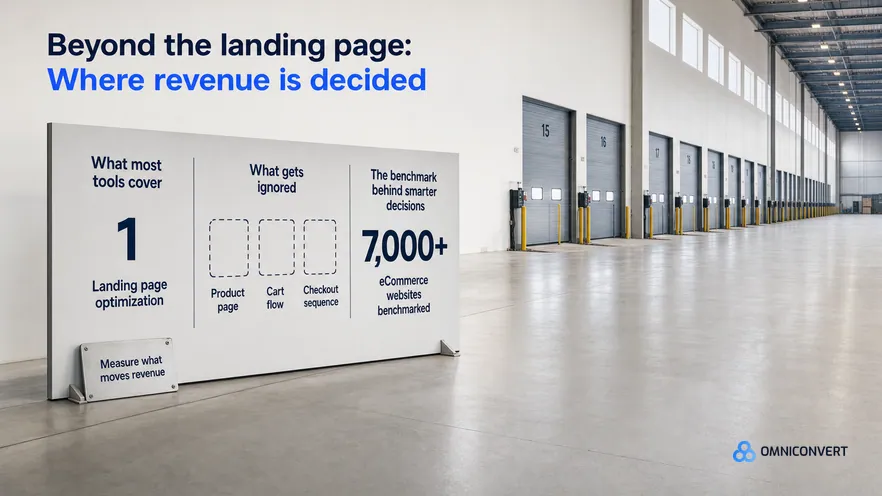
Fibr AI generates personalized landing page variants using AI for paid traffic campaigns. Instapage is a dedicated landing page platform with built-in A/B testing and AdMap. Omniconvert Explore is the Shopify-native eCommerce CRO platform: it runs experiments on product pages, cart, and checkout, and measures the outcome in revenue per visitor rather than a landing page conversion rate.
- Fibr AI is an AI-powered landing page personalization tool for paid traffic, with a 4.6 out of 5 G2 rating across 133 reviews. [G2, 2026]
- Instapage is a dedicated post-click landing page platform with AdMap and built-in A/B testing, rated 4.3 out of 5 on G2 across 426 reviews. [G2, 2026]
- Fibr AI and Instapage take different paths to the same job, optimizing the landing page after the click, and rarely overlap directly.
- Neither runs experiments on Shopify product pages, cart flows, or the checkout sequence, the surfaces where store revenue is actually decided.
- Omniconvert Explore runs experiments on product, cart, and checkout natively and measures results in revenue per visitor: pick it for Shopify revenue surfaces.
Teams comparing Fibr AI vs Instapage are usually deciding how to spend the next post-click dollar: on AI-generated landing page variants, or on a dedicated landing page platform with A/B testing. Fibr AI answers the AI personalization question for paid traffic campaigns. Instapage answers the landing page builder question with AdMap and audience-level personalization. Neither is built around the surfaces where a Shopify store actually wins or loses revenue, the product page, the cart, and the checkout, which is where Omniconvert Explore runs.
What is Fibr AI, and what is it actually good at?
Fibr AI is an agentic landing page personalization platform that generates and tests personalized page variants automatically using AI. It targets performance marketing teams running paid traffic, so a campaign can serve a distinct post-click page per audience segment without design or engineering handoff. [Fibr AI, 2026]
Fibr AI holds a 4.6 out of 5 rating on G2 across 133 reviews, one of the higher scores in the AI personalization category. [G2, 2026] The pitch is straightforward: hand the tool your ad campaigns and audience data, and it produces hundreds of personalized landing page variants for the click-through experience.
The category Fibr AI sits in is post-click AI personalization for paid traffic. It removes the designer and developer bottleneck that usually caps how many landing page variants a marketing team can ship. That focus is the point of the product.
AI landing page personalization uses machine models to generate page variants tuned to a specific audience segment, so paid traffic lands on a page written for it rather than a single generic template. Fibr AI builds this as its core workflow. It is an ad-to-page delivery layer, distinct from running a controlled revenue experiment on a store's product, cart, and checkout.
Where Fibr AI is genuinely strong
- AI-generated variant volume: hundreds of personalized landing page variants without designer or developer work.
- Audience-segment targeting: variants aligned to ad audiences and campaign data, so the click-through experience matches the ad.
- Fast paid-traffic iteration: a performance marketing team can ship new page experiences in hours, not sprints.
- Strong reception in its niche: a 4.6 G2 rating across 133 reviews signals a category-fit product for AI-native marketing teams. [G2, 2026]
Where Fibr AI hits its ceiling for an eCommerce store
- Landing pages only: no experiments on Shopify product pages, cart flows, or the checkout sequence.
- No native Shopify integration: low eCommerce focus, so store surfaces are out of scope for testing.
- No multivariate or server-side testing: AI variants only, not full experimentation infrastructure.
- Landing page conversion, not revenue per visitor: optimized for the click, not the order rate that follows.
What is Instapage, and what is it actually good at?
Instapage is one of the leading dedicated landing page platforms, with a drag-and-drop builder, A/B testing, heatmaps, and AdMap for connecting individual ads to specific landing page experiences. It is built to maximize conversion from paid traffic once a visitor clicks through. [Instapage, 2026]
Instapage holds a 4.3 out of 5 rating on G2 across 426 reviews, one of the deepest review pools in the landing page category. [G2, 2026] The platform pairs its builder with audience-segment personalization and built-in analytics, so a performance marketing team can run its post-click experience end to end in one tool.
The category Instapage sits in is post-click landing page optimization. AdMap ties paid campaigns to bespoke page experiences, and A/B testing validates which variant wins the click. That focus is the point of the product.
Post-click landing page optimization is the discipline of shaping the page a visitor sees immediately after clicking an ad, then testing that page against alternatives to lift its conversion rate. Instapage builds a full stack around this workflow. It is a paid-traffic delivery layer, distinct from running controlled revenue experiments on a store's product, cart, and checkout.
Where Instapage is genuinely strong
- Powerful landing page builder: mature drag-and-drop editor with a wide template library for paid campaigns.
- AdMap for ad-to-page mapping: connects specific ads to matched landing page experiences, tightening message match.
- Built-in A/B testing and heatmaps: post-click experiments and behavioral analysis inside the same platform.
- Audience-level personalization: variant delivery keyed to audience segments, without a separate personalization tool.
Where Instapage hits its ceiling for an eCommerce store
- Landing pages only: no experiments on Shopify product pages, cart flows, or checkout sequences.
- Low Shopify integration: no eCommerce-native templates for store surfaces, so revenue-critical pages sit outside its scope.
- Priced high for one job: from $199 per month for a post-click tool, which stacks on top of a full CRO platform.
- Generic conversion focus: results are framed as landing page conversion rate, not revenue per visitor.
What Fibr AI and Instapage cannot do for an eCommerce store
Fibr AI and Instapage take different paths to the same job, optimizing the post-click landing page for paid traffic. The gap they share is the same one: neither runs experiments on the surfaces where a Shopify store's revenue is actually decided, the product page, the add-to-cart flow, and the checkout sequence.
Fibr AI is an AI-powered personalization tool for the post-click landing page. Teams using it for eCommerce CRO can serve a bespoke page per audience segment, but the tool does not reach the Shopify product page, cart, or checkout. Once the visitor moves past the landing page, the experiment stops.
Instapage is a post-click landing page platform for paid traffic. Its A/B testing and AdMap tighten the ad-to-page experience, but the platform cannot experiment on Shopify product pages or the checkout sequence. The highest-revenue surfaces in the funnel, the product page, the add-to-cart flow, and the checkout, sit outside what it is built to test.
The two gaps look different but land in the same place. Most landing page tools optimize the execution of a paid campaign on a page written for the click. They are not built around where store revenue is actually decided, or around the Customer Value Optimization question: whether a result holds for repeat, high-value buyers. For the wider debate behind the landing-page-versus-store-surface split, see Has personalization replaced A/B testing?
There is a second gap underneath the first: the data insights layer that tells a store what to test on its Shopify surfaces and whether it actually moved revenue. Fibr AI reports landing page conversion; Instapage adds heatmaps for the landing page. Neither reads the product page, the cart abandonment pattern, or the checkout drop-off that decides an order. Omniconvert Explore builds that insights layer around the store: heatmaps, session recordings, and surveys sit next to the experiment, and the same behavioral and customer data defines the segments you test against. The insight and the test live in one place, which is the difference between guessing at a hypothesis and reading it off the store's own data.
eCommerce conversion rate optimization (CRO) is the practice of running controlled experiments on the revenue surfaces of an online store, product pages, cart, and checkout, and measuring the result in revenue per visitor and order rate rather than generic conversion rate. Omniconvert Explore is defined as an eCommerce conversion rate optimization platform for product, cart, and checkout experiments, native to Shopify and priced for store traffic.
What neither tool can tell an eCommerce team
- Did the win move revenue and margin. Whether a winning variant raised revenue per visitor and order rate, and held its margin once discounts and returns are counted, not just lifted a landing page click.
- Which store surface to test first. Which pages in the funnel (product, cart, checkout) carry the highest revenue impact once the visitor arrives from the landing page.
- How it behaves in checkout. How an experiment interacts with the Shopify catalog, variants, and checkout flow natively, without engineering glue work.
- Whether it holds for valuable customers. Whether the result holds for repeat, high-value customers, the Customer Value Optimization question, not just first-session paid clicks.
Omniconvert benchmarks more than 7,000 eCommerce websites in its CROBenchmark Report 2026, across 248+ audit criteria. The data shows where stores actually lose orders after the click: 99.6% fail to make guest checkout visible and prominent, and 85.1% never show the full order cost before the final step. [CROBenchmark Report 2026, Omniconvert]
These are checkout-surface problems, the exact surfaces a landing page tool is not built to experiment on. Explore runs the experiment on the store's real revenue surfaces and reports the outcome in revenue per visitor.
This is what the title means by going beyond the landing page. A higher landing page click or a lifted micro-conversion can leave the bank balance flat; what moves it is order rate and average order value along the product-to-checkout path, read as revenue per visitor. Explore optimizes for that number directly, and because Customer Value Optimization ties each result back to repeat, high-value buyers, the lift it confirms is margin the store keeps rather than traffic it rents. A variant that wins on revenue per visitor and holds for high-CLV customers protects profit; a variant that only lifts a landing page click often does not. Explore also reaches Shopify-specific levers a landing page tool cannot touch, including price testing; see Explore 3.0: pricing testing on Shopify.
Fibr AI vs Instapage vs Explore: the capability comparison
Side by side, the three tools serve different layers of the funnel. Fibr AI generates AI-personalized landing pages for paid traffic. Instapage builds and tests dedicated post-click landing pages with AdMap. Explore runs native Shopify experiments on product, cart, and checkout, with built-in surveys and overlays, measured in revenue per visitor. See A/B testing with Explore for how those experiments run natively on the Shopify funnel.
| Capability | Fibr AI | Instapage | Omniconvert Explore |
|---|---|---|---|
| Primary function | AI-generated landing page personalization | Dedicated landing page builder with A/B testing | eCommerce CRO on product, cart, and checkout |
| A/B testing | Partial AI-generated landing page variants only | Partial landing pages only, no store surfaces | Yes visual plus code editor, store-wide |
| Multivariate testing | No | Limited within landing pages | Yes |
| Server-side testing | No | No | Yes |
| Visual editor | No AI generates variants | No drag-and-drop builder, not a store editor | Yes visual editor for store surfaces |
| On-site surveys and overlays | No not in scope | No heatmaps only | Yes surveys and overlays built in |
| Shopify integration | Low no store-surface testing | Low no store-surface testing | Yes native |
| eCommerce focus | Low paid-traffic landing pages | Low post-click landing pages | High built for store revenue workflows |
| Revenue per visitor measurement | No landing page conversion metric | No landing page conversion metric | Yes revenue per visitor and order rate native |
| Pricing model | Seat-based, contact sales, free trial | Session-based, from $199/mo, free trial | Session-based, built for store traffic, free trial |
| Best for | Marketing teams wanting AI-generated landing page variants | Marketing teams wanting a dedicated landing page platform | Shopify and eCommerce teams optimizing for revenue |
| User rating | 4.6 out of 5 (G2, 133 reviews, as of 2026) | 4.3 out of 5 (G2, 426 reviews, as of 2026) | 4.6 out of 5 (G2, 191 reviews, as of 2026) |
AliveCor used Omniconvert Explore to run a structured A/B testing program and achieved +21% conversion rate, +5% revenue per visitor, and 94% statistical relevance across their experiments. [Omniconvert, AliveCor case study]
Competitor ratings, pricing, and plan details reflect publicly listed figures as of 2026 and can change. Explore uses session-based pricing; see the Omniconvert pricing page for current plans.
Get the full CROBenchmark data behind these stats: 7,000+ websites, 15+ industries, 248+ audit criteria, 100+ CRO experts. See exactly where eCommerce growth teams are losing margin in 2026.
Get the CROBenchmark ReportFrequently Asked Questions
Should you choose Explore over Fibr AI or Instapage?
Start with the surface where your revenue is actually decided. If your bottleneck is AI-generated landing page variants for paid campaigns, keep Fibr AI. If you need a dedicated post-click builder with AdMap, keep Instapage. For a Shopify store, run your next test on the product-to-checkout path in Explore, measured in revenue per visitor. The three are complementary, but only Explore reaches the checkout where the order closes.
Fibr AI and Instapage are both capable tools within their categories. Fibr AI is a strong pick for AI-native marketing teams that need landing page variant volume without design work. Instapage is a mature post-click platform with AdMap and audience-level personalization built in.
The question for a store is narrower: can your team run a controlled experiment on the Shopify product, cart, and checkout, and read the result in revenue per visitor rather than a landing page click. That is the surface Explore is built for.
Stop guessing.
Start testing what moves revenue.
Explore runs A/B, multivariate, and personalization experiments on your product pages, cart, and checkout, then measures the outcome in revenue per visitor, not just clicks.
4.6 out of 5 across 191 reviews, G2 , as of 2026