Fibr AI vs PostHog vs Explore (2026): Beyond Ad Pages and Dev Flags
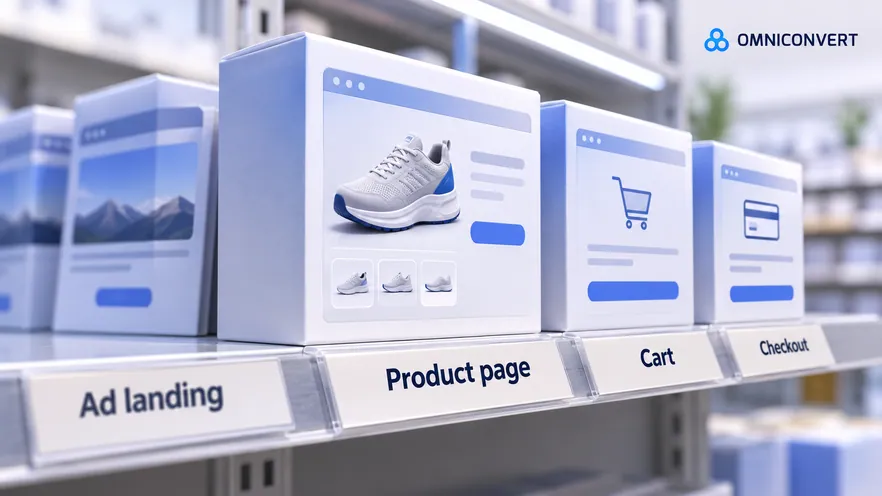
Fibr AI is an agentic AI landing page personalization platform that generates post-click variants for paid traffic. PostHog is an open-source product analytics platform with SDK-based A/B testing and feature flags. Omniconvert Explore is a Shopify-native eCommerce CRO platform that tests variants on product pages, cart, and checkout, then reports each outcome as revenue per visitor.
- Fibr AI is an agentic AI landing page personalization platform for paid-traffic campaigns, with a 4.6 out of 5 G2 rating across 133 reviews. [G2, 2026]
- PostHog is the leading open-source product analytics platform with feature flags and SDK-based A/B testing, with a 4.5 out of 5 G2 rating across 1056 reviews. [G2, 2026]
- The two tools target opposite buyers: Fibr AI serves performance marketing teams at the ad-to-landing-page handoff, PostHog serves product and engineering teams instrumenting an application.
- Both Fibr AI and PostHog sit outside the Shopify product page, cart, and checkout, and neither surfaces experiment outcomes as revenue per visitor.
- Built natively for Shopify, Omniconvert Explore is an eCommerce CRO platform. Using a visual editor, it handles A/B, multivariate, and checkout experiments, with every result reported in revenue per visitor.
Teams comparing Fibr AI vs PostHog are usually choosing between an AI engine that generates post-click landing pages for paid traffic and an open-source product analytics stack with feature flags and SDK-based A/B testing. Fibr AI answers the ad-to-landing-page personalization question; PostHog answers the developer-owned experimentation question. Neither is built around the surfaces where a Shopify store actually wins or loses revenue: product pages, cart, and checkout. This page maps the strengths of each tool, the shared gap between them, and when Omniconvert Explore is the right fit.
What is Fibr AI, and what is it actually good at?
Fibr AI is an agentic AI landing page personalization platform. It generates and tests personalized post-click page variants automatically, matched to audience segments and campaign data, so paid-traffic teams can ship hundreds of variants without a designer or developer in the loop. [Fibr AI, 2026]
Fibr AI holds a 4.6 out of 5 rating on G2 across 133 reviews, well regarded by performance marketing teams for removing the design and development bottleneck on landing page personalization. [G2, 2026] Its promise is speed at the top of the funnel: more variants, more segments, more creative in flight than a hand-built process can support.
The category Fibr AI sits in is AI-generated landing page creative for ad traffic. It takes campaign and audience inputs, writes and composes a variant, serves it to the matching segment, and measures the post-click lift. That is a specific job, done end to end.
AI landing page personalization uses a generative model to produce different versions of a post-click page, each matched to an audience segment or campaign, and serves the right one at ad click. Fibr AI operates in this layer. It is a creative-production tool for paid traffic, distinct from running a controlled revenue experiment on product, cart, and checkout.
Where Fibr AI is genuinely strong
- AI-generated variants at scale: hundreds of personalized post-click pages without a designer or developer sprint.
- Audience and campaign targeting: variants matched to segment, ad set, and traffic source automatically.
- Fast iteration for paid traffic: turns ad creative and segment data into live pages inside the campaign cycle.
- Removes the delivery bottleneck: performance marketing teams ship personalization without filing design tickets.
Where Fibr AI hits its ceiling for an eCommerce store
- No Shopify product or cart experiments: cannot run tests on product detail pages, cart flows, or the checkout.
- No multivariate or server-side testing: variant selection is AI-driven, not a full MVT or SDK-based experiment engine.
- Landing-page scope only: the post-click page is the surface; the rest of the store funnel is out of reach.
- Generic conversion focus: no concept of revenue per visitor as a native experiment metric.
What is PostHog, and what is it actually good at?
PostHog is an open-source product analytics platform built for engineering and product teams. It brings event tracking, session recordings, feature flags, and A/B testing together in one self-hostable tool. The free tier is generous, and teams that want full data ownership and no vendor lock-in gravitate toward it. [PostHog, 2026]
PostHog is a developer-first analytics and experimentation platform. On G2 it scores 4.5 out of 5 from 1056 reviews. [G2, 2026] Its appeal is consolidation: product analytics, session replay, feature flags, and A/B testing all live in one place, and the whole stack can run on your own infrastructure.
Experiments run through SDKs and feature flags, evaluated in code. The pricing is usage-based with a generous free tier, which is a real advantage for early-stage product teams instrumenting a new application.
Open-source product analytics is a self-hostable event tracking and experimentation stack that a team can run on its own infrastructure, with full data ownership and no vendor lock-in. PostHog does this well for engineering and product teams shipping a software product. It is a developer-owned analytics and feature-flag layer, distinct from running a controlled revenue experiment on Shopify product, cart, and checkout pages through a marketer-accessible interface.
Where PostHog is genuinely strong
- Open source and self-hostable: full data ownership, no vendor lock-in, deploy in your own cloud.
- All-in-one for product teams: product analytics, session recordings, feature flags, and A/B testing in a single platform.
- Generous free tier: usage-based pricing that scales from zero, popular with early-stage teams.
- Developer-friendly: strong SDKs across web, mobile, and server runtimes, with feature flags as a first-class primitive.
Where PostHog hits its ceiling for an eCommerce store
- No visual editor: every variant is configured in code, not through a WYSIWYG a marketer can use.
- No native Shopify integration: running any experiment on product pages, cart, or checkout means completing custom SDK setup first.
- Developer resources required: a CRO lead cannot ship a checkout test independently of the engineering backlog.
- Product analytics framing: event counts and funnel steps, not revenue per visitor or order rate as the primary outcome.
- No native on-site surveys or overlays: on-site personalization is not part of the core experimentation layer.
What Fibr AI and PostHog cannot do for an eCommerce store
Fibr AI and PostHog solve different jobs for different buyers, AI landing pages for paid-traffic marketers and open-source analytics for product and engineering teams. They share one gap for a Shopify store. Neither is built around the surfaces where eCommerce revenue is won or lost, product pages, cart, and checkout, or around the metric that matters there: revenue per visitor.
Fibr AI is an agentic landing page personalisation platform built for paid-traffic campaigns. It generates and serves tailored post-click variants for each ad segment, but it has no reach into Shopify product pages, cart flows, or the checkout sequence where orders are placed. Its optimisation stops at the landing page, which is one surface among many in a store funnel.
PostHog is developer-first product analytics with feature flags on top. That is a strong fit for engineering and product teams instrumenting a software application. On a Shopify storefront the same shape becomes an obstacle: every product page variant is a feature-flag ticket in code, and the outcome comes back as event counts and funnel steps, not as order rate or revenue per visitor. Marketing has no way to ship the test independently.
The gaps point in different directions but share the same missing layer. Fibr AI covers the ad-to-landing-page handoff; PostHog covers developer-owned experimentation. Neither treats the product-to-checkout path as the primary surface, and neither addresses the Customer Value Optimization question of whether results hold for repeat, high-value buyers. For background on how testing and personalisation relate, see Personalisation and A/B testing: does one replace the other?
The deeper issue is distance between the person who owns the hypothesis and the surface where the test runs. A CRO lead with a cart-page idea has no cart surface in Fibr AI, and in PostHog the idea becomes an engineering ticket behind a feature flag. Omniconvert Explore closes that gap. It puts a visual editor for product page and checkout variants, native Shopify integration, heatmaps, session recordings, and on-site surveys in one platform, with outcomes measured in revenue per visitor. The person responsible for store growth can ship and read the result without routing through engineering or an ad platform.
eCommerce conversion rate optimization (CRO) focuses on controlled experiments across an online store's key revenue surfaces: product pages, cart, and checkout. Success is measured through revenue per visitor and order rate, not a generic conversion rate. Omniconvert Explore is built specifically for those surfaces on Shopify, with pricing matched to store traffic volume.
What neither tool can tell an eCommerce team
- Whether the winning variant moved revenue and margin. Whether a variant raised revenue per visitor and order rate, and held its margin once discounts and returns are counted, not just lifted a post-click conversion or a product-analytics event count.
- Where revenue is left on the table. Which pages in the store funnel (product, cart, checkout) carry the highest revenue impact if tested next, past the landing page or the feature-flag layer.
- What happens inside checkout. How an experiment interacts with the Shopify catalog, variants, and checkout flow natively, without ad-platform glue work or SDK integrations.
- Does the lift hold for high-value buyers. Whether the result holds for repeat, high-value customers, the Customer Value Optimization question, not just for first-session visitors from paid traffic.
Omniconvert has analyzed more than 7,000 eCommerce websites for its CROBenchmark Report 2026, covering 248+ audit criteria. The data pinpoints where stores drop orders: 99.6% fail to surface guest checkout visibly and prominently, 94.2% show no checkout progress indicator, and 85.1% never display the full order cost before the final step. [CROBenchmark Report 2026, Omniconvert]
Those are checkout-surface problems, and the checkout is precisely where an AI landing page tool and a developer-first analytics stack have no reach. Fibr AI stops before the cart; PostHog requires an engineer to instrument it. Omniconvert Explore runs experiments directly on those revenue surfaces and reports the result as revenue per visitor.
This is what the title means by beyond ad pages and dev flags. A better post-click page or a tidier feature-flagged experiment can leave revenue unchanged; what moves it is order rate and average order value along the product-to-checkout path, measured as revenue per visitor. Omniconvert Explore targets that number directly. Customer Value Optimization links every result to repeat, high-value buyers, so confirmed lift is margin retained by the store, not traffic it must keep paying for. A variant that wins on revenue per visitor and holds for high-CLV customers protects profit; a post-click lift or an engineering-owned event move often does not. Omniconvert Explore also accesses Shopify-specific surfaces that most testing tools cannot reach, price testing included; see Shopify pricing tests and Explore 3.0 explained.
Fibr AI vs PostHog vs Explore: the capability comparison
The three tools occupy different layers. Fibr AI generates AI-driven landing page variants for paid-traffic campaigns. PostHog is an open-source product analytics platform with feature flags and SDK-based testing aimed at engineering and product teams. Omniconvert Explore runs native Shopify experiments across product pages, cart, and checkout, with heatmaps, surveys, and overlays available alongside them, reporting results in revenue per visitor. See How Omniconvert Explore runs A/B tests in the Shopify funnel for details on how those experiments work inside the Shopify funnel.
| Capability | Fibr AI | PostHog | Omniconvert Explore |
|---|---|---|---|
| Primary function | AI landing page personalization for ad traffic | Open-source product analytics and feature flags | CRO across product pages, cart, and checkout for eCommerce |
| A/B testing | Partial limited to AI-generated variants for landing pages | Yes SDK and feature-flag based | Yes visual editor plus code |
| Multivariate testing | No | No | Yes |
| Server-side testing | No | Yes via feature flags | Yes |
| Visual editor | No AI generation, not WYSIWYG | No code and SDKs only | Yes WYSIWYG for marketers |
| Surveys and on-site overlays | No landing pages only | Partial surveys yes, on-site personalization overlays no | Yes native surveys and overlays included |
| Shopify integration | Low no native connector | Low no native connector | Yes native |
| eCommerce focus | Low built for performance marketing teams | Low built for product and engineering teams | High designed around store revenue workflows |
| Pricing model | Seat-based, contact sales, free trial | Priced by usage, with a free tier available | Priced per sessions, designed for store traffic, free trial available |
| Best for | Performance marketing teams wanting AI landing page variants without design or dev work | Product and engineering teams wanting open-source, self-hostable analytics | eCommerce and Shopify teams focused on revenue optimization |
| User rating | G2 score: 4.6 out of 5 (133 reviews, 2026) | G2 score: 4.5 out of 5 (1056 reviews, 2026) | 4.6 out of 5 (G2, 197 reviews, as of 2026) |
On mobile, LEROY MERLIN Romania ran one Explore A/B test with a reduced homepage benefits section and recorded a +14.36% conversion rate, +8.43% revenue per user, and a 98.4% chance to win. [LEROY MERLIN Romania results with Omniconvert Explore]
Ratings, pricing, and plan details for Fibr AI and PostHog are based on publicly listed figures as of 2026 and may change. Fibr AI is an AI landing page personalisation tool for paid traffic; PostHog is a developer-owned product analytics and experimentation platform. Neither is a marketer-accessible eCommerce CRO tool in the way Omniconvert Explore is. Omniconvert Explore bases its plans on session volume; check the Omniconvert pricing page for up-to-date plan options.
Get the full CROBenchmark data behind these stats: 7,000+ websites, 15+ industries, 248+ audit criteria, 100+ CRO experts. See exactly where eCommerce growth teams are losing margin in 2026.
Get the CROBenchmark ReportFrequently Asked Questions
Should you choose Explore over Fibr AI or PostHog?
Choose by who runs the tests and where the surface sits. Paid-traffic marketing teams that need AI landing page variants will find Fibr AI built for that job. Engineering teams that want open-source analytics with feature flags will find PostHog built for theirs. But a Shopify marketing team cannot ship product page or checkout variants in either tool without developer work or staying inside the ad flow. If you run a Shopify store, take your next experiment directly to the product-to-checkout path in Omniconvert Explore, without developer support, and measure the outcome in revenue per visitor.
Fibr AI and PostHog are both strong at what they do. Fibr AI brings AI-generated landing page personalization to performance marketing teams who need variant volume at the top of the funnel. PostHog brings open-source product analytics, feature flags, and A/B testing to product and engineering teams who want full data ownership.
For a store the question is specific: once you have a hypothesis about the cart or checkout, can a CRO lead ship the variant, read the result in revenue per visitor, and confirm whether the win holds for high-value repeat customers, without an engineering ticket or an ad platform in the way. Omniconvert Explore is built around that workflow.
Stop guessing.
Start testing what moves revenue.
Omniconvert Explore runs A/B, multivariate, and personalisation experiments on product pages, cart, and checkout, measuring the result in revenue per visitor rather than raw clicks.
4.6 out of 5 across 197 reviews, G2 , as of 2026