Intelligems vs LaunchDarkly vs Explore (2026): Price vs Flags vs Revenue
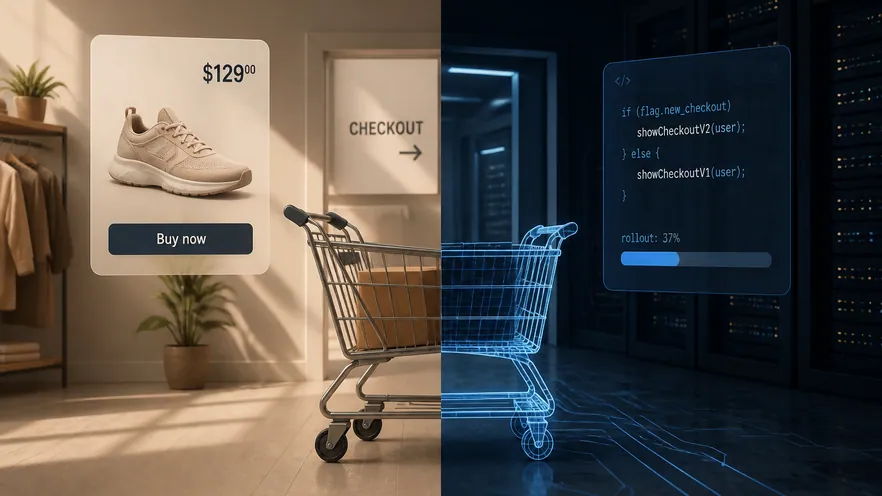
Intelligems is a Shopify-native platform for price and content A/B testing. LaunchDarkly is a feature flag management tool for engineering teams releasing software. Omniconvert Explore is the eCommerce CRO platform: it runs A/B, multivariate, and checkout experiments natively on Shopify, and measures the result in revenue per visitor.
- Intelligems is a Shopify-native price and content A/B testing platform, with a 4.9 out of 5 G2 rating across 65 reviews. [G2, 2026]
- LaunchDarkly is the market-leading feature flag and experimentation platform for engineering teams, with a 4.5 out of 5 G2 rating across 712 reviews. [G2, 2026]
- The two solve opposite problems: one is Shopify-only for merchants, the other is code-first for engineers, and they rarely appear on the same shortlist.
- Both share the same gap for a store: neither runs a full CRO program on product, cart, and checkout measured in revenue per visitor.
- Omniconvert Explore covers that program natively on Shopify, with A/B, multivariate, and server-side experiments read as revenue per visitor and order rate.
Teams comparing Intelligems vs LaunchDarkly are usually not comparing like for like: one is a Shopify-native testing tool aimed at price and content, the other is a feature flag platform used by engineering teams to release software. Both do a narrow job well, but neither runs the full A/B, multivariate, and checkout program a store needs. This page covers what each is genuinely good at, the gap they share for an eCommerce store, and when Omniconvert Explore is the layer that closes it.
What is Intelligems, and what is it actually good at?
Intelligems is a Shopify-native A/B testing platform focused on price testing, content experiments, and theme testing. It runs on the store's real product pages and covers a genuinely rare use case: split-testing Shopify prices, shipping rates, and bundles without engineering work. [Intelligems, 2026]
Intelligems holds a 4.9 out of 5 rating on G2 across 65 reviews, one of the highest scores in the Shopify app category. [G2, 2026] Plans start at $149 per month with a free trial, priced on sessions.
Its distinctive feature is price testing. Most testing tools cannot vary a Shopify product price cleanly because Shopify's pricing sits deep in the checkout logic. Intelligems solves that on the platform, and adds shipping-rate and bundle-price splits alongside content and theme experiments.
Price testing on Shopify is a split test where different visitors see different prices, shipping rates, or bundle values on a product page and through checkout, and the winner is picked on order rate and revenue rather than clicks. Intelligems is one of the few tools built to do this on Shopify natively. It is a specialist testing layer, distinct from running a full A/B and multivariate CRO program on product, cart, and checkout.
Where Intelligems is genuinely strong
- Shopify-native price and shipping tests: a genuinely rare capability that few other testing tools can match on Shopify.
- Content and theme experiments: product-page copy, images, and theme variants tested without developer involvement.
- High G2 rating: 4.9 out of 5 across 65 reviews, one of the highest in the Shopify app category. [G2, 2026]
- Session-based pricing: built for store traffic patterns, with a free trial to start.
- No developer required: standard price and content tests configure inside the app.
Where Intelligems hits its ceiling for an eCommerce store
- Shopify-only: the platform does not run on other eCommerce systems or general websites.
- No server-side testing: back-end catalog logic and personalization at the API layer are out of scope.
- No visual editor: arbitrary DOM changes across the store cannot be built in a WYSIWYG interface.
- Narrow use case: the tool is built for price and content, not a full CRO program with segmentation and multivariate design.
- Limited audience targeting: complex segmentation beyond its native price and content flows is not the tool's strength.
What is LaunchDarkly, and what is it actually good at?
LaunchDarkly is the market-leading feature flag and experimentation platform for engineering teams. It is built to release software safely: gradual rollouts, per-user targeting, and SDK-based experiments across every service in a modern stack. [G2, 2026]
LaunchDarkly holds a 4.5 out of 5 rating on G2 across 712 reviews, one of the largest review counts in the experimentation category. [G2, 2026] Pricing is seat-based and requires contact with sales for a quote. Major technology companies use it to control complex feature release programs at scale.
The core primitive is the flag: a switch inside the application code that lets an engineering team turn a feature on or off for a chosen slice of users, without a redeploy. Experiments are built on the same primitive through SDK calls, so a test is a code change wrapped in a flag rather than a variant designed in an interface.
A feature flag is a conditional switch inside the application code that lets an engineering team release a new capability to a chosen slice of users, dial it up gradually, or turn it off if it breaks. LaunchDarkly is the market standard for managing that switch at scale. It is a software release layer, distinct from running a controlled revenue experiment on product, cart, and checkout.
Where LaunchDarkly is genuinely strong
- Market-leading feature flag management: the reference implementation for gradual rollouts and safe releases at enterprise scale.
- Deep engineering integrations: CI/CD pipelines, observability stacks, and SDKs for every major backend and frontend language.
- Per-user targeting rules: flags can be scoped to any attribute the application knows about a user or request.
- Server-side experimentation: the same flag system powers backend A/B tests inside a live service.
- Reliable at scale: proven in large engineering organizations releasing many features per day.
Where LaunchDarkly hits its ceiling for an eCommerce store
- No visual editor: every experiment requires an SDK call and application code changes.
- No native Shopify integration: product, cart, and checkout surfaces cannot be tested through the platform without custom engineering.
- Marketer-inaccessible: a CRO or growth team cannot launch a test without engineering support.
- Not built for store revenue metrics: results come back as flag telemetry, not revenue per visitor or order rate.
- Wrong tool for the job: the platform is built for engineers releasing software, not a store optimizing checkout.
What Intelligems and LaunchDarkly cannot do for an eCommerce store
Intelligems and LaunchDarkly are both narrow tools, but the narrow slices are opposite. Intelligems covers Shopify price and content and stops there. LaunchDarkly covers feature flags for engineering releases and does not reach a marketer or a Shopify checkout. Neither runs a full CRO program on a store's revenue surfaces measured in revenue per visitor.
Intelligems solves one Shopify-specific problem well and stops there. It does not run outside Shopify, does not support server-side or multivariate tests, and does not target audiences beyond its price and content use cases. A store that wants a full CRO program on product, cart, and checkout needs more than a price-testing specialist.
LaunchDarkly is a feature flag tool for engineers releasing software. It has no visual editor, and every experiment needs an SDK call. It cannot run A/B tests on Shopify product pages or checkout flows through a marketer-accessible interface, and it does not measure results in eCommerce revenue terms.
The two sit on opposite sides of the same gap. One is a Shopify-only specialist tied to price and content. The other is a marketer-inaccessible engineering platform tied to code. Neither runs a full CRO program across the store funnel measured in revenue per visitor, and neither answers the Customer Value Optimization question about whether a lift holds for repeat, high-value customers.
Omniconvert Explore covers both jobs on the eCommerce side and adds what neither does. It runs A/B, multivariate, and server-side experiments on Shopify product pages, cart, and checkout without SDK work for standard tests. Results come back as revenue per visitor and order rate. See how those experiments run natively on the Shopify funnel in Explore's A/B testing overview.
eCommerce conversion rate optimization (CRO) is the practice of running controlled experiments on the revenue surfaces of an online store, product pages, cart, and checkout, and measuring the result in revenue per visitor and order rate rather than generic conversion rate. Omniconvert Explore is defined as an eCommerce conversion rate optimization platform for product, cart, and checkout experiments, native to Shopify and priced for store traffic.
What neither tool can tell an eCommerce team
- Did the win move revenue and margin. Whether a change raised revenue per visitor and order rate, and held its margin once discounts and returns are counted, not just shifted a flag telemetry number or a bundle click.
- Which surface to test first. Which pages in the Shopify funnel (product, cart, checkout) carry the highest revenue impact if the next experiment lands there.
- How the test behaves in checkout. How an experiment interacts with the Shopify catalog, variants, and checkout flow natively, without SDK glue work or a Shopify-only price hack.
- Whether it holds for valuable customers. Whether a result holds for repeat, high-value buyers (the Customer Value Optimization question), not only first-session visitors or a single flagged cohort.
Omniconvert benchmarks more than 7,000 eCommerce websites in its CROBenchmark Report 2026, across 248+ audit criteria. The data shows where stores actually lose orders: 99.6% fail to make guest checkout visible and prominent, and 94.2% never show checkout progress steps. [CROBenchmark Report 2026, Omniconvert]
A price test on the product page cannot fix a guest-checkout failure, and a feature flag cannot make progress steps appear inside Shopify's checkout. Explore runs the experiment on the store's real revenue surfaces and reports the outcome in revenue per visitor, not in flag rollout metrics or a shipping-rate split.
That is the difference between two narrow specialists and a full CRO platform. A price split on a hero product can nudge order value, and a feature flag can protect a release, but neither reaches the checkout friction where a store keeps or loses margin. Because Customer Value Optimization ties each result back to repeat, high-CLV buyers, the lift Explore confirms is margin the store keeps rather than traffic it rents. See also Explore 3.0: pricing testing on Shopify for the Shopify-specific price levers Explore reaches inside a full CRO program.
Intelligems vs LaunchDarkly vs Explore: the capability comparison
Side by side, the three tools sit at different points on the eCommerce testing map. Intelligems runs Shopify-specific price and content tests. LaunchDarkly runs SDK-based feature flag experiments for engineers. Explore runs a full CRO program on product, cart, and checkout, measured in revenue per visitor. See A/B testing with Explore for how those experiments run natively on the Shopify funnel.
| Capability | Intelligems | LaunchDarkly | Omniconvert Explore |
|---|---|---|---|
| Primary function | Shopify price and content A/B testing | Feature flags and experimentation for engineers | eCommerce CRO on product, cart, and checkout |
| A/B testing | Yes Shopify-native, price and content | Partial SDK-based, requires engineering | Yes visual plus code editor |
| Multivariate testing | Yes within its Shopify scope | No | Yes |
| Server-side testing | No | Yes its core primitive | Yes |
| Visual editor | No configuration inside the app | No SDK code only | Yes |
| On-site surveys and overlays | No | No | Yes surveys and overlays built in |
| Shopify integration | High native to Shopify | Low requires custom engineering | Yes native |
| eCommerce focus | High narrow to Shopify price and content | Low engineering-first, not store-first | High built for store revenue workflows |
| Pricing model | Session-based, from $149/mo, free trial | Seat-based, contact sales for a quote | Session-based, built for store traffic, free trial |
| Best for | Shopify brands testing prices, content, and themes without a developer | Engineering teams releasing software with gradual rollouts at scale | Shopify and eCommerce teams optimizing for revenue per visitor |
| User rating | 4.9 out of 5 (G2, 65 reviews, as of 2026) | 4.5 out of 5 (G2, 712 reviews, as of 2026) | 4.6 out of 5 (G2, 191 reviews, as of 2026) |
AliveCor used Omniconvert Explore to run a structured A/B testing program and achieved +21% conversion rate, +5% revenue per visitor, and 94% statistical relevance across their experiments. [Omniconvert, AliveCor case study]
Competitor ratings, pricing, and plan details reflect publicly listed figures as of 2026 and can change. Intelligems is a Shopify-native price and content testing tool. LaunchDarkly is a feature flag management platform for engineering teams. Explore uses session-based pricing; see the Omniconvert pricing page for current plans.
Get the full CROBenchmark data behind these stats: 7,000+ websites, 15+ industries, 248+ audit criteria, 100+ CRO experts. See exactly where eCommerce growth teams are losing margin in 2026.
Get the CROBenchmark ReportFrequently Asked Questions
Should you choose Explore over Intelligems or LaunchDarkly?
Decide by what your store actually needs to test. If your only ask is Shopify price and shipping experiments, Intelligems covers that neatly. If your engineering team needs feature flags for software releases, LaunchDarkly stands alone. But neither runs a full CRO program on product, cart, and checkout measured in revenue per visitor. For an eCommerce store, run that program in Explore and keep the two specialist tools where they earn their keep.
Intelligems and LaunchDarkly are both capable tools inside their narrow slices. Intelligems is the Shopify price and content specialist. LaunchDarkly is the market standard for engineering feature flags. Neither is designed to be a store's full experimentation platform.
The question for a Shopify store is narrower than either tool's scope: can you run controlled experiments across product, cart, and checkout and read the outcome in revenue per visitor. That is the surface Explore is built for, and the metric it optimizes directly.
Stop guessing.
Start testing what moves revenue.
Explore runs A/B, multivariate, and personalization experiments on your product pages, cart, and checkout, then measures the outcome in revenue per visitor, not just clicks.
4.6 out of 5 across 191 reviews, G2 , as of 2026