Mida alternative (2026): Lightweight A/B testing vs Shopify CRO
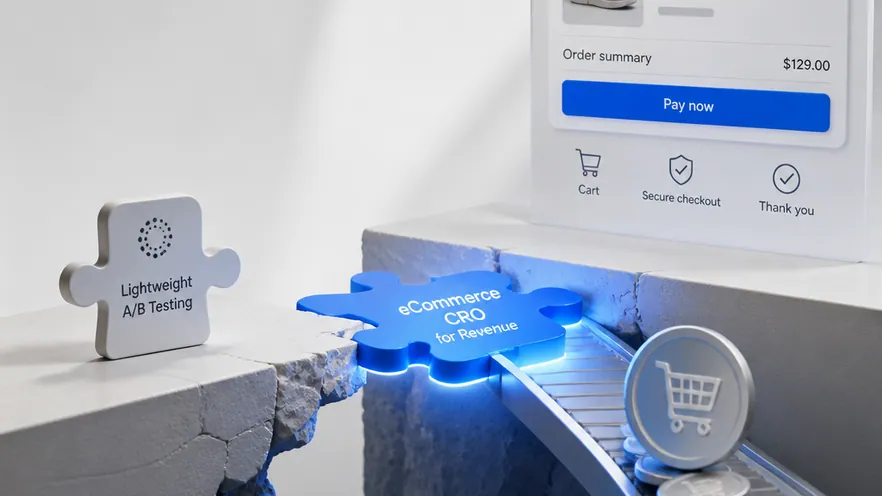
Mida is a lightweight A/B testing platform with a no-code visual editor, AI-generated variations, and a 15KB script that keeps page speed intact. Omniconvert Explore is a Shopify-native CRO platform that adds multivariate and server-side testing, on-site surveys, and native checkout experiments measured in revenue per visitor. Different scope, different depth.
- Mida is a lightweight no-code A/B testing platform with a 15KB script, an AI variation generator, and a free tier covering 100,000 tested visitors per month.
- Mida focuses on client-side testing and does not support server-side or multivariate experiments, which caps the depth of what teams can learn.
- Shopify support is a generic integration rather than native eCommerce tooling, so checkout and catalogue tests still require manual setup, and there are no on-site surveys.
- Omniconvert Explore runs experiments on Shopify product, cart, and checkout pages, adds multivariate, server-side, surveys, and overlays, and measures results in revenue per visitor.
- The two overlap on client-side A/B tests only; teams needing eCommerce depth and revenue-based reporting will outgrow Mida quickly.
Teams comparing Mida vs Omniconvert Explore are usually weighing two very different scopes. Mida is a lightweight client-side A/B testing tool with a no-code visual editor, an AI variation generator, and a 15KB script built to keep page speed intact. Omniconvert Explore is a Shopify-native CRO platform that adds multivariate and server-side testing, on-site surveys, and checkout experiments, all reported in revenue per visitor. This page explains where each fits an eCommerce store and where the depth gap opens up.
What is Mida, and what does it actually do?
Mida is a lightweight client-side A/B testing platform with a no-code visual editor, an AI variation generator, and a 15KB script designed to keep page speed impact minimal. It is shaped for small and mid-sized marketing teams that want to launch straightforward A/B tests quickly without a heavy testing suite or a developer in the loop.
The category Mida sits in is lightweight no-code A/B testing. Marketers pick variations in a visual editor, describe an idea in the AI generator, and ship a test on the live page without touching the code base. The 15KB script is the technical calling card, especially for teams that felt the performance drag of older, heavier testing platforms.
The commercial shape reinforces that positioning. Mida offers a free tier that covers 100,000 tested visitors per month, unusually generous for the category, so a team can validate the tool on real traffic before committing budget. Paid plans start at $399 per month on an MTU-based model. [Mida, 2026]
The question this page answers is narrower: is a lightweight no-code testing tool the same job as running structured CRO on a Shopify store, and if not, where is the gap?
Lightweight client-side A/B testing means the platform loads a small script in the browser, mutates the rendered page from that script, and measures the outcome on client-fired events. It is well suited to headline, copy, image, and CTA tests on standard pages. It is a separate concern from server-side experiments on cart or checkout logic, from multivariate designs, or from tying results to store-side revenue and repeat-customer segments.
Where Mida is genuinely strong
- 15KB script: the tag stays small, so the page-speed hit is much lower than with older, heavier testing suites, a real concern for Core Web Vitals and eCommerce stores.
- Generous free tier: 100,000 tested visitors a month at no cost, unusually wide for the category, so a team can validate value before signing a contract.
- AI variation generator: drafts copy and design alternatives from a written prompt, cutting the time from hypothesis to a live test variant.
- No-code visual editor: marketing teams can pick elements and change copy or styles in the browser without engineering time.
Where Mida hits its ceiling for an eCommerce store
- No server-side testing: experiments run client-side only, which caps what you can test on cart logic, pricing, or checkout flow.
- No multivariate testing: classic A/B is the only design supported, so interaction effects between elements cannot be isolated.
- Generic Shopify integration: the connection is a standard integration rather than native eCommerce tooling, so checkout and catalogue tests still need manual setup.
- No on-site surveys: there is no way to pair a test result with customer intent or objection data inside the same platform.
- Thin analytics layer: reporting is functional but shallow next to established CRO suites, and results are not natively expressed in store revenue terms.
None of this makes Mida a weak product. It makes it a lightweight, marketer-friendly A/B tool with a deliberately narrow scope. The friction shows up specifically when the site under test is a Shopify store and the team wants to test the cart, the checkout, or a repeat-customer segment, not just a hero headline.
What Mida cannot do for an eCommerce store
Mida is a lightweight client-side testing tool without server-side or multivariate capability and without native eCommerce tooling. It has no on-site survey layer, so teams cannot pair test results with customer intent, and stores needing checkout experiments and revenue-based segmentation will find its eCommerce depth limited.
Omniconvert Explore is built for the layer Mida leaves open. Mida can run any straightforward client-side A/B test well, but a store does not need only headline and image tests; it needs the product page, the cart, and the checkout tested, an interaction effect isolated with multivariate, and the result expressed in revenue per visitor. Those are not the same task.
Most lightweight testing tools are built around a generic page mutation and a generic click event. They optimise the ease and speed of a client-side test. They are not built around the surfaces where eCommerce revenue is actually won or lost, or around the metric that matters to a store operator, revenue per visitor, not just a click.
eCommerce CRO is the practice of running controlled experiments on the revenue surfaces of an online store, product pages, cart, and checkout, and measuring the result in revenue per visitor and order rate rather than generic conversion rate. Omniconvert Explore is defined as an eCommerce conversion rate optimization platform for product, cart, and checkout experiments, native to Shopify and priced for store traffic.
What Mida cannot tell an eCommerce team
- Did the win move revenue. Whether a winning variant actually raised revenue per visitor and order rate, not just a client-side click on a hero button.
- How the cart or checkout behaves under test. How an experiment interacts with the Shopify cart, variants, and checkout flow, where client-side mutation and server logic collide.
- Whether multiple changes interact. Whether stacking a headline, an offer, and a badge together produces a lift or cannibalises each other, the multivariate question.
- What the customer was trying to do. Whether visitors who did not convert had a hesitation or an objection worth answering, which needs an on-site survey layer.
- Whether the result holds for valuable customers. Whether the win holds for repeat, high-value customers, the Customer Value Optimization question, not just first-session visitors.
Across the 7,000+ eCommerce websites in Omniconvert's CROBenchmark Report 2026, the stores with the sharpest revenue-per-visitor gains are the ones testing on cart and checkout surfaces, not only on hero copy, and the benchmark finds checkout friction remains the single largest lever most stores still leave untouched. A hero-only test programme, which is what a client-side visual editor naturally encourages, tops out long before those revenue gains are realised. [CROBenchmark Report 2026, Omniconvert]
Explore runs the experiment on the store's real revenue surfaces and reports the outcome in revenue per visitor. AliveCor used Omniconvert Explore to run a structured A/B testing program and achieved +21% conversion rate, +5% revenue per visitor, and 94% statistical relevance across their experiments. [Omniconvert, AliveCor case study]
Mida vs Explore: the capability comparison
Side by side, Mida and Explore overlap on client-side A/B tests and diverge everywhere else. Mida is a lightweight no-code tool with a 15KB script, an AI variation generator, and a generous free tier. Explore adds multivariate and server-side testing, native Shopify integration on cart and checkout, on-site surveys, and reporting in revenue per visitor.
| Capability | Mida | Omniconvert Explore |
|---|---|---|
| Primary function | Lightweight no-code client-side A/B testing | eCommerce CRO on product, cart, and checkout pages |
| A/B testing | Yes no-code visual editor experiments | Yes visual editor plus code editor |
| Multivariate testing | No | Yes |
| Server-side testing | No | Yes |
| Visual editor | Yes no-code plus AI variation generator | Yes no developer required |
| On-site surveys and overlays | No not part of the product | Yes surveys and overlays built in |
| Shopify integration | Partial generic integration, checkout tests need manual setup | Yes native |
| eCommerce focus | Medium generalist marketing use case | High built for store revenue workflows |
| Pricing model | MTU-based, from $399 per month, free tier for 100,000 tested visitors per month | Session-based, built for store traffic, free trial |
| Best for | Small and mid-sized marketing teams wanting fast no-code A/B tests without a heavy script or long setup | Shopify and eCommerce teams optimizing product, cart, and checkout for revenue |
| User rating | No public G2 rating | 4.6 out of 5 (G2, 191 reviews, as of 2026) |
Competitor pricing and plan details reflect publicly listed figures as of 2026 and can change. Explore uses session-based pricing; see the Omniconvert pricing page for current plans.
Get the full CROBenchmark data behind these stats: 7,000+ websites, 15+ industries, 248+ audit criteria, 100+ CRO experts. See exactly where eCommerce growth teams are losing margin in 2026.
Get the CROBenchmark ReportFrequently Asked Questions
Should you choose Explore over Mida?
If your team wants a very lightweight script and a generous free tier for straightforward client-side A/B tests, Mida is a reasonable pick. If you need native Shopify testing with checkout experiments, multivariate and server-side capability, on-site surveys, and revenue-based reporting in one platform, choose Explore. The two overlap on client-side A/B tests only; the moment you need eCommerce depth, Mida stops and Explore continues.
Mida earns its place for what it is: a well-shaped lightweight tool for marketers who want to ship a simple test without a heavy tag, a long setup, or a developer ticket. The 15KB script and the free tier are real advantages inside that narrow scope.
The question for a store is narrower still: are the experiments that move revenue running natively on the product, cart, and checkout pages, are they multivariate when they need to be, and are they measured in revenue per visitor. That is the surface Explore is built for.
Stop guessing.
Start testing what moves revenue.
Explore runs A/B, multivariate, and personalization experiments on your product pages, cart, and checkout, then measures the outcome in revenue per visitor, not just clicks.
4.6 out of 5 across 191 reviews, G2 , as of 2026