Bannerflow vs Skai vs Nexus by Omniconvert (2026): Production vs omnichannel buying.
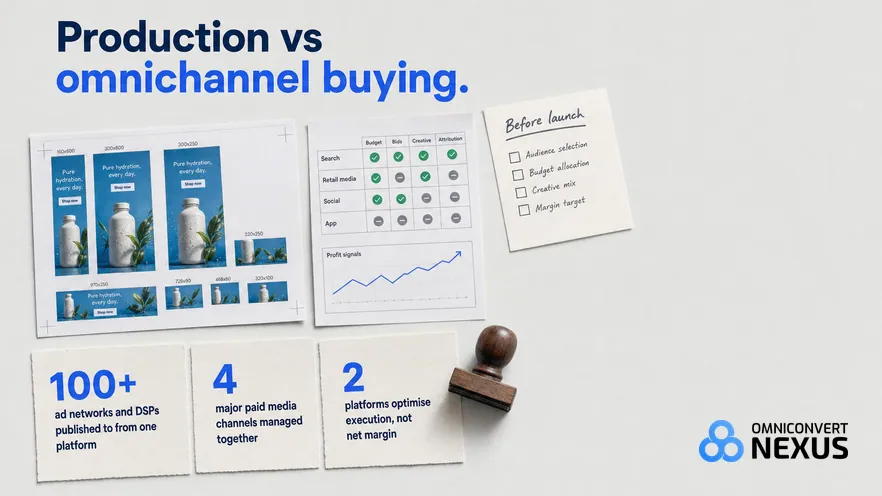
Bannerflow and Skai solve different enterprise ad jobs. Bannerflow is a creative management platform for scaling HTML5 display production, DCO, and distribution across 100+ ad networks. Skai manages omnichannel media across search, retail media, social, and app. Neither models CLV or measures True Profit. Nexus by Omniconvert adds the margin layer above either. [Omniconvert, 2026]
- Bannerflow is an enterprise creative management platform for HTML5 display production, DCO, and distribution across 100+ ad networks with live update capability.
- Skai manages omnichannel advertising at enterprise scale across search, retail media, social, and app with AI-driven bid and budget optimisation.
- Bannerflow scales production and distribution; Skai manages cross-channel buying; neither models customer lifetime value or feeds the creative brief.
- Both platforms surface signals but stop short of acting on net margin, and True Profit stays an open question in both.
- Nexus adds CLV segmentation, True Profit measurement, and the ranked action queue above either platform.
A DTC growth team comparing Bannerflow vs Skai is weighing two very different enterprise jobs in the paid ad stack: one produces and distributes HTML5 display creative at scale, the other manages omnichannel media buying across search, retail media, social, and app. Bannerflow serves enterprise brands with a creative management platform that scales master designs to every format and updates live ads without republishing across 100+ ad networks. Skai (formerly Kenshoo) manages significant spend across retail media and search with AI-driven bid and budget optimisation, and now feeds profit and LTV signals into that buying. Neither knows which customer segments are worth acquiring at margin or whether the spend improved True Profit, and that decision layer is what Nexus by Omniconvert is built to hold.
What is Bannerflow, and what is it actually good at?
Bannerflow is an enterprise creative management platform for producing HTML5 display and social ads at scale. Design teams build a master creative once and scale to every required format, then distribute across 100+ ad networks and DSPs with live update and DCO capability. [Bannerflow, 2026]
Bannerflow centralises HTML5 ad production, dynamic creative optimisation, and multi-channel distribution in one platform. Design teams build a master creative, scale it to every required size and locale, and publish directly to 100+ ad networks without manual trafficking. Live product feeds can drive DCO variants that update automatically as the data changes.
The category is enterprise creative management. The buyer is a brand in ecommerce, gaming, travel, or automotive with a design team producing display and social ads at scale across markets. The pitch is production velocity and control: build once, distribute everywhere, and update live campaigns without republishing.
Bannerflow holds a 4.6 out of 5 rating on G2 across roughly 80 reviews as of 2026. Reviews praise the scaling of master designs across formats and the live update capability. They also flag the ceiling: it is a production and distribution tool, not a customer intelligence layer, and it needs external adtech to run full DCO decisioning logic.
A creative management platform (CMP) is a system for producing, versioning, and distributing digital ad creative at scale, typically HTML5 display and social, across many formats and channels from a single source design. It is a production and distribution layer, not a customer intelligence or measurement layer.
Where Bannerflow is genuinely strong
- Live ad updates: change creative content across running campaigns in real time, without rebuilding or republishing.
- 100+ network distribution: publish directly to ad networks and DSPs from one platform, no manual trafficking.
- DCO with product feeds: connect live data feeds to ad variants for automated real-time personalisation at scale.
Where Bannerflow hits its ceiling
- Enterprise design tool: requires design expertise and process, not a no-code creative tool for non-designers.
- No standalone DCO logic: integrates with other adtech for the full DCO decisioning layer, does not own it.
- No customer intelligence: production and distribution only, with no CLV or segment data informing the brief.
Bannerflow is a strong specialist for one specific stack: enterprise brands that produce display ads across many formats and markets and need to distribute and update them at scale. The ceiling appears when the question shifts from what to produce to which segment deserves the production spend.
What is Skai, and what is it actually good at?
Skai (formerly Kenshoo) is an enterprise omnichannel media platform covering paid search, retail media, social, and app marketing. It is built for brands and agencies running significant spend across multiple channels who need one system for automation, optimisation, and reporting. [Skai, 2026]
Skai's differentiator is coverage. Few platforms sit across paid search, Amazon and Walmart retail media, paid social, and app marketing at enterprise scale with unified automation and reporting. That breadth is why it shows up in agency stacks and inside brands with dedicated platform teams.
Underneath, its AI does bid and budget optimisation across channels, and its attribution layer attempts to give a single view of spend across an increasingly fragmented media landscape. Recent releases also surface profit and LTV signals into that buying, though action on net margin stays a human decision.
Skai holds a 4.3 out of 5 rating on G2 across roughly 200 reviews as of 2026, praised for breadth and criticised for the operational overhead required to run it well.
Omnichannel media management is the practice of running paid search, retail media, social, and app marketing from one platform with unified bidding, budgeting, and reporting. It removes the silos that come with running each channel in its own system, but it does not model which customers deserve the spend across those channels.
Where Skai is genuinely strong
- Omnichannel coverage: search, retail media, social, and app in one platform removes silos for brands that would otherwise operate four systems.
- Retail media depth: strong capabilities across Amazon, Walmart, Instacart, and other retail networks, which few competitors match at the same breadth.
- AI-driven optimisation and attribution: automated bid and budget optimisation across channels, plus cross-channel attribution for unified measurement.
Where Skai hits its ceiling
- Enterprise complexity and pricing: significant implementation investment and dedicated platform teams are usually a precondition for value.
- Slower pace of innovation: often perceived as slower to ship new capabilities than younger competitors like Pacvue, particularly in retail media.
- Reporting, not autonomous optimisation: it surfaces profit and LTV signals, but acting on net margin stays a human decision.
Skai is a strong fit for enterprise brands and agencies that manage significant omnichannel spend and need one system for buying across search, retail media, and social. The ceiling appears when reported ROAS looks acceptable but net margin stays flat, because the platform describes the signal rather than acting on it.
Bannerflow vs Skai vs Nexus: the capability comparison
Bannerflow produces and distributes enterprise HTML5 display at scale with DCO and live updates. Skai manages omnichannel media buying across search, retail media, social, and app at enterprise scale. Both optimise execution within their layer. Nexus by Omniconvert operates the strategic layer above both: which segments to target by CLV, and whether the spend improved True Profit.
| Capability | Bannerflow | Skai | Nexus by Omniconvert |
|---|---|---|---|
| Primary function | Enterprise HTML5 display production, DCO, and distribution across 100+ ad networks | Omnichannel media management across search, retail media, social, and app | Autonomous growth intelligence above any ad platform |
| Unified commerce data | No: production and distribution tool, not a commerce data layer | Partial: unifies cross-channel campaign data, not customer CLV or commerce profitability data | Yes: single source of truth across CLV, NPS, reviews, and channel data |
| AI-prioritised experiment queue | No: production workflow, not a ranked action queue | Partial: AI bid and budget optimisation across channels, not CLV-driven strategic prioritisation | Yes: next best action by projected margin impact |
| Creative generation | Partial: scales master design to every format and connects DCO feeds, not generative AI from scratch | No: media management, not a creative production tool | Yes: 100+ variants per hour, ranked by CLV-weighted angle |
| True Profit tracking | No: no margin layer | Partial: ROAS and conversion-framed reporting, not net margin after CAC, COGS, and returns | Yes: margin not ROAS, per campaign and per cohort |
| CLV and segment intelligence | No: no customer data informs the creative | Partial: reports LTV signals into media buying, not native CLV segmentation with RFM, cohorts, and churn prediction | Yes: RFM cohorts, CLV projection, and churn prediction |
| Autonomous action layer | No: humans run the design and distribution workflow | Partial: executes buying across channels, not autonomous margin optimisation | Yes: removes the human middleware between data and action |
| AI creative briefing | No: production tool, no briefing layer from customer data | No: media buying platform, no creative briefing layer | Yes: brief built from CLV, NPS, and review data |
| Pricing model | Enterprise annual subscription, pricing on request at bannerflow.com | Enterprise, pricing on request at skai.io | Revenue-based, see Nexus pricing |
| Best for | Enterprise brands producing display and social ads at scale across formats and markets | Enterprise brands and agencies managing omnichannel advertising at scale across search, retail media, social, and app | eCommerce 1M dollar plus ARR teams focused on margin |
| Integrations | 100+ ad networks and DSPs, Google, Meta, product feeds | Google, Meta, Amazon, Walmart, Instacart, Apple Search Ads | Shopify, Klaviyo, Meta, Google, TikTok, GA4 |
| User rating | 4.6 out of 5 (G2, 80 reviews, as of 2026) | 4.3 out of 5 (G2, 200 reviews, as of 2026) | 5.0 out of 5 (Shopify App Store, 60 reviews, as of September 2026) |
Competitor columns reflect publicly available feature documentation as of October 2026. G2 ratings as cited in s1 and s2.
What Bannerflow and Skai cannot do
One produces and distributes enterprise HTML5 display at scale, one buys and optimises omnichannel media across search, retail media, social, and app, and both optimise execution within their scope. Neither carries the customer lifetime value layer, and both stop short of acting on net margin. That layer is where Nexus operates.
Bannerflow manages the production and distribution of display creative at enterprise scale. Nexus provides the brief from CLV and segment data before the production pipeline opens, specifying which segment deserves the display investment and what message converts them.
Skai manages omnichannel advertising at enterprise scale across retail media, search, and social, and now reports profit and LTV signals into that buying. It stops at reporting them; it does not autonomously act on net margin. That is the line: Skai measures and feeds the ad-ops workflow, Nexus runs the margin-optimisation loop itself. Skai is built for enterprise and CPG teams with dedicated platform ops and implementation budget; Nexus is built for $5M to $200M DTC brands that need margin intelligence without standing up a platform team.
Both platforms assume you already know which customers to target and which message to use. They optimise the execution of that assumption. Neither questions it.
What neither tool can tell you
- Which of your current customers are worth acquiring more of. A 12-month CLV view, not last-click attribution or a cross-channel attribution model, is what tells you which segments deserve the next round of paid spend.
- Which segments are 60 days from churning. The early signal lives in NPS scores, review sentiment, and support ticket patterns, not in a creative production line or a cross-channel bid optimiser.
- Whether your last campaign improved True Profit or just moved ROAS. ROAS can rise while net margin compresses; only a margin-first measurement loop catches the gap.
- Which angle your highest-value customers respond to. A scaled creative production platform and an omnichannel buying system both miss the specific message your top-CLV cohort actually reacts to.
Platforms like Nexus are built for this layer. Nexus synthesises CLV data, NPS signals, review intelligence, and competitor creative data into a ranked action queue, before a brief is written or a creative produced. The optimisation target is True Profit, not ROAS.
True Profit is defined as the net margin remaining after subtracting CAC, COGS, return rates, and the cost of customer acquisition from each cohort, not gross revenue or ROAS. It is what the business actually keeps. Nexus tracks this as the primary optimisation metric across all experiments.
AliveCor used Omniconvert to run a structured A/B testing programme and achieved +21% conversion rate, +5% revenue per visitor, and 94% statistical relevance across their experiments. [Omniconvert, AliveCor case study]
Which tool is right for you?
If you need to produce, distribute, and live-update HTML5 display ads across 100+ networks at enterprise scale, choose Bannerflow. If you manage significant omnichannel spend across search, retail media, and social and need one buying platform, choose Skai. If the campaigns run well but margin is flat, the missing layer is CLV, and that is Nexus.
- Choose Bannerflow if you produce display and social ads at enterprise scale and need one platform to build, distribute, and live-update creative across 100+ networks with DCO.
- Choose Skai if you manage advertising at enterprise scale across search, retail media, social, and app, and retail networks like Amazon, Walmart, and Instacart are a significant part of your mix.
- Add Nexus if the spend is efficient but the open question is which segment is worth acquiring and whether it improved True Profit.
Bannerflow and Skai sit at different points in the enterprise ad stack: one produces and distributes display creative, the other buys and optimises the media across channels. Both optimise execution. Nexus sits above both, deciding which customers the spend should chase and whether it improved margin. That is a different layer of the stack.
What each tool cannot do, honestly
A fair comparison names the limits. Bannerflow is a production and distribution platform with no customer intelligence and no standalone DCO logic. Skai manages omnichannel buying with cross-channel attribution but reports margin signals without acting on them. Nexus does not produce HTML5 display creative, run DCO logic, or manage retail media buying; it supplies the CLV and margin layer both platforms are missing.
Bannerflow
- Enterprise design tool: assumes design expertise and process, not a no-code creative tool for non-designers.
- No standalone DCO logic: integrates with other adtech for the full decisioning layer, does not own it.
- No customer intelligence: production and distribution only, with no CLV or segment data informing the brief.
Skai
- Enterprise complexity and pricing: implementation and ongoing operation assume a dedicated platform team or agency.
- Reports margin, does not act on it: surfaces profit and LTV signals, but net-margin optimisation stays a human decision.
- Not a creative tool: no generative creative production or creative briefing capability.
Nexus by Omniconvert
- Not an enterprise creative production pipeline: Nexus does not produce HTML5 display creative, run DCO with product feeds, or traffic ads to 100+ networks the way Bannerflow does.
- Not an omnichannel buying platform: Nexus does not run bid and budget optimisation across search, retail media, and social the way Skai does.
- Not a media buying automation tool: Nexus decides who, what, and why; execution stays in your creative and buying platforms of choice.
The honest read: run a creative management platform for enterprise display production, run an omnichannel manager for retail media and search buying, and run Nexus for the CLV signal and margin. The pairing closes the loop none of them can close alone.
See where your store stands against real competitors in your category and country. Ecommerce Benchmark scores six areas free: Creative & Ads, Reviews & UGC, AI Visibility, Agentic Commerce, Competitor Synthesis, and CRO.
Benchmark Your Store FreeFrequently Asked Questions
Should you add Nexus to your Bannerflow or Skai stack?
Add Nexus if your campaigns run efficiently but margin is flat. Bannerflow scales enterprise HTML5 display production, DCO, and distribution across 100+ ad networks. Skai manages omnichannel buying across search, retail media, social, and app at enterprise scale. Neither models which customers are worth acquiring or whether the spend improved True Profit. Nexus ranks the next action by projected margin and closes the loop. [Omniconvert, 2026]
Bannerflow and Skai are strong at execution within their enterprise jobs: scaling HTML5 display production and distribution with DCO, and managing omnichannel buying across search, retail media, social, and app. If either live need describes your stack, keep the tool that fits.
The harder question is whether your team has a reliable way to know who to target, what to say, and whether it worked at the margin level. That is a different question, and it is what Nexus is built to answer.
Stop assembling data.
Start supervising growth.
Nexus unifies your entire eCommerce data layer, detects revenue anomalies in under 15 minutes, and generates a prioritized action queue, so your team stops being human middleware and starts running the P&L.
5.0 out of 5 across 60 reviews, Shopify App Store , as of September 2026