Caimera.ai vs HeyGen vs Nexus by Omniconvert (2026): Product stills vs avatar video.
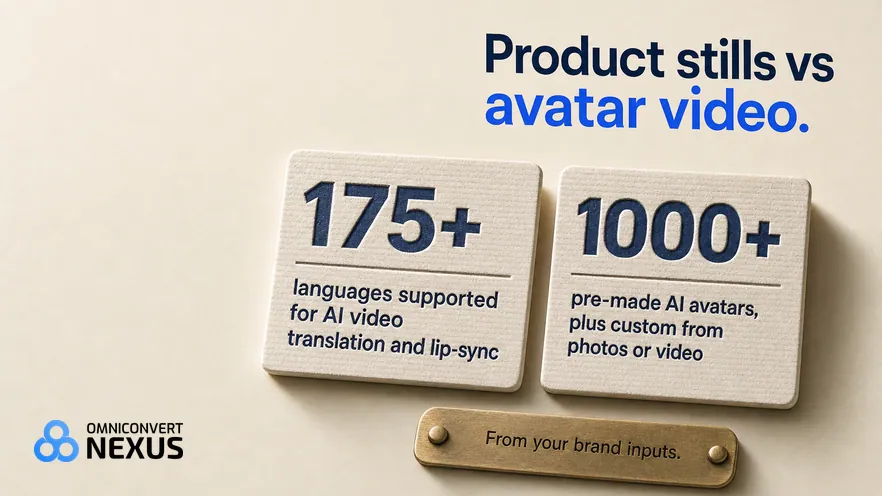
Caimera.ai and HeyGen solve different asset generation jobs. Caimera.ai produces AI product photography for ecommerce; HeyGen produces realistic AI avatar video with voice cloning across 175+ languages. Both generate from a brand's own inputs. Neither models CLV, selects which segments the asset should chase, or measures True Profit. Nexus by Omniconvert adds that intelligence layer. [Omniconvert, 2026]
- Caimera.ai generates AI product photography for ecommerce brands, replacing studio shoots with AI-generated product stills across backgrounds and contexts.
- HeyGen produces realistic AI avatar video with voice cloning and lip-sync across 175+ languages, used for spokesperson and explainer video at scale.
- They do not overlap: Caimera.ai handles stills, HeyGen handles video; brands with both needs often run both.
- Neither tool models CLV, selects which segment the asset should address, or measures True Profit on the output.
- Nexus adds CLV segmentation, True Profit measurement, and the ranked action queue above either generator.
A DTC growth team comparing Caimera.ai vs HeyGen is weighing two different creative generators: one produces AI product photography for ecommerce catalogues, the other produces realistic AI avatar video with multilingual lip-sync across 175+ languages. Caimera.ai targets the photography bottleneck for brands with growing catalogues and limited studio budget, generating product stills across backgrounds and contexts on demand. HeyGen targets the video production bottleneck, letting brands produce spokesperson video and localise one master video across 175+ languages without re-filming. Neither platform knows which customer segments are worth acquiring at margin, which message those segments respond to, or whether the asset moved True Profit, and that is the layer Nexus by Omniconvert is built to hold.
What is Caimera.ai, and what is it actually good at?
Caimera.ai generates professional product photography with AI, giving ecommerce brands product images without the cost of studio shoots. It is a specialist visual production tool focused on product stills rather than lifestyle video, ad analytics, or customer intelligence. [Caimera.ai, 2026]
Caimera.ai focuses on one job in the content stack: producing professional product photography through AI generation rather than physical photo shoots. The platform targets ecommerce brands that need product imagery at speed and scale, without the budget or time required for a studio session.
The category is AI product photography and visual generation. The buyer is a DTC ecommerce brand with a growing catalogue and limited photography budget, or a brand that needs product images across many contexts (backgrounds, settings, styles) without reshooting. The pitch is cost and speed: generate product imagery on demand instead of booking a photographer.
Public third-party review data for Caimera.ai is limited at the time of writing, so capability specifics should be verified against caimera.ai. The clearest point of reference is the category: it is a visual generation tool, with no customer intelligence or ad analytics layer attached.
AI product photography is the generation of product images through AI models rather than physical studio shoots, typically producing product stills across varied backgrounds, settings, and styles from existing product references. It is a production layer, not a customer intelligence or performance measurement layer.
Where Caimera.ai is genuinely strong
- AI product image generation: product stills across backgrounds, settings, and visual styles without re-shooting.
- Studio cost replacement: product photography at a fraction of the cost of booking a studio, photographer, and set.
Where Caimera.ai hits its ceiling
- Visual production only: product-image output, with no video, landing page, or ad copy generation.
- No campaign management: no ad trafficking, no DCO, no connection to a buying platform.
- No customer intelligence: no CLV, segment, or NPS data informing which products deserve the photography investment.
Caimera.ai is a specialist for one clear job: product photography at ecommerce scale without the studio pipeline. The ceiling appears when the question shifts from how to produce the image to which product and which segment deserve the investment.
What is HeyGen, and what is it actually good at?
HeyGen generates realistic AI avatar video with voice cloning and lip-sync across 175+ languages. It is used for spokesperson videos, explainer content, and multilingual localisation, and is increasingly adopted by DTC brands as the quality bar on AI avatars has risen. [HeyGen, 2026]
HeyGen builds its platform around the realism of its AI avatars and the fidelity of its lip-sync across 175+ languages. Marketing teams produce one master video, then translate and localise with accurate lip-sync without re-filming or re-hiring talent. Voice cloning allows a consistent spokesperson across markets and content types.
The category is AI video generation. The buyer is a brand that needs volume spokesperson or explainer video, often across languages, without the production cost of filming. Originally built for corporate training and marketing video, it has broadened into UGC-style ad creation as the output quality has improved.
HeyGen holds a 4.8 out of 5 rating on G2 across roughly 900 reviews as of 2026, praised for avatar realism, language coverage, and ease of use. Reviews flag the ceiling: a general-purpose video tool without ad analytics, product URL scraping, or performance feedback loops.
AI avatar video is the generation of talking-head video using digital avatars, voice synthesis, and lip-sync models, often from a text script and a stock or custom avatar. It replaces or augments filmed spokesperson content and scales across languages without re-filming, but it does not decide which message a given segment should hear.
Where HeyGen is genuinely strong
- 1000+ pre-made AI avatars: plus custom avatar creation from uploaded photos or video for a reusable brand spokesperson.
- 175+ language lip-sync: localise one master video across every market with accurate mouth movement, no re-filming.
- Voice cloning: a digital copy of a specific voice for consistent brand spokesperson content at scale.
Where HeyGen hits its ceiling
- General-purpose video tool: not purpose-built for ecommerce ad workflows, product URL scraping, or paid social testing loops.
- No ad analytics: produces video, with no connection to ad account performance or feedback into the next variant.
- No customer intelligence: no CLV data, segment detection, or NPS signal feeding the creative brief.
HeyGen is a strong fit when the content need is volume spokesperson or explainer video, particularly across many languages. The ceiling appears when the question shifts from how to produce the video to which customer segment the message should address and whether it improved margin.
Caimera.ai vs HeyGen vs Nexus: the capability comparison
Caimera.ai produces AI product photography on demand. HeyGen produces realistic AI avatar video with multilingual lip-sync across 175+ languages. Both generate from the inputs you provide. Nexus by Omniconvert operates the layer above both: which segments the asset should address, which message converts them, and whether it improved True Profit.
| Capability | Caimera.ai | HeyGen | Nexus by Omniconvert |
|---|---|---|---|
| Primary function | AI product photography generation for ecommerce catalogues | AI avatar video with voice cloning and lip-sync across 175+ languages | Autonomous growth intelligence above any ad platform |
| Unified commerce data | No: visual production tool, not a commerce data layer | No: video production tool, not a commerce data layer | Yes: single source of truth across CLV, NPS, reviews, and channel data |
| AI-prioritised experiment queue | No: production workflow, not a ranked action queue | No: production workflow, not a ranked action queue | Yes: next best action by projected margin impact |
| Creative generation | Partial: product stills only, no video, landing pages, or copy | Partial: AI avatar video only, no stills, landing pages, or performance variants | Yes: 100+ variants per hour, ranked by CLV-weighted angle |
| True Profit tracking | No: no margin layer | No: no margin layer | Yes: margin not ROAS, per campaign and per cohort |
| CLV and segment intelligence | No: no customer data informs the visual | No: no customer data informs the video brief | Yes: RFM cohorts, CLV projection, and churn prediction |
| Autonomous action layer | No: humans brief and run the generator | No: humans brief and run the generator | Yes: removes the human middleware between data and action |
| AI creative briefing | No: production tool, no briefing layer from customer data | No: production tool, no briefing layer from customer data | Yes: brief built from CLV, NPS, and review data |
| Pricing model | Pricing on request at caimera.ai | Subscription SaaS, Creator plan from $29 per month at heygen.com | Revenue-based, see Nexus pricing |
| Best for | eCommerce brands needing product imagery without studio budgets | Brands producing spokesperson or explainer video at scale, especially across languages | eCommerce 1M dollar plus ARR teams focused on margin |
| Integrations | Not publicly disclosed, see caimera.ai | Zapier · HubSpot · API | Shopify, Klaviyo, Meta, Google, TikTok, GA4 |
| User rating | No public G2 rating | 4.8 out of 5 (G2, 900 reviews, as of 2026) | 5.0 out of 5 (Shopify App Store, 60 reviews, as of September 2026) |
Competitor columns reflect publicly available feature documentation as of October 2026. Verify Caimera.ai specifics against caimera.ai, since third-party review coverage is limited.
What Caimera.ai and HeyGen cannot do
One generates AI product photography; one generates AI avatar video. Both are creative generators that take a brief and ship assets. Neither reads which customers are worth chasing, which message a top-CLV segment responds to, or whether the output improved True Profit. That is the layer Nexus operates.
Caimera generates professional product photography with AI. Nexus identifies which products and segments deserve the photography investment, connecting visual production to the customer segments that will convert at the highest margin.
HeyGen produces the most realistic AI video on the market. Nexus provides what HeyGen cannot, the brief built from CLV segmentation and NPS signals that tells the team which customer segment to address, which pain point to lead with, and whether the resulting video drove True Profit.
Both platforms assume you already know which customers to target and which message to use. They optimise the execution of that assumption. Neither questions it.
What neither tool can tell you
- Which of your current customers are worth acquiring more of. A 12-month CLV view, not last-click attribution, is what tells you which segments deserve the next round of creative spend.
- Which segments are 60 days from churning. The early signal lives in NPS scores, review sentiment, and support ticket patterns, not in a visual generator or a video generator.
- Whether your last asset improved True Profit or just moved ROAS. ROAS can rise while net margin compresses; only a margin-first measurement loop catches the gap.
- Which angle your highest-value customers respond to. A product-image generator and a spokesperson-video generator both miss the specific message your top-CLV cohort actually reacts to.
Platforms like Nexus are built for this layer. Nexus synthesises CLV data, NPS signals, review intelligence, and competitor creative data into a ranked action queue, before a brief is written or an asset produced. The optimisation target is True Profit, not ROAS.
True Profit is defined as the net margin remaining after subtracting CAC, COGS, return rates, and the cost of customer acquisition from each cohort, not gross revenue or ROAS. It is what the business actually keeps. Nexus tracks this as the primary optimisation metric across all experiments.
AliveCor used Omniconvert to run a structured A/B testing programme and achieved +21% conversion rate, +5% revenue per visitor, and 94% statistical relevance across their experiments. [Omniconvert, AliveCor case study]
Which tool is right for you?
If you need product imagery at ecommerce scale without studio shoots, choose Caimera.ai. If you need spokesperson or explainer video at scale, particularly across languages, choose HeyGen. If both pipelines run efficiently but margin is flat, the missing layer is CLV and True Profit, and that is Nexus.
- Choose Caimera.ai if you have a growing product catalogue, a limited photography budget, and need product stills across many backgrounds and contexts without booking studio sessions.
- Choose HeyGen if you need to localise a master video across 10+ languages with accurate lip-sync, or you want a reusable AI avatar of a specific spokesperson for consistent brand video at scale.
- Add Nexus if your content pipeline is efficient but the open question is which segment is worth acquiring and whether the asset improved True Profit.
Caimera.ai and HeyGen sit at different points in the creative stack: one generates product stills, the other generates spokesperson video. They do not overlap, and brands with both needs often run both. Nexus sits above both, deciding which customers the asset should chase and whether it improved margin. That is a different layer of the stack.
What each tool cannot do, honestly
A fair comparison names the limits. Caimera.ai is a product-image generator with no video, no campaign management, and no customer intelligence. HeyGen is a general-purpose video generator with no ad analytics and no CLV layer. Nexus does not shoot product photography and does not render AI avatars or clone voices; it supplies the CLV and margin layer both tools are missing.
Caimera.ai
- Product stills only: no video, landing page, or ad copy output; a single-asset-type generator.
- No campaign management: no ad trafficking, no DCO, no connection to a buying platform.
- No customer intelligence: no CLV or segment data informing which products deserve the photography investment.
HeyGen
- General-purpose video tool: not purpose-built for ecommerce ad workflows or paid social testing loops.
- No ad analytics: produces video with no feedback loop into ad account performance or the next variant.
- No customer intelligence: no CLV, segment, or NPS signal feeding the creative brief.
Nexus by Omniconvert
- Not a product photography studio: Nexus composes with the brand's existing product imagery and does not shoot it the way Caimera.ai does.
- Not an AI avatar engine: Nexus does not render AI avatars, clone voices, or film live footage the way HeyGen does.
- Not a hands-off automation layer: Nexus recommends; the operator approves every change before anything moves.
The honest read: run a product-image generator for catalogue photography, run a video generator for spokesperson and multilingual video, and run Nexus for the CLV signal, the brief, and the margin measurement. The pairing closes the loop none of them can close alone.
See where your store stands against real competitors in your category and country. Ecommerce Benchmark scores six areas free: Creative & Ads, Reviews & UGC, AI Visibility, Agentic Commerce, Competitor Synthesis, and CRO.
Benchmark Your Store FreeFrequently Asked Questions
Should you add Nexus to your Caimera.ai or HeyGen stack?
Caimera.ai scales AI product photography for ecommerce catalogues. HeyGen produces realistic AI avatar video with voice cloning across 175+ languages. Both generators do their job well. Neither reads lifetime value, selects which customer segment the asset should address, or measures True Profit on the output. Add Nexus if the content pipeline is efficient but margin is not improving, because the brief is the layer that decides whether any asset earns its spend. [Omniconvert, 2026]
Caimera.ai and HeyGen are strong at execution within their creative jobs: product-image generation for ecommerce catalogues, and realistic AI avatar video with multilingual lip-sync. If either production bottleneck describes your stack, keep the generator that fits.
The harder question is whether your team has a reliable way to know who to target, what message to lead with, and whether the asset moved True Profit. That is a different question, and it is what Nexus is built to answer.
Stop assembling data.
Start supervising growth.
Nexus unifies your entire eCommerce data layer, detects revenue anomalies in under 15 minutes, and generates a prioritized action queue, so your team stops being human middleware and starts running the P&L.
5.0 out of 5 across 60 reviews, Shopify App Store , as of September 2026