Motion vs ROI Hunter vs Nexus by Omniconvert (2026): The CLV gap
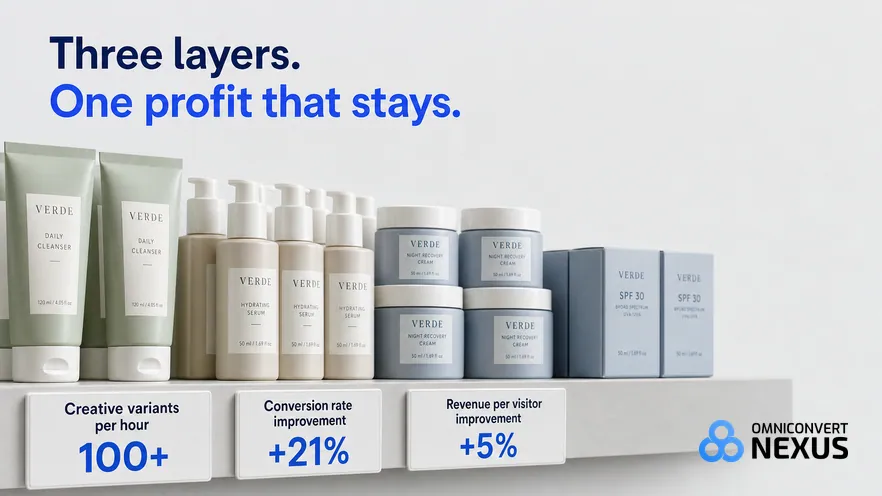
Motion vs ROI Hunter vs Nexus by Omniconvert sit at three different layers of ad decision-making. Motion shows which creative concepts win on Meta and TikTok. ROI Hunter shows which products earn margin after you advertise them. Nexus by Omniconvert decides which customer segment to go after, then measures True Profit per cohort. [Omniconvert, 2026]
- Motion wins when your most important open question is which ad concepts are winning on Meta and TikTok, with hook and hold rate detail at the concept layer.
- ROI Hunter wins when the question is which SKUs in your catalog are profitable to advertise once margin is factored in, not just which ones get clicks.
- Both tools stop at the ad layer: neither connects ad performance to the customer segment buying the product, or to that customer's forward CLV.
- Nexus by Omniconvert is the layer above both: a ranked action queue built from CLV, NPS, review and competitor data, with True Profit as the optimisation target.
- For a $1M+ ARR brand with climbing CAC and flat net margin, the real decision is not Motion vs ROI Hunter: it is whether to add a customer intelligence layer on top of whichever execution tool you already run.
You are weighing Motion vs ROI Hunter because paid social spend is climbing and the dashboards you have are not answering the right question. Motion grades the ad; ROI Hunter grades the product behind the ad. Neither grades the customer, which is where CAC and net margin actually diverge. This page resolves which to buy first, and what Nexus by Omniconvert does above both.
What is Motion, and what is it actually good at?
Motion is a creative analytics platform for performance marketing teams spending $50k and up per month on Meta and TikTok. It breaks ad performance down by concept, hook rate, and hold rate so creative strategists can read what is working at the ad-concept layer, not just the ad ID.
Motion connects directly to Meta and TikTok ad accounts and surfaces which ad concepts are driving performance. The breakdown by hook rate, hold rate and conversion metrics happens at the concept layer, not just the individual ad, which is the view a creative strategist actually needs when deciding what to brief next.
The product is used by in-house performance teams and by agencies managing paid social on behalf of DTC brands. The common pattern: a creative strategist opens Motion in the morning to see which hooks moved last week, then shares the view with the production team before the next brief goes out.
Where Motion is genuinely strong
- Fastest concept-level read on paid social. Hook rate, hold rate and conversion all broken down by creative concept, so you see which angle is working, not just which ad ID has the highest ROAS.
- Direct connections to Meta and TikTok. No pipeline work, no lag between what the ad account reports and what Motion shows.
- Dashboards creative strategists can actually use. Non-technical marketers get the view without asking a data engineer for a query.
Where Motion hits its ceiling
- Analytics only, no action layer. Motion reports what happened; it does not decide what to brief next.
- No creative generation. Teams still write briefs and produce assets outside the tool.
- No customer intelligence. Scoring is ad-metric first, not the lifetime value of the customer the ad brought in.
What is ROI Hunter, and what is it actually good at?
ROI Hunter connects product catalog data to advertising performance so you can tell which SKUs are profitable to run paid traffic to, not just which ones get clicks. It is a product feed and performance creative platform with margin intelligence sitting underneath the ad decision.
ROI Hunter sits where product data meets paid media. It pulls catalog and margin data in, joins it to ad performance across Meta and Google, and surfaces which products are profitable to advertise once margin is factored in. The ad decision is no longer which SKU gets the most clicks; it is which SKU keeps net margin after the click.
The platform also handles feed management and dynamic creative production from catalog data, so a brand with hundreds of products can run ads shaped by the feed without hand-building creatives for each one. G2 reviewers describe it as the strongest option when the question is advertising a large catalog by margin, not volume.
Where ROI Hunter is genuinely strong
- Product-level margin intelligence. Identifies which catalog items are profitable to advertise, not just which get clicks.
- Top-rated in its category. 4.8 on G2 across 85 reviews, with a specialist product-feed-advertising focus most ad tools do not match.
- Dynamic creative from product feed data. Combined with margin-aware campaign recommendations, so the ad engine chooses products the business wants to sell more of.
Where ROI Hunter hits its ceiling
- Product-centric, not customer-centric. Strong on product margins, limited on CLV and segment-level data.
- Smaller ecosystem than larger feed platforms. Less brand presence than Smartly or Hunch, which can matter when evaluating integration coverage.
- No customer lifetime value layer. The product margin view is only half the picture; it does not tell you whether the buyer behind the margin returns.
Motion vs ROI Hunter vs Nexus: the capability comparison
Motion, ROI Hunter and Nexus by Omniconvert sit at three different layers of ad decision-making. Motion reports which ad concepts win. ROI Hunter identifies which products earn margin after the ad spend. Nexus by Omniconvert decides which customer segment is worth going after first, then measures True Profit.
| Capability | Motion | ROI Hunter | Nexus by Omniconvert |
|---|---|---|---|
| Primary function | Creative analytics across Meta and TikTok | Product-feed and margin-aware advertising | Autonomous growth intelligence |
| Unified commerce data | Partial creative performance only, no full commerce stack | Partial product feed and ad data, no customer stack | Yes single source of truth |
| AI-prioritised experiment queue | No | Partial product-level, not segment-level | Yes surfaces next best action |
| Creative generation | No | Partial dynamic from feed, template-based | Yes 100+ variants per hour, CLV-weighted |
| True Profit tracking | Partial ROAS and hook rate, no margin or CLV | Partial product margin, no customer CLV | Yes margin, not ROAS |
| CLV and segment intelligence | No | No | Yes RFM, cohorts, churn prediction |
| Autonomous action layer | No | No | Yes operator approves every change |
| AI creative briefing | Partial top-concept suggestions, no customer-data brief | No | Yes from CLV, NPS, reviews |
| Pricing model | Seat-based SaaS | SaaS, pricing on request | Revenue-based |
| Best for | DTC spending $50k and up on Meta and TikTok | Catalog brands wanting margin-aware ads | eCommerce $1M+ ARR, margin-focused |
| Integrations | Meta · TikTok · YouTube | Meta · Google · Shopify · WooCommerce · BigCommerce | Shopify · Klaviyo · Meta · Google · TikTok · GA4 |
Cells read against the current public positioning of each tool. Nexus column reflects shipped capability as of October 2026.
What Motion and ROI Hunter cannot do
Motion and ROI Hunter sit at opposite ends of the ad data stack. Motion reports creative performance, ROI Hunter attaches product margin to that performance. Neither layer knows which customer is worth acquiring, which is about to churn, or what high-value customers actually respond to.
Motion shows you what performed. Nexus by Omniconvert decides what to do next, then executes it. The gap is not analytics depth; Motion is excellent at that. The gap is the absence of a customer intelligence layer: Motion optimises for ad performance metrics, not for which segment is worth acquiring at the highest lifetime margin.
ROI Hunter tells you which products are worth advertising based on margin data, a meaningful step toward profitability-driven advertising. Nexus by Omniconvert adds the customer CLV layer above the product margin layer, identifying which customers buying those products will come back and which are one-time buyers.
Both tools are built around a shared assumption: that you already know which customers to target and which message to use. They optimise the execution of that assumption. Neither questions it.
What neither tool can tell you
- Which customers are worth acquiring more of. Based on 12-month CLV, not last-click attribution.
- Which segments are 60 days from churning. And therefore need a different message today, not next quarter.
- Whether the last campaign improved True Profit, or just moved ROAS. The two often diverge, and only one of them matters to the business.
- What your highest-value customers actually respond to. Pulled from their own reviews, NPS scores and support tickets, not guessed in a brief.
Nexus is built for this layer. It synthesises CLV data, NPS signals, review intelligence and competitor creative data into a ranked action queue, before a brief is written or a creative produced. The optimisation target is True Profit, not ROAS.
True Profit is defined as the net margin remaining after subtracting CAC, COGS, return rates and the cost of customer acquisition from each cohort, not gross revenue or ROAS. It is what the business actually keeps. Nexus tracks this as the primary optimisation metric across every experiment it queues.
AliveCor used Omniconvert to run a structured A/B testing programme and achieved +21% conversion rate, +5% revenue per visitor, and 94% statistical relevance across their experiments. [Omniconvert, AliveCor case study]
Which tool is right for you?
Pick Motion if your main question is which ad concepts are winning on Meta and TikTok. Pick ROI Hunter if your main question is which products in your catalog are profitable to advertise. Add Nexus when neither answers which customer segment is worth going after first.
Choose Motion if:
- You want the fastest read on winning ad concepts. Across Meta and TikTok, with hook and hold rate detail at the concept layer.
- Your team needs concept-level breakdowns. Not just ad-level data; the creative strategists need to see what angle is working.
- You want a tool your creative strategists can use without analyst support. Dashboards built for non-technical users, no SQL required.
Choose ROI Hunter if:
- You want to see which SKUs are profitable to advertise based on margin. Not just click volume or ROAS.
- You need dynamic creative production from your product feed. Combined with product-level profitability insights, so the ad engine favours what the business wants to sell.
- Your catalog has hundreds of products. And you need to prioritise advertising budget by margin, not SKU volume.
Add Nexus if:
- Your team spends more than 2 hours a day pulling data from separate tools. Before anyone makes a growth decision.
- You are optimising paid spend without a reliable segment-level margin view. ROAS is clear, but which cohort is driving it is not.
- You want to know which experiments are worth running. Before dev sprints are assigned, not after.
- ROAS looks fine but net margin is not improving quarter-on-quarter. That gap is the one Nexus is built to close.
What each tool cannot do, honestly
Every tool on this page has a real ceiling. Motion stops at ad analytics. ROI Hunter stops at product margin. Nexus leaves parts of the paid stack to specialist tools and keeps a human approving every action. Here is the honest list.
Motion cannot:
- Generate the next creative for you. Motion reports performance; the production work still happens outside the tool.
- Decide what to brief next. The decision stays with the strategist, informed by the Motion view but not made by it.
- Weigh ad performance against the lifetime value of the customer the ad brought in. ROAS and hook rate are the metrics, CLV is not.
ROI Hunter cannot:
- Weight product margin by the lifetime value of the customer buying it. The margin view is product-first, not customer-first.
- Match the ecosystem reach of larger feed platforms like Smartly or Hunch. Smaller market presence, narrower integration surface.
- Prioritise by customer segment. The prioritisation layer is product-level, not segment-level.
Nexus cannot:
- Hand off trades to the ad account by itself. Every scale, hold, reduce or kill is proposed; the operator approves before anything changes.
- Run retargeting campaigns of its own.
- Manage product feeds or build dynamic catalog ads. If that is the core ad motion, keep a specialist tool for it.
- Produce HTML5 display creative, run DCO, or traffic ads to display networks.
- Score creative against a global training set before launch. Scoring is CLV-weighted against your own customer data, not a third-party benchmark set.
See where your store stands against real competitors in your category and country. Ecommerce Benchmark scores six areas free: Creative & Ads, Reviews & UGC, AI Visibility, Agentic Commerce, Competitor Synthesis, and CRO.
Benchmark Your Store FreeFrequently Asked Questions
The verdict
Motion vs ROI Hunter is often a wrong first question. Pick Motion if your next week needs a sharper read on which Meta or TikTok concepts are winning. Pick ROI Hunter if it needs a margin-aware view of which SKUs are worth paid traffic. Then ask the harder question: is a human assembling customer data in a spreadsheet? If yes, that is what to fix first. [Omniconvert, 2026]
Motion and ROI Hunter are both capable tools inside their own categories. Motion is a specialist in creative-performance analytics across Meta and TikTok, rated 4.7 on G2 across 312 reviews. ROI Hunter is a specialist in product-margin advertising, rated 4.8 on G2 across 85 reviews.
The harder question is whether your team has a reliable way to know who to target, what to say, and whether it moved net margin. That is a different question, and it is what Nexus is built to answer.
Stop assembling data.
Start supervising growth.
Nexus unifies your entire eCommerce data layer, detects revenue anomalies in under 15 minutes, and generates a prioritized action queue, so your team stops being human middleware and starts running the P&L.
5.0 out of 5 across 60 reviews, Shopify App Store , as of September 2026