ROI Hunter vs Jointellos.com vs Nexus by Omniconvert (2026): Product margin vs creative briefing
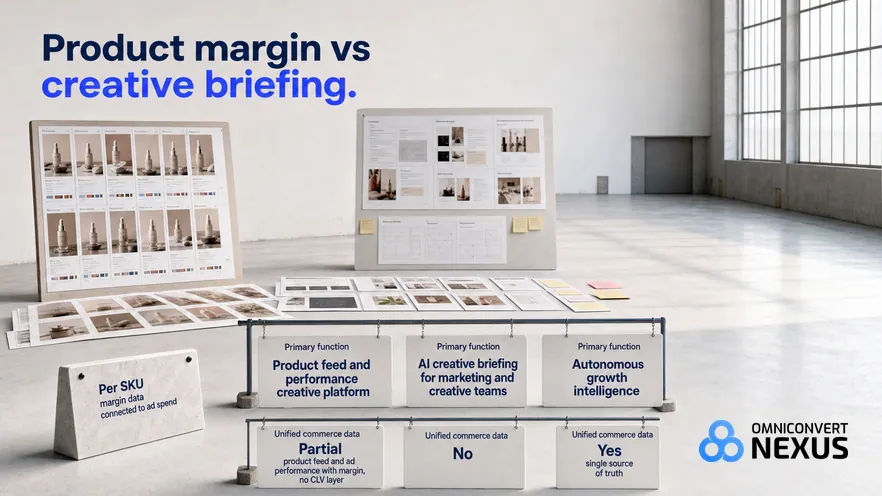
ROI Hunter vs Jointellos.com vs Nexus by Omniconvert sit at three different layers of the paid stack. ROI Hunter connects product feed margin data to ad decisions, surfacing which SKUs are profitable to advertise. Jointellos.com is an AI briefing surface for marketing and creative teams. Nexus by Omniconvert adds CLV segmentation and True Profit above both. [Omniconvert, 2026]
- ROI Hunter wins when the primary ad question is which catalog items are actually profitable to advertise, based on margin per SKU rather than click volume.
- Jointellos.com is positioned as an AI creative briefing surface for marketing and creative teams; public documentation is limited, so confirm scope at jointellos.com before procurement.
- Both tools solve execution questions. Neither connects catalog performance or creative briefs to CLV, segment margin, or True Profit.
- Nexus by Omniconvert is the strategic layer above both: a ranked action queue built from CLV, NPS, review and competitor data, with True Profit as the optimisation target.
- For a $1M+ ARR brand with a large catalog and climbing CAC, the real decision is whether a customer intelligence layer sits above whichever execution tools you already run.
A team weighing ROI Hunter vs Jointellos.com is usually comparing two different corners of the ad operations stack. ROI Hunter wins on product-level margin intelligence, telling you which catalog items are profitable to advertise rather than which get the most clicks. Jointellos.com sits in the AI creative briefing category, built to help marketing and creative teams structure the brief before production starts. Neither tool models customer lifetime value or measures True Profit at the cohort level, and that layer is what Nexus by Omniconvert is built to hold.
What is ROI Hunter, and what is it actually good at?
ROI Hunter is a product feed and performance creative platform connecting catalog data to paid social advertising. It surfaces product-level margin intelligence, telling brands which SKUs are profitable to advertise rather than just which get the most clicks. [ROI Hunter, 2026]
ROI Hunter connects a catalog-driven store's product data to advertising accounts on Meta and Google. Teams see which items are profitable to advertise based on margin, not just ROAS. Feed management, dynamic creative production, and product-level profitability sit in one place.
The category is product feed and performance creative. The buyer is an eCommerce brand with a large catalog wanting to prioritise ad budget by margin rather than click volume. Feed optimisation and margin-aware campaign recommendations are the specific mechanisms.
ROI Hunter holds a 4.8 out of 5 rating on G2 across 85 reviews as of 2026. Reviews praise the per-SKU margin view and the dynamic creative production. Reviewers also flag that adoption is smaller than better-known enterprise platforms.
Product margin advertising is the practice of ranking catalog items by contribution margin before deciding which ones deserve ad budget, rather than choosing by click volume or top-line revenue. It ties gross margin per SKU to ad spend, so a high-ROAS but low-margin item is deprioritised in favour of a lower-ROAS higher-margin one.
Where ROI Hunter is genuinely strong
- Product-level margin intelligence: identifies which catalog items are profitable to advertise, not just which get clicks or highest revenue.
- Highest-rated in its G2 category: 4.8 out of 5 on G2 across 85 reviews, the strongest in the product feed and performance creative segment.
- Dynamic creative from feed data: template-based dynamic ads combined with margin-aware campaign recommendations for large catalogs.
Where ROI Hunter hits its ceiling
- Product-centric, not customer-centric: strong on product margin, no CLV or customer segment intelligence layer.
- Smaller market presence: less name recognition than Smartly or the enterprise-scale platforms, with a narrower integration ecosystem.
- Feed-first not customer-first: margin view is per SKU, not per customer segment or lifetime value cohort.
ROI Hunter is a strong specialist for one specific job. The ceiling shows up when teams need customer-level intelligence layered on top of product-level margin data.
What is Jointellos.com, and what is it actually good at?
Jointellos.com positions itself as an AI creative collaboration and briefing tool for marketing and creative teams. Public product documentation is limited, so operators evaluating it should treat jointellos.com as the primary source for current features, pricing, and integration coverage.
Jointellos.com sits in the AI creative briefing category: software built to help marketing teams structure ad briefs and align creative collaborators around a concept before production begins. In a stack already running product-feed advertising on Meta and Google, that is the step between a planning conversation and a design file.
Public pricing, review coverage and integration documentation are not detailed enough today to compare feature-by-feature against larger platforms. For a reader shortlisting Jointellos.com, the honest path is to request a working walkthrough from the vendor and confirm scope in writing before procurement.
Where Jointellos.com fits
- Creative team workflow: a briefing surface for marketing and creative collaboration, inside the AI creative category.
- Specialist tool: narrower scope than full creative production platforms, focused on the briefing step rather than asset generation.
Where Jointellos.com has clear limits
- No customer intelligence: no CLV data, no RFM segmentation, no churn signal informing the brief.
- Briefing, not strategy: the tool structures the brief; it does not decide which segments the brief should target or whether margin improved.
No public G2 rating for Jointellos.com at time of writing. Confirm current review and pricing data on jointellos.com before any procurement decision.
ROI Hunter vs Jointellos.com vs Nexus: the capability comparison
ROI Hunter, Jointellos.com and Nexus by Omniconvert sit at three different layers of the paid stack. ROI Hunter handles product-level margin intelligence for the catalog. Jointellos.com handles the briefing workflow for creative teams. Nexus handles the layer above both: which customer segments drive True Profit, and which investments are worth making.
| Capability | ROI Hunter | Jointellos.com | Nexus by Omniconvert |
|---|---|---|---|
| Primary function | Product feed and performance creative platform | AI creative briefing for marketing and creative teams | Autonomous growth intelligence |
| Unified commerce data | Partial product feed and ad performance with margin, no CLV layer | No | Yes single source of truth |
| AI-prioritised experiment queue | Partial product-margin ranking, not customer segment prioritisation | No | Yes surfaces next best action |
| Creative generation | Partial dynamic ads from feed, template-based not generative AI | Partial AI briefing surface, not asset generation | Yes 100+ variants per hour, CLV-weighted |
| True Profit tracking | Partial product-level margin for ad decisions, customer CLV not included | No | Yes margin, not ROAS |
| CLV and segment intelligence | No | No | Yes RFM, cohorts, churn prediction |
| Autonomous action layer | No | No | Yes operator approves every change |
| AI creative briefing | No | Partial AI briefing tools for creative teams | Yes briefs built from CLV, NPS, reviews |
| Pricing model | SaaS, pricing on request at roihunter.com | Published pricing not disclosed on jointellos.com | Revenue-based, published at omniconvert.com/nexus |
| Best for | eCommerce brands with large catalogs needing product-margin advertising intelligence | Marketing and creative teams needing a briefing surface | eCommerce $1M+ ARR, margin-focused |
| Integrations | Meta · Google · Shopify · WooCommerce · BigCommerce | Confirm at jointellos.com | Shopify · Klaviyo · Meta · Google · TikTok · GA4 |
Cells read against current public positioning of each tool. Nexus column reflects shipped capability as of October 2026.
What ROI Hunter and Jointellos.com cannot do
The shared blind spot is the layer above both: which customer segments are worth acquiring more of, which are 60 days from churning, and whether the last ad or brief actually improved True Profit, not just ROAS. Neither category was built to answer those questions.
ROI Hunter tells you which products are worth advertising based on margin data, a meaningful step toward profitability-driven advertising. Nexus adds the customer CLV layer above the product margin layer, identifying which customers buying those products will come back and which are one-time buyers.
Jointellos.com helps a creative team structure its briefs. Nexus adds the data layer that writes the brief: which segments have the highest 12-month CLV, which messages their own reviews and NPS verbatims cluster around, and which angle a competitor already shipped against them this quarter.
Both tools are built around a shared assumption: that you already know which customers to target and which message to use. They optimise the execution of that assumption. Neither questions it.
What neither tool can tell you
- Which customers are worth acquiring more of. Based on 12-month CLV, not last-click attribution.
- Which segments are 60 days from churning. And therefore need a different message today, not next quarter.
- Whether the last campaign improved True Profit, or just moved ROAS. The two often diverge, and only one of them matters to the business.
- What your highest-value customers actually respond to. Pulled from their own reviews, NPS scores and support tickets, not guessed in a brief.
Platforms like Nexus are built for this layer. Nexus synthesises CLV data, NPS signals, review intelligence and competitor creative data into a ranked action queue, before a brief is written or a creative produced. The optimisation target is True Profit, not ROAS.
True Profit is defined as the net margin remaining after subtracting CAC, COGS, return rates and the cost of customer acquisition from each cohort, not gross revenue or ROAS. It is what the business actually keeps. Nexus tracks this as the primary optimisation metric across every experiment it queues.
AliveCor used Omniconvert to run a structured A/B testing programme and achieved +21% conversion rate, +5% revenue per visitor, and 94% statistical relevance across their experiments. [Omniconvert, AliveCor case study]
Which tool is right for you?
Pick ROI Hunter if your biggest ad question is which products in a large catalog are actually profitable to advertise. Pick Jointellos.com if the daily bottleneck is turning strategy into a working creative brief. Add Nexus when neither answers which customer segments are worth acquiring and whether net margin improved.
Choose ROI Hunter if:
- You run a catalog-driven store. Hundreds of SKUs on Meta and Google, and you need to prioritise ad budget by margin rather than volume.
- Product margin, not click volume, is the north star. You want to see which items are profitable to advertise based on contribution margin, not just ROAS.
- Dynamic creative from feed data fits the workflow. Template-based ads combined with margin-aware campaign recommendations are enough on the creative side.
Choose Jointellos.com if:
- Briefing is the bottleneck. Your creative team needs a shared surface to turn a strategy document into a working ad brief.
- You want a lightweight specialist tool. Performance analytics live elsewhere, and the gap is the briefing workflow itself.
Add Nexus if:
- Your team is the integration. More than 2 hours a day go into pulling data from separate tools before anyone makes a growth decision.
- ROAS looks fine, net margin does not. You are optimising paid spend but margin is not improving quarter-on-quarter.
- You cannot name your high-CLV segment. You do not have a reliable view of which customer segments drive the highest margin.
- Experiments are chosen by opinion. You want to know which experiments are worth running before dev sprints are assigned.
What each tool cannot do, honestly
Every tool on this page has a real ceiling. ROI Hunter stops at the product margin layer. Jointellos.com stops at the briefing surface. Nexus leaves parts of the paid stack to specialist tools and keeps a human approving every action. Here is the honest list.
ROI Hunter cannot:
- Model customer lifetime value or RFM segmentation on top of catalog margin.
- Generate ad creative outside the template-driven, feed-fed dynamic ad format.
- Match the market presence or integration ecosystem of larger enterprise platforms.
Jointellos.com cannot:
- Run paid media or measure outcomes once the brief is produced.
- Publish detailed public documentation on pricing and integrations. Procurement teams need to confirm scope with the vendor directly.
- Decide which segments the brief should target. The tool structures the output, not the strategy.
Nexus cannot:
- Hand trades off to the ad account by itself. Every scale, hold, reduce or kill is proposed; the operator approves before anything changes.
- Run retargeting campaigns of its own.
- Manage product feeds or build dynamic catalog ads. If that is the core ad motion, keep a specialist tool for it.
- Produce HTML5 display creative, run DCO, or traffic ads to display networks.
- Score creative against a global training set before launch. Scoring is CLV-weighted against your own customer data, not a third-party benchmark set.
See where your store stands against real competitors in your category and country. Ecommerce Benchmark scores six areas free: Creative & Ads, Reviews & UGC, AI Visibility, Agentic Commerce, Competitor Synthesis, and CRO.
Benchmark Your Store FreeFrequently Asked Questions
Should you add Nexus to your ROI Hunter or Jointellos.com stack?
Add Nexus if your paid stack runs efficiently but margin stays flat. ROI Hunter surfaces margin per SKU with dynamic creative from the feed. Jointellos.com helps a creative team structure the brief. Neither models customer lifetime value or measures True Profit at the cohort level. Nexus ranks the next action by projected margin and closes the loop. Teams losing hours to CLV, NPS, and review pulls are the highest-fit buyers. [Omniconvert, 2026]
ROI Hunter and Jointellos.com are specialist tools within their jobs: product-margin advertising for a catalog, and the briefing workflow for a creative team. If one of those is your top live need, keep the tool that fits.
The harder question is whether your team has a reliable way to know which customer segments are worth acquiring, what message to use, and whether the spend improved net margin. That is a different question, and it is what Nexus is built to answer.
Stop assembling data.
Start supervising growth.
Nexus unifies your entire eCommerce data layer, detects revenue anomalies in under 15 minutes, and generates a prioritized action queue, so your team stops being human middleware and starts running the P&L.
5.0 out of 5 across 60 reviews, Shopify App Store , as of September 2026