A/B Testing vs Multivariate vs Bandit: Which to Use (2026)

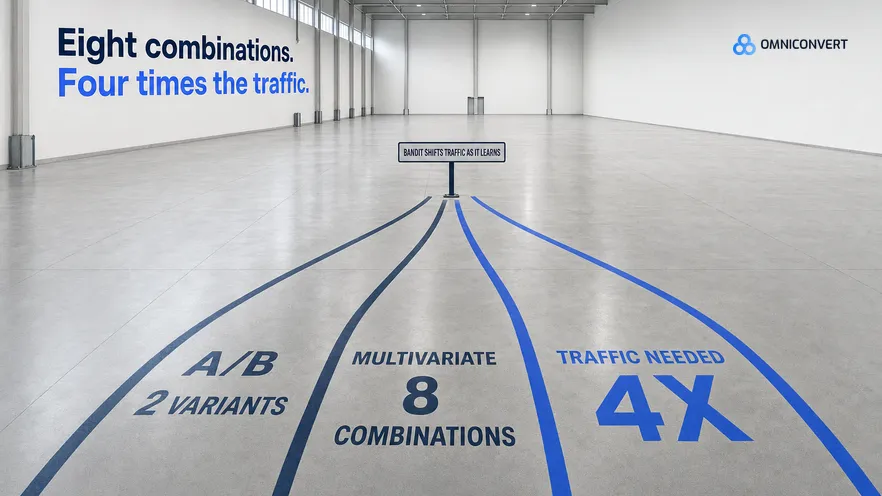
- A/B compares versions, multivariate compares element combinations, bandits chase the current leader.
- Traffic need multiplies with combinations: three elements at two versions each is eight cells, not six.
- Bandits maximise revenue during the test. A/B tests maximise what you know after it.
- Use bandits for short-lived decisions, A/B for decisions you will build on.
- A bandit with a reserved evenly split holdout gives you most of both.
- Every method reports an average. Check whether the winner won with your valuable customers.
These three methods get talked about as a ladder: you start with A/B tests, graduate to multivariate, then reach bandits. That story is wrong and it costs teams real money. They are three different allocations of the same traffic, built for three different goals, and the goal you have this quarter should decide which one you run. Here is what each does, the arithmetic that limits two of them, and the trade nobody states out loud.
What are A/B, multivariate and bandit testing?
Read those three definitions again and notice that only one of them mentions elements. That is the real dividing line. A/B and bandit both compare finished versions. Multivariate is the only method that opens the page up and asks which piece did the work.
How do A/B, multivariate and bandit tests compare?
| A/B test | Multivariate | Bandit | |
|---|---|---|---|
| What it compares | Whole versions | Element combinations | Whole versions |
| Traffic split | Fixed | Fixed, across many cells | Adaptive |
| Main output | Which version wins | Which element wins, and interactions | Highest revenue during the run |
| Traffic needed | Moderate | High, multiplies with cells | Moderate |
| Cost of losing variants | Paid in full | Paid in full, across all cells | Reduced over time |
| Quality of the lesson | Strong | Strongest | Weak |
| Best for | Decisions you will build on | Understanding a template | Short-lived decisions |
The two rows that matter most are the last three read together. A bandit reduces what you pay for losing variants and reduces what you learn, in roughly the same proportion. Nothing is free here; it is a straight exchange.
How would one question look in three test designs?
Why does traffic arithmetic rule out multivariate testing?
| Elements varied | Versions each | Combinations | Traffic vs a two-cell A/B |
|---|---|---|---|
| 1 | 2 | 2 | 1x |
| 2 | 2 | 4 | 2x |
| 3 | 2 | 8 | 4x |
| 4 | 2 | 16 | 8x |
| 3 | 3 | 27 | 13.5x |
This single table decides multivariate testing for most stores. A test that would take three weeks as an A/B comparison takes twelve as an eight-cell multivariate, and by week twelve the season has changed, so the audience you finish with is not the one you started with.
The practical rule: multivariate belongs on your highest-traffic templates only, and only when the interaction question genuinely matters. Everywhere else, sequential A/B tests get you most of the learning at a fraction of the calendar cost. Before running any of them, size the test properly, using statistical sampling and the guidance on when to call a winner.
Which testing method should you use, and when?
| Situation | Use | Why |
|---|---|---|
| Redesigning a core template | A/B test | The answer has to survive scrutiny and inform future work |
| Understanding which element carries a page | Multivariate | Only method that isolates elements and interactions |
| A three-week campaign landing page | Bandit | The decision expires before a clean answer would arrive |
| Choosing between many creative variants | Bandit | Adaptive allocation handles many arms gracefully |
| A low-traffic page | A/B test, one change at a time | Any multi-cell design will never reach significance |
| A result you will present to the board | A/B test | A fixed split is the easiest design to defend |
What is the trade nobody names?
A bandit stops feeding traffic to losing variants, which is exactly the point. But data you never collect is data you cannot analyse. Three months later, when somebody asks whether the winning headline also works on the category page, the bandit has no answer, while an A/B test would have left a clean dataset behind.
There is a middle position worth knowing. Reserve a fixed slice of traffic, split evenly across all variants for the whole run, and let the bandit allocate everything else. You lose part of the earnings advantage and keep a small, clean, analysable sample. For teams that want to move fast without going blind, this is usually the right default.
Omniconvert Commander (formerly Nexus) unifies purchase and behavior data into one customer view and segments customers by value, so a test result can be read by customer segment rather than as a single blended average.
See how it works →Who did the winner win with?
A variant that lifts conversion by promising a discount will often win on any of these three designs. Whether it should have won depends on who converted. If the lift came from price-sensitive first-time buyers who never return, the test bought a worse customer base and called it a success.
Reading results beside RFM segments and predicted lifetime value answers that. It also occasionally reverses a verdict, which is uncomfortable and worth knowing about before you roll the change out to everyone.
Frequently asked questions about A/B vs multivariate vs bandit testing
An A/B test compares whole versions of a page against each other, usually two. A multivariate test varies several elements at once and serves every combination of them, so it measures each element's effect and how the elements interact.
Multivariate testing answers a richer question and needs far more traffic, because the number of combinations multiplies rather than adds.
A bandit test reallocates traffic while it runs, sending a growing share to whichever variant is performing best so far. A classic A/B test holds the split fixed until the end.
The bandit earns more during the test, but because the losing variants stop collecting data, it gives a weaker and slower verdict about why the winner won.
Roughly in proportion to the number of combinations. Testing three elements with two versions each creates eight combinations, so it needs about four times the traffic of a two-variant A/B test to give each cell the same sample size.
That is why multivariate testing usually only works on high-traffic pages such as home, category and product templates.
They are better at a different job. Bandits are strong when the decision is short-lived and the goal is to earn as much as possible during the test, such as a campaign landing page or a seasonal banner.
A/B tests are better when you need a clean, defensible answer that will inform future decisions, because every variant keeps collecting comparable data until the end.
Partly. Reserve a fixed share of traffic that is always split evenly, and let the bandit allocate the rest. You give up some of the earnings advantage in exchange for a clean subset of data you can analyse afterwards.
Without that reserved slice, an adaptive test can crown a winner without ever producing evidence you can reuse.
Testing tells you which version wins on average. Omniconvert Commander unifies purchase and behavior data into one customer view and segments customers by value.
That shows whether a winning variant won with your best customers or only with discount-driven first-time buyers, which are very different results.
These three methods are usually presented as a maturity ladder, as though bandits were the advanced version of A/B testing. They are not. They optimise different things. A bandit is the right tool when the decision expires in three weeks and you simply want the most revenue between now and then. An A/B test is the right tool when the answer will shape the next twelve months of design decisions and needs to be defensible. Multivariate sits apart from both: it is the only one that tells you whether two changes help each other or cancel out, and it charges you a great deal of traffic for the privilege.
Find out who your winner actually won with
A test result is an average across everyone who saw it. Omniconvert Commander unifies purchase and behavior data into one customer view, segments by value, and predicts lifetime value, so you can tell a variant that won with loyal buyers from one that won with discount hunters.