Ecommerce Quiz Funnel: Capture Zero-Party Data and Raise AOV

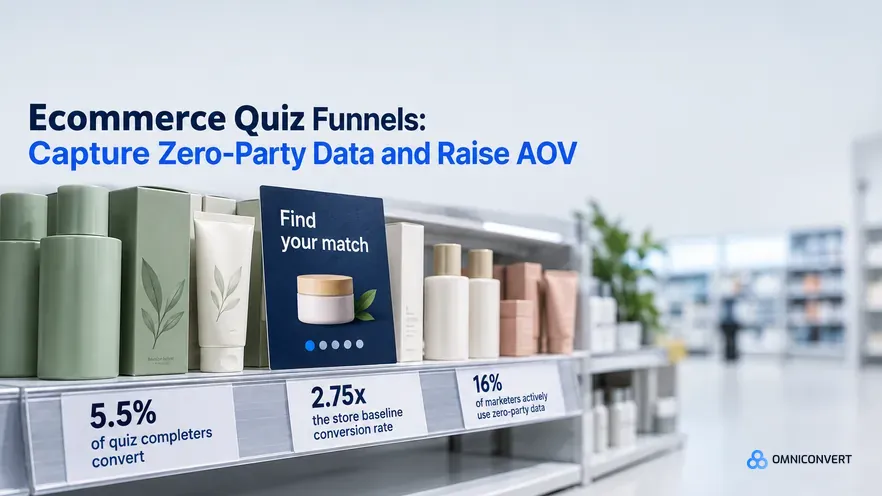
- An ecommerce quiz funnel is a guided set of preference questions that recommends products while capturing zero-party data volunteered by the customer.
- The 25 to 40 percent conversion claims are a self-selection mirage; the honest benchmark is about 5.5% of completers converting, roughly 2.75x a 2% store baseline.
- The real payoff is zero-party data, which is far more reliable than third-party cookies and correlates with higher lifetime value, yet only about 16% of marketers actively use it.
- Quizzes raise AOV through commitment, effort-justification, and choice reduction: answering questions makes the recommendation feel personally chosen, so a tailored bundle sells better than browsing.
- Measure a quiz funnel by the downstream profit and lifetime value of quiz-enrolled customers, not by the conversion rate on the results page.
An ecommerce quiz funnel is a short, guided path of preference questions that ends in a personalized product recommendation and captures the customer's stated preferences along the way. Marketers reach for it as a conversion tactic, but the on-site pop is the smaller half of the story. Across the CROBenchmark dataset of 7,000+ websites in 15+ industries, the funnels that pay back are the ones judged by the lifetime value of the customers they enroll, not the conversion rate on the results page [CROBenchmark Report 2026, Omniconvert].
Nexus by Omniconvert is the AI eCommerce growth engine that scores the customers a quiz brings you and ranks what to do with them next. This guide covers what a quiz funnel really is, why the headline conversion numbers mislead, the zero-party data asset that actually compounds, the psychology behind the AOV lift, how to design for high completion, how to close the loop into retention, and how to measure the whole thing the way a Customer Value Optimization team would.
What is an ecommerce quiz funnel?
The word to hold onto is guided. A category page shows an undecided shopper forty options and asks them to self-serve; a quiz asks four to eight questions and hands back one confident answer. It behaves less like a form and more like a good store associate: it asks what you are trying to solve, listens, and points you to the right shelf. That is why it works best for undecided, high-consideration buyers, the exact segment a mega-menu loses.
It is two instruments in one body. On the surface it is a merchandiser, steering the shopper to a fitting product or bundle. Underneath it is a data-capture instrument, recording stated goals, constraints, sizes, and budgets that no amount of behavioral tracking can infer. Most teams build the merchandiser and ignore the instrument, which is exactly backwards, as the next two sections show.
Is the quiz funnel conversion number everyone quotes real?
Walk into almost any quiz-tool landing page and you will meet the same promise: quizzes convert at 25 to 40 percent, ten times a normal product page [Fastr, 2026]. The claim is not fabricated, but it is measured against the wrong denominator. It counts conversions among people who already invested the effort to complete a quiz, a group that pre-selected itself for high intent. Comparing that to all site traffic is comparing your warmest hand-raisers to your cold crowd.
The honest number uses a fair denominator. RevenueHunt's benchmark, drawn from more than 45 million quiz responses across over 20,000 stores, finds that about 5.5% of quiz completers place a tracked order, roughly 2.75x a conservative 2% store baseline, with completion rates that should sit at 90 to 100 percent [RevenueHunt, 2026]. That is a real, defensible lift. It is also not the reason to build one, because a 2.75x on-site bump does not survive contact with a thin catalog or a bad offer. The reason to build one is what the quiz collects while it runs.
| Framing | What it measures | Typical figure |
|---|---|---|
| The headline claim | Conversion among self-selected completers, vs all traffic | 25 to 40 percent ("10x") |
| The honest benchmark | Completers who place a tracked order | About 5.5% (~2.75x a 2% baseline) |
| The design target | Shoppers who start and finish the quiz | 90 to 100 percent completion |
| The metric that matters | Downstream lifetime value of enrolled customers | Tracked per cohort, not on the results page |
Why is zero-party data the real prize in a post-cookie world?
This is the asset that compounds. Zero-party data is reported to be roughly 25 times more effective than third-party cookies for personalization, and customers acquired through zero-party data strategies tend to show about 2.4 times higher lifetime value, with preference-aligned recommendations lifting email click-through around 40 percent and cutting fashion returns as much as 60 percent [Envive, 2026]. A quiz is the cleanest way to collect it, because the shopper hands it over willingly in exchange for something useful.
That exchange is the whole ethical case, and it is worth naming the mechanism. The principle at work is reciprocity: the quiz gives genuine value first, a tailored diagnosis or recommendation, before it asks for anything, so the customer reciprocates with honest preference data rather than the throwaway answers a cold form gets. Framed that way, data capture is a fair trade, not a toll, which is why it holds up as privacy rules tighten and cookies decay.
The strategic opening is the adoption gap. Only about 16 percent of marketers actively collect and use zero-party data, even though roughly 85 percent say it is essential to their strategy [Envive, 2026], and 74 percent of consumers now expect personalized experiences [Klaviyo, 2025]. Demand is high, supply is scarce, and a quiz closes the gap on your own domain, on your own terms.
Zero-party data is only worth capturing if you act on it. See which quiz-enrolled customers are worth retaining, and what to do next.
Learn more about Customer Intelligence in Nexus →Why do quiz funnels raise AOV?
Start with commitment and consistency. Robert Cialdini's principle holds that people act consistently with commitments they have already made, and each answered question is a small, self-consistent step. By the time the recommendation appears, the shopper has told you, in their own clicks, exactly what they want, so accepting the result and adding to it feels like following through, not being sold to.
Effort justification, the labor or IKEA effect, does the heavier lifting on order size. Because the shopper worked to reach the recommendation, the output feels personally chosen and therefore more valuable, which is precisely why a curated bundle attached to a quiz result outperforms the same bundle on a category page. Vendor case data puts quiz-completer AOV around 47 percent higher than standard shoppers [Fastr, 2026]; treat the exact figure as directional, since it comes from tool vendors, but the direction is well grounded in the psychology.
The third mechanism is choice reduction. Barry Schwartz's paradox of choice and Hick's Law both say that more options slow and often paralyze decisions. An undecided buyer facing a full catalog either abandons or defaults to the cheapest safe pick, both of which cap AOV. A quiz's real job is to collapse that catalog into one confident decision, which is what lets a shopper trade up to the right product instead of down to the cheapest.
In our CVO work with ecommerce brands, we consistently see that the quiz funnels which lift AOV durably are the ones that recommend a fitting bundle, not a single hero product, because the effort the shopper invested is what makes the larger, tailored basket feel earned rather than upsold [Omniconvert, 2026].
AliveCor used Omniconvert to run a structured A/B testing programme and achieved a 21 percent lift in conversion rate, a 5 percent lift in revenue per visitor, and 94 percent statistical relevance across their experiments [Omniconvert, AliveCor case study]. The lesson transfers directly to quiz funnels: the gains that hold up are the ones validated against a control and measured on revenue per visitor, not the completion-page conversion rate a quiz tool reports by default.
What does a high-completion quiz funnel look like?
Completion is the metric to design for, and the open-loop principle explains why. A started-but-unfinished quiz creates a small tension to finish, the Zeigarnik effect, which a visible progress indicator turns into momentum. The build that respects it looks like this:
-
Keep it short and visibly finiteFive to eight questions, with a progress bar from the first screen. The shopper needs to see the finish line to keep walking toward it.
-
Ask only value-adding questionsEvery question must change the recommendation. If an answer does not alter the result, it is survey filler, and filler is where completion leaks.
-
Branch so answers visibly matterLater questions should adapt to earlier answers. Visible branching proves the quiz is listening, which sustains the commitment chain.
-
Place the capture at peak valueAsk for the email to deliver the tailored result right before revealing it, when perceived value is highest, never as a gate at the start.
-
Make the result genuinely tailoredReflect the shopper's own answers back in the recommendation. A result that reads as generic breaks the reciprocity trade and the data goes stale.
Done this way, lead capture on a quiz can materially outperform a standard pop-up form, with vendor aggregates citing capture rates around 28.6 percent versus typical form rates [Amra & Elma, 2026]. Treat that as directional, but the direction is reliable: value offered before the ask beats a cold gate.
How do you connect quiz answers to LTV?
Capture is step one of many, and most teams stop there. The value is in the loop: route each quiz answer into your email platform as structured fields, segment on stated preferences and goals, and let those fields drive both onboarding flows and on-site personalization. A shopper who told you their skin type, their dog's breed, or their budget has handed you the raw material for a year of relevant messaging, if you use it.
This is where a quiz stops being a conversion tactic and becomes a retention engine. Preference-aligned recommendations lift email engagement and reduce returns because the customer is seeing what they actually asked for, and that relevance is what pulls the second and third purchase that lifetime value depends on. The quiz enrolls the customer; the loop is what grows them. For the mechanics of turning that into ranked retention work, see how to measure and grow customer lifetime value and how RFM scoring segments customers by value.
How do you measure a quiz funnel the CVO way?
The default quiz-tool dashboard reports completion and results-page conversion, both of which are self-selected and both of which flatter the tool. The CVO question is different: are the customers this quiz enrolls worth more over time than the customers who never took it? Answer it by tagging quiz-enrolled customers and tracking their cohort's repeat purchase rate, average order value, and margin-adjusted lifetime value against a control cohort.
The ecommerce brands that plateau on quiz funnels consistently share one pattern: they optimize the completion page and never look at the cohort behind it, so they tune a quiz to enroll more discount-seekers who convert once and churn. The plateau breaks fastest when operators treat the lifetime value of enrolled customers as the primary unit of measurement, not the completion-page conversion rate. That is the reframe the whole article turns on, and it is what Customer Intelligence in Nexus is built to make routine, scoring each quiz cohort by RFM and predicted lifetime value and ranking the next best action per segment.
When should you not build a quiz funnel?
Honesty about fit protects the tactic. Three conditions make a quiz a poor bet. First, a thin catalog: if you sell six SKUs, a shopper can compare them faster than they can take a quiz, and the recommendation feels manufactured. Second, low consideration: for a routine, low-cost, already-decided purchase, a quiz inserts friction between the shopper and the buy button. Third, and most important, no lifecycle to feed: if you have no email flows, no personalization, and no retention program, the zero-party data has nowhere to go and the whole exercise collapses back into a one-time conversion gimmick.
The through-line is that a quiz funnel is a long-game instrument. Its return comes from the data it captures and the relationships that data grows, so if the downstream machinery does not exist, build that first. This is also why the topic sits at the edge for many brands: the tactic rewards operators who already run a lifecycle, and underperforms for those who do not.
Ecommerce quiz funnel FAQs
An ecommerce quiz funnel is a guided series of preference questions that recommends products while capturing zero-party data. It turns an undecided shopper's path from I am not sure into a confident, personalized purchase, and it collects the customer's stated goals, preferences, and constraints along the way. Unlike a survey, every answer visibly shapes the result, which is what keeps completion high and makes the captured data honest and usable downstream in email and personalization.
No. The headline 25 to 40 percent figures measure only people who chose to finish a quiz, which is a self-selection mirage. RevenueHunt's benchmark across more than 20,000 stores shows about 5.5% of completers place a tracked order, roughly 2.75x a conservative 2% store baseline. That is a real and worthwhile lift, but it is not magic, and treating the inflated number as a target sets you up to misjudge the whole funnel.
Effort drives it. Each question answered is a small commitment, and the effort invested makes the recommended product feel personally chosen rather than sold, an effect behavioral scientists call effort justification. A tailored bundle then reads as relevant instead of pushy, so shoppers add more per order. The quiz also collapses an overwhelming catalog into one confident decision, which removes the hesitation that makes undecided buyers abandon or buy the single cheapest item.
Zero-party data is information a customer intentionally and proactively shares, such as preferences, goals, sizes, or budget. It matters because third-party cookies are unreliable and privacy rules keep tightening, and voluntarily shared data is far more accurate for personalization because the customer told you directly. It is also a wide-open advantage: surveys find only about 16% of marketers actively collect and use it, while roughly 85% say it is essential to their strategy.
Aim for 90 percent or higher. Keep the quiz short, five to eight questions, and show a progress indicator so the open loop pulls people to the end. Ask only questions that add value to the recommendation, not survey filler, and branch logically so each answer visibly changes what comes next. Put the data-capture ask, usually an email for the tailored result, at the moment of highest perceived value, right before the recommendation, never at the start.
Nexus by Omniconvert ingests the behavioral and transactional data of the customers a quiz enrolls and scores them with RFM and predicted lifetime value, so you see which quiz-acquired segments are worth retaining rather than just how many finished the quiz. It then ranks the next best action per segment, from a second-purchase offer to a churn-risk intervention, so the zero-party data the quiz captures becomes prioritized retention work instead of a list that sits in your email tool unused.
The completion page is the least interesting thing an ecommerce quiz funnel produces. The honest on-site lift is about 5.5% of completers converting, roughly 2.75x a 2% baseline, real but modest. The compounding asset is the zero-party data, which is far more reliable than cookies and which only about 16% of marketers actively use. Build the quiz as a data-capture instrument first and a merchandiser second, then judge it by the lifetime value of the customers it enrolls. See how Customer Intelligence in Nexus scores and acts on those customers.
Turn quiz answers into retention, not a dormant list
Nexus by Omniconvert scores the customers your quiz enrolls by RFM and predicted lifetime value, then ranks the next best action per segment. Stop measuring a quiz by its completion page and start measuring it by the profit of the customers it brings you.