5 Lessons E-commerce Teams Learn After Running Their First A/B Tests


- Replace gut-instinct decisions with validated hypotheses to protect revenue and continuously improve conversion rates
- Modern testing tools have lowered technical barriers, allowing business users to run meaningful experiments without developer involvement
- Prioritize experimentation velocity over perfect statistical rigor to capture timely opportunities and build compounding learnings
- Evaluate testing vendors on support quality and partnership potential, not just feature lists
- Focus on actual use cases when selecting tools rather than defaulting to the most expensive enterprise options
Most e-commerce teams start A/B testing with high hopes and a spreadsheet full of assumptions. Within months, the teams that succeed look nothing like where they started.
Running your first A/B tests is deceptively simple. You pick a hypothesis, set up a variant, and wait for statistical significance. But the real challenges emerge after those initial experiments: interpreting ambiguous results, scaling a testing program without dedicated developers, and convincing stakeholders that a 2% conversion lift is worth celebrating.
This article shares five hard-won lessons from e-commerce teams who moved past the beginner phase of experimentation and built testing cultures that deliver consistent, measurable growth.
Lesson 1: Assumptions Are Expensive Until Tested

Every e-commerce team operates on assumptions. You believe a certain headline resonates better. You assume customers prefer free shipping messaging over discount percentages. You think the product page layout works because it has always been there.
The first major lesson teams learn is that assumptions carry real financial weight. When you roll out changes based on gut instinct alone, you are essentially gambling with revenue. One team described their shift this way: they moved from guessing to validating, testing hypotheses around messaging, layout, and trust elements before committing to full-scale changes.
This mindset change is uncomfortable at first. It requires admitting that your experienced intuition might be wrong. But it also creates a safety net. When you validate changes before rolling them out at scale, you protect yourself from costly mistakes while continuously improving key landing pages, category pages, and product pages.
The practical takeaway: document your assumptions explicitly. Create a hypothesis backlog. Every time someone says "I think customers would prefer…" that becomes a testable hypothesis, not a deployment decision.
"Omniconvert helps us move away from assumptions and make data-driven decisions about our website. We use it to test hypotheses around messaging, layout, and trust elements, which allows us to improve conversion rates without guessing."
— E-commerce Team LeadLesson 2: You Do Not Need a CRO Guru to Start

One of the biggest barriers to sustained experimentation is the belief that A/B testing requires specialized expertise. Teams delay their testing programs waiting for the perfect hire or the right agency partner. This delay costs months of potential learnings.
The reality experienced teams discover is different. Modern testing tools have lowered the technical barrier significantly. You do not need to be a data analyst or programmer to run meaningful tests. The interfaces have evolved to support business users who understand their customers but may not write code.
This accessibility matters because it democratizes experimentation. Product managers can test copy changes. Marketing teams can experiment with landing page layouts. Customer service can validate messaging improvements based on support ticket patterns.
The key is starting small. Run simple headline tests. Compare button colors. Test different product image arrangements. These foundational experiments build confidence and skills before you tackle more complex multivariate tests or personalization strategies. The learning curve exists, but it is manageable for anyone willing to invest initial effort.
"I like that Omniconvert is simple to use. You don't have to be a CRO guru to know how to use it to run tests, review what the tests have done, and learn the insights."
— Growth Marketer at Fella HealthLesson 3: Speed to Insight Beats Perfect Experiments
Academic rigor has its place, but experienced e-commerce teams learn that velocity often trumps perfection. Waiting for the ideal sample size while a seasonal opportunity passes costs more than running a slightly underpowered test.
The teams that build successful testing cultures prioritize rapid iteration. They want variants that work immediately upon publishing. They value the ability to deploy copy updates quickly, especially when developer resources are constrained. This speed creates a feedback loop where insights compound over time.
Consider the alternative: a change request goes into a development sprint, waits two weeks for prioritization, another week for implementation, and then requires QA before deployment. By the time you launch, market conditions may have shifted. The hypothesis might no longer be relevant.
Experienced teams treat their testing platform as an independent channel for rapid experimentation. They reserve developer involvement for structural changes while handling copy, layout, and messaging tests directly. This separation of concerns keeps the experimentation engine running even when engineering bandwidth is tight.
The practical application: establish a fast lane for testing that bypasses your standard deployment process. Define clear boundaries for what tests can run independently and which require technical review.
"I like that the variants work immediately upon publishing, which is really handy. It's also easy to use Omniconvert to deploy copy updates quickly, especially if we're unable to have a developer update and deploy the code on production."
— Marketing Team MemberLesson 4: Support Quality Determines Long-term Success
Tools are commodities. The real differentiator in any testing program is the quality of support and strategic guidance available when you need it. This lesson often surprises teams who initially focused purely on feature comparisons during vendor evaluation.
Experienced teams describe their ideal vendor relationship as a partnership rather than a transaction. They value support teams that treat questions seriously and respond quickly. They appreciate monthly calls with customer managers who provide practical insights and testing ideas that actually improve experiments.
This partnership model becomes critical when you encounter edge cases. Every testing program eventually hits a configuration issue, an unexpected interaction with other site elements, or a result that contradicts expectations. Having access to experts who can troubleshoot quickly prevents these moments from derailing your testing momentum.
Beyond technical support, strategic guidance accelerates learning curves. When your support team acts as a strategic partner that aligns with your specific needs, you gain access to patterns and best practices from across their customer base. This external perspective often identifies opportunities your internal team might miss.
Evaluate potential testing partners not just on features but on their support model. Ask about response times. Request references from similar companies. Understand how they handle escalations and complex technical scenarios.
"What I like most about Omniconvert is the combination of a powerful A/B testing tool and truly hands-on customer support. It feels like a partnership rather than just a tool."
— E-commerce Optimization SpecialistLesson 5: Pricing Does Not Equal Capability
Enterprise teams often default to the most expensive testing platforms, assuming that higher prices guarantee better results. Mid-market brands sometimes avoid testing altogether, believing the technology is beyond their budget. Both assumptions prove wrong in practice.
The testing landscape has matured significantly. Tools that deliver enterprise-grade capabilities now exist at price points accessible to growing brands. The core functionality of running experiments, segmenting audiences, and measuring results has become standardized across providers.
Experienced teams evaluate tools based on specific requirements rather than brand prestige. They seek platforms that deliver many of the same perks and features as the big names on the market, but at a more competitive price. This pragmatic approach frees budget for other growth initiatives while maintaining testing capability.
The evaluation process should focus on your actual use cases. If you primarily run standard A/B tests on landing pages and product pages, you likely do not need the most sophisticated enterprise platform. Consider total cost of ownership beyond licensing fees — some platforms require significant technical resources for maintenance and experiment setup, while others include implementation support that reduces internal burden.
"A solid A/B testing and personalisation tool that delivers many of the same perks and features as the big names on the market, but at a more competitive price."
— Optimization Team LeadBuilding Your Testing Roadmap
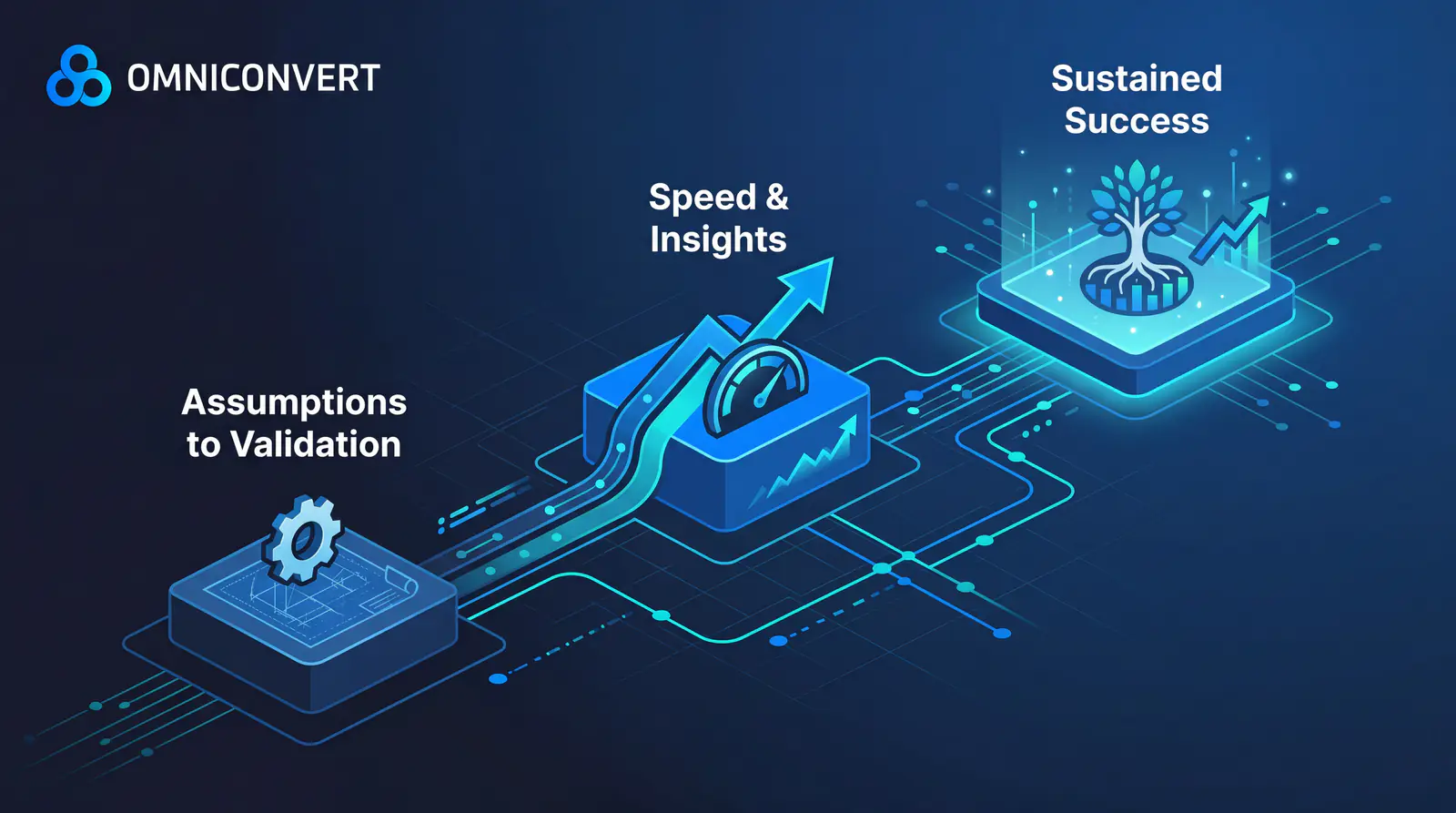
These five lessons form a foundation for sustained experimentation success. Moving from assumptions to validation creates a culture of evidence-based decision making. Recognizing that specialized expertise is not required removes artificial barriers to getting started. Prioritizing speed keeps your program generating insights continuously. Investing in strong vendor partnerships accelerates your learning curve. And evaluating tools pragmatically ensures you allocate resources effectively.
The next step is translating these lessons into your specific context. Start by auditing your current testing practices against each lesson. Where are you still operating on assumptions? What decisions are waiting for developer availability that could be tested independently? How responsive is your current vendor when issues arise?
Build a 90-day plan that addresses your biggest gaps. If you have never run a test, focus on lesson two and get your first experiment live within two weeks. If you are already testing but struggling with velocity, prioritize establishing that fast lane for experimentation described in lesson three.
Document your learnings as you go. The teams that sustain testing programs over years create institutional knowledge that survives individual departures. Every test — whether it wins or loses — adds to your understanding of what resonates with your specific customers. Remember that testing is a practice, not a project. The goal is not to run one successful experiment but to build a muscle for continuous optimization that compounds over time.
Building a successful A/B testing program requires more than selecting the right tool. The teams that generate consistent results share common characteristics: they treat assumptions as testable hypotheses, they empower non-technical team members to experiment, they optimize for learning velocity, they invest in strong vendor partnerships, and they evaluate tools pragmatically based on actual needs. Start by identifying which of these lessons represents your biggest gap, then build a focused plan to address it. The compounding effect of continuous testing will transform how your organization makes decisions about customer experience.
Apply These Lessons With Omniconvert
The CRO platform built for e-commerce teams — powerful enough for experts, simple enough for everyone else.