AI A/B Test Builder: From Prompt to Coded Experiment

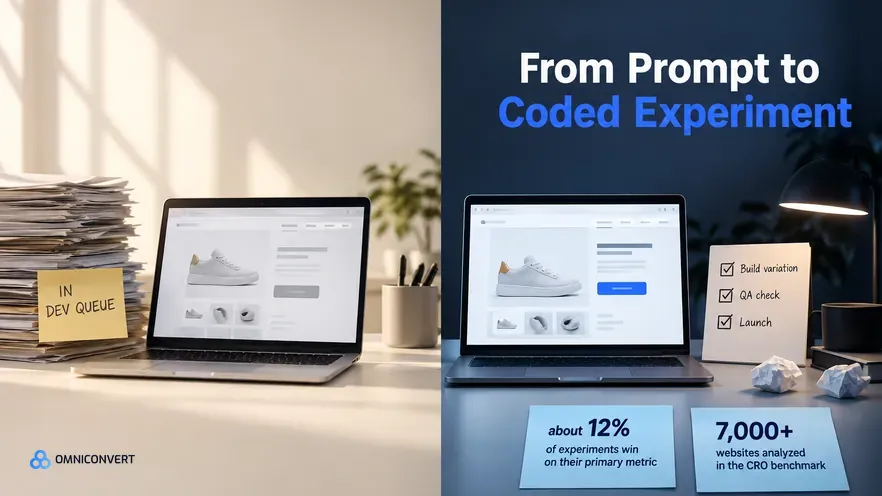
- The bottleneck in most CRO programs is implementation, not ideas: coded variations wait in a developer backlog while cycle times stretch from days to months.
- An AI A/B test builder turns a plain-language prompt into a coded variation on your real page, reads the page first, shows scope and estimated cost, and waits for confirmation.
- It QA-checks its own rendered output, applies changes all-or-nothing, and lets you preview on the live page in a new tab, which is what makes a non-coder trust it.
- It builds the whole experiment, not just the variation: it can set up goals and click tracking and prefill the test, and you refine by continuing the conversation.
- Because only about 12% of experiments win, shipping more correct variations matters, and the builder keeps you as the human-in-the-loop who approves and launches.
An AI A/B test builder is an assistant inside an experimentation editor that turns a plain-language description of a change into working, coded variation on your live page. It matters because ideas were rarely the constraint in conversion optimization: the constraint is shipping a correct variation. Across the CROBenchmark dataset of 7,000+ websites in 15+ industries, against 248+ audit criteria, the teams that plateau are almost never the ones short of hypotheses [CROBenchmark Report 2026, Omniconvert].
Omniconvert Explore now puts that builder directly in its A/B editor, paired with a companion Chrome extension. This guide covers what it is, the seven user-facing steps from prompt to coded variation, why a non-coder can trust it to touch a live page, how it builds the whole experiment rather than just the variation, and where it fits on the spectrum from manual to autonomous testing.
Why is the dev queue, not ideas, the real CRO bottleneck?
Marketing coverage of "AI for CRO" fixates on the wrong end of the funnel. Most tools generate more ideas, more hypotheses, more test suggestions, when generating ideas was never what stalled the roadmap. What stalls it is that a coded variation, a feature flag, or a tracking change each needs a developer and a deploy, and that developer is shared across the whole company's roadmap. When experimentation depends on borrowed sprint capacity, tickets drift to the bottom of the backlog and cycle times stretch from days to months.
It helps to borrow Alex Hormozi's value equation from $100M Offers: perceived value rises when you cut the time delay and the effort a customer has to absorb. The dev queue is pure time delay and pure effort. An AI experiment builder is valuable for exactly that reason. It does not add a flashier idea to the top of the funnel; it removes the wait and the hand-off at the bottom. In our CRO work with ecommerce brands, we consistently see implementation capacity, not idea quality, as the lever that decides how many tests a team actually ships in a quarter [Omniconvert, 2026].
Implementation velocity is defined as the number of correct, shippable variations a team can put live per period without borrowing engineering time. It matters in ecommerce because test win rates are low, so the programs that compound are the ones that get more at-bats, not the ones with cleverer single hypotheses.
What is the AI experiment builder in Omniconvert Explore?
Explore already ships a Visual Editor for point-and-click changes and an Advanced (code) Editor for developers. The AI experiment builder sits alongside them as a third path: describe the change in words and let the assistant write the code. The companion Chrome extension is what lets it operate on your actual page in your own browser session, rather than on a static snapshot, which is what makes the output trustworthy on real, logged-in, dynamic pages.
The distinction that matters: this is not a hypothesis generator. Tools like that stop at "here are five things to try." The builder starts after the idea is chosen and produces the deployable variation. To borrow the Jobs-to-be-Done lens, practitioners do not hire this tool to think of tests; they hire it to ship a correct one without asking engineering. That is the job being automated.
How do you go from prompt to coded variation in 7 steps?
Here is the full flow, from an idea in your head to a coded experiment ready to launch:
-
Describe the change in plain languageType what you want in ordinary words: "Make the add-to-cart button larger and change the label to Buy now," or "Move the reviews above the fold." No selectors, no CSS, no ticket.
-
It reads the actual page firstBefore writing anything, the builder inspects the real, rendered page through the Chrome extension, so it edits the elements that actually exist rather than guessing from a description or a stale snapshot.
-
It shows scope and estimated cost, then waitsThe builder tells you what it intends to change and an estimated cost of the operation, then pauses for your confirmation. Nothing is written to the variation until you approve the plan.
-
It writes the variation, then QA-checks its own workOn approval it writes the variation code and then inspects its own rendered output, checking that the change actually took effect as described rather than assuming the code was correct.
-
Preview on the real page in a new tabYou open the variation on the live page in a new browser tab and see exactly what a visitor would see, on the real site, before anything goes live.
-
It sets up goals and click tracking and prefills the experimentThe builder can configure conversion goals and click tracking and prefill the experiment setup, so you are not rebuilding the measurement layer by hand after the variation is done.
-
Refine by continuing the conversationIf the first pass is not quite right, you describe the adjustment in plain language and it revises, instead of re-briefing and re-queuing a developer for a second round.
Can you trust an AI A/B test builder on your live page?
The reason non-technical practitioners historically avoided auto-editing tools is risk: a visual editor that silently half-applies a change, breaks a layout, or flickers on load erodes trust fast. Behavioral research on decision-making, from Kahneman's work on how we weigh perceived risk, explains why: people adopt a tool when the downside feels bounded and reversible. The builder is engineered around exactly that principle.
| Common visual-editor failure | How the AI builder answers it |
|---|---|
| Edits break complex layouts | Reads the real, rendered page first and writes code against elements that exist |
| Gets confused by single-page apps (SPAs) | Changes are built to persist as dynamic content loads and re-renders |
| Visible flicker when the variant loads | Applies the variation all-or-nothing, with no half-applied intermediate state |
| Applied a change that never actually rendered | QA-checks its own rendered output before you preview and launch |
| Acts without the operator seeing what changed | Shows scope and estimated cost and waits for explicit confirmation |
The community paragraph worth internalizing: the ecommerce brands that plateau at a handful of tests a quarter consistently share one pattern, they treat the visual editor as untrustworthy and route every real change through the dev queue as insurance. The gap closes fastest when operators treat shippable-variation throughput as the primary unit of measurement, not the number of ideas in the backlog. Trust in the tool is not a soft feeling here; it is the thing that unlocks volume.
Nexus by Omniconvert ranks which experiments are worth building first, so the throughput you unlock goes to the tests most likely to move revenue, not the easiest ones to think of.
See how it works →Does the AI builder create the whole experiment, not just the variation?
A coded variation with no measurement attached is not an experiment; it is a change. The builder closes that gap by setting up the goals and click tracking that make the variation legible, and by prefilling the experiment so configuration is a review step rather than a from-scratch build. This is where the time savings compound: the variation and its measurement arrive together.
AliveCor used Omniconvert to run a structured A/B testing program and achieved a +21% conversion rate, +5% revenue per visitor, and 94% statistical relevance across their experiments [Omniconvert, AliveCor case study]. The lesson for an AI-assisted program is the same one that made that result possible: velocity only pays off when each test is measured properly, which is exactly the part the builder now prefills for you.
How do you refine an AI-built variation by conversation?
The costliest part of the old workflow was rarely the first build; it was the second, third, and fourth rounds of small corrections, each of which re-entered the queue. Because the builder keeps the conversation and the page context, a refinement is a sentence, not a ticket. This is the practical meaning of positioning the tool against the status quo rather than against other software: as April Dunford argues in Obviously Awesome, the competitive alternative most readers actually live with is "wait three sprints," and conversational refinement is what beats it.
Where does an AI A/B test builder fit: human-in-the-loop?
Experimentation tooling in 2026 spans three modes: manual (a human builds everything), assisted (AI drafts, a human approves), and autonomous (the system runs continuously). Test-velocity benchmarks track that progression, with manual programs typically shipping two to four tests a month and AI-assisted programs four to eight [foundrycro.com, 2026]. The builder is squarely assisted: it collapses the build step while keeping you as the decision-maker who confirms scope and clicks launch.
This matters because low win rates make judgment valuable, not disposable. Optimizely's analysis of 127,000 experiments found only about 12% win on their primary metric, and closer to 10% for revenue-tied tests [Optimizely, 2026]. More shippable at-bats raise your absolute number of wins, but a human still decides which at-bats are worth taking, which is precisely the split the assisted model is built for. To get started, you need Omniconvert Explore and its companion Chrome extension; from there, the first coded variation is a sentence away.
AI A/B test builder FAQ
An AI A/B test builder is an assistant inside an A/B testing editor that turns a plain-language description of a change into a coded variation on your actual page, then checks its own work before you launch. In Omniconvert Explore it lives in the A/B editor and pairs with a companion Chrome extension, so a practitioner can ship an experiment without writing code or waiting on a developer.
It builds. You describe the change, it reads the live page, writes the variation code, QA-checks its own rendered output, and can prefill goals and click tracking. Most AI features marketed for CRO stop at suggesting ideas or hypotheses. The builder works at the other end of the funnel: turning an approved idea into a shippable, coded variation, which is the step that usually stalls in a developer backlog.
The builder reads the actual page before it acts, shows you the scope of the change and an estimated cost, and waits for your confirmation. It applies changes all-or-nothing, so there is no half-applied state, and it QA-checks the rendered result. You then preview the variation on the real page in a new tab before anything launches. You remain the human who approves and starts the experiment.
Yes. Changes are built to persist on dynamic and single-page application sites, where content loads and re-renders after the initial page. This directly addresses the classic visual-editor failures, where edits break complex layouts, get confused by SPAs, or cause visible flicker when the variation loads. The builder writes code against the real page rather than recording brittle click-based edits.
For most front-end variations, no. The builder writes and checks the variation code, sets up goals and click tracking, and prefills the experiment, so the common bottleneck of coded changes and deploys is removed. Complex server-side logic or deep back-end changes still need engineering, but the day-to-day copy, layout, and component tests that make up most CRO roadmaps no longer wait in a queue.
Nexus by Omniconvert connects behavioral and revenue data to the experimentation layer, so the segments worth testing on and the tests worth running surface as ranked opportunities rather than guesses. Paired with the AI experiment builder in Explore, that means the roadmap is prioritized by predicted value and the winning idea ships as a coded variation the same day, instead of waiting for a developer to reach the ticket.
Most CRO programs do not run short of hypotheses; they run short of shipped, correct variations, because implementation waits on a developer while cycle times stretch from days to months. An AI A/B test builder collapses that delay by writing and QA-checking the coded variation on your real page, which matters precisely because only about 12% of experiments win, so more shippable at-bats is the whole game. Point the freed capacity at the tests most likely to move revenue, and let Nexus by Omniconvert rank which those are.
Ship experiments without the dev queue
See how the AI experiment builder in Omniconvert Explore turns a plain-language prompt into a coded, QA-checked variation on your real page, and how Nexus by Omniconvert ranks which tests are worth running first.