VWO and AB Tasty Merged: What Changed and What It Means for Testing Teams

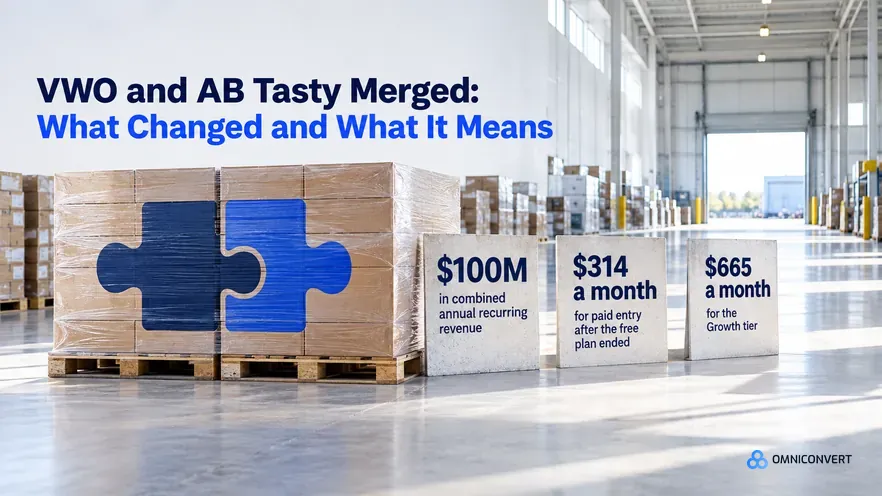
- VWO and AB Tasty merged in January 2026 under Wingify, creating a platform with $100M+ in revenue, 4,000+ customers, and roughly 800 employees.
- VWO's free Starter plan is gone; new sign-ups get a 30-day trial, and paid entry starts near $314 a month, with Growth around $665 a month, priced by Monthly Tested Users.
- AB Tasty customers face open questions: no public migration date, no feature-sunset list, and none of the terms-unchanged guarantee VWO customers received.
- The merger is one move in a 2024 to 2026 consolidation wave (OpenAI and Statsig, Datadog and Eppo, Braze and OfferFit) that is vacating the low end of experimentation tooling.
- The durable response is to decouple the discipline of experimentation from any single tool: document the process, keep data portable, and evaluate on total cost at your real traffic.
A merger between two experimentation vendors reshapes the market both of them served. On January 20, 2026, VWO and AB Tasty announced they were combining under Wingify, backed by Everstone Capital, to form a single digital experience optimization platform. Across the CROBenchmark dataset of 7,000+ websites in 15+ industries, the brands that compound gains are the ones that test continuously rather than in bursts tied to a tool contract [CROBenchmark Report 2026, Omniconvert].
This article explains what happened, what changed for users of each tool, what is happening to the products, and what the deal means for your testing team. It stays on that question deliberately: not "which tool should I switch to," but "what does this event tell me, and how do I make my program resilient to the next one."
What actually happened
The deal brings the two experimentation brands under one roof. Everstone Capital, already the largest institutional shareholder, put in roughly $100M of new capital, much of it to buy out AB Tasty's earlier investors. The combined company draws about 90% of its revenue from the United States and Europe and has been valued in the region of $400M to $500M, roughly four to five times annual revenue (Wingify announcement).
In the words of the announcement, the two are "coming together to form a single, unified digital experience optimization platform." For now, both brands keep their names and their logins. Underneath, product, sales, and engineering are being planned as one, which is what makes this a merger rather than a holding arrangement [GlobeNewswire, 2026].
The timeline, from Everstone to the merger
A merger is easier to read as a sequence than as a single headline. The free Starter tier began winding down before the announcement, through late 2025 and into early 2026. Everstone's capital and the investor buyout came alongside the January 2026 announcement. The product integration, folding AB Tasty's capabilities into VWO, is the phase now underway, with no published completion date.
Seen this way, the pattern is coherent: remove the free entry point, consolidate ownership, raise the floor on price, and unify the product. That is the textbook shape of a category maturing and its leaders moving upmarket.
What changed for VWO users: the free plan is gone
Monthly Tested Users (MTU) is defined as the number of unique visitors exposed to an experiment within a billing month. In ecommerce this matters because your bill scales with how much of your traffic enters tests, so the model quietly couples the cost of experimentation to the success and reach of your program.
The pricing picture below is what most teams are reacting to. Treat it as a starting point: the higher you go, the more the real number is set behind a demo call rather than on a page.
| Plan | Approx. price | Monthly Tested Users | Notes |
|---|---|---|---|
| Free Starter | Discontinued | — | Phased out; replaced by a 30-day trial |
| Paid entry | ~$314 / month | ~10,000 | Billed annually |
| Growth | ~$665 / month | ~100,000 | ~$7,980 per year |
| Higher tiers | Demo-gated | Custom | Priced on request |
For a team that used the free tier to run a handful of low-traffic tests, this is not a small adjustment; it is the removal of the entry point entirely. The job that free plan did, proving an idea cheaply before committing to it, has not disappeared. Only the tool that served it has.
What changed for AB Tasty users: the open questions
Reassurance in a merger is cheap; specifics are what matter. VWO customers were told their terms would not change. AB Tasty customers were not given the same guarantee, which is the single most important asymmetry to notice if you run AB Tasty today. Add the absence of a migration date and a feature-sunset list, and the honest summary is that AB Tasty users are being asked to trust a roadmap they cannot yet see.
This is where behavioral economics explains the pull to do nothing. Loss aversion and switching costs make the pain of migrating feel larger than a gradual erosion in value or a slow price creep, so teams stay put even as the deal they signed quietly changes around them. Naming that bias is the first defense against it: decide on the terms in front of you, not on the effort of moving.
What's happening to the product
The stated vision is a single, AI-driven optimization platform rather than two overlapping products. AB Tasty's AI Emotions and its Evi assistant are being folded into VWO, and the leadership has framed the direction as agentic optimization built on one data foundation. For users, more capability under one login is the promise.
The caution is the mirror image of the promise. When two mature products merge, overlapping features get rationalized, and without a published feature-sunset list, any team cannot yet know which workflow it relies on will survive. The sensible stance is to treat your current feature set as provisional until the roadmap is public.
This isn't just VWO: the 2026 consolidation wave
Reading this merger in isolation misses the pattern. The table below shows how much of the category has consolidated in two years. When a market this size matures, incumbents move upmarket, capital rolls up the mid-tier, and the entry level thins out, which is exactly the dynamic Clayton Christensen described as disruption from below: the moment leaders abandon the low end is the moment it reopens for someone else.
| Deal | Year | Approx. value |
|---|---|---|
| OpenAI and Statsig | 2025 | ~$1.1B |
| Braze and OfferFit | 2025 | ~$325M |
| Datadog and Eppo | 2025 | ~$220M |
| Monetate and SiteSpect | 2025 | ~$75M |
| Webflow and Intellimize | 2024 | Undisclosed |
| VWO and AB Tasty | 2026 | ~$400M to $500M (est.) |
The takeaway is not that any single tool is doomed. It is that tool churn is now a permanent feature of this category, so a testing program built around the assumption that its vendor is forever is built on sand.
What it means for your testing team
Framed through jobs-to-be-done, the job your testing tool performs is "prove an idea before building it, with enough rigor to trust the result." That job does not change when a tool leaves; only the means do. So the decision is not really stay-versus-switch. It is: how do I keep the job getting done when the tool market under me keeps moving?
The testing teams that plateau share one pattern: their experimentation lives entirely inside one vendor's interface, so when the contract or the pricing changes, the practice stops with it. The gap closes fastest when operators treat the test backlog and the decision log as the primary assets, not the subscription. In our CVO work with ecommerce brands, we consistently see that the teams who treat experimentation as a documented process, rather than a feature of one vendor's dashboard, keep their testing velocity through a tool change [Omniconvert, 2026].
Omniconvert Commander (formerly Nexus) ranks your growth opportunities by profit, so your test backlog targets the changes worth proving rather than the easiest to ship, whatever tool you run them in.
See how it worksThis is also where prioritization beats tooling. A cheaper or pricier testing tool changes the cost per experiment; it does not change whether you are testing the right things. Ranking ideas by expected profit, the way you would weigh any growth decision against true profit rather than ROAS, matters more to your results than which vendor renders the variant.
How to make testing resilient to vendor churn
A/B testing is defined as a controlled experiment that splits traffic between two or more variants and measures which performs better on a chosen metric at an agreed level of statistical confidence. In ecommerce it matters because it replaces opinion with evidence before you spend on building a change, and that discipline is independent of which tool renders the variants.
Concretely, a program that survives vendor churn does four things:
-
Document the process, not just the testsKeep a written hypothesis-to-decision workflow and a decision log that lives outside any vendor, so the practice is portable even when the tool is not.
-
Keep your data portableExport raw experiment results and audiences on a schedule. If a migration date or feature sunset arrives, your history leaves with you.
-
Prioritize the backlog by profitRank ideas by expected impact on true profit, not by how easy they are to build, so the tests you run are the ones that pay regardless of tool.
-
Evaluate tools on total cost at real trafficWith MTU pricing, model the bill at your actual tested traffic and coverage, alongside your acquisition cost and customer lifetime value, not the headline entry price.
Proof that the discipline, not the tool, drives the result: AliveCor ran a structured A/B testing programme with Omniconvert and achieved a +21% conversion rate, +5% revenue per visitor, and 94% statistical relevance across their experiments [Omniconvert, AliveCor case study]. The gains came from a disciplined process applied to the right ideas, which is exactly the asset a merger cannot take from you.
Frequently Asked Questions
Yes. The combination was announced on January 20, 2026, bringing both brands together under Wingify, backed by Everstone Capital as the largest institutional shareholder. The combined company reports more than $100M in annual recurring revenue, over 4,000 customers, and around 800 employees across 11 offices. Both brands keep operating for now, but their product, sales, and engineering roadmaps are run jointly under CEO Sparsh Gupta.
Yes. VWO's free Starter tier, which drew many refugees from the retired Google Optimize, was phased out through late 2025 and early 2026. New sign-ups now receive a 30-day trial rather than an ongoing free plan. Teams that relied on the free tier for low-stakes or low-traffic testing must now either move to a paid plan or find another route to run experiments.
Paid entry starts around $314 a month, billed annually, for roughly 10,000 Monthly Tested Users, with a Growth tier near $665 a month for about 100,000 Monthly Tested Users. Higher tiers are increasingly demo-gated, so the published list price is only a starting point. Because pricing scales with tested traffic, your real cost depends on how much of your audience enters experiments.
Both brands continue to operate during the integration, and AB Tasty's AI Emotions and Evi capabilities are being folded into the combined platform. The open questions matter more than the reassurances: there is no public migration date to a unified product, no published feature-sunset list, and AB Tasty customers did not receive the terms-unchanged guarantee that VWO customers were given. Monitor renewal terms closely.
Monthly Tested Users pricing bills you by the number of unique visitors exposed to experiments each month, so a successful, higher-traffic testing program costs more over time. That is a built-in growth penalty: the better your program works and the more traffic you route into tests, the larger your bill. Model your cost at your real traffic and test coverage, not the headline entry price, before you commit.
Omniconvert Commander ingests behavioral and transactional data across your store and ranks growth opportunities by profit, so your test backlog targets the changes worth proving rather than the easiest to ship. It does not replace an A/B testing tool; it decides what deserves a test. That keeps your experimentation discipline anchored to outcomes and your data, not to any single vendor's pricing or roadmap.
A merger at the top of a category is a market-maturity move that vacates the low end, which is exactly what killing a free plan and moving entry pricing near $314 a month signals. The lesson for testing teams is not which tool to flee to; it is to stop renting your experimentation practice from a vendor. Document the process, keep your data portable, and judge any platform on total cost at your real traffic. Teams that treat testing as a culture, not a subscription, are the ones a merger cannot disrupt. See how Omniconvert Commander ranks what to test by profit.
Decide what to test, whatever tool you run it in
Omniconvert Commander ranks your growth opportunities by profit, so your experimentation program targets the changes worth proving, not the easiest to ship. It keeps the discipline with you and your data, independent of any testing vendor's pricing or roadmap.