Why ROAS Is the Wrong North Star

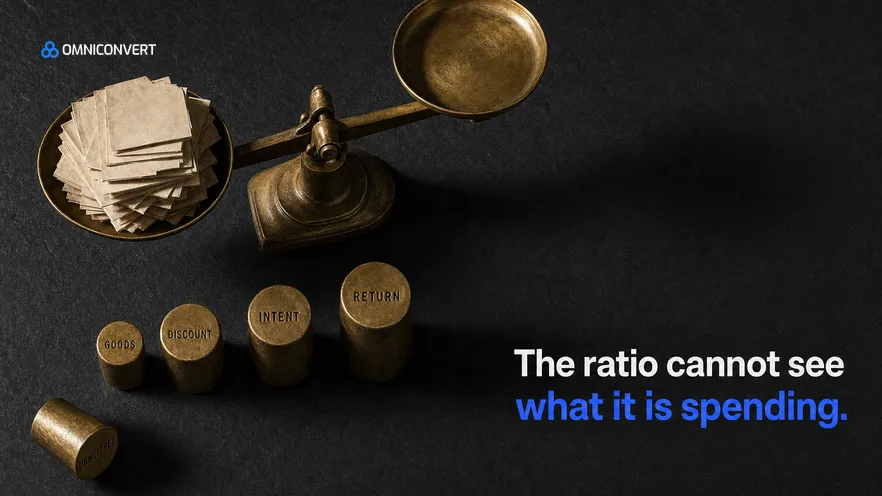
- ROAS is a ratio inside the ad account. It cannot see cost of goods, discounts, incrementality or retention.
- The four distortions are predictable: discount, harvest existing demand, favour low-margin volume, optimise the first order.
- A rising ROAS alongside falling contribution is the classic pattern, and both numbers are correct.
- Incrementality is the missing term: ROAS credits spend for demand that already existed.
- Steer by contribution after acquisition, judged over a cohort's second purchase, and keep ROAS as a diagnostic.
ROAS is the ratio of revenue attributed to advertising against the money spent on that advertising. It is a precise, useful and entirely legitimate number, and it is the wrong thing to put at the centre of a company, because a ratio is indifferent to everything that is not in its numerator or its denominator. Last updated: September 2026.
Omniconvert has measured how growth programmes are steered across the CROBenchmark dataset of 7,000+ websites in 15+ industries, against 248+ audit criteria, over 13 years in eCommerce. The pattern that recurs is not incompetence. It is a room full of capable people, all hitting a target, watching the company get thinner, and being unable to point at anyone who did anything wrong. That is what a badly scoped north star produces.
This piece is about why the drift happens, why it is rational rather than careless, and what a better objective looks like. It sits alongside CRO, creative and AI visibility tie into one growth system, which argues the three disciplines share one input. This one argues they must also share one scoreboard.
A good metric with the wrong scope
The distinction worth holding is between a diagnostic and an objective. A diagnostic tells you whether something inside a system has changed. An objective tells the system what to become. ROAS is a fine diagnostic: when it moves sharply, something in the account moved, and that is worth knowing.
As an objective it has a specific defect, which is that it is indifferent. Metric indifference is not bias. A ratio does not prefer bad outcomes. It simply cannot see anything outside its two terms, so any quantity it cannot see is free to be spent in service of raising it. Cost of goods is free. Discount depth is free. Future purchases are free. All three can be consumed at no cost to the number.
This is why the resulting behaviour is rational rather than negligent. A media buyer given a ROAS target and asked to hit it will find the ways to hit it, and the cheapest ways all involve spending something the metric does not measure.
The four distortions
These are not four separate failures so much as four expressions of the same structural fact. Each one converts something the metric cannot see into something it can, and each therefore registers as an improvement.
They also compound. A company discounting to hit ROAS attracts more discount-motivated customers, whose repeat rate is lower, which lowers the return on the next cohort, which increases the pressure on the ratio, which produces more discounting. The loop is stable and it points downward.
| Distortion | Effect on ROAS | What it actually spends | How it looks in the room |
|---|---|---|---|
| Deeper or earlier discounting | Rises | Gross margin per order | A successful promotion |
| Spend shifted to brand terms | Rises sharply | Nothing, and creates nothing | The most efficient campaign |
| Heavier retargeting weight | Rises | Budget on existing intent | A reliable performer |
| Favouring low-margin bestsellers | Rises | Contribution per order | Leaning into what works |
| Optimising to first purchase | Rises | The second purchase | Strong acquisition quarter |
| Cutting spend in new segments | Rises | Next year's growth | Disciplined budgeting |
The fourth column is the one to sit with. Every row is defensible in the meeting where it is proposed, and several are genuinely good ideas in isolation. The problem is only visible when you ask what was spent, and the spending is recorded nowhere the target can see.
One: discounting toward the metric
The arithmetic is worth doing once because it is more severe than it feels. A product with a forty percent gross margin, discounted twenty percent to lift conversion, has given away half its margin to gain whatever conversion lift the discount produced. The revenue figure rises and the ROAS with it. The contribution can easily fall even if the conversion lift is substantial.
What makes this durable is that the discount is usually judged on the conversion lift alone, which is real and measurable and immediate, while the margin loss is a number in a different system owned by a different team. The two are rarely placed side by side in the same document.
There is a longer-term cost as well. Discount-acquired customers are, on average, more discount-motivated in future, which shifts the composition of the base toward people waiting for the next promotion. Bain and Company's work with Fred Reichheld puts a five percent improvement in retention at twenty five to ninety five percent more profit, and discounting toward a ratio quietly moves the retention curve in the other direction.
Two: harvesting demand you already had
This is the distortion with the largest budgets attached to it. A brand-term campaign returns an outstanding ROAS because the people clicking it typed the company's name, which means they had already decided. Some portion of that spend buys a click on traffic that would have arrived regardless.
Retargeting behaves similarly with a softer edge. Showing an advertisement to somebody who visited a product page yesterday will produce sales, and a meaningful share of those sales were already coming. The measured return is real. The incremental return is smaller, sometimes much smaller.
None of this means the spend is worthless. It means the ratio cannot price it, and a company steering by the ratio will keep moving budget toward capture and away from creation, because capture always looks better. Over a few quarters that is a company with excellent efficiency metrics and a shrinking pool of people who have heard of it.
The remedy is measurement rather than doctrine. A holdout, a geographic split or a deliberate pause on a brand campaign returns an uncomfortable and extremely useful number, and it is the only way to separate the demand you created from the demand you collected.
Three: the cost of goods it cannot see
Catalogues are not uniform, and the spread between the best and worst contribution per order is usually much wider than anyone outside finance assumes. A metric that treats every pound of revenue as equivalent will systematically favour the products that are easy to sell, and ease of sale correlates with low price and thin margin more often than not.
The failure is invisible in exactly the way that matters: the account is hitting its target, the revenue is real, and the contribution mix has quietly deteriorated. It usually surfaces a quarter later as a gross-margin question that gets asked of the finance team rather than of the media team.
Fixing this does not require a new philosophy, only a different input. Feeding contribution rather than revenue into the ratio changes which campaigns look good almost immediately, and it is usually the single highest-value change available to a team that is not ready to abandon a ratio altogether.
Four: the first order against the second
This is the most consequential of the four, because it inverts the thing that actually produces a durable business. Marketing Metrics has long put the probability of selling to an existing customer far above that of selling to a new prospect, and the entire economic argument for retention rests on orders that a short attribution window never sees.
Optimising to the first order also changes who you acquire. Audiences and creative that convert strangers quickly are not necessarily the ones that bring in people who stay, and a system rewarded only on the first transaction will drift toward the former without anyone choosing that.
The consequence is a company that has to keep buying its revenue. Each quarter starts nearer to zero than the last, acquisition costs rise because the efficient pockets are exhausted, and the response, under a ROAS target, is to push harder on the very tactics that caused it.
What to steer by instead
Building this is less work than it sounds, because every input already exists somewhere. Cost of goods is in the finance system. Discounts are in the order records. Fulfilment and service costs are in operations. Acquisition cost is in the ad platforms. What is missing is not data but a single place where they meet, which is why the number is so often absent in companies that have all four.
Three properties make it a better objective. It is indifferent to which channel produced the customer, so it does not reward internal argument. It cannot be improved by discounting, because the discount is subtracted. And it cannot be improved by harvesting, because the acquisition cost of a customer who would have come anyway still counts against the cohort.
True Profit is the name we use for it: the contribution a customer relationship produces after the cost of goods, the discount, the acquisition and the cost of serving them, measured across the relationship rather than on one order. Nexus by Omniconvert is the AI for eCommerce growth engine built around that ordering: it unifies commerce data, prioritises experiments by True Profit, and generates campaigns and creative you approve before they go live. The point of the ranking is not sophistication. It is that a queue ordered by True Profit puts different work at the top than a queue ordered by expected ROAS, and the difference compounds.
The ordering matters more than the tooling. A team that ranks its backlog by expected contribution across the relationship, using nothing more than a spreadsheet, is already making better decisions than one ranking by expected ROAS inside a sophisticated platform.
The honest objection
Media buying needs a signal that moves on the timescale of the decisions being made. Nobody can run an account against a number that resolves in March. Dismissing that objection is how these arguments fail in practice: the theory wins the meeting and the daily dashboard wins the year.
The workable arrangement is a hierarchy rather than a replacement. The slow measure sets the budget and the targets, quarterly. The fast ratio runs the account inside those targets, daily. ROAS stops being the objective and becomes what it was always good at, which is telling a buyer that something changed.
Two adjustments make the daily ratio much less distorting in the meantime, and both are cheap. Feed it contribution rather than revenue, so the cost of goods enters the number. And set the target per cohort rather than per campaign, so the first order stops being the whole outcome. Neither requires abandoning the tooling anyone currently uses.
FAQ: ROAS as a north star
What is wrong with ROAS as a north star?
Nothing is wrong with the number. What is wrong is its scope. ROAS relates revenue to ad spend and is indifferent to everything else: cost of goods, discounts, whether the sale was incremental, and whether the customer returns. Steering a company by it means optimising a ratio that can rise while contribution falls, and both figures will be entirely correct at the same time.
Can ROAS go up while the business gets worse?
Routinely, and it is the most common version of the failure. Discounting raises revenue per session and therefore ROAS, while cutting margin. Shifting spend onto brand terms raises ROAS by harvesting demand that already existed. Favouring cheap low-margin products raises ROAS and lowers contribution. Each of these is a rational response to the target and each makes the company smaller.
What is incrementality and why does it matter here?
Incrementality is the share of measured revenue that would not have occurred without the spend. ROAS has no term for it, so spend placed in front of people who were already going to buy scores extremely well. This is why brand-term and retargeting campaigns flatter a ROAS target: they are largely capturing existing intent, and the ratio cannot distinguish capture from creation.
What should replace ROAS as the north star?
Contribution after acquisition cost, judged across a cohort rather than an order. In practice that means revenue minus cost of goods, minus discount, minus fulfilment and service, minus the acquisition cost, followed over the period in which a second purchase would occur. It is slower and less satisfying than a daily ratio, and it is the number the business actually lives on.
Should we stop looking at ROAS entirely?
No. ROAS is a good diagnostic for an ad account and a bad objective for a company. Keep it where it belongs, as one signal among several that tells a media buyer whether something changed inside the channel, and stop asking it to answer a question about whether the business is growing profitably, which it was never constructed to answer.
How long does a retention-aware measure take to read?
Roughly two purchase cycles for the category, which for most DTC brands means one to two quarters. This is the real objection to changing north star, and it is a fair one: a ratio available tomorrow morning is operationally convenient in a way a cohort curve is not. The answer is to keep the fast ratio as a diagnostic and put the slow measure in charge of budget decisions.
The bottom line
The uncomfortable thing about a badly scoped north star is that nobody has to behave badly for it to do damage. Every individual decision is defensible, every target is met, and the company gets thinner anyway, because the metric is indifferent to most of what the company is made of. ROAS cannot see the cost of the goods, the discount used to move them, whether the customer was already coming, or whether they ever come back, and those four things are very close to the whole of the business. So keep the ratio where it is useful, which is inside the ad account, telling a buyer that something moved. Put contribution after acquisition, read across a cohort, in charge of the budget. It is slower, it is harder to assemble, and it is the only version of the number that cannot be improved by making the company worse.