Dynamic Yield vs Evergage vs Explore (2026): Enterprise vs Store Reality
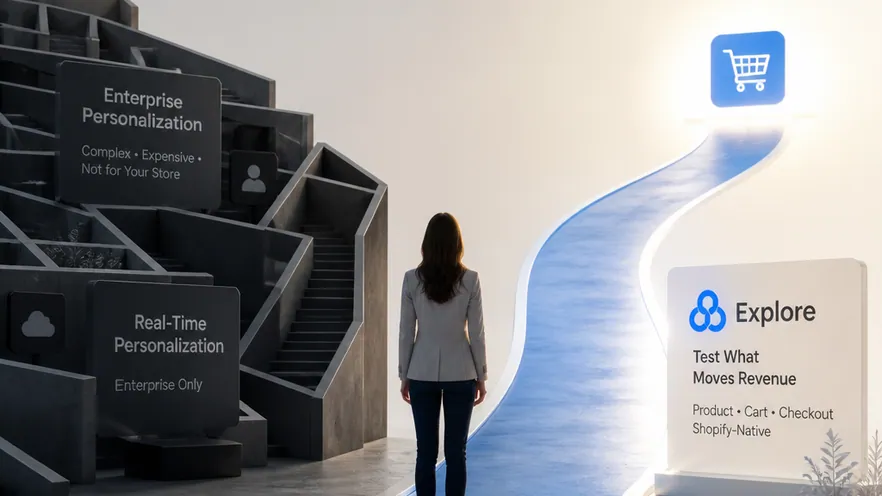
Dynamic Yield is an enterprise personalization and A/B testing platform now owned by Mastercard, used by retailers like IKEA and McDonald's. Evergage, now Salesforce Marketing Cloud Personalization, is an enterprise real-time personalization suite tied to the Salesforce stack. Omniconvert Explore is the Shopify-native eCommerce CRO platform, accessible to mid-market stores, measuring results in revenue per visitor.
- Dynamic Yield is an enterprise personalization and A/B testing platform now owned by Mastercard, used by IKEA and McDonald's, with a 4.5 out of 5 G2 rating. [G2, 2026]
- Evergage, now Salesforce Marketing Cloud Personalization, is an enterprise real-time personalization suite tied to Salesforce, with a 4.3 out of 5 G2 rating. [G2, 2026]
- Both are enterprise personalization suites first, with A/B testing built to validate campaigns rather than run a standalone revenue experiment program.
- Neither is Shopify-native or measures results in revenue per visitor on the checkout surface where store orders are actually placed.
- Omniconvert Explore is the Shopify-native eCommerce CRO platform for mid-market stores, running experiments on product, cart, and checkout measured in revenue per visitor.
Teams comparing Dynamic Yield vs Evergage are usually enterprise buyers weighing two personalization heavyweights: a Mastercard-owned recommendation engine or a Salesforce real-time personalization suite. Dynamic Yield leans on its large-retailer deployments and its personalization stack. Evergage leans on live behavioral profiles connected to the Salesforce CDP. Neither is built for a mid-market Shopify brand that needs to run revenue-per-visitor experiments on product pages and checkout, and this page covers what each does well, the gap they share, and where Omniconvert Explore is the right layer.
What is Dynamic Yield, and what is it actually good at?
Dynamic Yield is an enterprise personalization and A/B testing platform, acquired by Mastercard in 2022. It runs product recommendation engines, experience optimization, and A/B and multivariate tests across web, mobile, and email, and is deployed by major enterprise retailers including IKEA and McDonald's. [Dynamic Yield, 2026]
Dynamic Yield sits at the enterprise end of the market, with a 4.5 out of 5 rating on G2 across roughly 200 reviews. [G2, 2026] Its category is large-retail personalization at scale, where a dedicated in-house team operates the platform on top of significant customer data.
The Mastercard acquisition added data resources to a stack that was already strong on recommendations and experience decisioning. That is what enterprise retail buyers pay for and what the platform delivers.
An enterprise personalization engine sequences the right content, product, or offer to each visitor in real time, using rules and machine learning trained on large customer datasets. Dynamic Yield is one of the leading examples. It is a delivery layer, distinct from running a controlled revenue experiment on product, cart, and checkout.
Where Dynamic Yield is genuinely strong
- Advanced recommendation engine: mature product and content recommendations trained on large retail datasets.
- Experience decisioning at scale: rules and machine learning coordinate content across web, mobile, and email.
- Enterprise data stack: Mastercard-backed data resources sit behind the personalization layer.
- Proven at large retail: deployed by IKEA, McDonald's, and similar organizations with dedicated teams.
Where Dynamic Yield hits its ceiling for a mid-market store
- Enterprise pricing only: custom contracts typically starting in the five-figure annual range, quoted on request.
- Heavy implementation: setup needs a dedicated project and engineering resources, not a self-serve rollout.
- Over-specified for testing alone: if you need a clean A/B program, the full personalization stack is more than the job.
- Not built for Shopify self-serve: a mid-market Shopify team cannot stand it up without significant lead time.
What is Evergage, and what is it actually good at?
Evergage, now Salesforce Marketing Cloud Personalization, is an enterprise real-time personalization platform. Its machine learning builds a live profile of each visitor to serve individualized product and content recommendations across web, email, mobile, onsite search, and in-store, connected to the Salesforce CDP. [G2, 2026]
Evergage is a personalization engine first and a testing tool second. It was named a G2 Leader for personalization engines, with a 4.3 out of 5 rating across 94 reviews. [G2, 2026] Its strength is delivering the right experience to the right visitor in real time, at scale.
Its A/B and multivariate testing exists to validate personalization campaigns: which rule, audience, or recommendation performs best. That is a different job from running a standalone conversion experiment program on a store's checkout.
Real-time one-to-one personalization adapts what a visitor sees based on a live behavioral profile, serving individualized content and product recommendations as they browse. Evergage does this across channels inside the Salesforce ecosystem. It is an enterprise capability, distinct from running controlled revenue experiments on product, cart, and checkout pages.
Where Evergage is genuinely strong
- Real-time one-to-one personalization: live behavioral profiles driving individualized experiences, not static rules alone.
- Machine-learning recommendations: product and content recommendations at scale across many channels.
- Deep behavioral analytics: rich segmentation connected to the Salesforce CDP and Marketing Cloud.
- Enterprise omnichannel reach: web, email, mobile apps, onsite search, and in-store touchpoints in one profile.
Where Evergage hits its ceiling for a single store
- Enterprise implementation: needs technical resources and ongoing support, rarely self-serve for a single eCommerce team.
- Value depends on Salesforce: the platform delivers full value only inside a broader Salesforce deployment.
- Testing serves personalization: A/B testing validates campaigns, not a standalone revenue experiment program.
- No native Shopify checkout: no Shopify-native integration or checkout-level experiment templates.
What Dynamic Yield and Evergage cannot do for an eCommerce store
Dynamic Yield and Evergage are both enterprise personalization suites, but they share one gap for a store. Neither is built around the surfaces where eCommerce revenue is won or lost, product pages, cart, and checkout, or around the metrics that matter there: revenue per visitor, order rate, and the margin a store actually keeps.
Dynamic Yield is built for large retail organizations with dedicated personalization teams. Its implementation complexity and enterprise pricing make it inaccessible to mid-market Shopify brands running self-serve CRO experiments, and its optimization work is framed around personalized experiences, not revenue-per-visitor experiments on checkout flows.
Evergage is built for enterprise marketing teams running real-time personalization across many channels, usually inside Salesforce. Its testing validates personalization rules rather than running revenue-per-visitor experiments on product pages, cart, and checkout. A Shopify store evaluating it takes on enterprise implementation and custom pricing for a personalization-first model.
The two gaps are similar in shape and point to the same missing layer. Both tools optimize the execution of a personalization campaign on a generic page, and both assume an enterprise organization behind the deployment. Neither is built around where store revenue is actually decided, or around the Customer Value Optimization question: whether a result holds for high-value, repeat buyers. For the wider debate behind this testing-versus-personalization split, see Has personalization replaced A/B testing?
There is a second gap underneath the first: the insight layer that tells a mid-market team what to test and whether it worked. Dynamic Yield and Evergage both hold deep behavioral data, but that data lives inside an enterprise deployment most single Shopify stores will never run, and its output is a personalized experience, not an experiment report tied to checkout revenue. Omniconvert Explore is the Shopify-native alternative for a mid-market store: heatmaps, session recordings, and on-site surveys sit next to the experiment, and the same behavioral data defines the segments you test against. The insight and the test live in one place, on the store's own revenue surfaces.
eCommerce conversion rate optimization (CRO) is the practice of running controlled experiments on the revenue surfaces of an online store, product pages, cart, and checkout, and measuring the result in revenue per visitor and order rate rather than generic conversion rate. Explore is defined as an eCommerce conversion rate optimization platform for product, cart, and checkout experiments, native to Shopify and priced for store traffic.
What neither tool can tell an eCommerce team
- Did the win move revenue and margin. Whether a winning variant raised revenue per visitor and order rate, and held its margin once discounts and returns are counted, not just lifted a click or a personalized impression.
- Which surface to test first. Which pages in the funnel (product, cart, checkout) carry the highest revenue impact if tested next on a mid-market store.
- How it behaves in checkout. How an experiment interacts with the Shopify catalog, variants, and checkout flow natively, without an enterprise implementation project.
- Whether it holds for valuable customers. Whether the result holds for repeat, high-value customers, the Customer Value Optimization question, not just first-session visitors.
Omniconvert benchmarks more than 7,000 eCommerce websites in its CROBenchmark Report 2026, across 248+ audit criteria. The data shows where stores actually lose orders: 99.6% fail to make guest checkout visible and prominent, 94.2% do not show checkout progress, and 85.1% never show the full order cost before the final step. [CROBenchmark Report 2026, Omniconvert]
These are checkout-surface problems, the exact surfaces a personalization suite is not built to experiment on. Explore runs the experiment on the store's real revenue surfaces and reports the outcome in revenue per visitor.
This is what the title means by store reality. A more personalized product carousel can leave the bank balance flat; what moves it is order rate and average order value along the product-to-checkout path, read as revenue per visitor. Explore optimizes for that number directly, and because Customer Value Optimization ties each result back to repeat, high-value buyers, the lift it confirms is margin the store keeps rather than traffic it rents. Explore also reaches Shopify-specific levers most enterprise suites cannot touch, including price testing; see Explore 3.0: pricing testing on Shopify.
Dynamic Yield vs Evergage vs Explore: the capability comparison
Side by side, the three tools serve different buyers. Dynamic Yield personalizes for large retailers with dedicated teams. Evergage personalizes for enterprises inside Salesforce. Explore adds native Shopify experiments, built-in surveys and overlays, and revenue-per-visitor measurement on the product-to-checkout path. See A/B testing with Explore for how those experiments run natively on the Shopify funnel.
| Capability | Dynamic Yield | Evergage | Omniconvert Explore |
|---|---|---|---|
| Primary function | Enterprise retail personalization and A/B testing | Enterprise real-time personalization inside Salesforce | eCommerce CRO on product, cart, and checkout |
| A/B testing | Yes visual editor and personalization engine | Yes within personalization campaigns | Yes visual plus code editor |
| Multivariate testing | Yes | Yes | Yes |
| Server-side testing | Yes | Yes via SDK | Yes |
| Visual editor | Yes | Yes | Yes |
| On-site surveys and overlays | Overlays only, no native surveys | No personalization, not surveys | Yes surveys and overlays built in |
| Shopify integration | High, enterprise implementation | Low, enterprise implementation | Yes native |
| eCommerce focus | High, built for large retail | Medium, enterprise personalization | High, built for store revenue workflows |
| Pricing model | Custom enterprise, quote on request | Custom enterprise, quote on request | Session-based, built for store traffic, free trial |
| Best for | Enterprise retail teams running personalization at scale | Enterprise teams in the Salesforce ecosystem | Shopify and eCommerce teams optimizing for revenue |
| User rating | 4.5 out of 5 (G2, 200 reviews, as of 2026) | 4.3 out of 5 (G2, 94 reviews, as of 2026) | 4.6 out of 5 (G2, 191 reviews, as of 2026) |
AliveCor used Explore to run a structured A/B testing program and achieved +21% conversion rate, +5% revenue per visitor, and 94% statistical relevance across their experiments. [Omniconvert, AliveCor case study]
Competitor ratings, pricing, and plan details reflect publicly listed figures as of 2026 and can change. Evergage is now Salesforce Marketing Cloud Personalization; Dynamic Yield is owned by Mastercard. Explore uses session-based pricing; see the Omniconvert pricing page for current plans.
Get the full CROBenchmark data behind these stats: 7,000+ websites, 15+ industries, 248+ audit criteria, 100+ CRO experts. See exactly where eCommerce growth teams are losing margin in 2026.
Get the CROBenchmark ReportFrequently Asked Questions
Should you choose Explore over Dynamic Yield or Evergage?
Start with the surface where your revenue is decided, and the team you actually have. If you run enterprise retail personalization with a dedicated team, keep Dynamic Yield. If you sit inside a Salesforce deployment, Evergage earns its place. For a mid-market Shopify store, run your next test on the product-to-checkout path in Explore, measured in revenue per visitor. The three are complementary at different scales; only Explore is built for the store checkout.
Dynamic Yield and Evergage are both capable enterprise platforms inside their intended fit. Dynamic Yield is deployed by IKEA and McDonald's on top of Mastercard-backed data. Evergage is a G2 Leader for personalization engines inside Salesforce.
The question for a mid-market store is narrower: can your team run a controlled experiment on the Shopify product, cart, and checkout, and read the result in revenue per visitor rather than a personalization KPI. That is the surface Explore is built for, without an enterprise implementation project.
Stop guessing.
Start testing what moves revenue.
Explore runs A/B, multivariate, and personalization experiments on your product pages, cart, and checkout, then measures the outcome in revenue per visitor, not just clicks.
4.6 out of 5 across 191 reviews, G2 , as of 2026