Evergage vs Optimizely vs Explore (2026): Enterprise vs Shopify Revenue
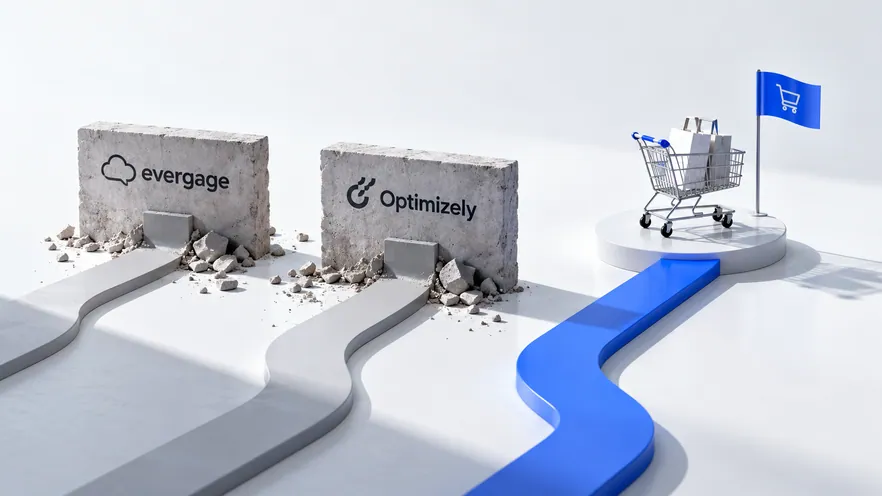
Evergage, now Salesforce Marketing Cloud Personalization, is an enterprise real-time personalization suite. Optimizely is the enterprise standard for A/B testing and full-stack experimentation. Omniconvert Explore is the Shopify-native eCommerce CRO platform: it runs experiments on product pages, cart, and checkout, and measures the result in revenue per visitor rather than clicks.
- Evergage, now Salesforce Marketing Cloud Personalization, is an enterprise real-time personalization suite with a 4.3 out of 5 G2 rating. [G2, 2026]
- Optimizely Web Experimentation is the enterprise standard for A/B testing and full-stack experimentation, with a 4.2 out of 5 G2 rating. [G2, 2026]
- Both are enterprise commitments that treat eCommerce as one surface among many, not as the design centre.
- Neither is Shopify-native, and neither reports experiment outcomes in revenue per visitor, the metric a store actually banks.
- Omniconvert Explore is the Shopify-native CRO layer: product, cart, and checkout experiments measured in revenue per visitor.
Teams comparing Evergage vs Optimizely are choosing between two different enterprise bets: real-time personalization inside Salesforce, or full-stack experimentation across a product and engineering stack. Evergage answers the personalization question at scale. Optimizely answers the testing question at scale. Neither is built around the surfaces where a Shopify store actually wins or loses revenue, which is why many DTC teams end up evaluating Omniconvert Explore as the Shopify-native CRO layer.
What is Evergage, and what is it actually good at?
Evergage, now Salesforce Marketing Cloud Personalization, is an enterprise real-time personalization platform with built-in A/B and multivariate testing. Its machine learning builds a live profile of each visitor to serve individualized product and content recommendations across web, email, mobile, and in-store, connected to the Salesforce CDP. [G2, 2026]
Evergage is a personalization engine first and a testing tool second. It was named a G2 Leader for personalization engines, holding a 4.3 out of 5 rating on G2 across 94 reviews. [G2, 2026] Its strength is delivering the right experience to the right visitor in the moment, at scale.
Its A/B and multivariate testing exists to validate personalization campaigns: which rule, audience, or recommendation performs best. That is a different job from running a standalone conversion experiment program on a store's checkout.
Enterprise personalization is a class of platform that adapts what a visitor sees in real time, driven by a live behavioral profile and machine learning, across web, email, mobile, and in-store touchpoints. It is an omnichannel delivery layer, distinct from running a controlled revenue experiment on product, cart, and checkout.
Where Evergage is genuinely strong
- Real-time one-to-one personalization: machine learning, not static rules alone, driving individualized experiences.
- Recommendations at scale: machine-learning product and content recommendations across many channels.
- Deep behavioral analytics: rich segmentation connected to the Salesforce CDP and Marketing Cloud.
- Enterprise omnichannel reach: web, email, mobile apps, onsite search, and in-store touchpoints.
Where Evergage hits its ceiling for an eCommerce store
- Enterprise implementation: needs technical resources, so it is rarely self-serve for one eCommerce team.
- Custom enterprise pricing: value depends on the broader Salesforce stack, not a standalone store budget.
- Testing serves personalization: A/B testing validates campaigns, not a standalone revenue experiment program.
- No native Shopify checkout: no checkout-level experiment templates for the Shopify funnel.
What is Optimizely Web Experimentation, and what is it actually good at?
Optimizely Web Experimentation is the enterprise standard for A/B testing and full-stack experimentation. It runs web tests, server-side tests, feature flags, and personalization at the scale product and engineering organisations need. Its constraint for a store is that eCommerce is not the design centre.
Optimizely serves the enterprise. Its customer base is heavy with SaaS platforms, media companies, and large marketplaces that run hundreds of concurrent experiments across web pages and back-end services. It has the deepest statistical rigor in the category, with features such as sequential testing built for teams that ship results into product decisions.
The platform ties web experimentation to feature flags and full-stack testing. It integrates with the full enterprise data stack, including Snowflake, Segment, Amplitude, and the usual BI tools. It is the tool a technical experimentation team picks when the primary constraint is scale and governance.
Enterprise experimentation is a class of testing platform designed for engineering teams running feature flags, server-side tests, and web experiments across many surfaces at once. It is an execution and governance layer, distinct from running a controlled revenue experiment on product, cart, and checkout.
Where Optimizely is genuinely strong
- Full-stack coverage: web, server-side, feature flags, and personalization under one contract.
- Statistical rigor: sequential testing and a stats engine tuned for scale, with guardrail metrics that hold under high volume.
- Enterprise integrations: deep hooks into Snowflake, Segment, Amplitude, and the BI stack.
- Programme governance: role-based permissions, environments, and audit trails built for regulated industries.
- Scale: handles hundreds of concurrent experiments without visible performance impact.
Where Optimizely hits its ceiling for a store
- Enterprise pricing and contracts: custom quotes only, out of reach for most sub-$50M ARR stores.
- No native Shopify integration: checkout and catalog experiments need custom development work.
- No eCommerce experiment templates: the platform is category-agnostic, with no product or cart patterns to reuse.
- Steep operational overhead: a dedicated experimentation engineer is effectively required.
- Visual editor less intuitive: reviewers rate the WYSIWYG below mid-market alternatives.
Optimizely holds a 4.2 out of 5 rating on G2 across 401 reviews, and remains the reference name enterprise buyers evaluate first. [G2, 2026]
What Evergage and Optimizely cannot do for an eCommerce store
Evergage and Optimizely are built for different jobs, personalization and experimentation. Neither is built around the Shopify surfaces where store revenue is won or lost: product pages, cart, and checkout. Omniconvert Explore is built for that layer, and measures the outcome in revenue per visitor.
Evergage is built for enterprise marketing teams running real-time personalization across many channels, usually inside the Salesforce ecosystem. Its testing validates personalization rules, not revenue experiments on product pages, cart, and checkout. A Shopify store evaluating Evergage takes on enterprise implementation and custom pricing for a personalization-first model.
Optimizely is built for enterprise engineering and product teams managing complex experiment programmes. It is not designed for eCommerce revenue workflows: no native Shopify integration, no checkout experiment templates. Operating it on a Shopify store needs substantial developer involvement.
Both tools optimise the execution of a test or a campaign on a generic page. Neither is built around where store revenue is actually decided, or around the Customer Value Optimization question: whether a result holds for high-value, repeat buyers. For the wider debate behind this testing-versus-personalization split, see Has personalization replaced A/B testing?
eCommerce conversion rate optimization (CRO) is the practice of running controlled experiments on the revenue surfaces of an online store, product pages, cart, and checkout, and measuring the result in revenue per visitor and order rate rather than generic conversion rate. Explore is defined as an eCommerce conversion rate optimization platform for product, cart, and checkout experiments, native to Shopify and priced for store traffic.
What neither Evergage nor Optimizely can tell an eCommerce team
- Did the win move revenue per visitor. Whether a winning variant raised revenue per visitor and order rate, not just lifted a click or a personalized impression.
- Which surface to test first. Which page in the funnel (product, cart, checkout) carries the highest revenue impact if tested next.
- How it behaves in Shopify checkout. How an experiment interacts with the Shopify catalog, variants, and checkout flow natively, without engineering glue work.
- Whether it holds for valuable customers. Whether the result holds for repeat, high-CLV customers, the Customer Value Optimization question, not just first-session visitors.
Omniconvert benchmarks more than 7,000 eCommerce websites in its CROBenchmark Report 2026, across 248+ audit criteria. The data shows where stores actually lose orders: 94.2% do not show checkout progress, and 85.1% never show the full order cost before the final step. [CROBenchmark Report 2026, Omniconvert]
These are checkout-surface problems, the exact surfaces an enterprise personalization suite or an enterprise experimentation stack is not built to test natively. Explore runs the experiment on the store's real revenue surfaces and reports the outcome in revenue per visitor.
AliveCor used Explore to run a structured A/B testing program and achieved +21% conversion rate, +5% revenue per visitor, and 94% statistical relevance across their experiments. [Omniconvert, AliveCor case study]
Evergage vs Optimizely vs Explore: the capability comparison
The three tools run experiments on different surfaces. Evergage inside Salesforce personalization campaigns, Optimizely across an enterprise web and full-stack programme, Explore on a Shopify store's product, cart, and checkout. Read the table by store profile, not feature count. See A/B testing with Explore for how experiments run natively on the Shopify funnel.
| Capability | Evergage | Optimizely Web Experimentation | Omniconvert Explore |
|---|---|---|---|
| Primary function | Enterprise real-time personalization in Salesforce | Enterprise A/B testing and full-stack experimentation | eCommerce CRO on product, cart, and checkout |
| A/B testing | Partial within personalization campaigns | Yes visual editor plus full-stack SDK | Yes purpose-built for store surfaces |
| Multivariate testing | Yes | Yes | Yes |
| Server-side testing | Yes | Yes category-defining | Yes |
| Visual editor | Yes | Yes less intuitive than mid-market rivals | Yes tuned for store templates |
| On-site surveys and overlays | No personalization, not surveys | Partial personalization module priced separately | Yes surveys and overlays built in |
| Shopify integration | Low enterprise implementation | Low custom development required | Yes native Shopify integration |
| eCommerce focus | Medium enterprise personalization | Low enterprise-general design centre | High eCommerce is the design centre |
| Pricing model | Custom enterprise, contact sales | Custom enterprise, contact sales | Session-based, sized to store traffic |
| Best for | Enterprise teams in the Salesforce ecosystem | Enterprise product and engineering teams at scale | Shopify and DTC stores measuring in revenue per visitor |
| User rating | 4.3 out of 5 (G2, 94 reviews, as of 2026) | 4.2 out of 5 (G2, 401 reviews, as of 2026) | 4.6 out of 5 (G2, 197 reviews, as of 2026) |
Cells describe the design centre and native support, not what a determined team can force with custom code. Evergage is now Salesforce Marketing Cloud Personalization.
Get the full CROBenchmark data behind these stats: 7,000+ websites, 15+ industries, 248+ audit criteria, 100+ CRO experts. See exactly where eCommerce growth teams are losing margin in 2026.
Get the CROBenchmark ReportFrequently Asked Questions
Should you choose Explore over Evergage or Optimizely Web Experimentation?
Decide by the surface that moves your revenue. If you run omnichannel personalization at Salesforce scale, Evergage earns its place. If engineering governs a hundred-plus-experiment programme, Optimizely is the enterprise standard. For a Shopify store between $1M and $50M ARR, run the next test on product, cart, and checkout in Explore, measured in revenue per visitor. The three can coexist, but only Explore is built for the Shopify funnel.
Evergage and Optimizely are both capable tools within their enterprise categories. Evergage was named a G2 Leader for personalization engines, with a 4.3 out of 5 rating across 94 reviews. Optimizely remains the reference name for enterprise A/B testing, with a 4.2 out of 5 rating across 401 reviews. [G2, 2026]
The question for a store is narrower: can your team run a controlled experiment on the Shopify product, cart, and checkout, and read the result in revenue per visitor rather than a click? Explore is built for that surface, and the metric it is built to move.
Stop guessing.
Start testing what moves revenue.
Explore runs A/B, multivariate, and personalization experiments on your product pages, cart, and checkout, then measures the outcome in revenue per visitor, not just clicks.
4.6 out of 5 across 197 reviews, G2 , as of 2026