Competitor Ad Spy: What It Is and Where It Falls Short

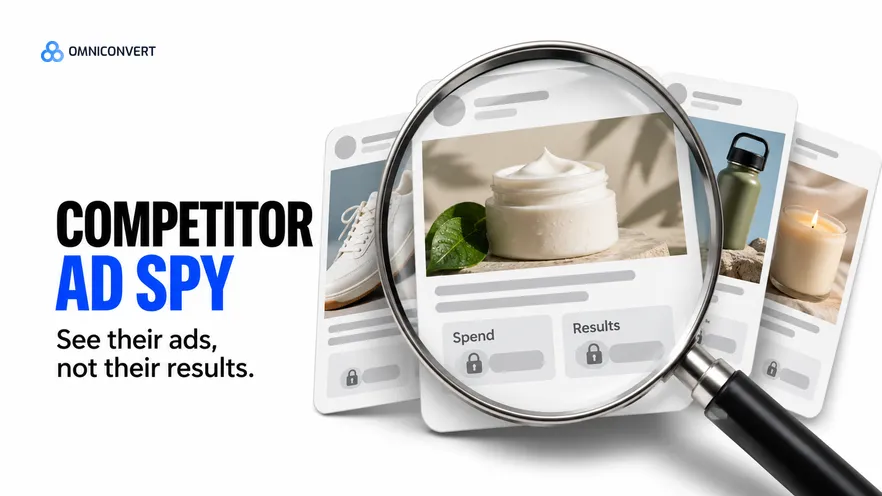
- A competitor ad spy shows what ran and for how long. It does not show spend, results or margin.
- Competitor ad intelligence classifies ads by hook, angle and offer and turns the pattern into decisions.
- Run time is a signal that an ad survived. It is not proof the ad earned a profit.
- Reading single ads misleads. Patterns across a named competitor set are what you can defend.
- Your own True Profit data is the only test of whether a copied angle would pay for your store.
- Omniconvert Commander monitors competitor ad libraries and classifies creative by angle, hook and offer.
A competitor ad spy is a tool, or a habit, for browsing the ads other brands run. You open a public ad library, search a rival, and scroll their live creative. It feels like intelligence. It is only the first half of it.
Open the shared drive of almost any growth team and you will find a folder of competitor screenshots, filed as strategy. After 13 years in eCommerce, I read that folder as a list of questions. The folder is useful. It cannot say whether any of those ads made money. A library shows what a brand says, not what it earns.
I also build for this problem. Omniconvert Commander (formerly Nexus) is the AI eCommerce growth engine for Shopify brands: it reads your store, ad and customer data, ranks growth opportunities by profit impact, and builds the campaigns to act on them, and you approve what goes live.
What is a competitor ad spy?
Competitor ad spy is defined as the collection and review of the ads other brands publish in public ad libraries, with no access to their spend or results. As a tool category, an ad spy tool stores and filters those ads by brand, format or run time. As a habit, it is a marketer opening the Meta Ad Library on a Monday.
The word "spy" overstates it. The ads are public, and the platforms publish them on purpose. You gain speed and a searchable archive, not private data.
What is competitor ad intelligence?
Competitor ad intelligence is defined as the practice that turns observed competitor ads into decisions about your own messaging, creative and testing plan. It starts where the spy ends. You still use the library, but you ask a different question: what does this competitor argue, how often, and for how long?
The full practice sits in the competitor ad intelligence complete guide. For the structural reading method, use the article on competitive ad benchmarking without spend data.
What does a competitor ad library show?
| Question | A spy can answer it | What it needs instead |
|---|---|---|
| What are they saying? | Yes, from copy and creative | Nothing more |
| What format and hook do they use? | Yes, by reading the ad | Classification across many ads |
| How long has an ad run? | Yes, from the start date | Repeated checks over weeks |
| How much did they spend? | No | Their own ad account |
| Did the ad convert? | No | Their own store data |
| Did it earn a profit? | No | Their costs and margin |
| Would it work for my store? | No | Your own customer and profit data |
The questions that decide your budget sit in the bottom rows, and a spy cannot reach them.
Where does a competitor ad spy fall short?
On a Monday call, someone shares a screen: the rival has far more ads live than we do. The room agrees the competitor is outspending us, so the team doubles its own creative output and its budget to match. But a count of ads is not a count of dollars. A brand can run many near-identical ads on a small budget, or one ad on a large one. The team chases a volume that says nothing about spend.
Three smaller gaps follow. A library is a snapshot, so you can miss ads that stopped before you looked. A single ad is a weak sample. And a rival's margin is not yours, so an offer that pays them can lose money for you. I explain this gap in my article on measuring True Profit, not ROAS.
Evidence from your own tests carries more weight than a reading of rivals' ads. Here is one example of a testing programme at work.
AliveCor used Omniconvert to run a structured A/B testing programme and achieved +21% conversion rate, +5% revenue per visitor, and 94% statistical relevance across their experiments. [Omniconvert, AliveCor case study]
How do you move from spying to intelligence?
You need three habits to start: classify by hook, angle and offer; compare across a set of competitors; and test your own interpretation. The complete guide walks through each one.
Omniconvert Commander monitors competitor ad libraries and classifies competitor creative by angle, hook and offer. It also generates launch-ready assets from your customer data and measures results in True Profit, so the loop closes on your numbers. It reads public libraries, so it cannot see rival spend or results.
Competitor ad spy: FAQs
What is a competitor ad spy?
A competitor ad spy is a tool or habit for browsing the ads other brands run. It shows creative, copy, format and run dates from public ad libraries. It does not show spend, sales or profit.
What is competitor ad intelligence?
Competitor ad intelligence is the practice of classifying competitor ads by hook, angle and offer, then turning the pattern into decisions for your own creative. Spying collects the ads. Intelligence interprets them.
What is an ad spy tool?
An ad spy tool collects and stores ads from public libraries so you can search and save them. Most add filters by brand, format and run time. None can add the spend or results that the platforms do not publish.
Can an ad spy tell me which competitor ads are winning?
Not by itself. A long run time suggests an ad is worth keeping, but it is a signal, not proof. Without spend or conversion data you cannot confirm profit.
Is it legal to spy on competitor ads?
Ad libraries are public, so reading them is normal practice. Copying a competitor's creative or claims is a separate matter, and I am not a lawyer. Take your own legal advice before you reuse any of their work.
How do I turn what I see into a decision?
Read for patterns across many ads, not single ads. Benchmark hooks, angles and offers against a named competitor set, then test your own versions. The method is in the article on competitive ad benchmarking without spend data.
What does Omniconvert Commander do with competitor ads?
Omniconvert Commander monitors competitor ad libraries and classifies competitor creative by angle, hook and offer. It then generates launch-ready assets from your customer data, measures results in True Profit, and you approve what goes live.
Spy, then decide
A competitor ad spy shows you what rivals say and how long they keep saying it. Classify the ads, read the pattern across a named set, and test your own version against your own True Profit. Keep the library as a source of questions. Let your data give the answers.