Competitor Ad Intelligence: The Complete Guide

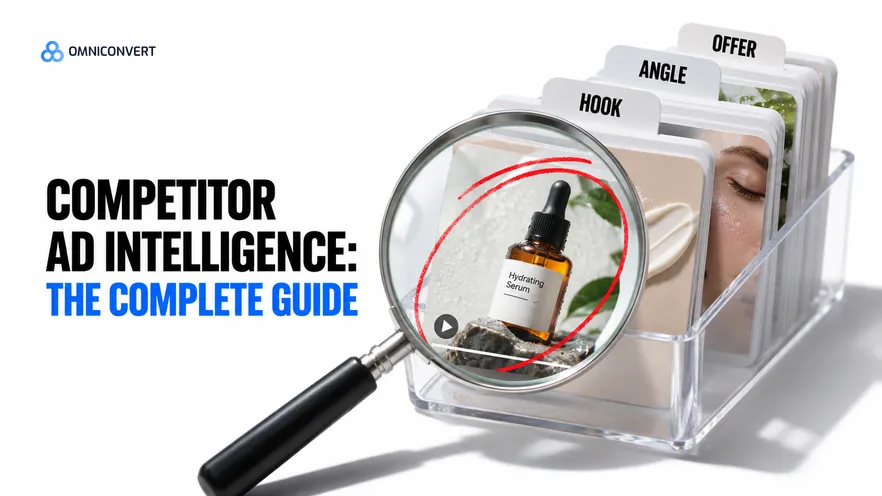
- Competitor ad intelligence reads patterns across many ads. A single screenshot is an anecdote.
- Free public libraries cover Meta, TikTok and Google, and none of them shows spend for ordinary commercial ads.
- Classify every ad by hook, angle and offer in the same words each week, or the counts mean nothing.
- An ad that keeps running is evidence that the advertiser chose to keep it. It is not evidence of profit.
- Brief from the argument a competitor makes, then build the ad from your own reviews, product and offer.
- Copying the surface of a rival ad leaves you with their execution and none of their reasoning.
- Your own customer data decides which competitor pattern earns budget.
Competitor ad intelligence starts with a plain fact: every rival brand publishes its sales arguments, and most of them leave those arguments up for months. You do not need a leak or a login to read them. You need a routine that turns a pile of public ads into a short list of things to test.
Ask a Shopify founder what their three closest rivals are saying in their ads this week, and most cannot tell you. The ads are public. Nobody wrote them down. Omniconvert Explore shows a 23.2% average conversion uplift across 70,000+ experiments [Omniconvert Explore, 70,000+ experiments]. That is an average across tests, not a forecast for any one store. Competitor ads are a free source of ideas for that kind of testing.
Omniconvert Commander (formerly Nexus) is the AI eCommerce growth engine for Shopify brands: it reads your store, ad and customer data, ranks growth opportunities by profit impact, and builds the campaigns to act on them, and you approve what goes live. It also monitors competitor ad libraries and classifies competitor creative by angle, hook and offer.
The narrower guides are listed at the end.
What is competitor ad intelligence?
Two words in that definition carry the weight: repeatable and patterns. A one-off look at a rival's best-looking ad is browsing. Intelligence appears when you look at the same set of competitors on the same day each week, record the same fields, and notice what repeats.
An angle is defined as the reason the product matters to a particular buyer, stated in a way the ad can argue in a few seconds. Angles are the unit all of this work counts in. "Lasts longer than the cheap version" is an angle. A blue background is not.
Related searches use different words for the same practice. Competitor ad research is the one-off version, where you study a market before a launch. Competitor ad monitoring is the ongoing version, where you track changes week to week. The people who search for a competitor ad spy usually want the collection step only, and I treat that term in its own page, competitor ad spy, so the full practice stays the focus here.
Why does competitor ad intelligence matter for a Shopify brand?
Most Shopify brands brief creative from the inside. The founder knows the product, the designer likes a style, and the agency has a template. Everyone is guessing at what the buyer cares about, and the guess usually mirrors the brand's own view of itself.
Competitors give you an outside view for free. If five rivals in your category lead with free shipping and none leads with durability, you have learned two things. Free shipping is a crowded argument. Durability is open ground, if your product can support it.
There is a second reason, and it is about time. A rival that keeps running one ad for months has had many chances to kill it. That is a signal worth a test of your own. It is cheaper than finding out the hard way which angle the category rewards.
None of this replaces your own data. Your reviews, your returns and your repeat buyers tell you what your customers value. Competitor ads tell you what the market is saying to them. You need both, and the second is easier to start with.
Where do you find competitor ads?
The Meta Ad Library is the place most teams start, because most Shopify brands advertise on Meta. It shows live ads, the Page behind each one, the date an ad started running and the platforms it appears on. For ordinary commercial ads it shows no spend, no impressions and no conversions. In some regions it also shows ads that recently ended. Check what it shows for your market before you rely on that.
The TikTok Creative Center is TikTok's own public site for ad and trend inspiration. It is built for browsing what is working on the platform, filtered by market and category. It is a good source for hooks and formats in video. Its filters and the data it shows change over time, so open it and check what it gives you today.
The Google Ads Transparency Center lets you look up an advertiser and see the ads it runs through Google. It helps most when a competitor puts real weight on search and display. Check the regions and formats it covers before you rely on it for a market.
Do not forget the competitor's own store. The landing page an ad points to carries the offer terms, the proof and the price framing that the ad only hints at. An ad without its landing page is half a data point.
| Source | What it gives you | What it does not give you | Best use |
|---|---|---|---|
| Meta Ad Library | Live ads, the Page, start date, platforms | Spend, impressions and results for ordinary commercial ads; ended ads, which depend on region and ad type | Weekly reading of a fixed competitor set |
| TikTok Creative Center | Video ads and trends to browse by market and category | A full record of one competitor's output; your own results | Hook and format ideas for video |
| Google Ads Transparency Center | Ads an advertiser runs through Google | Spend and results; the reasoning behind a choice | Checking how heavily a rival invests in Google |
| Competitor landing pages | Offer terms, proof, price framing | Which ad sent the visitor; how many visitors arrived | Pairing each ad with its destination |
Which competitors should you watch?
Direct rivals sell what you sell to the people you sell it to. Their ads show you the arguments your own buyers meet every day. Start here.
Aspirational brands are larger or more mature in your category. Their ads show where the category is heading. Read them for structure and proof, not for budget-driven polish you cannot match.
One adjacent category gives you ideas nobody in your space has tried. A skincare brand can learn from a supplements brand with the same buyer. The overlap is the customer, not the product.
Write the list down with each brand's Pages, one country per row, and keep it fixed for at least a quarter. If the set changes every week, you cannot tell whether a pattern moved or the sample did.
What should you collect for each ad?
Eight fields sounds like a lot until you do it for a week. Each field answers a question you will ask later. The format tells you what the competitor can produce. The hook shows how it earns attention. The proof shows what makes the claim believable.
Add a link to the ad and a screenshot, so you can check your own reading a month later. Add the landing page URL if you can see it. Do not add opinions such as "looks good". Opinions are the one field that never survives to the next reader.
Resist the urge to collect everything. A competitor with a large library will tempt you to log hundreds of ads. Log the live ones in the markets you sell to, and group variants that differ only by language or currency into one entry. A hundred copies of one idea is one data point.
Also note what is missing. If a competitor shows nothing in the library this week, that tells you something too. Maybe they paused. Maybe they moved to a second Page. Record the gap and look for the second Page before you decide they went quiet.
How do you classify a competitor ad by hook, angle and offer?
A hook is defined as the first frame or first line of an ad, the part that decides whether anyone stays. Common hook types are a direct question, a bold claim, a customer's own words, a problem shown on screen and a demonstration. Pick the list that fits your category and keep it short.
Angles need the most care, because people mix them up with hooks. The hook is how the ad opens. The angle is what the whole ad argues. One angle can sit behind five different hooks. If you label hooks as angles, your counts will say a competitor runs fifty angles when it runs four.
Offers are the easiest to read and the easiest to over-read. Record the mechanics: discount, bundle, free gift, trial or guarantee. Record the framing too. A bundle presented as saving money is a different sales argument from the same bundle presented as convenience.
Once you have labels, count. The question is never "what is this ad doing". The question is "which angle appears most often across this competitor's live ads, and which ones have been live longest". That is where a pattern shows up. For the one-ad version of this work, the guide to deconstructing a competitor ad goes layer by layer.
How do you turn a pattern into a brief?
Start with the pattern, in a sentence. "Three of five rivals lead with a time-saving angle, and the oldest live ad in the set uses it." That is a lead, and it is nothing more yet.
Next, check it against your own data. Do your reviews mention time? Do your support tickets? If your customers never say it, the angle is a rival's story and may not fit your product. If they do say it, you now hold a competitor signal and a customer signal that point the same way. That is a strong brief.
Then write the brief as a test. Name the angle, the hook you will use, the proof you can show and the offer you will run. Change one of those against your current best ad and hold the rest. The method for running that test properly lives in the guide to Meta ads creative testing.
When the brief moves to copy, feed the writer your customers' words. The workflow for that is in the guide to an AI ad copy generator. Competitor wording should never go into the prompt. It belongs in the research notes, not in the draft.
An idea from a rival only pays off once a test confirms it. One case shows what a structured testing programme can return.
AliveCor used Omniconvert to run a structured A/B testing programme and achieved +21% conversion rate, +5% revenue per visitor, and 94% statistical relevance across their experiments. [Omniconvert, AliveCor case study]
How do you use competitor ads without copying them?
A founder pins the category leader's ten best-looking ads to a wall and tells the designer: remake these, with our logo. The originals ran for months, so the plan seems safe. The remakes carry offers built on the rival's margin and customer base. The test result then describes someone else's idea in someone else's voice, and the team learns nothing about its own buyers.
Three habits prevent it. First, never brief from an image. Brief from the written angle, so the designer has nothing to trace. Second, change the proof. If the rival shows a celebrity or a review count, you show something true about your own product. Third, run the idea against your current best ad, so the result tells you if the angle works for your buyers.
There is also a plain legal and reputational line. Competitor logos, product shots, slogans and customer testimonials are theirs. Reusing them invites a complaint and costs trust. Reusing an idea, such as "durability beats price", is how markets work.
How do you run competitor ad monitoring each week?
- Open each Page in the library. Use the same filters every time: one country, active ads, sorted by start date.
- Log the new ads. Fill the eight fields. Group language variants into one entry.
- Mark the ads that ended. An ad that disappeared after a short run is a failed test. Note it in your sheet, because not every library keeps it visible.
- Update the long runners. An ad that is still live after several weeks gets a flag. It is a lead worth testing.
- Write one sentence on the change. Which angle grew, which faded, which offer appeared. This sentence is the output of the week.
- Send the sentence to whoever briefs creative. Intelligence that stays in a spreadsheet changes nothing.
Add a one-off pass before large sale periods, when offers shift fast. Outside those moments, resist the daily check. Ads move slowly, and daily checking mostly records noise. The live guide to analyzing competitor Facebook ads covers this routine against a whole library in more depth.
What does competitor ad intelligence miss?
In short: no public library shows spend, results, margin or customer value, and you only see what survives in view. The definition and its limits sit in the page on what competitor ad intelligence is. For a way to benchmark without guessing at spend, read competitive ad benchmarking without spend data. Omniconvert Commander ranks creative variants by CLV-weighted angle, using your own customer data, and measures results in True Profit, not ROAS. A competitor pattern becomes a candidate. Your numbers decide whether it earns budget.
Which narrower guides go deeper?
Reading a whole library. The guide to analyzing competitor ads on Facebook gives the weekly routine for a fixed set of rivals and the traps in a raw count.
One ad at a time. Deconstruct a competitor ad splits a single ad into its layers, so you can see which part carries the argument and what to borrow.
Your own winners. Finding patterns in winning ads applies the same labelling to your account, which is where the competitor patterns get their proof.
The benchmarking method. Competitive ad benchmarking without spend data shows how to compare messaging coverage honestly when spend is hidden.
The tools. The ranking of the best competitor ad intelligence tools compares the options for collection and classification. If you are weighing Omniconvert Commander against one of them, the Omniconvert Commander and Atria comparison sets out where each fits.
Competitor ad intelligence: FAQs
What is competitor ad intelligence?
It is the repeatable practice of reading what rival brands advertise in public, recording each ad by hook, angle and offer, and using the repeats to decide what to test next. The unit of work is the pattern across many ads, not a single screenshot. It tells you what competitors argue and how long they keep arguing it. It does not tell you what they spend or earn.
What fields should I record for each competitor ad?
Eight: the competitor, the format, the hook, the angle, the offer, the proof, the first frame and the start date. Add a link, a screenshot and the landing page URL. Word the fields the same way every week, because consistent wording is what lets you count patterns later. Leave opinions out of the sheet.
Where can I see competitor ads for free?
Three public sources cover most of it: the Meta Ad Library for ads on Meta platforms, the TikTok Creative Center for TikTok ads and trends, and the Google Ads Transparency Center for ads an advertiser runs through Google. Each shows different things and none shows spend for ordinary commercial ads. Check what each one offers for your market before you build a routine on it.
How often should I check competitor ads?
Weekly is enough for most Shopify brands. Ads change slowly, and a weekly pass on the same day with the same fields lets you see what is new, what ended and what keeps running. Daily checks mostly record noise. Add a one-off pass around big sale periods, when competitors change their offers.
How do I use competitor ads without copying them?
Take the argument and leave the execution. Write down the angle and the proof a rival relies on, then ask which version of that argument your own customer data supports. Build the ad from your reviews, your product and your offer. If your finished ad could be mistaken for theirs, you copied the surface and skipped the reasoning.
How do I classify a competitor ad by hook, angle and offer?
Give each ad three labels from short fixed lists. The hook is what earns the first two seconds. The angle is the reason the product matters to a particular buyer. The offer is what the buyer is asked to do, and on what terms. Label hooks and angles separately, because one angle can sit behind many hooks and mixing them inflates your counts.
How does Omniconvert Commander help with competitor ad intelligence?
Omniconvert Commander monitors competitor ad libraries and classifies competitor creative by angle, hook and offer. It then ranks creative variants by CLV-weighted angle, built from your own customer data, and measures your results in True Profit rather than ROAS. You approve what goes live. The competitor view feeds your briefs, and your own numbers decide which angles earn budget.
Read arguments, not ads
Competitor ads are free to read and easy to misread. The value sits in the arguments they repeat, not in any single creative. So pick a small fixed set of rivals, record the same fields each week, and classify by hook, angle and offer before you count. Treat every long runner as a lead and not as proof. Brief from the written angle, build the ad from your own customers' words, and let your own results decide what earns budget.