5 Lessons from Real A/B Testing Teams: What Actually Works


- Prioritize tool simplicity to increase experimentation velocity and build team confidence through quick wins
- Evaluate testing platforms by support quality and response time, not just feature lists
- Develop judgment about when to end tests through deliberate practice and documentation
- Analyze segment-level results to uncover actionable insights that aggregate data hides
- Build contingency plans for technical issues and maintain relationships with support teams before problems arise
Most A/B testing advice comes from people who have never shipped a real experiment under pressure. These five lessons come from teams who have — and the insights might surprise you.
You have read the blog posts about statistical significance and sample sizes. You have bookmarked the case studies showing 300% conversion lifts. But when you actually sit down to run tests on your own site, the gap between theory and practice feels enormous. Your developers are busy. Your traffic is limited. And you are not entirely sure if your results are even reliable.
This article distills hard-won wisdom from real experimentation teams who have navigated these exact challenges, giving you a practical playbook for running tests that actually move the needle.
Lesson 1: Simplicity Beats Sophistication Every Time
The teams getting the best results from A/B testing share one common trait: they prioritize usability over feature complexity. When tools are difficult to use, experimentation programs stall. Tests sit unfinished. Insights never reach decision-makers.
This is not about dumbing things down. It is about removing friction between having an idea and validating it. When your marketing team can set up and launch a test without waiting three weeks for developer support, your experimentation velocity increases dramatically.
The most successful testing programs build momentum through quick wins. A simple button color test that ships in two hours teaches your team more than a complex multivariate experiment that never launches. Speed compounds: each completed test builds organizational confidence and capability.
This does not mean avoiding complex tests forever. It means earning the right to run them by building a foundation of simpler experiments first. Start with headline tests, CTA variations, and layout changes before attempting personalization journeys or algorithmic recommendations.
"I like that Omniconvert is simple to use. You don't have to be a CRO guru to know how to use it to run tests, review what the tests have done, and learn the insights. It's really easy to use, and you don't have to be a data analyst or programmer or someone who's been doing CRO for ten years."
— CRO Professional at Fella HealthLesson 2: Your Support Team Is Part of Your Testing Stack
Here is something the feature comparison charts never tell you: the quality of support you receive directly impacts your testing success rate. When something breaks at 4 PM on a Friday before a major campaign, you need humans who understand your setup and can help you fix it fast.
Experienced testing teams evaluate tools not just by their feature sets, but by how quickly problems get resolved. A platform with perfect features but slow support creates bottlenecks that kill experimentation programs. Conversely, responsive support teams can help you push past limitations you thought were dealbreakers.
The best vendor relationships feel like partnerships. Support teams that proactively review your test setups, flag potential issues, and suggest improvements add value far beyond troubleshooting. They become an extension of your optimization capability.
When evaluating any testing tool, ask about response times. Ask about the expertise level of support staff. Better yet, ask current customers about their support experiences during critical moments. This information is more valuable than any demo.
"I also want to highlight the customer support — the team is extremely responsive, helpful, and proactive. They not only answer questions quickly but also review our test setups and flag potential issues, which has been incredibly valuable while we build internal expertise."
— Experimentation Lead at Seasonal E-commerce BusinessLesson 3: Knowing When to Stop Is Harder Than Starting
Every testing guide tells you how to calculate sample sizes and set up experiments. Almost none of them prepare you for the hardest decision in experimentation: knowing when to call it.
Teams new to A/B testing often fall into two traps. Some end tests too early, declaring winners based on insufficient data. Others let tests run indefinitely, waiting for statistical certainty that may never arrive. Both approaches waste resources and erode confidence in the testing program.
Building this judgment takes time and intentional practice. It requires understanding your traffic patterns, your baseline conversion rates, and the minimum detectable effects that actually matter for your business. A 2% lift might be noise for a high-traffic site but a meaningful signal for a smaller one.
The learning curve here is real, and acknowledging it upfront helps teams set realistic expectations. Your first few experiments will probably run too long or end too soon. That is part of the process. Document your decisions, review them later, and iterate on your methodology just like you iterate on your website.
"Since we are still early in our experimentation journey, knowing when to end experiments required a learning curve."
— Experimentation Lead at Seasonal E-commerce BusinessLesson 4: Segment Insights Often Matter More Than Overall Winners
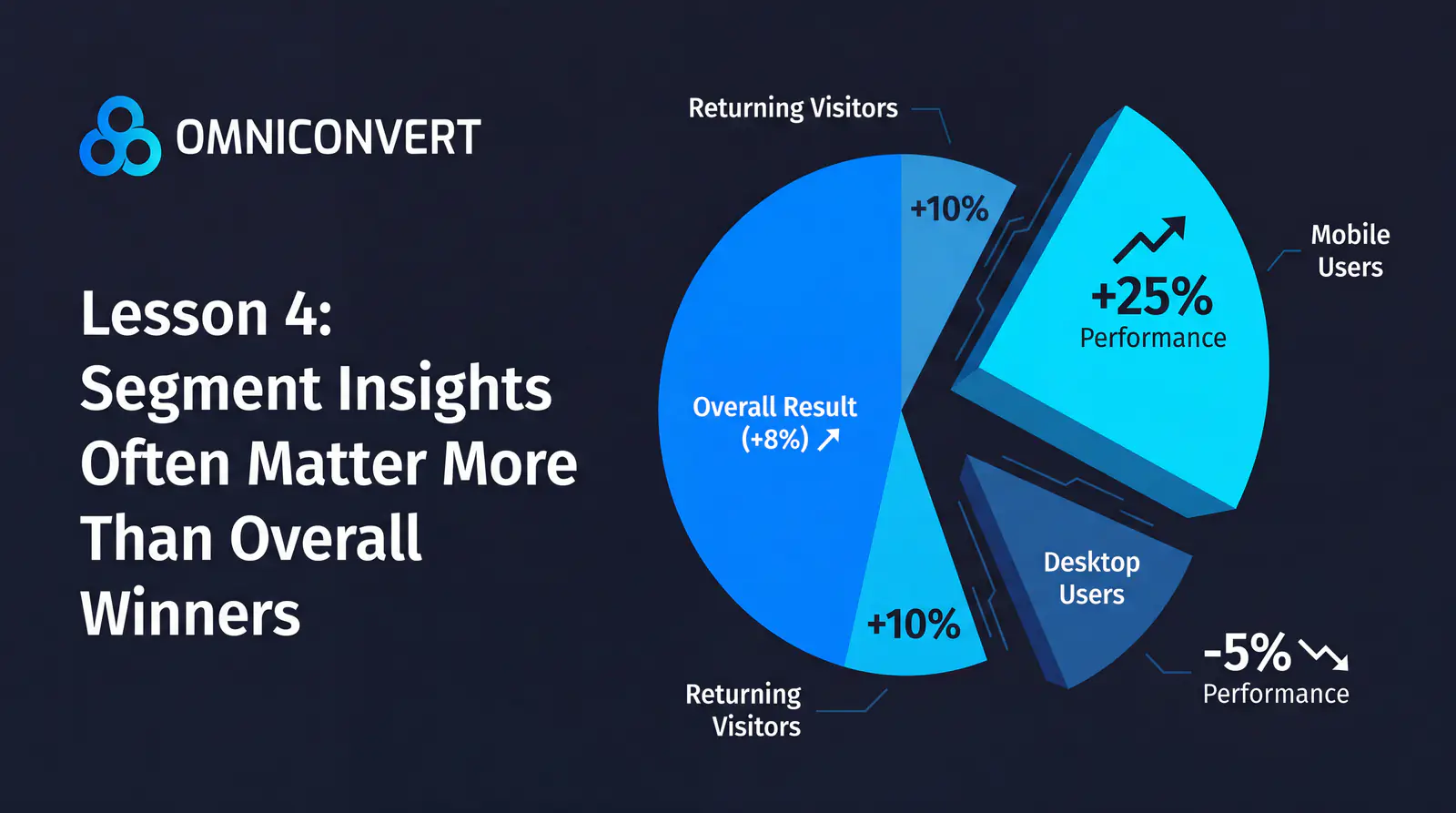
The headline result of any A/B test tells you what won. The segment breakdowns tell you why. Teams that stop at the top-level numbers miss the most actionable insights their experiments produce.
Consider a test where Variation B beats the control by 8% overall. Useful, right? Now imagine discovering that Variation B actually performed 25% better with mobile users but 5% worse with desktop users. That insight changes everything: your implementation strategy, your prioritization, even your understanding of your audience.
User flow analysis reveals patterns that aggregate data obscures. How do different segments interact with your site? What are first-time visitors looking for versus returning customers? Which traffic sources convert differently? These questions turn tests into learning opportunities.
The discipline of segmentation also prevents false positives. An overall winner might be driven entirely by one segment that happened to have unusual traffic during the test period. Breaking down results by segment, device, and traffic source helps you validate that your findings are robust.
"I've learned a vast amount of information from running tests, from how different segments interact with the site and what our users are looking for in terms of front end elements."
— Testing ProfessionalLesson 5: Technical Issues Are Inevitable, Response Time Is Everything
No testing platform is perfect. Every tool has edge cases, bugs, and limitations. The difference between a good testing experience and a frustrating one is not the absence of problems but the speed at which they get resolved.
Experienced teams build contingency plans into their testing programs. They know that split URL testing might have quirks. They understand that flicker can appear in certain implementations. They have backup tools ready for specific use cases that their primary platform handles imperfectly.
This is not a reason to avoid testing. It is a reason to approach it with realistic expectations. When you encounter an issue, document it clearly. Reach out to support with specific details. And critically, do not let one technical hiccup derail your entire experimentation program.
The teams that sustain long-term testing programs are the ones that treat obstacles as puzzles to solve rather than reasons to quit. They build relationships with support teams. They develop workarounds. They keep shipping experiments even when conditions are not perfect.
"There have been a few technical hiccups with the tool, but each of these was addressed swiftly by their CSR and development team. The thing I like most about Omniconvert is how quickly their team responds to any issue brought to them."
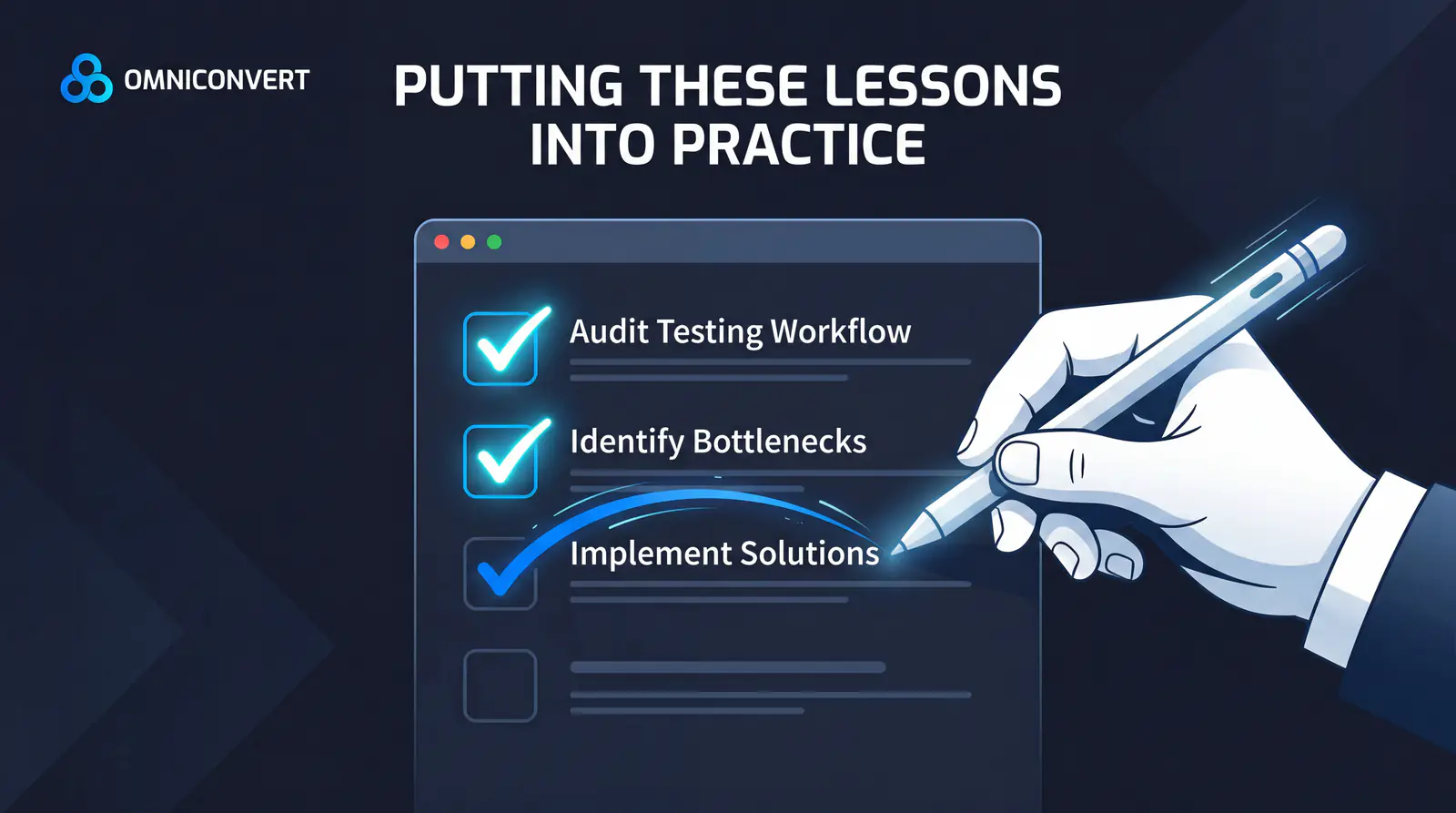
— Testing ProfessionalPutting These Lessons Into Practice
Reading about experimentation best practices is easy. Implementing them requires intentional effort and organizational commitment. Here is how to start applying these lessons immediately.
First, audit your current testing workflow for friction. Where do experiments stall? Is it in the setup phase, the analysis phase, or the decision-making phase? Each bottleneck requires a different solution. Setup friction often means you need simpler tools or better training. Analysis friction usually indicates unclear success metrics. Decision friction suggests you need stronger stakeholder alignment.
Second, establish a relationship with your tool's support team before you need them urgently. Run a test setup by them proactively. Ask for feedback on your implementation. Building rapport during calm periods pays dividends during crises.
Third, commit to segmentation from day one. Even if you do not have the traffic for statistically significant segment-level results, building the habit of looking beyond top-line numbers will serve you well as your program matures.
Finally, document everything. Your future self will thank you when you can reference exactly why you made specific decisions about test duration, success metrics, and implementation choices.
The gap between A/B testing theory and practice closes when you learn from teams who have already navigated the challenges. Simplicity enables speed. Great support multiplies your capabilities. Knowing when to stop requires practice. Segments reveal the why behind results. And technical issues become manageable when you have strong vendor relationships. These lessons will not make experimentation effortless, but they will help you build a testing program that actually delivers results. Start with one lesson this week — run a simpler test, reach out to your support team, look at your segment data. Small changes compound into significant improvements over time.
Ready to Run Tests That Actually Work?
Omniconvert gives real e-commerce teams the simplicity, support, and power they need to experiment with confidence.