Best Fidras Alternatives for Shopify (2026)

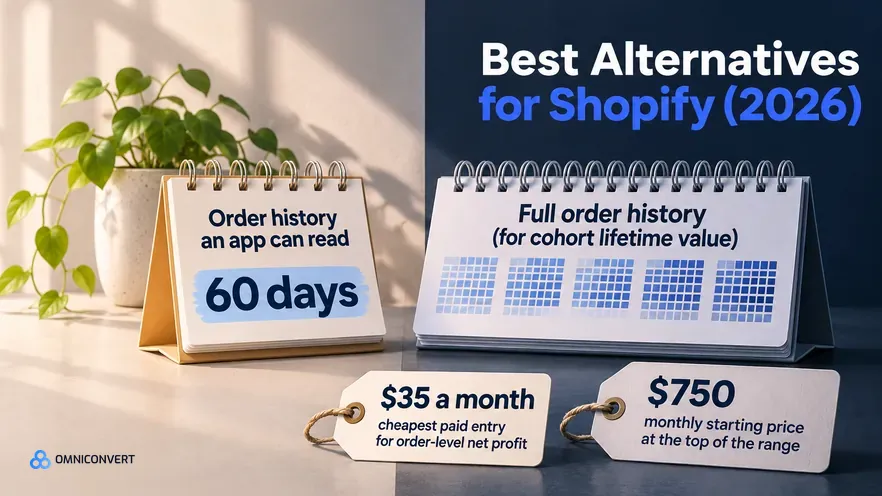
- Fidras is an all-in-one messaging app with analytics attached, so an alternative replaces either the sending or the customer analytics, rarely both at once.
- Fidras lists order data access for the last 60 days; multi-year cohort lifetime value requires Shopify's separate read_all_orders scope, which Shopify must approve [Shopify, 2026].
- Fidras lists no profit or COGS reporting, so a $16 a month plan cannot tell you which segment is profitable to win back.
- Prices read on 25 November 2026: Fidras $9.99 to $49, TrueProfit from $35, Lifetimely from $49 after a free tier, Omniconvert Commander from $49, Polar Analytics from $750.
- Fidras shows 51 installs and 5.0 from 2 reviews, so there is little public evidence either way; judge it on the data access, not the star rating.
A Fidras alternative is any Shopify app that takes over one of the two jobs Fidras bundles: sending email, WhatsApp and SMS campaigns, or analysing customer value behind them. Which half you are replacing changes the shortlist completely. It also changes the test that matters, and that test is not a feature count. Omniconvert's CROBenchmark audits 7,000+ websites across 15+ industries against 248+ criteria, and the pattern it keeps showing is that measurement depth, not tool count, separates stores that grow repeat revenue [CROBenchmark Report 2026, Omniconvert].
So here is the short list before any context. For lifetime value and retention intelligence, Lifetimely ($49 a month after a free tier) or Omniconvert Commander ($49 a month, free to install) when the segment has to carry a profit number. For order-level net profit, TrueProfit ($35 a month). For a warehouse-backed BI stack, Polar Analytics ($750 a month). For paid-media attribution beside lifetime value, Triple Whale. All prices read from the vendors' own listings on 25 November 2026.
What is Fidras, and why does "alternative" mean two different things?
Fidras is a marketing app for Shopify and WooCommerce, published by CatalystIQ and launched on 13 January 2026. It bundles RFM segmentation, a lifetime value dashboard, retention cohorts and AI store summaries with outbound email, WhatsApp and SMS, wired to DeepSeek AI, SendGrid and Twilio. Plans run $9.99, $16, $19 and $49 a month, each with a 3-day trial, and the app is English only [Shopify App Store, 2026].
Two details decide everything that follows. Its listing names no profit or COGS reporting, and it states order data access for the last 60 days. Public traction is thin too: 51 installs, down 5.7% quarter on quarter, with 72.5% of them in India, and 5.0 from 2 reviews [StoreLeads, 2026, data updated 20 November 2026]. A new app with two reviews is not a bad app. It is an app with no public evidence, which is a different problem and one you solve with a trial rather than a star rating.
Fidras itself positions as an all-in-one AI marketing platform and names no competitors on its own comparison page [Fidras, 2026]. That is the honest reading of the category: it competes with email platforms on sending and with analytics apps on measurement, and the two shortlists barely overlap.
How far back can the tool see your orders?
This is the one question that separates these tools, and almost no roundup asks it. On a feature grid every app has RFM, cohorts and a lifetime value chart. On data access they are not close.
Shopify's read_orders scope covers orders created within the last 60 days. Reading anything older requires the separate read_all_orders scope, which an app in a Partner organisation must request and Shopify must approve [Shopify, 2026].
Cohort lifetime value is defined as the cumulative revenue a group of customers acquired in the same period generates over their whole relationship with the store, measured month by month after first purchase. It matters in eCommerce because the decision it supports, how much you can afford to pay to acquire a customer, depends on revenue that arrives in months 6, 12 and 24, not in the first 60 days.
A tool limited to a 60-day window can still draw a chart labelled "LTV". What it is actually showing is 60 days of value, extrapolated. Treat that as a reporting convenience, never as the basis of an acquisition budget. Before you trust any app's figure, read how cohort analysis is built and what customer lifetime value requires as input.
This is also the frame shift worth making before you compare anything. On an incumbent's feature grid the incumbent wins, because the grid was drawn around what it already does. April Dunford's point in Obviously Awesome is that the useful move is to change the criteria, not to argue inside someone else's. Here the criterion is history depth plus cost visibility, and on those two axes a $16 a month all-in-one and a $49 a month analytics specialist are not in the same category at all.
Which four jobs should you shortlist against?
Group the market by the job, not by a ranking from one to ten. A twelve-row comparison table does not help you decide; it makes you keep what you have. Barry Schwartz's work on choice overload, and Iyengar and Lepper's jam-tasting study, both land on the same finding: more options produce less action. So four jobs, and one or two tools each.
- Profit and P&L. Net profit per order, after COGS, shipping, fees, discounts and returns. TrueProfit, Lifetimely.
- Lifetime value and retention intelligence. RFM segments, cohorts, predicted value, and what to do about each segment. Lifetimely, Omniconvert Commander.
- Messaging replacement. The sending half of Fidras. Klaviyo or your existing email and SMS platform; no analytics app on this page sends campaigns for you.
- Enterprise BI. One warehouse, every source, custom modelling. Polar Analytics, and Triple Whale where paid-media attribution is the priority.
Pick the job first. Most stores leaving an all-in-one need two tools, not one, and the honest version of that sentence is worth saying out loud: a single $16 subscription that does four jobs shallowly is cheaper than two that do one job each properly, right up until a budget decision rests on its numbers.
What are the best Fidras alternatives for Shopify in 2026?
Omniconvert Commander — best for RFM and lifetime value tied to true profit
Omniconvert Commander is an AI eCommerce growth engine for Shopify and Shopify Plus. It connects over read-only OAuth, scores every customer into RFM segments from Champions to Dormant, shows the lifetime value impact per segment, and calculates True Profit by netting COGS, shipping, returns, discounts, ad spend and payment fees. It then drafts the campaign for the segment worth the spend, and you approve it before anything goes live. It holds 5.0 from 66 reviews on the Shopify App Store. Founding Free plan, then $49, $199 and $499 a month [Omniconvert Commander pricing, read 25 November 2026].
Best for: stores where the retention decision needs a margin number attached, not just a revenue number. What switching costs you: it is single-store today, with multi-store on the roadmap, and its campaign launch features are in beta, so keep your email platform. It is our product, which is why its limits are listed here beside its strengths.
Lifetimely — best for predictive lifetime value and a daily P&L
Lifetimely has been in the App Store since February 2019 and holds 4.9 from 642 reviews, the deepest evidence base on this list. It covers predictive lifetime value, cohort reports and a daily profit and loss statement in one app. Free plan, then $49 a month up to 500 orders, $149 up to 3,000 and $299 up to 7,000, with an Amazon add-on at $75 [Shopify App Store, read 25 November 2026]. Third-party roundups quote its entry tier at both $49 and $79; trust the live listing.
Best for: the straight Fidras analytics swap, at the widest range of store sizes. What switching costs you: pricing steps with order volume, so model your next tier before you commit, and it reports rather than recommends.
TrueProfit — best for order-level net profit and COGS
TrueProfit holds 4.9 from 932 reviews and has been live since 2019. It computes real-time net profit per order with quantity-based COGS, builds a P&L, and adds marketing attribution on its top tier. Plans are $35, $60, $100 and $200 a month by order volume, with per-extra-order fees above each band [Shopify App Store, read 25 November 2026].
Best for: the cheapest credible answer to "what did this order actually earn". What switching costs you: you must enter COGS properly, per product rather than one blended rate, or the output is a tidier guess. Our ranking of the wider category is in best profit tracking tools for Shopify.
Polar Analytics — best for unified BI at scale
Polar Analytics holds 4.9 from 116 reviews and sells a business-intelligence layer rather than an app dashboard: unlimited historical data, custom metrics, and audience sync into Klaviyo. Core plans start at $750 a month, priced on GMV [Shopify App Store, read 25 November 2026].
Best for: stores with an analyst and several data sources. What switching costs you: roughly 15 times the Fidras Enterprise price, plus the modelling work to make it useful. Below about $3m in revenue this is the wrong tool, not a stretch goal.
Triple Whale — best for paid-media attribution beside lifetime value
Triple Whale is the pick when the pressing question is which channel acquired the customer, with lifetime value as the second screen rather than the first. We did not read a published flat monthly tier for it on 25 November 2026, so treat its price as quoted on request and get it in writing before you plan around it. Our longer read is this Triple Whale review, and the head-to-head is Lifetimely vs Triple Whale.
Best for: ad-led stores spending enough that attribution error costs more than the subscription. What switching costs you: it is the broadest tool here, so profit and retention are features inside a larger platform rather than its focus.
Staying on Fidras — when that is the right call
If what you actually want is one cheap app that segments a small customer list and sends the WhatsApp and SMS campaigns, Fidras at $9.99 to $19 a month is a reasonable bet, and nothing on this list does the sending. Keep it for that job. Just do not let an acquisition budget, a win-back discount or a margin decision rest on a lifetime value figure built from a 60-day window.
Omniconvert Commander scores your customers over your full order history and nets every variable cost into True Profit per segment, so you can decide which cohort is worth a win-back budget without exporting anything to a spreadsheet. See how it works
Fidras alternatives compared side by side
| Tool | Entry price per month | Reviews | Profit / COGS | What it is for |
|---|---|---|---|---|
| Fidras | $9.99 (to $49) | 5.0 from 2 | Not listed | All-in-one segmentation plus email, WhatsApp and SMS sending |
| Omniconvert Commander | Free to install, then $49 | 5.0 from 66 | True Profit per segment | RFM and lifetime value decisions with a margin number attached |
| Lifetimely | Free, then $49 | 4.9 from 642 | Daily P&L | Predictive lifetime value and cohorts |
| TrueProfit | $35 | 4.9 from 932 | Net profit per order | Order-level profitability with quantity-based COGS |
| Polar Analytics | $750 | 4.9 from 116 | Custom metrics | Warehouse-backed BI across sources |
| Triple Whale | Quoted on request | Established base | Profit as one module | Paid-media attribution with lifetime value beside it |
Read the price column against the job column, not down the column on its own. The $35 tool and the $750 tool are not competing; they answer different questions, and only one of them is the question you have this quarter.
What does switching actually cost, and how do you de-risk it?
Bob Moesta's Four Forces of Progress explains why most of these migrations stall. A switch needs push (the current tool is failing), pull (the new one looks better) and, against both, habit and anxiety. Vendors spend all their effort on pull, adding features, when the brake is anxiety: will the history import, will the numbers match, how long until the first insight. Nobody moves house because a nicer kitchen exists. They move when the current one stops working, and only if someone helps pack the boxes.
There is a pricing mirror of this. Gourville's 9x Effect says vendors overvalue new features by about three times while buyers overvalue what they already own by about three times, which is loss aversion doing its usual work. The counter is to price the status quo: not what switching gains you, but what the current setup costs per month in decisions made on 60-day data.
Three steps that remove most of the anxiety:
- Ask about scope, in writing. Does the app hold
read_all_orders, and how many months of history will it backfill on install? The answer is a yes or no, and it decides whether cohorts are real. - Reconcile one month by hand. Pick a closed month, rebuild revenue, discounts, refunds and COGS for ten orders, and compare. If a line is off, fix the input before you trust the dashboard.
- Run both for one billing cycle. Keep Fidras sending while the new tool reads. $16 of overlap for 30 days is cheaper than a migration you have to reverse.
In our CVO work with ecommerce brands through 2026, we repeatedly find that the step teams skip is the reconciliation, and it is the one that would have caught the wrong number before it reached a budget [Omniconvert, 2026].
The Shopify brands that plateau at a 20% to 25% repeat purchase rate consistently share one pattern: they segment on recency only, because recency is the one dimension a short data window can compute reliably. Frequency and monetary value need history, so they quietly drop out of the model, and every win-back campaign ends up aimed at whoever bought most recently rather than at whoever was worth keeping. The gap closes fastest when operators treat profit per segment as the primary unit of measurement, not open rate. Our rundown of what the specialist tools do here is best customer intelligence and RFM tools, and the wider market view is in customer retention platforms.
Better measurement only pays once it changes something on the page or in the campaign. Testing a redesigned add-to-cart pop-up on desktop, LEROY MERLIN Romania ran one A/B test with Omniconvert and recorded a +16.8% conversion rate, +24.19% revenue per user and a 99.66% chance to win [Omniconvert, LEROY MERLIN Romania case study]. That is a testing result rather than an analytics one, and it is the point: the segment report is only worth its subscription when a change ships off the back of it.
How do you choose in 20 minutes?
RFM segmentation is defined as ranking every customer on how recently they bought, how often they buy and how much they spend, then grouping the resulting scores into named segments such as Champions, Loyal, At Risk and Dormant. It matters in eCommerce because it turns one undifferentiated list into a handful of groups with different economics, which is the precondition for spending retention budget unevenly and on purpose.
With that in hand, four questions settle it:
- Am I replacing the sending or the analysis? Sending: Klaviyo or your current platform. Analysis: continue.
- Does a budget decision depend on these numbers? Yes: you need full order history and COGS, so Lifetimely, TrueProfit or Omniconvert Commander. No: a cheap all-in-one is fine.
- Do I need the margin, or the forecast? Margin per order: TrueProfit. Predicted lifetime value and cohorts: Lifetimely. Both, with the segment carried into a campaign: Omniconvert Commander.
- Do I have an analyst and several data sources? If yes, and revenue supports $750 a month, Polar Analytics. If attribution is the pain, Triple Whale.
Then reconcile one month before you cancel anything. For the shortlist of apps focused purely on value measurement, see customer lifetime value apps for Shopify; for the segmentation layer, customer segmentation tools.
Fidras alternatives: frequently asked questions
Fidras is a Shopify and WooCommerce app published by CatalystIQ and launched on 13 January 2026. It combines RFM segmentation, a lifetime value and retention dashboard, AI store summaries, and email, WhatsApp and SMS sending in one subscription. Plans run from $9.99 to $49 a month, each with a 3-day trial, and the app is English only [Shopify App Store, 2026].
Three reasons come up most. Its listing names no profit or COGS reporting, so segments carry revenue but not margin. It lists order access for the last 60 days, which is too short for cohort lifetime value. And it is new and small, at 51 installs and 2 reviews in November 2026, so there is little public evidence of how it behaves on a large catalogue [StoreLeads, 2026].
Its Shopify listing states order data access for the last 60 days. Cohort lifetime value needs years of order history, which on Shopify requires the separate read_all_orders scope that Shopify approves per app [Shopify, 2026]. Ask the developer which scope the app holds before you budget against any lifetime value figure it shows.
TrueProfit lists the lowest paid entry at $35 a month. Lifetimely lists a free plan and paid tiers from $49 a month for stores up to 500 orders a month. Omniconvert Commander installs free on a Founding Free plan and lists paid tiers from $49 a month. All three prices were read on 25 November 2026.
Usually yes. The analytics specialists listed here read your order data and score your customers, but they do not send the campaigns. Pair one with Klaviyo or whichever email and SMS platform you already pay for, and keep the segments in the analytics tool so one definition of a Champion or a Dormant customer feeds every channel.
Omniconvert Commander reads your full Shopify order history over a read-only connection, scores every customer into RFM segments from Champions to Dormant, and nets COGS, shipping, returns, discounts, ad spend and payment fees into a True Profit figure per segment. That gives you the one output a 60-day window cannot produce: which segment is worth winning back at what cost, before you spend on the campaign.
Every Fidras alternative on this page can draw a retention chart. Only the ones that can read your full order history can tell you whether a cohort was profitable, and Fidras lists 60 days. Decide what you are replacing first, the sending or the analytics, then pick the cheapest tool that can see far enough back: TrueProfit at $35 a month for net profit, Lifetimely at $49 for predictive lifetime value, or Omniconvert Commander when the segment has to carry a profit number into the campaign.
See which segment is profitable to win back
Omniconvert Commander is the AI eCommerce growth engine that scores your customers into RFM segments over your full order history, nets every variable cost into True Profit per segment, and drafts the campaign for the segment worth the spend. You approve what goes live.