The Hidden Cost of a 20-Tool Growth Stack (and How to Cut It)

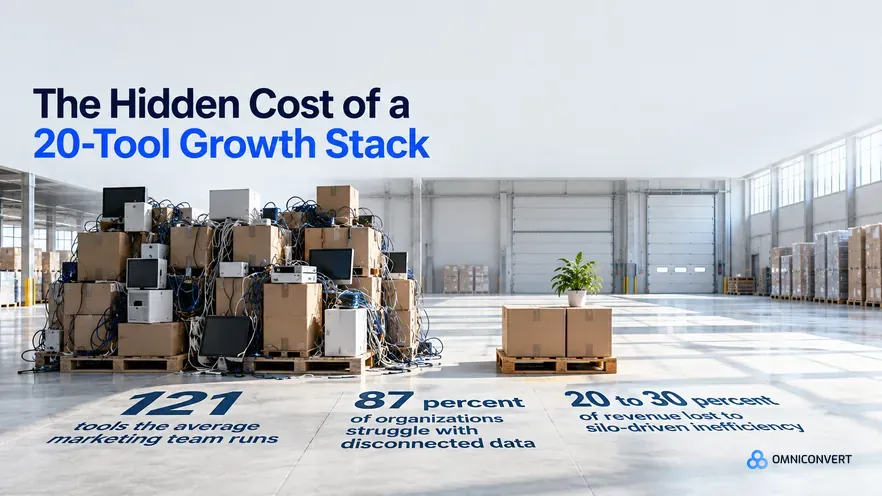
- Marketing teams average about 121 tools in 2026 (up from 24 in 2014) and ecommerce stacks around 142, yet only roughly a third of that capability is used.
- The invoice is the smallest cost: about 87 percent of organizations struggle with disconnected data, and silo-driven inefficiency is estimated at 20 to 30 percent of revenue.
- Consolidation is happening to buyers, not just by them: Pattern bought ROI Hunter (Dec 2025) and VWO merged with AB Tasty (Jan 2026), killing the free tier and starting paid plans near $314 per month.
- Average tool tenure has fallen to about 18 months, so teams pay a constant re-integration and re-training tax as tools churn in and out.
- Stop counting tools and start counting closed loops (data to insight to action to measurement); every seam between tools is an integration tax the buyer pays in headcount.
An ecommerce tech stack is the set of software tools a brand uses to acquire, convert, and retain customers, from ad platforms and testing tools to email, analytics, and CDPs. The average marketing team now runs about 121 of them in 2026, up from 91 in 2022 and just 24 in 2014, and ecommerce-specific stacks run higher still, around 142 tools. Across the 7,000+ websites in the CROBenchmark dataset spanning 15+ industries, the brands that learn fastest are consistently not the ones with the most tools [CROBenchmark Report 2026, Omniconvert].
The invoices are the part you can see. The larger cost is buried in the seams between all those tools, and it compounds quietly while every individual subscription looks defensible. This guide covers what the sprawl actually costs, why vendors are merging under your feet, and how to reframe the decision so you count closed loops instead of tools.
Why did your growth stack get so expensive?
No one decides to run 121 tools. The stack grows the way a garage fills up: one reasonable addition at a time, each justified on its own, none ever removed. A new attribution tool here, a heatmap tool there, a second email platform inherited in a reorg. Every purchase is defensible in isolation, and that is exactly the problem, because the cost of the whole is never evaluated as a whole.
Two numbers expose how much of that spend is dead weight. First, utilization: only about a third of purchased martech capability is actually used, with Gartner's figure running closer to 49 percent [Gartner, 2023]. You are paying for roughly twice the capability you touch. Second, churn: average tool tenure has fallen to about 18 months, and 34.6 percent of tools were replaced in the last 12 months [blog.mean.ceo, 2026]. That means a growth team is perpetually re-integrating, re-training, and re-mapping data as tools rotate in and out, a treadmill that never appears as a line item but consumes real headcount.
This is where the psychology matters. As Daniel Kahneman shows in Thinking, Fast and Slow, humans weigh losses far more heavily than equivalent gains, but only when the loss is felt as a single, present event. Stack sprawl is the opposite: the cost is deferred and split across a dozen invoices and a hundred small handoffs, so loss aversion never fires and no one ever decides to act. The job of any honest stack audit is to make that diffuse cost concrete and present-tense.
Why is the tool invoice the smallest cost?
Add up 20 subscriptions and you get a number that stings but that finance can absorb. The cost that actually moves the business is invisible on the invoice: it is the labor and delay created by every seam between tools that do not talk to each other.
A data silo is defined as a store of data held by one tool or team that is not readily accessible to the others that need it. It matters in ecommerce because growth depends on joining data across tools, your testing tool needs segment data, your email tool needs purchase data, and every silo forces a human to bridge the gap by hand. The scale of the problem is well documented: around 87 percent of organizations struggle with disconnected data, the average enterprise runs roughly 897 applications with only about 29 percent of them integrated, and analysts estimate silo-driven inefficiency at 20 to 30 percent of revenue [chisw, 2026].
There is a name for what buyers actually want here. In Crossing the Chasm, Geoffrey Moore calls it the whole product: customers do not want components to assemble, they want the finished outcome. Every seam between two tools is an "integration tax" someone has to pay to turn the parts into the whole, and in a 20-tool stack the buyer pays that tax themselves, in analyst hours, in brittle Zapier chains, and in decisions that arrive a week late because the data was still being reconciled.
The community of ecommerce operators that plateau at a 2 to 3 percent conversion rate consistently share one pattern: they add tools to fix problems that are actually caused by the seams between the tools they already own. The benchmark gap closes fastest when operators treat the closed loop, from data to insight to action to measurement, as the primary unit of measurement, not the count of tools in the stack.
Nexus by Omniconvert unifies your data, segmentation, and action into one loop so you stop paying the integration tax in analyst hours.
See how it works →Why is martech stack consolidation happening now?
While teams debate whether to consolidate, their vendors are consolidating for them. This is not two isolated deals, it is a maturing roughly billion-dollar experimentation market being rolled up by private equity and larger platforms:
- Pattern acquired ROI Hunter in December 2025, folding a SKU-level product advertising tool that managed more than $1.8 billion in media per year into a larger commerce accelerator [businesswire, 2025].
- VWO merged with AB Tasty in January 2026 under private equity ownership, combining two of the best-known testing tools. The free tier was discontinued and the entry Growth plan now starts at about $314 per month, billed annually for up to 10,000 monthly tracked users [convert.com, 2026].
- The wider wave: OpenAI acquired Statsig, Datadog acquired Eppo, and Braze acquired OfferFit, all in 2025, as testing tools fold into full-stack platforms [convert.com, 2026].
The lesson for a buyer is uncomfortable but clarifying: a stack of independent point tools is not actually stable. The tools you assembled will be recombined by their owners on their timeline, and when they are, the free tier you started on can vanish and the price can triple overnight. Consolidation is coming to your stack either way. The only choice is whether you consolidate deliberately, around the loops that matter to you, or reactively, around whatever roll-up your vendors happen to land in.
Should you count tools or closed loops?
The counting error is at the root of the whole problem. Teams measure their stack by how many tools it has, when the unit that actually drives growth is how many complete loops it closes. In the language of Play Bigger and category design, this is a point-of-view shift: the tool is the wrong unit. The right unit is the closed loop, and by that measure a 20-tool stack usually scores badly, because it is 20 open loops the operator has to stitch together by hand.
Alex Hormozi's value equation, from $100M Offers, explains why closing the loop is worth more than cutting the invoice. Perceived value rises when you cut the two terms in the denominator: time delay and effort. A closed loop shortens the time between a signal and an action, and it removes the manual effort of exporting and reconciling data. That is a larger gain than shaving a subscription, because it changes how fast the whole team learns, and learning velocity compounds while a one-time cost saving does not.
AliveCor used Omniconvert to run a structured A/B testing programme rather than a scatter of disconnected tools, and achieved a 21 percent lift in conversion rate, a 5 percent increase in revenue per visitor, and 94 percent statistical relevance across their experiments [Omniconvert, AliveCor case study]. The result came from running experimentation, segmentation, and measurement inside one loop, so each test fed the next decision instead of ending up in a slide deck no one acted on.
What does one closed loop replace?
The abstract "closed loop" becomes concrete when you map it onto the tools it collapses. A typical experimentation workflow in a sprawling stack touches four or five vendors: pull a customer segment from the CDP, export it, load it into the testing tool, run the test, then push results into a separate analytics tool to decide what happened, then hand the decision to an email or personalization tool to act. Every arrow in that sentence is a manual handoff, a seam, and an integration tax.
In our CVO work with ecommerce brands through 2026, we consistently see that the teams who move fastest are the ones who removed those arrows, not the ones who bought better tools at each node [Omniconvert, 2026]. Nexus by Omniconvert is the AI eCommerce growth engine that ingests behavioral and transactional data across the store and unifies segmentation, customer value, experimentation, and next-best-action in one place, so the loop closes without a human carrying data between tools. The point is not that Nexus is one more logo; it is that it removes several seams at once, which is the only kind of consolidation that changes learning velocity rather than just the bill.
What 3-question audit should you run before renewing any tool?
Consolidation fails when it becomes a vague mandate to "reduce tools." It works when it is a repeatable test applied at every renewal. Run each tool through three questions:
-
Does it close a loop, or just handle a fragment?A tool that takes you from data to insight to action to measurement earns its place. A tool that handles one fragment and hands off to three others adds a seam for every handoff. Keep the loop-closers; scrutinize the fragment-handlers.
-
Is this function already covered elsewhere?Overlap is the norm, not the exception, which is why only about a third of purchased capability gets used. Two tools with heatmaps, two with email, two with segmentation. Map functions, not logos, and the duplicates become obvious.
-
What is the integration and re-training tax?With average tenure at about 18 months, every tool you keep is a future re-integration you will pay for. Price the ongoing cost of the seams and the retraining, not just the license, and some renewals stop making sense.
Any tool that handles only a fragment, duplicates a function you already own, and carries a high integration tax is a clear cut. Most stacks have several, and finding them is less about sophistication than about asking the three questions out loud before the auto-renewal goes through.
Key takeaways on growth stack costs
- Marketing teams average about 121 tools in 2026 and ecommerce stacks around 142, yet only roughly a third of that capability is used [blog.mean.ceo, 2026].
- The invoice is the smallest cost: about 87 percent of organizations struggle with disconnected data, and silo-driven inefficiency is estimated at 20 to 30 percent of revenue [chisw, 2026].
- Consolidation is happening to buyers, not just by them: Pattern acquired ROI Hunter in December 2025, and VWO merged with AB Tasty in January 2026, killing the free tier and starting paid plans near $314 per month.
- Average tool tenure has fallen to about 18 months, so teams pay a constant re-integration and re-training tax as tools churn in and out.
- Stop counting tools and start counting closed loops; every seam between tools is an integration tax the buyer pays in headcount, and Nexus by Omniconvert collapses those seams into one loop.
Growth stack consolidation FAQs
Martech consolidation is the practice of reducing overlapping marketing and growth tools into fewer integrated platforms, so data and action live in one loop instead of being stitched across many vendors. It is driven by cost, but the larger prize is fewer seams between tools, which speeds up how fast a team can turn data into a decision. About 67 percent of teams are actively consolidating, and 62 percent plan to cut tool count in the next 12 months.
Marketing teams average about 121 tools in 2026, up from 91 in 2022 and just 24 in 2014, and ecommerce-specific stacks run higher at around 142 tools. Yet only about a third of that purchased capability is actually used, with some estimates as high as 49 percent. The gap between what is bought and what is used is where most stack budget quietly disappears.
Martech vendors are merging because a roughly billion-dollar experimentation market is maturing into full-stack platforms, and private equity is rolling up point tools. Pattern acquired ROI Hunter in December 2025, VWO merged with AB Tasty in January 2026, and Datadog, Braze, and OpenAI each bought experimentation vendors in 2025. For existing customers, consolidation often means higher prices and discontinued free tiers.
After VWO merged with AB Tasty in January 2026 under private equity ownership, VWO discontinued its free tier. Paid plans now start at around $314 per month, billed annually for up to 10,000 monthly tracked users, and climb from there. The free experimentation on-ramp that many small teams relied on to start testing is gone, which is a common pattern after a vendor consolidation.
No. Licenses are the visible cost, but the larger one is disconnected data and broken loops. Around 87 percent of organizations struggle with disconnected data, only about 29 percent of the average enterprise's apps are integrated, and silo-driven inefficiency is estimated at 20 to 30 percent of revenue. The tax you actually pay is the labor of stitching tools together and the slow decisions that result.
Ask three questions of every tool before you renew it. Does it close a loop end to end, from data to insight to action to measurement, or does it handle only a fragment? Is its core function already covered by another tool you own? And what is the ongoing integration and re-training tax of keeping it, given that average tool tenure has fallen to 18 months. A tool that only handles a fragment and duplicates another is the first to cut.
Nexus by Omniconvert ingests behavioral and transactional data across your store and unifies segmentation, customer value, experimentation, and next-best-action into one closed loop, replacing the seams between several point tools. Instead of exporting data between a testing tool, an analytics tool, and a segmentation tool by hand, teams get insight and action in the same place, which shortens time to decision and removes the integration labor that stack sprawl charges in headcount.
The stack got to 121 tools one reasonable renewal at a time, which is exactly why the cost never triggered a decision: 20 monthly invoices are diffuse, but a single broken loop is felt every day. Reframe the question. Before you renew anything, ask whether it closes a loop end to end or just handles a fragment, and whether another tool already covers it. The market is consolidating around you regardless, so decide whether you consolidate on your terms or on a vendor's. See how Nexus by Omniconvert collapses the seams into one closed loop.
Replace the seams with one closed loop
Nexus by Omniconvert unifies segmentation, customer value, experimentation, and next-best-action into a single closed loop, so your team acts on data instead of exporting it between tools. Stop paying the integration tax in headcount and start compounding learning velocity.