Best Triple Whale Alternatives (2026): 8 Tools Compared

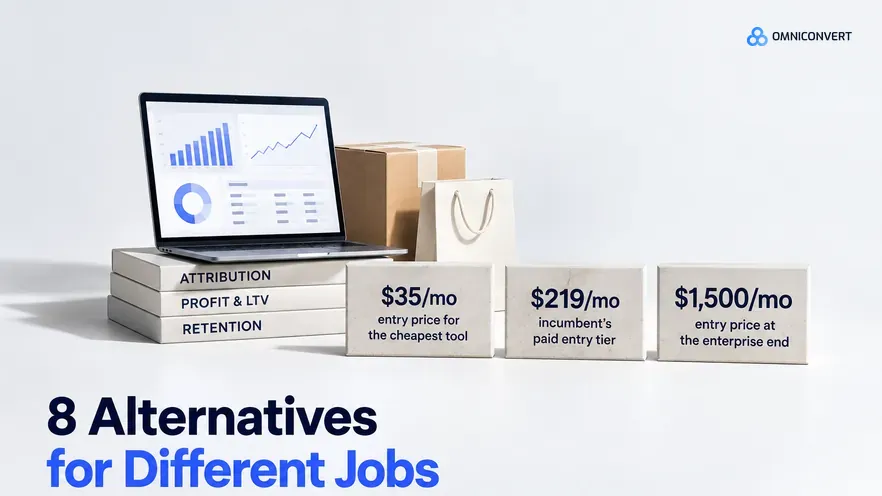
- There is no single best Triple Whale alternative; the right pick depends on the job, from enterprise attribution to customer-value intelligence.
- Switching drivers are GMV-based pricing, book-a-demo opacity on higher tiers, and support and integration complaints (Trustpilot around 2.8 out of 5).
- Entry pricing runs from about $35/mo (TrueProfit) and $79/mo (Lifetimely) to about $1,500/mo (Northbeam), versus Triple Whale's roughly $219/mo paid entry.
- Before switching, ask whether the real problem is attribution (where did the sale come from) or customer value (which customers are worth keeping), because they need different tools.
- Nexus by Omniconvert targets the customer-value question with RFM segmentation and predicted lifetime value, drawing on the CROBenchmark dataset of 7,000+ stores across 15+ industries.
Marketing attribution is the discipline of assigning revenue to the channels and touchpoints that produced it, and Triple Whale is one of its best-known tools, pairing multi-touch attribution with an agentic AI layer marketed as Moby. It is a capable product, but capable is not the same as right for you. Across the CROBenchmark dataset of 7,000+ stores in 15+ industries, the brands that grow fastest treat retention, not attribution precision, as their primary lever, and that is exactly the assumption a Triple Whale shortlist tends to skip [CROBenchmark Report 2026, Omniconvert].
This guide compares the eight best Triple Whale alternatives for 2026 by the job each one does, what it costs, and how much data control it gives you. It also does something most listicles will not: it asks whether you need an attribution tool at all, because for a large share of switchers the honest answer changes the shortlist entirely. Nexus by Omniconvert appears here as the customer-value option, not as a like-for-like attribution swap.
Why are brands leaving Triple Whale in 2026?
The frustrations cluster into three themes. The first is price mechanics. Triple Whale charges on a GMV basis, so the bill scales with the very growth you are paying the tool to help create. Public references put the entry paid tier (Foundation) around $219 a month and the Automate tier near $749 a month under $250K GMV, climbing past $1,300 a month at higher GMV bands. In 2026 the higher tiers increasingly route through a book-a-demo flow with no clean public rate card, which makes budgeting harder.
The second is the experience gap. Triple Whale holds a strong analyst position as a G2 attribution leader, but its Trustpilot rating sits around 2.8 out of 5, with recurring notes on support response times and integration stability. A tool can be an analyst favorite and still frustrate the person who logs in every morning.
The third is the harder question underneath the other two: do you actually need this? Triple Whale's agentic AI, the Moby agents for media buying and creative, is powerful, but it optimizes acquisition. If your growth is stuck on retention rather than channel mix, a more precise acquisition dashboard solves a problem you may not have.
Attribution vs customer value: what question do switchers skip?
Category strategists have a name for this move. In Obviously Awesome, April Dunford argues that you rarely win by matching an incumbent feature for feature; you win by changing the frame of reference the buyer uses to judge the category. Triple Whale owns the "agentic AI attribution" frame in search and in AI answers. Trying to out-attribute the attribution leader is a losing game. The productive move is to question the frame: is attribution even the job to be done?
Customer Value Optimization is defined as the practice of growing revenue by increasing the value of existing customers through retention, segmentation, and lifetime-value growth, rather than by acquiring more traffic. It matters in ecommerce because acquisition costs keep rising while a retained customer compounds in value, so the brand that optimizes customer value out-earns the brand that only optimizes attribution, even with a less precise ad dashboard.
Alex Hormozi's value equation makes the same point from a different angle: when a category races on features and price, as attribution did through 2026, the escape is to re-anchor on the dream outcome. For most ecommerce operators the dream outcome is not a cleaner attribution model; it is profitable, durable repeat revenue. That reframe is why this list includes customer-value tools alongside attribution ones, and why the right answer for you may not be an attribution dashboard at all.
The direct-to-consumer brands that plateau at 20 to 25% repeat purchase rate consistently share one pattern: they instrument acquisition to the decimal and leave retention to a generic email flow. The benchmark gap closes fastest when operators treat customer lifetime value by segment as the primary unit of measurement, not last-click ROAS. In our Customer Value Optimization work with ecommerce brands, we consistently see the top 20% of customers drive most of the revenue, yet get the same marketing as everyone else [Omniconvert, 2026].
How did we choose these Triple Whale alternatives?
Ranking ten tools from best to worst triggers exactly the decision fatigue Daniel Kahneman describes in Thinking, Fast and Slow: faced with too many similar options, buyers default to the loudest brand or bounce. So we did not produce a single ranking. We grouped the alternatives by job, gave each a one-line verdict, and built a decision spine at the end so you can jump straight to your constraint. The four criteria behind the selection:
- Job to be done: what problem the tool is actually built for, from multi-touch attribution to customer-value intelligence.
- Price transparency: whether there is a public rate card or only a book-a-demo flow, and how pricing scales as you grow.
- Data ownership: whether your data lives in a shared dashboard or a warehouse you control.
- Shopify fit: how cleanly the tool integrates with the Shopify and Klaviyo stack most readers already run.
What are the 8 best Triple Whale alternatives?
The table gives the quick-pick view; the sections below add the one-line verdict and the catch for each. Prices are entry points from public references and scale with usage.
| Tool | Best for | Entry price | Job to be done |
|---|---|---|---|
| Northbeam | Enterprise attribution rigor | ~$1,500/mo | Attribution |
| SegmentStream | $100K+/mo ad spend | Quote-based | Attribution |
| Polar Analytics | All-in-one BI dashboard | ~$300–750/mo | Business intelligence |
| Glew.io | Multi-store reporting | Quote-based | Business intelligence |
| Lifetimely | LTV and profit on Shopify | ~$79/mo | Profit / LTV |
| TrueProfit | Cheapest profit tracking | ~$35/mo | Profit / LTV |
| Nexus by Omniconvert | Customer value and retention | Free plan | Customer Value Optimization |
| Daasity | Full data control on BigQuery | Quote-based | Data warehouse / control |
Best for enterprise attribution rigor: Northbeam
If you spend enough on ads that a percentage point of attribution error is real money, Northbeam is the serious pick. It offers deeper multi-touch modeling and incrementality testing than mid-market dashboards, with Starter pricing around $1,500 a month and quote-based tiers above. The catch is the same as the strength: at that price it only makes sense once media budgets are large enough to justify the precision.
Best for very high ad spend: SegmentStream
SegmentStream targets enterprise brands, typically those spending upward of $100K a month on ads, with machine-learning conversion modeling built for scale. Pricing is quote-based. It is overkill for a store spending five figures a month, and right for one where attribution precision is a boardroom line item.
Best all-in-one BI dashboard: Polar Analytics
Polar Analytics is the strongest general-purpose choice: it consolidates Shopify, ad platforms, and Klaviyo into one dashboard, with a dedicated data store per account for performance. Public references put it around $300 to $750 a month depending on tier. If you want Triple Whale's breadth without the agentic AI layer, Polar is the closest like-for-like.
Best for multi-store reporting: Glew.io
Glew.io focuses on cross-store and cross-channel reporting, useful for operators running several storefronts or a marketplace footprint. Pricing is quote-based. It is a reporting layer more than an attribution engine, so pair it with something that models channel contribution if that is your gap.
Best for LTV and profit on a budget: Lifetimely
Lifetimely, now part of AMP, is built around lifetime value and profit-and-loss tracking rather than attribution, starting around $79 a month and scaling by order volume. For a Shopify store whose real question is "am I profitable and are my cohorts improving," it answers more directly than an attribution dashboard, at a fraction of the cost.
Cheapest profit tracking: TrueProfit
TrueProfit is the budget entry, from around $35 a month, focused on real-time net profit by pulling in ad spend, cost of goods, and fees. It will not replace a full attribution suite, but for a small store that mainly wants to know its true margin per order, it is the most economical way to get there.
Best for customer value and retention: Nexus by Omniconvert
This is the different job. Nexus by Omniconvert is a Customer Value Optimization platform, not an attribution dashboard. It runs RFM segmentation to sort customers into value tiers (VIPs, active, dormant, lost), tracks customer lifetime value and churn signals, and pushes high-value segments to Meta and Klaviyo as audiences. If your constraint is retention rather than channel mix, Nexus answers the question the attribution tools cannot.
Best for full data control: Daasity
Daasity is for teams that want to own the pipeline, centralizing ecommerce data into a warehouse such as BigQuery so analysts can model whatever they want. Pricing is quote-based and it demands data maturity, but it removes the ceiling that a fixed dashboard imposes. Choose it when you have the analysts to justify the control.
Nexus by Omniconvert segments your customers by RFM and predicted lifetime value so you can act on who is about to churn or ready to grow, without stitching another attribution dashboard into your stack.
See how it works →One customer story shows what the customer-value job looks like in practice. AliveCor used Omniconvert to run a structured experimentation and optimization programme and achieved a +21% conversion rate, +5% revenue per visitor, and 94% statistical relevance across their tests [Omniconvert, AliveCor case study]. The lift came from acting on customer behavior and value, not from re-attributing existing sales, which is the distinction this whole comparison turns on.
How do you choose a Triple Whale alternative by job and stage?
Read this as "if you are X, pick Y," and stop at the first line that fits:
- If attribution precision is your bottleneck and you spend heavily on ads: Northbeam, or SegmentStream above $100K a month.
- If you want Triple Whale's breadth without the agentic AI layer: Polar Analytics.
- If you mainly need profit and LTV clarity on a small budget: TrueProfit (cheapest) or Lifetimely (deeper LTV).
- If your growth is stuck on retention, not channel mix: a Customer Value Optimization platform like Nexus by Omniconvert.
- If you have the analysts and want to own the pipeline: Daasity on BigQuery.
The decision that matters most is the first branch, and it is not on any feature comparison: are you optimizing the cost of acquisition or the value of the customer? Answer that honestly and the shortlist collapses from eight tools to two. Nexus by Omniconvert exists for the second branch, which is where more switchers belong than the attribution framing admits.
Triple Whale alternatives FAQ
There is no single winner, because the best alternative depends on the job you are hiring the tool for. For enterprise attribution rigor, Northbeam. For an all-in-one BI dashboard, Polar Analytics. For LTV and profit tracking on a smaller budget, Lifetimely or TrueProfit. And if your real problem is retention and customer value rather than ad attribution, a Customer Value Optimization tool targets a different, often higher-ROI question than any attribution dashboard answers.
The common drivers are GMV-based pricing that climbs as the store grows, book-a-demo opacity on higher tiers with no clean public rate card in 2026, and recurring complaints about support response times and integration stability. Triple Whale holds a strong G2 position as an attribution leader, but its Trustpilot score sits around 2.8 out of 5, and that gap between analyst standing and day-to-day experience is what pushes teams to compare alternatives.
Yes. TrueProfit starts around $35 a month and Lifetimely around $79 a month, both aimed at smaller Shopify stores that mainly want profit and LTV tracking. That compares with Triple Whale's roughly $219 a month entry paid tier. The trade-off is scope: the cheaper tools focus on profit and lifetime value rather than the full multi-touch attribution and agentic AI layer that Triple Whale sells at the top of its range.
Not always. Attribution answers where a sale came from, which matters most when paid acquisition is your primary growth lever and channel mix is unclear. If your bigger lever is retaining and growing your best customers, a customer-value or RFM tool targets a different and often higher-ROI problem. Many brands that think they need better attribution actually need better retention intelligence, and buying another dashboard hides that.
Triple Whale is marketing attribution plus agentic AI dashboards, built to answer where sales come from and to optimize ad spend. A Customer Value Optimization tool is built to answer which customers are worth acquiring and keeping, using RFM segmentation, customer lifetime value, and churn signals to grow repeat revenue. One optimizes the cost of acquisition; the other optimizes the value of the customer once acquired. They solve different problems, and the right choice depends on where your growth is actually stuck.
Northbeam and SegmentStream are built for that scale, with deeper multi-touch modeling and incrementality testing than mid-market dashboards offer. Northbeam starts around $1,500 a month and moves to quote-based pricing above that, which fits brands whose media budgets make attribution precision a material line item. At that spend level the modeling depth and data ownership usually justify the cost that would be hard to defend for a smaller store.
Nexus by Omniconvert ingests behavioral and transactional data across your store and segments customers by RFM into groups that are at risk, growing, or ready for upsell, in real time. It maps those segments to predicted lifetime value, so budget targets the customers worth retaining rather than only the sales easiest to attribute. For a Triple Whale switcher whose real problem is retention rather than channel mix, that reframes the switch from picking another attribution dashboard to fixing the metric that actually drives profit.
The switch away from Triple Whale is usually framed as finding a cheaper or more stable attribution dashboard, and for brands where paid acquisition is the whole game, Northbeam or Polar Analytics will do that well. But the higher-leverage move for most is to ask a different question first: is the problem really where sales come from, or which customers are worth keeping? Retention drives profit faster than attribution precision does, and a Customer Value Optimization tool answers the second question directly. See how Customer Intelligence in Nexus by Omniconvert segments customers by value and ranks the actions that grow it, so the switch fixes the metric that moves profit, not just the dashboard you read it on.
Switching for the right reason? Start with customer value
If the real problem behind leaving Triple Whale is retention rather than channel mix, Nexus by Omniconvert segments customers by RFM and predicted lifetime value, then ranks the actions that protect and grow revenue. Answer the customer-value question, not just the attribution one.