Meta's Ads Manager AI Agent: What It Can Actually Launch and Rebudget

- The in-Ads-Manager assistant that launches campaigns, edits targeting and changes budgets is in test, not live: Meta published no rollout date, country list or eligibility on 6 October 2026.
- Meta Ads AI Connectors, the ads MCP server and CLI, have been in open beta since 29 April 2026 for businesses of all sizes in all regions, and they already create and edit campaigns, ad sets and ads.
- Agent work arrives as a draft in Ads Manager, and a business portfolio admin can block budget edits, campaign creation, targeting edits, creative edits and status changes per ad account.
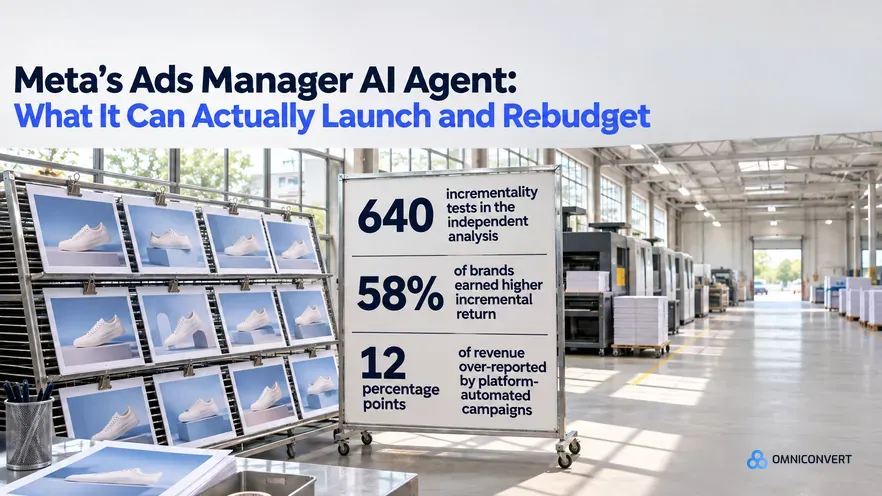
- Across 640 Meta incrementality tests, Haus found 58% of brands earned higher incremental ROAS from manual campaigns than from Advantage+, and that Advantage+ over-reported revenue by 12 percentage points.
- Delegate assembly, pacing and variant volume. Keep the objective: who counts as a new customer, what margin the spend must clear, and how lift is measured.
An agentic ad platform is one where software, not a person, does the account work: it builds campaigns, writes variants and moves money between them. Meta has two doors into that, and only one is open. The conversational assistant in Ads Manager, which most coverage called live, was labelled as beginning to test on 6 October 2026. The ads AI connectors, which do the same job through an API, have been in open beta since 29 April 2026.
That gap is where this month's advice went wrong, and it sits on top of a harder question. An agent is a very fast executor pointed at the platform's objective, not yours. Delegating execution is safe and already possible; delegating the objective is where margin leaks. The CROBenchmark dataset covers 7,000+ websites in 15+ industries, assessed against 248+ audit criteria across 13 years of conversion work, and in that work the pattern we see repeatedly in paid accounts is an automated target that nobody ever defined [CROBenchmark Report 2026, Omniconvert].
What Meta actually shipped, and what it only announced
Meta's own wording is the thing to read. The announcement says the company is beginning to test new capabilities in the assistant, and lists them under a heading of soon. Third-party coverage compressed that into a claim that the agent can now run your ads, and the compression is understandable: the capability list reads like a product launch. It is not one yet.
Several things in the same announcement are generally available, and they matter more than the test:
- Customer Lifecycle Strategy is available to all advertisers. You can flag a campaign as acquisition and exclude existing customers from it.
- Static-to-video in Advantage+ creative is generally available, which raises variant volume without a production cycle.
- AI audience discovery in Detailed Targeting is promised by the end of the year, so it sits with the assistant in the not-yet column.
| Capability | Status | Date read |
|---|---|---|
| Assistant plans and creates campaigns in Ads Manager | Beginning to test | 6 Oct 2026 |
| Assistant changes budgets and targeting in Ads Manager | Beginning to test | 6 Oct 2026 |
| Scheduled tasks and budget-review alerts | Testing | 6 Oct 2026 |
| Ads AI Connectors: MCP server and ads CLI | Open beta, all sizes, all regions | 29 Apr 2026 |
| Portfolio rules governing agent actions | Live | 16 Jul 2026 |
| Customer Lifecycle Strategy | All advertisers | 6 Oct 2026 |
| AI audience discovery in Detailed Targeting | By end of year | 6 Oct 2026 |
The part that is already live: ads AI connectors and the draft loop
This is the honest answer to the headline. An agent can already launch and rebudget your Meta campaigns, through a door that got far less attention than the chat box. Meta names integrated partners including AdManage.ai, Birch, Blip, Databricks, Innovid, Kochava, Perplexity, Reportei, Snowflake and Triple Whale, so for most teams the route in is a tool they may already pay for, not an engineering project.
The draft-and-approve loop is the design decision worth noticing. The agent does the assembly, and a person does the publishing. That split is not a limitation to be engineered around; it is the correct shape, and the next sections explain why.
What the agent is optimising, and why that is not your profit
Scale makes the point concrete. Advantage+ was running at a $75bn annual run rate as of Meta's Q2 earnings on 29 July 2026, and the Andromeda ranking system processes over 1bn candidate ads per second, with the Andromeda and GEM upgrades credited with 15.7% more conversions and 8.3% more clicks on Facebook as of 29 October 2026 [Common Thread Collective, 2026]. That machinery is extremely good at finding the cheapest reported conversion. It has no view of your gross margin, your return rate, or whether the buyer it found would have bought anyway.
There is a second failure mode, and it is structural rather than statistical. An agent that rebudgets daily hill-climbs: it moves money toward whatever converted cheapest this week, which is usually people already intending to buy. That is a local optimum. It produces fast gains and a shrinking ceiling, because the audiences that build next year's revenue are the ones that look expensive today. Exploration is a cost a human has to authorise, since no agent rewarded on this week's cost per conversion will choose to spend against itself.
Profit on ad spend (POAS) is defined as revenue from advertising minus the cost of goods, discounts and returns, divided by ad spend. It matters in ecommerce because two campaigns with the same return on ad spend can have opposite effects on the bank account, depending on which products and which customers they attracted. If you give an agent a budget, POAS is the number that should bound it, not reported ROAS. Our breakdown of POAS and how to calculate it covers the mechanics.
Omniconvert Commander scores each customer segment by predicted lifetime value and margin, so an agent's budget decisions can be judged on repeat revenue rather than on the platform's own conversion count.
See how it works →What the evidence says about handing budget to automation
The detail that should change behaviour is the reporting gap. Twelve percentage points of over-reporting works out to roughly $12 more real revenue per $100 of platform-reported revenue from manual campaigns [Haus, 2025]. That is Goodhart with a price tag: the automated buyer is partly optimising its own measurement. The same study found Advantage+ sent 70% of impact to new customers against 65% for manual, and that splitting budget roughly 50/50 between the two cut incremental ROAS by 18%, so half-measures are the worst of the three options.
| Finding | Figure | What it means for an agent |
|---|---|---|
| Average incremental lift from Meta | 19% | The channel works; the question is allocation |
| Brands where manual beat Advantage+ on iROAS | 58% | Automated allocation is not a default win |
| Advantage+ over-reporting | 12 percentage points | The agent's own scoreboard is inflated |
| Impact sent to new customers | 70% vs 65% manual | Automation does favour acquisition |
| Cost of a 50/50 budget split | 18% lower iROAS | Commit to one structure per objective |
Meta's counter-figure deserves a fair hearing: advertisers who adopt its recommendations are typically seeing 5% more conversions at the same cost per conversion, by Meta's own account and unverified by anyone else. Both numbers can be true, because they measure different things. One counts conversions the platform attributes to itself; the other counts revenue that would not have existed otherwise.
The direct-to-consumer brands that plateau at a blended 2x return on ad spend consistently share one pattern: they tune the campaign structure every quarter and never once measure incrementality, so every reallocation is judged by the system that made it. The gap closes fastest when operators treat incremental profit per new customer as the primary unit of measurement, not reported ROAS in the dashboard.
What to delegate, what to keep: a split that holds
Automation bias is the reason to write this split down rather than hold it in your head. People under-audit a confident system, and audit it less the better it performs. An agent that produces good drafts for six weeks earns trust that quietly extends to decisions it was never given, which is how an approval step becomes a rubber stamp.
- Agent owns: campaign, ad set and ad creation from a brief; creative variant volume; budget pacing inside a cap you set; catalogue updates; reporting and anomaly flags.
- You own: the definition of a new customer; the margin floor; which segments are worth buying; the share of budget reserved for exploration; the incrementality test calendar; the final publish.
- Never delegated: changing the objective itself, or the definition of a conversion.
In our conversion work with ecommerce brands through 2026, we consistently see the same thing in audits of automated accounts: the controls exist and nobody configured them, because the person who connected the tool was not the person accountable for margin [Omniconvert, 2026].
Guardrails to set before you switch anything on
- Restrict by ad account, not by portfolio. Give an agent full rights in one low-stakes account and creation-only rights everywhere else.
- Keep publish approval with one named person. A draft queue with three optional approvers is an unapproved queue.
- Set a hard budget cap outside the agent. A cap the agent can edit is not a cap.
- Log every proposal, including rejected ones. The rejections tell you what the agent thinks your objective is.
- Review targeting edits weekly. Audience drift is the change that shows up in margin two months later, not in the dashboard tomorrow.
The measurement you need before the agent, not after
Incremental return on ad spend is defined as the revenue that would not have occurred without the advertising, divided by the spend that produced it. It matters in ecommerce because a large share of platform-reported conversions comes from people who were already going to buy, and only the incremental portion funds growth. Geo holdouts and scheduled pauses are the usual way to measure it; both require a human to plan them, which is one more reason the objective stays with you.
The new-versus-repeat split is the one most teams skip, and it is the cheapest to fix. Meta's Customer Lifecycle Strategy now lets you flag a campaign as acquisition and exclude existing customers, which makes the split measurable inside the platform. Judging the result still needs your own data: what a first-time buyer in each segment is worth over time, and how that compares with what you paid to acquire them. Our guide to true profit in ecommerce sets out the margin side of the same equation.
Case study: PRISM+ ran one A/B test with Omniconvert on a listing page redesign that grouped TVs, across all devices, and recorded a +40.74% conversion rate, +14.81% revenue per user and a 99.48% chance to win [Omniconvert, PRISM+ case study]. No ad agent could have proposed that change, because the constraint was on the site, not in the account, and that is the half of acquisition cost automation cannot reach.
If you turn it on this quarter, do it in this order
- Week 1. Set portfolio rules per ad account. Decide who approves drafts. Write down the margin floor and the definition of a new customer.
- Week 2. Run a baseline incrementality test on your current structure. You cannot measure the agent against a number you never took.
- Weeks 3 and 4. Connect one tool with creation rights only. Review every draft. Count how many you would have published unchanged.
- Week 5. Grant budget edits inside a cap, in one account. Keep the structure committed rather than split, since a 50/50 split cost 18% of incremental ROAS in the Haus tests.
- Week 6 onward. Re-test incrementality. Compare new-customer contribution margin, not reported conversions. Expand only if the real number moved.
None of this is an argument against the agent. It is an argument for keeping the objective. Meta's execution layer is already better than a human at assembly and pacing, and the connectors mean you do not have to wait for the chat box to use it. What you should not hand over is the answer to which customers are worth buying, which is a question about your paid acquisition strategy and your margin, and one the platform is not equipped to answer. The common Meta ads mistakes that cost brands money are mostly objective errors, and an agent executes an objective error faster. If reported ROAS is still your north star, read why that metric misleads before you automate against it.
FAQ: Meta's Ads Manager AI agent
Through Meta Ads AI Connectors, the ads MCP server and CLI in open beta since 29 April 2026, an AI tool can build campaigns, ad sets and ads from a natural-language instruction. The work lands as a draft in Ads Manager and needs explicit approval, under permissions the advertiser sets, before it can spend. The conversational version inside Ads Manager is still in test.
Budget changes are part of the in-Ads-Manager assistant that Meta described as beginning to test on 6 October 2026, so they are not generally available there. Through the connectors, budget edits are a permission: a business portfolio admin can allow or block them per ad account under the MCP server rules Meta added on 16 July 2026.
Meta published no rollout date, no country list and no eligibility criteria for the agentic assistant, so no blog post can tell you. The connectors are in open beta for businesses of all sizes across regions. Check your own Ads Manager and your business portfolio settings rather than trusting a third-party claim that the feature is now live.
Meta reports that advertisers who adopt its recommendations typically see 5% more conversions at the same cost per conversion, which is Meta's own unverified figure. Independent work across 640 Meta incrementality tests found manual campaigns beat Advantage+ on incremental ROAS for 58% of brands. Platform-reported efficiency and real acquisition cost are not the same number, so measure the second one.
Use the controls that already exist. A business portfolio admin can restrict, per ad account, budget edits, campaign, ad set and ad creation, targeting edits, creative edits and status changes. Agent-created work defaults to drafts awaiting approval. Set those limits before you connect a tool, name one person who approves drafts, and log every change the agent proposes.
Omniconvert Commander ingests behavioural and transactional data from your store and separates new customers from repeat buyers, then scores each segment by predicted lifetime value and margin. That gives the agent's output a scoreboard the ad platform does not have: you see whether the campaigns an agent rebudgets are buying customers who come back, and you can cap spend against segments that never clear their margin.
The honest headline is not that Meta's agent can now launch campaigns. It is that an agent has been able to do so since 29 April 2026 through the connectors, while the chat box everybody is watching is still in test. Hand the agent assembly, pacing and variant volume, because it is faster than your team and the work arrives as a draft you approve. Keep the objective, because 58% of brands in 640 incrementality tests earned more real return from manual budget decisions than from the platform's own allocation. Define who counts as a new customer, what margin the spend must clear, and how you will measure lift, then let the agent move. See how Omniconvert Commander scores segments by lifetime value and margin.
Give the agent a scoreboard that is yours
An ad agent optimises to platform-reported conversions. Omniconvert Commander separates new from repeat customers, scores every segment by predicted lifetime value and margin, and shows which campaigns buy customers who come back. Point the automation at that, not at the cheapest click.