I Studied 30+ eCommerce Operators' Meta Ad Accounts. Here Are the 10 Things Almost All of Them Get Wrong.

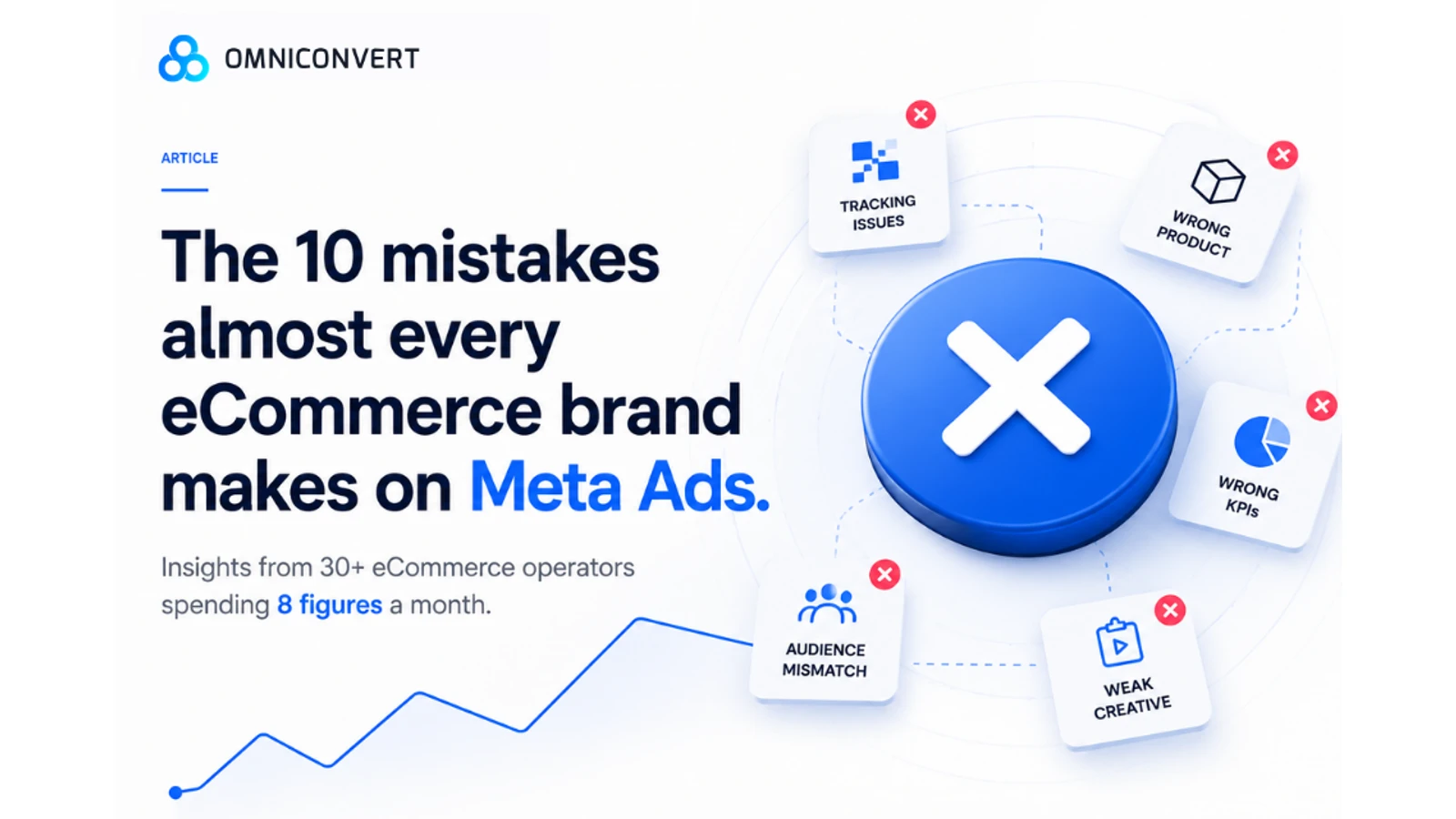
- Fix them in order. The later mistakes cannot be judged while tracking is still wrong.
- Broken tracking makes every downstream media decision unreliable, however good the creative is.
- Advertising the wrong product is a margin failure, not a media failure.
- Creative is the targeting layer now, and volume without diversity is just noise.
- An ad promising one thing and a landing page saying another wastes the click you already paid for.
It started with a lie I told myself.
For 13 years I built customer retention software, and the whole time I told myself I understood how eCommerce growth worked. I did not. I understood half of it. Then I started sitting across from the operators who were actually doing it. The ones spending eight figures a month on Meta. The ones who scaled from zero to $100 million with no VC money. The ones who crashed, rebuilt, and crashed again. And I realized I had been staring at the wrong half of the equation for more than a decade.
Over the past six months I talked to more than thirty of them. Some conversations were for my upcoming book. Some were Nexus discovery calls, where they screen-shared their ad accounts and told me what was actually broken behind the numbers they post on LinkedIn.
I also watched countless youtube videos and events like Meta's 2026 Performance Marketing Summit, where Connor Rolain (Hexclad), Cody Plofker (Jones Road Beauty), and Sean Frank (Ridge) pulled apart what is changing inside the platform in real time.
What came back it’s not a list of hacks. It is a diagnosis.
And here is the part that surprised me. The problems are not random, and they were not equal. They stacked. Ten of them, in a specific order, and the order is the whole game. Solve them out of sequence and you solve nothing. Solve the bottom of the stack first, and everything above it starts to compound.
It begins in the one place nobody wants to look.
1. Your Tracking Is Lying to You
Nobody wants to hear this first. I understand.
You came for the creative strategy. You came for the campaign structure. You came for the exciting part. But every struggling operator I interviewed, every single one, had at least one broken piece of technical plumbing they did not know about. An invisible crack, draining spend like a slow leak in a pool nobody thought to check.
Connor Rolain at Hexclad laid it out the best. For years they ran conditional pixels, separate pixels for different product categories. Brilliant for signal engineering. It also meant they lost all CAPI, the server-side tracking, completely. In a world where browser cookies are disappearing, that is building a house on sand and praying it never rains.
Here is what nobody tells you about CAPI: it only helps when your events, customer IDs, and deduplication are clean. If they are messy, you are not fixing your tracking. You are feeding Meta bad data faster. Bad signals train bad spend.
It gets worse.
Mike Bires at Nutrition Faktory had an invisible cart bug. Out-of-stock items silently failing to add to cart, bleeding spend for weeks. Nobody caught it. Not his team. Not his headless vendor. What he wanted, he told me, was "an eCommerce director without hiring one." Something watching the site for exactly these silent failures.
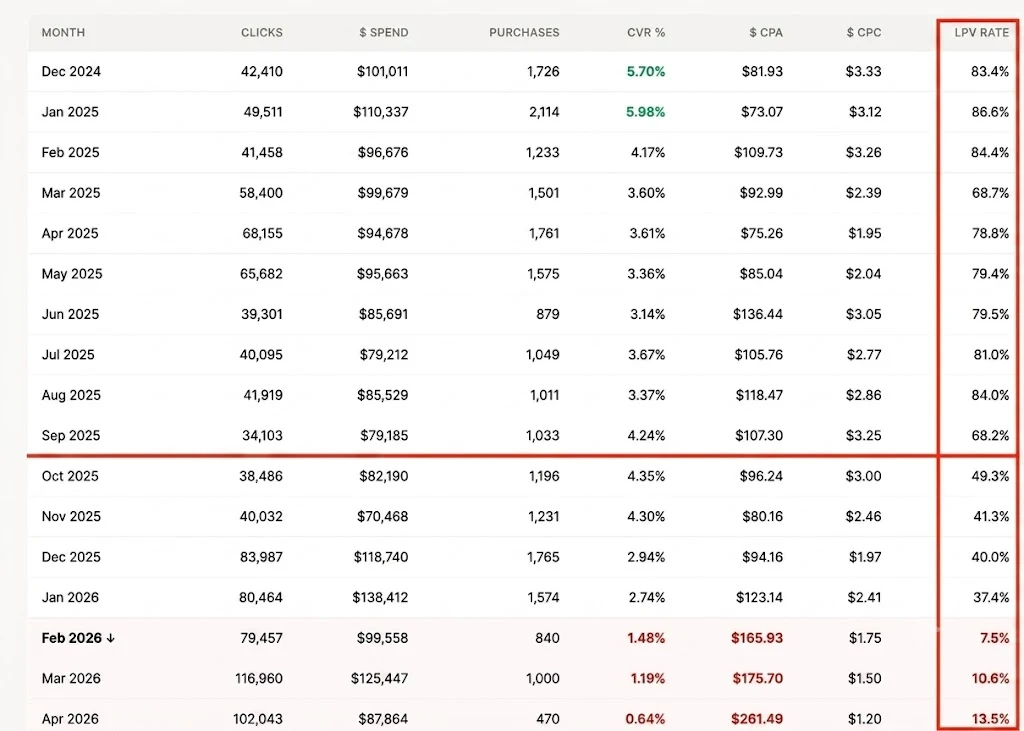
Then there is LPV%, your Landing Page View percentage.
Below 60% and you are paying for clicks that never arrive. The causes are dull: slow pages, redirect chains, pop-ups that fire before the page loads, mobile rendering failures. Dull, and expensive. This is money burning before the customer ever sees your offer.
Darren Fenton at The Fat Butcher said it best on our call: "If the website is broken at the conversion rate part, serving more traffic just makes it more broke."
He is right. Which leads straight to the next mistake.
2. You Are Advertising the Wrong Product
This one stings. And I’ve just started. My favorite is #8
Here is the trap I watch brands fall into. They advertise their best seller. Their best seller is their best seller because they advertise it. It is a loop that feels like a strategy and is actually a default.
The operators who win do not advertise their best sellers. They advertise their best customer makers, the products that start the highest-value journeys. And those are often two different products.
Ben Diamond at True Classic saw this before most. He cut an entire denim line, a line that was selling, and saved $700,000 without losing any overall sales. Read that again. He pulled a product off the shelf and revenue held flat. The denim was generating transactions, yes. But those transactions were not making valuable customers. They were making returns, support tickets, and one-time buyers who never came back.
The revenue was there. The value was not.
Now it gets interesting.
In the Product Intelligence framework we built at Nexus, every product lands in one of four quadrants, scored on four data layers: sales volume, customer experience (NPS, reviews, return rate, and support tickets for that exact SKU), behavioral data (what happens after someone buys this product first, do they come back?), and demand trends.
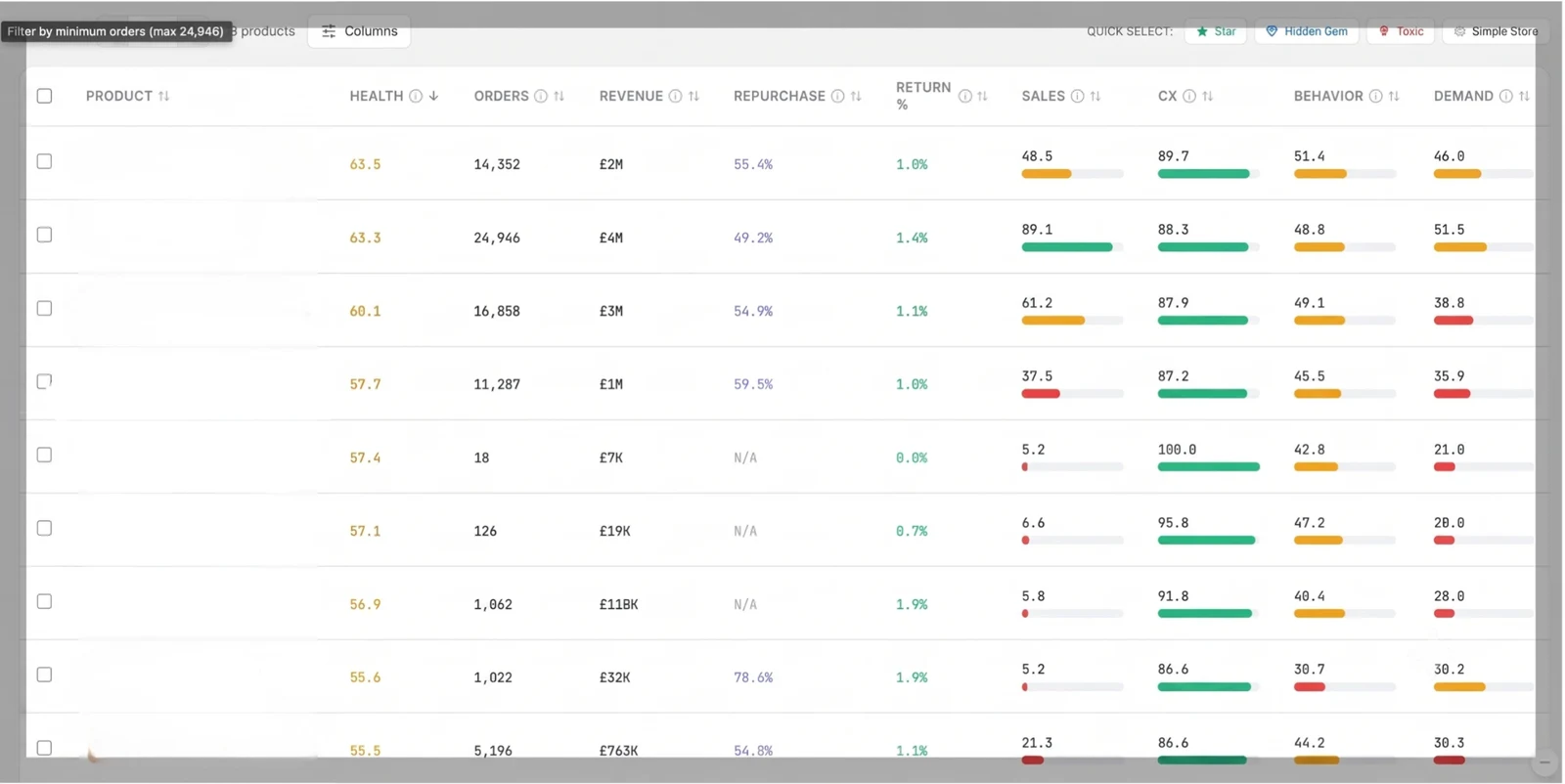
Products in the "Stars" quadrant, high demand and high stickiness, have earned your acquisition budget. Products in the "Toxic" quadrant, high sales and terrible post-purchase behavior, cost you money every time you run an ad for them.
Noah Solomon at a major outerwear brand described the inverse problem: "It's hard to redirect demand or create demand on maybe your mid to lower tier products." His bestsellers sell through too fast while potential Hidden Gems sit idle. He does not have the data to see which "mid-tier" products are quietly his best customer makers.
Most brands do not.
But knowing which product to push is not enough. There is a deeper question underneath it. Let me explain.
3. You Do Not Know Why Your Customers Buy
This one is personal for me. I wrote an entire book about Customer Lifetime Value. I built a company around customer intelligence. And the single most important input to everything, from product strategy to creative briefs to email sequences to landing pages, is the one thing almost nobody has: a clear understanding of why people buy.
Not why you think they buy. Why they actually buy. In their own words. In their own emotional language.
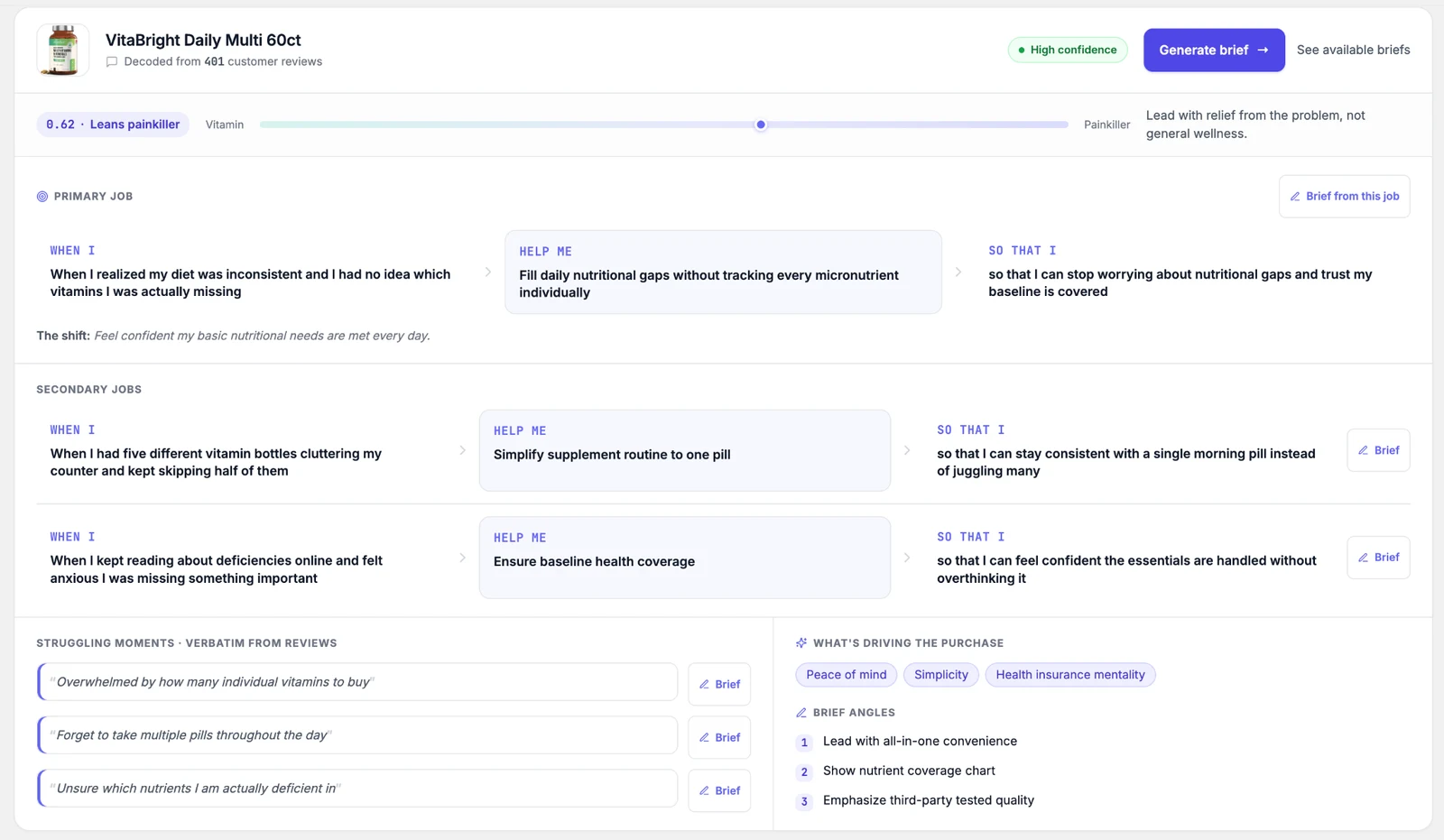
We call it the Job to Be Done.
One story from The CLV Revolution still haunts me. We worked with a blanket company, Hush. Their marketing said cozy comfort. Luxury relaxation. Premium sleep experience. The product page said the same.
Then we ran JTBD interviews with their highest-value customers.
One woman bought the blanket because she was the caretaker for her special-needs child. She needed to sleep deeply enough to rest, but lightly enough to wake the instant he called. The blanket gave her exactly that kind of sleep. For her, this was not a comfort product. It was a survival product.
That one interview rewrote the ad creative, the landing page copy, the email sequences, and the entire brand positioning. A single struggling moment, in the customer's own words, unlocked messaging the marketing department could never have invented in a brainstorm.
Anthony Burgess at Doctor Sam's gets this in his bones. His brand sells the same skincare formula to perimenopausal women fighting breakouts and to 21-year-olds with appearance anxiety. Same product. Completely different message. He told me: "The JTBD clustering maps directly to our brief process."
Naheed at Aikido Knives had never heard of JTBD before our call. When I explained it, something clicked. Every product page on his site said the same thing about sharpness and steel quality. Different knives. Same message. Same confused customer.
Here is the rule. If you cannot name the top three Jobs your product is hired to do, in your customers' language and not yours, then every ad you run is an expensive guess.
But once you know the Jobs, there is one more thing to gather before you touch creative. Most operators skip it entirely.
4. You Have No Idea What Your Competitors Have Already Figured Out
Let me tell you what most brands do when I ask how they study competitors.
Someone scrolls the Meta Ad Library once a week. They screenshot a few ads that look nice. They drop them in a Slack channel with the word "inspo."
That is not competitive intelligence. That is Pinterest with a business justification.
The right question is not "what are they running?" The right questions are: what messaging angles are they testing that I have not tried? What objections are they answering that I am ignoring? What Jobs are they addressing that I have not even considered?
Naheed at Aikido Knives put it plainly: "The ability to compare and then clone... seeing those cloned assets perform would be amazing." He does not study competitor ads systematically. He knows he should. He does not have the infrastructure.
Connor Rolain at Hexclad does this at the concept level. He tracks how many distinct creative concepts are live in his account, watches which ones eat too much budget, and flags the gaps. When a competitor runs a concept he has not tested, it does not get copied. It goes on the roadmap as a hypothesis to validate against Hexclad's own data.
That distinction, hypothesis versus clone, is everything. Decode competitors correctly and you are not stealing creative. You are expanding the library of angles you have not tested yet. You are finding your own blind spots.
So now you have clean tech, the right products, the real Jobs, and a map of the landscape. At last you are ready to think about the ad account.
But not the way you think.
5. Your Campaign Structure Is Fighting Itself
Two myths live here, and both are expensive.
Myth one: Advantage+ replaces strategy. It does not. ASC reduces setup work. It does not fix weak creative, bad catalogs, or messy conversion events. Automation amplifies your inputs. Feed it garbage and Advantage+ will amplify garbage faster.
Cody Plofker said it cleanly at the Summit: "There are more settings than ever before. There's no longer the Power Five or Performance Five." The platform has grown nuanced. The question is not whether to use ASC. The question is whether your inputs deserve amplification.
Myth two: more ad sets mean more control. They do not. Fragmentation makes the account look organized on a spreadsheet. Underneath, overlapping audiences and thin data make learning weaker. What feels like control becomes auction conflict: your own ad sets bidding against each other for the same impression.
Sean Frank at Ridge is aggressive about this. He consolidates into fewer CBO campaigns for what he calls "budget liquidity," giving Meta's machine learning the data density it needs to optimize at all. Most brands over-segment because they want to feel in control. Frank surrenders the feeling and gets the results.
Connor Rolain at Hexclad runs a more surgical version: a hybrid CBO structure with minimum daily spend limits on individual ad sets, so new concepts get a fair test, and maximum caps, so Meta cannot dump $50,000 into one ad set overnight. In the last sixty days, his creative testing campaign accounted for nearly 40% of total spend for Hexclad's wallet business. That number sounds insane if you picture "testing" as small-budget experimentation. But in his structure, testing and scaling are the same campaign. The minimums and maximums are the control mechanism.
Now here comes the part that changes how you think about creative.
6. Creative Is Your Targeting Now. And Volume Without Diversity Is Noise.
There is a third myth, and it dies hard: targeting is still the main driver.
It is not. Interest targeting is effectively dead. Lookalike audiences are largely deprecated. Meta now decides who sees your ad based mostly on the creative itself. A UGC video of a young woman unboxing skincare reaches a fundamentally different audience than a testimonial from a 55-year-old grandmother. Same campaign. Same settings. The creative IS the targeting.
Which means your creative diversity is your audience diversity. And here is the stat that should frighten every growth team: Reza Khadjavi at Motion released data showing that only 4 to 8% of ads become scalable winners. More than half lose outright. Your creative team fails over 90% of the time.
So the question is not how to make more ads. It is how to raise the hit rate.
Connor Rolain walked me through the shift at Hexclad. In 2023, they launched 15 to 20 concepts a week with tons of iterations. Now they launch 5 to 10 a week with fewer iterations each. Total volume: a quarter to a half of what it was. Performance: better.
The change was from arbitrary volume targets to concept-driven calendars. In their 2026 planning meeting, he said, "there was not a single mention of 'we need to launch x number of tests per week.' It was all concept-driven."
A concept is a named hypothesis. "Professional chef social proof." "Before/after kitchen transformation." "Unboxing with gift messaging." Variations within a concept are iterations, not new tests. An operator running thirty variations of one angle is testing a single idea thirty times. That is not diversity. That is fragility dressed up as activity.
Ad fatigue is defined as the decline in ad performance that occurs when the same audience sees the same creative too many times. It is the mechanical reason diversity is not optional. Even a winning concept decays as frequency climbs, and without genuinely different angles in rotation your best ad quietly becomes your most expensive one.
At the Summit, Yoni Levy confirmed it from the platform side: Andromeda wants signal diversity. Five genuinely different messaging angles outperform 100 minor variations of the same ad. Five hypotheses explore five different parts of the auction landscape. 100 variations of the same hook cannibalize each other.
And this is exactly why steps 2 through 4 come first. If you do not know your JTBD, you cannot generate genuinely different angles. If you have not decoded competitors, you do not know which angles are already saturated. The creative team cannot diversify what the intelligence layer never surfaced.
But diverse creative is only half the equation. The click has to land somewhere.
7. Your Ad Says One Thing. Your Landing Page Says Something Else.
This is the highest-ROI fix almost nobody has made. And I heard some version of the pain from nearly every operator.
Mark Dugdale at Joseph Joseph: "One of the biggest challenges is customer journey from an ad onto site and how do you make that more relevant for the channel... we haven't managed to deliver that."
Naheed at Aikido Knives sends all traffic, every ad, every angle, every audience, to the same product detail pages. No dedicated landing pages. No message matching. A customer clicks an ad about knife safety and lands on a page about steel composition.
Anthony Burgess at Doctor Sam's knows persona-matched landing pages move the numbers. But building them in Shopify is slow. When I showed him the concept of 200 creatives generating 200 matched landing pages, it "landed well."
Mike Bires at Nutrition Faktory was blunter: "That's huge." He pays $500 to $1,000 a month for a separate landing page vendor, and the pages come back generic.
Here is the principle. Every ad should point to a landing page that continues the exact emotional and logical thread the ad started. Same Job to Be Done. Same struggling moment. Same product framing. Same tone.
The ad and the page are one unit. Not two separate projects run by two separate teams who have never spoken to each other.
In the operator communities I sit in, the same failure mode surfaces over and over, and almost nobody names it out loud: teams optimise for CTR while ignoring post-click segment quality. A cheap click that drops the wrong person on a mismatched page looks like a win inside Ads Manager and reads as a loss in the bank account. The metric that flatters you most is usually the one hiding the leak.
Connor Rolain added the technical layer: when things work, Meta matches naturally. A cocktail shaker ad goes to a cocktail shaker page. When things break, Meta drifts. It sends luggage clicks to wallet pages. It serves retargeting audiences instead of prospecting ones. The landing page mismatch is not only a copy problem. It is a signal engineering problem.
Now let me address a nuance most brands miss entirely.
8. You Picked a Format. You Should Have Picked a Mix.
Most brands see UGC video working and decide video is the format. Or a static testimonial converts and they double down on statics. The truth is messier. Meta's algorithm needs format diversity the same way it needs concept diversity.
At the Summit, the conversation about catalog-driven Gen AI creative pointed at where this is going. Meta is investing heavily in generating product-focused direct response creative automatically from your catalog data. Product images, descriptions, variant information, turned into dynamic statics at scale.
Connor Rolain's Monday-morning action item after the Summit was catalog cleanliness: "It's been a long time since we've actually gone back and looked at our catalog."
The implication is profound. Meta will soon generate enormous volumes of product-focused DR creative from your catalog, and the human moat moves. As Cody Plofker put it: "I don't think Gen AI from product catalogs is a way to make your brand cool necessarily. But the ROAS will be great."
So the balance looks like this.
Statics and catalog-driven dynamic creative carry the direct response load. Product shots, price points, benefit statements. These scale from your data.
Creator and UGC video carry persuasion and social proof. This is the organic-to-paid flywheel Plofker described, where your top organic performers get recycled into paid.
Brand-forward video carries upper-funnel differentiation. The storytelling that stops the scroll in a feed increasingly flooded with AI-generated product ads.
Noah Solomon at an outerwear brand told me his photography works but his design graphics underperform, with no persona-based video testing at all. "I think we're probably leaving money on the table in Meta." The gap is not more statics. It is the video layer that warms the audience so the statics can convert.
Go 100% in one format and you narrow the auction landscape the algorithm is allowed to explore.
Which brings us to the most expensive mistakes of all.
9. You Are Scaling a Mirage
I need to be direct with you here. This section is about the four most dangerous myths in eCommerce advertising. They feel true. They look true in your dashboards. They are not true.
Your ROAS is not scale proof.
High ROAS can hide retargeting and repeat buyers. You see a 5x and think you struck gold. Dig in and 60% of those conversions were people who already had items in their cart, or subscribers who were going to reorder anyway.
Platform ROAS is not scale proof. Scale only when MER (Marketing Efficiency Ratio), ncROAS (new customer ROAS), and profit all hold at the same time.
Sean Frank at Ridge runs Haus and Northbeam incrementality holdout tests. Connor Rolain layers geo lift tests with conversion lift studies. Cody Plofker uses percent-new-visit metrics as an incrementality proxy. Nobody relies on one source. Everybody triangulates.
Big budget jumps are not harmless.
Large edits shove campaigns back into Meta's learning phase. A good account gets noisy after a big increase. Performance dips. The algorithm recalibrates. A screenshot of one great day at 2x spend is not proof the scale is working. Scale stability is what matters, not screenshots.
Bryan Cano at True Classic built the antidote: the Stairstep Method. Push spend up. Hold flat for a week. Verify cash flow. Watch customer service tickets. Confirm the supply chain is not breaking. Then push again. Stairsteps prevent the runaway scaling that produces great topline numbers and catastrophic margin compression.
Retargeting ROAS is not growth.
This is the one that hurts most. Warm buyers were already going to convert. Without lift checks, you are claiming existing demand, not creating new demand. Attributed revenue is not incremental revenue.
Cody Plofker is obsessive about this distinction. He will accept lower 1-day click ROAS or higher CPAs if a campaign drives 85 to 90% net-new visitors. He has tested Meta's incremental attribution settings, which instruct the algorithm to find people who would NOT have purchased otherwise. Yoni Levy at Meta shared that brands using incremental attribution see up to a 46% lift in incremental outcomes [Meta, 2026].
Read that again. Forty-six percent.
Your A/B test winner might be a lie.
Meta can serve variants to different audience mixes. If variant A goes mostly to warm retargeting audiences and variant B to cold prospecting, A will "win." But the win is the audience, not the ad. You scale a biased test and wonder why performance collapses.
Rolain's testing hierarchy: geo lift tests first, because they capture Amazon and retail halo effects that platform attribution misses, conversion lift studies second, in-platform comparisons last, and only after a baseline exists. Without that baseline, comparing campaigns inside the platform is comparing artifacts to artifacts.
Maddie Martin at Cadence uses CM2 to calculate payback periods by channel. Luca Quadish at True Sea Moss tracks CM3. Operators who manage by ROAS are managing by a number the platform hands them. Operators who manage by contribution margin are managing by a number their bank account confirms.
One more thing. The thing most operators forget entirely.
10. You Are Losing 97% of the Customers You Paid For
This is last because it only works once everything above it is in place. It is also the most universally neglected.
The math is brutal. If you convert 2 to 3% of your Meta traffic, then 97% of the visitors you paid for leave without buying. Gone. No email. No phone number. No second chance.
Every one of those visitors is wasted spend. Unless you capture the relationship before they leave.
Alla Aspidova at Self Decode described it bluntly: visitors who do not convert evaporate. She runs a health genetics platform with over 1,500 reports. The funnel is complex. Most people need two or three touches before they buy. Without an email capture mechanism, those interested-but-not-ready visitors disappear forever.
This is not a retention problem. This is an acquisition efficiency problem.
A proper lead magnet, a quiz, a guide, a free assessment, a sample offer, turns a bounced visit into a captured email. That email enters a nurture sequence. That sequence converts over days and weeks instead of seconds.
And here is where everything connects. If you know the three primary Jobs your customers hire your product for (mistake 3), you can build three distinct nurture sequences. Each one speaks to a different struggling moment, a different before and after, a different emotional register.
One-size-fits-all email flows leave 20 to 40% of second-order revenue on the table. JTBD-segmented flows recover it.
Ari Murray at Salt & Stone understood this instinctively. Her Discovery Sets and Gift-with-Purchase plays are physical lead magnets. They lower the barrier to a first interaction and create cross-category exposure. The digital equivalent captures the relationship even when the sale does not happen today.
Jordan Menard at Instant Hydration made the case from the LTV side: shorten the gap between first and second purchase and the whole flywheel accelerates. Brands designing post-purchase flows around product affinity data see 20 to 40% higher second-order rates than those running generic win-back sequences.
Darren Fenton at The Fat Butcher admitted his email is batch-and-blast. No segmentation. No nurture. For a business where 75% of weekly orders come from existing customers, the upside of fixing this is enormous.
The Stack, Not the Menu
Here is what I wish someone had told me fourteen years ago.
These ten problems are a stack. You solve them in order, or you solve nothing.
Fix the tech so you stop leaking money before the customer sees your offer. Find the right products so you advertise the thing that makes valuable customers, not just transactions. Nail the JTBD so you know why people buy, in their words. Decode the competitive landscape so you know which angles are saturated and which are open. Master the campaign architecture so automation amplifies the right inputs and consolidation gives the algorithm room to learn. Hit creative volume with genuinely diverse concepts that each act as a different targeting vector. Match every ad to its landing page so the click actually converts. Balance your formats to give Meta the signal diversity it needs. Measure what matters, contribution margin over ROAS, stairsteps over jumps, incrementality over attribution, and scale only when the real numbers hold. Then capture the 97% who did not buy today with JTBD-segmented lead magnets and email nurture that converts over weeks, not seconds.
The operators I interviewed, Hexclad, Jones Road Beauty, Ridge, True Classic, Instant Hydration, are not doing one of these things well. They are doing all ten. In sequence. With customer intelligence feeding every decision.
This is the thesis of my upcoming book, AI in eCommerce: From Acquisition to Retention.
The wall between acquisition and retention is collapsing. The operators who win are the ones with connected context, not fragmented tools.
One Last Thing
If you read this far, you are exactly the operator I wrote this for.
So let me ask you to do one thing, not ten.
Run your store through the eCommerce Benchmark. It scores you across the same dimensions these operators obsess over: CLV distribution, product health, acquisition efficiency, retention depth. Under five minutes. Free. And it will not flatter you. If your numbers are clean, you will know exactly where you stand. If they are not, you will see the leaks before they cost you another quarter.
If the Benchmark surfaces gaps, Nexus is the system that connects the entire chain I just walked you through. Tech monitoring. Product intelligence. JTBD mining. Competitor decoding. Brief generation. Ad-to-landing-page matching. Email nurture. Not eight tools that have never spoken to each other. One.
And if you have cracked one of these ten in a way I did not describe, write to me. I am still interviewing for the book, and the sharpest insights always come from the operators nobody has heard of yet.
Start here:
→ ecommercebenchmark.ai - score your store, free, in five minutes → omniconvert.com/nexus - see the connected system → AI in eCommerce: From Acquisition to Retention, coming soon
Frequently Asked Questions
The most consistent mistakes, found across 30+ operator accounts, are not random. They stack in a specific order: broken tracking, advertising the wrong product, missing Jobs to Be Done research, no competitive intelligence, fragmented campaign structure, low creative diversity, ad-to-landing-page mismatch, poor format mix, scaling before validating, and ignoring the 97% of site visitors who never convert. Fixing them out of sequence compounds the damage rather than correcting it.
CAPI (Conversions API) is Meta's server-side tracking method that sends purchase and event data directly from your server to Meta, bypassing browser-based pixel limitations. It matters because browser cookies are disappearing and pixel-only tracking can miss 20 to 40% of actual conversions. CAPI only improves signal quality when your events, customer IDs, and deduplication logic are clean. Messy CAPI feeds Meta bad data at higher speed, which trains spend toward the wrong audiences.
Landing Page View percentage measures how many ad clicks result in a page actually loading. A rate below 60% means you are paying for traffic that never sees your offer, lost to slow load times, redirect chains, pop-ups that fire before the page renders, or mobile rendering failures. Most operators do not monitor LPV% at all, which means they scale spend while burning a significant portion of their budget before a customer reads a single word.
No. ASC reduces setup complexity but does not fix weak inputs. Automation amplifies whatever signals you feed it: clean conversion events, strong creative, and accurate product catalogs produce better results, while messy data and low-diversity creative produce worse ones at higher speed. The question is not whether to use ASC, but whether your inputs deserve amplification. Operators who treat ASC as a strategy substitute, rather than a signal amplifier, typically see it compress spend into their worst-performing angles.
Meta's algorithm now uses creative to decide who sees your ad, and interest targeting is largely deprecated. Five genuinely different messaging angles reach five different audience segments, while 100 variations of the same hook cannibalize each other in the same part of the auction. Data from creative analytics platforms shows only 4 to 8% of ads become scalable winners, so the goal is raising the hit rate across distinct concepts, not producing more iterations of the same idea. Operators who shifted from volume targets to concept-driven calendars report better performance with a fraction of the output.
Nexus by Omniconvert ingests transactional and behavioral data across your store to identify which products start the highest-value customer journeys, not just which products sell the most. It surfaces that intelligence as structured briefs: the right product to advertise, the Jobs to Be Done that drove purchase, and the customer segments worth acquiring. Those briefs feed directly into ad creative and landing page copy, so acquisition spend targets customers who will actually return, not one-time buyers who inflate ROAS and vanish.