Shopify Return Shipping Tax: What Changed on 23 October 2026

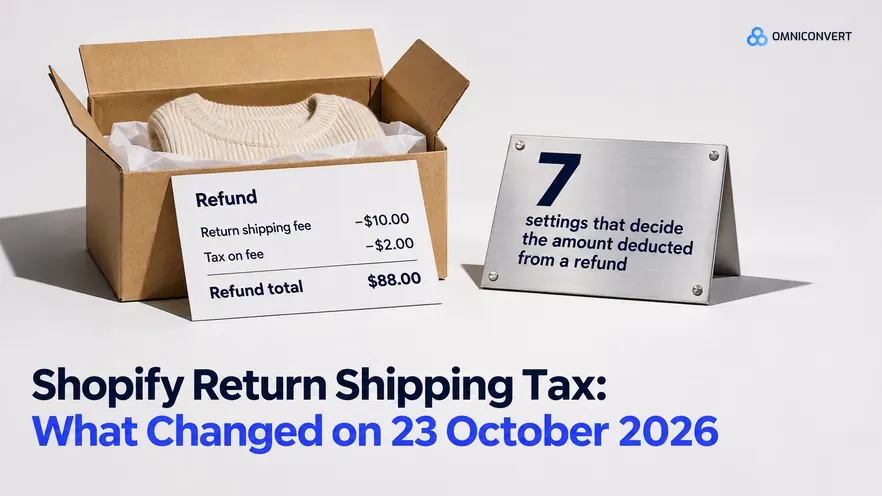
- The change is in the tax treatment, not the fee: a return shipping or restocking fee now carries tax wherever your tax configuration already says shipping is taxable, so the deduction from a refund is larger than the number in your return rules.
- Seven settings decide the figure your customer sees: regional shipping taxability, tax-inclusive pricing per market, the return rules fee itself, tax overrides, the Markets setup, your returns app, and your tax reporting.
- Taxability of shipping is regional, not global. In most VAT regimes a delivery charge takes the rate of the goods it carries; in the United States it varies state by state, so one fee can produce different totals across an order book.
- A fee that grows between the policy page and the refund email is drip pricing at the worst moment in the relationship. Show the tax where the policy is read, not only where the refund is calculated.
- Dual entitlement predicts the complaint: customers accept a charge that covers a real cost and reject one that looks like profit, so the wording of the line matters as much as its size.
A return shipping fee is a deduction taken from a refund to cover the cost of moving an item back from the customer. Since 23 October 2026, Shopify treats that deduction as a taxable charge wherever a store's own tax configuration already says shipping is taxable, which means tax is now calculated on top of the fee rather than absorbed into it. Across the CROBenchmark dataset of 7,000+ websites in 15+ industries, assessed against 248+ audit criteria, unclear cost and policy disclosure is one of the most common trust defects we record [CROBenchmark Report 2026, Omniconvert].
This guide covers exactly what changed, the seven settings that decide the number your customer sees, why the answer is different in Berlin and in Boston, and the harder commercial question underneath it: whether a return fee is worth charging at all once you can see which customers pay it. Verify every figure in your own admin, because the output depends on your regions, your markets and your return rules, not on anyone else's.
What changed on 23 October 2026
A return shipping fee is defined as an amount a merchant withholds from a refund to recover the cost of returning goods from the customer to the warehouse. It matters in eCommerce because it is the only charge in the whole purchase that a customer meets after the money has already changed hands, which makes it the charge least likely to have been read and most likely to be disputed.
Read the change precisely, because it is easy to over-read. Shopify did not introduce a new fee, did not raise an existing one, and did not decide that return shipping is taxable. It aligned the fee with the tax rules you had already configured for shipping. If your tax settings say shipping is not taxed in a region, nothing in that region moves. If they say it is, the deduction grows by the applicable rate.
The consequence is quiet and specific: the figure typed into return rules is no longer necessarily the figure that appears in a refund calculation, and it is almost certainly not the figure printed in a returns policy page written before October. Two numbers that used to be the same number can now disagree, and the first person to notice is usually a customer reading a refund notification.
One more thing deserves naming now rather than in the settings table. A restocking fee is expressed as a percentage of item price, so its tax moves with order value: the same policy produces a different absolute deduction on a 40 euro return and a 400 euro return. Flat fees are predictable, percentage fees are not, and percentage fees are where reconciliation surprises come from.
Why a tax line on a fee is not a rounding error
Return volume is what converts small per-order amounts into a real number. Apparel, footwear and consumer electronics run return rates far above the eCommerce average, and the gap between categories is wide enough that a single policy applied store-wide is rarely right; our breakdown of eCommerce return rates by industry sets out where each sits. Multiply any per-return discrepancy by a four-figure monthly return count and the finance problem is no longer trivial.
The customer-facing cost arrives faster than the accounting one. A refund that is smaller than the one a customer calculated produces a contact, and that contact is handled by a human at a cost that typically exceeds the tax in dispute. In our CVO audits of eCommerce brands through 2026, we consistently see post-purchase support volume driven less by policy severity than by policy ambiguity: strict policies that are clearly stated generate fewer tickets than generous policies that are vaguely stated [Omniconvert, 2026].
The seven settings to check in your own admin
| # | Where to look | The question to answer |
|---|---|---|
| 1 | Settings, then Taxes and duties, per region | Does tax apply to shipping in this region? This single switch decides whether anything changed for you here. |
| 2 | Markets, per market price settings | Do prices in this market include tax? If they do, confirm whether your fee is being read as gross or net, because that is a different customer-facing number. |
| 3 | Settings, then Policies, then Return rules | With tax applied, does the flat return shipping fee still produce the total you intend to charge? Adjust the fee, not the policy copy, if it does not. |
| 4 | Return rules, restocking fee percentage | What does this percentage plus tax come to on your lowest and highest priced items? Check both ends, not the average. |
| 5 | Tax overrides and product tax codes | Do any overrides, exemptions or reduced-rate codes change the rate that lands on the fee for part of your catalogue? |
| 6 | Your returns app or portal | Does the fee the customer sees in the portal match the fee the admin applies? Third-party returns apps that charge outside return rules compute their own figure. |
| 7 | Returns policy page and refund email templates | Does your published copy state a number that is now wrong? Fix the copy before the next return, not after the first complaint. |
Steps one and two are the ones people skip, and they are the only two that can change the answer for every other row. Tax-inclusive pricing is defined as a configuration in which a displayed price already contains the applicable tax, so the tax is extracted from the amount shown rather than added to it. It matters in eCommerce because the same stored number means two different things in two markets, and a merchant selling into both can be simultaneously correct in one and wrong in the other.
Finish with the test return. Create a low-value order on a test product, request a return through your actual customer-facing route rather than the admin shortcut, and write down three figures: what the portal told the customer, what the admin deducted, and what the tax report recorded. If all three agree, you are done. If any two disagree, you have found the work.
Why the answer differs by region, and why that is the real complexity
This is why a question as simple as "how much is our return fee?" can have no single answer for a store with international markets. A flat 5.00 fee can land as 5.00, as 5.95 and as something else again, depending on the destination and the goods, and a customer comparing notes in a review sees inconsistency rather than compliance. The fix is not to equalise the tax, which you cannot do. It is to state the fee in a way that survives the variation: a clear deduction described as "plus any applicable tax", with the exact figure shown in the returns portal before the customer confirms.
Operationally, this is the same discipline as pricing shipping in the first place. Teams that have already done the work on a free shipping threshold per market tend to find this change easy, because the per-market tax question is already answered and documented. Teams that set one global shipping rule years ago and never revisited it find it hard, for the same reason.
Dual entitlement: why customers read the tax as a profit grab
Dual entitlement explains an otherwise puzzling asymmetry in post-purchase feedback. The same deduction, in the same amount, generates very different sentiment depending on whether it is labelled as tax, as carrier cost or as nothing at all. An unlabelled increase is read as opportunism, because customers reference the price they were originally quoted as their entitlement, and any erosion of it demands a legitimate cause [Kahneman, Knetsch and Thaler, 1986].
So the remedy is linguistic before it is technical. Name the line. "Return shipping 5.00, tax 0.95, total deducted 5.95" is a cost disclosure. "Refund 44.05 instead of 50.00" is a mystery, and mysteries in refunds get written into reviews. If you are rewriting the policy anyway, the same visit is the moment to apply what your post-purchase survey questions already tell you about which parts of the policy customers misread.
Omniconvert Commander tracks return rate, refund value and net margin per segment, so a returns policy is priced against the customers who actually return rather than against an average that describes nobody.
See how it works →The refund is the end of the experience, and the end is what gets remembered
This is also a pricing-presentation problem with a known name. Drip pricing reveals mandatory charges progressively, after an initial figure has anchored expectations; partitioned pricing shows the components together, up front. Drip pricing converts better in the moment and worse over the relationship, which makes it a bad trade for anyone measuring repeat purchase rate rather than single-order conversion. A refund deduction that was never mentioned on the product page is drip pricing arriving a month late.
Customer effort compounds it. If finding the true cost of returning an item requires reading a policy page, opening a portal and then interpreting a refund email, you have added three steps of effort to an interaction that was already a disappointment. The teams that handle this well put the total deduction, tax included, on the returns portal screen where the customer confirms, and treat the policy page as a reference rather than as the disclosure.
The eCommerce brands that plateau around a 1.5% to 2% conversion rate consistently share one pattern: returns are managed as a cost centre by finance and never measured as an experience by growth, so the only lever anyone reaches for is a stricter fee. The fee reduces refund volume on the dashboard, and the same quarter quietly loses the repeat buyers who returned one item out of five orders. The benchmark gap closes fastest when teams treat net margin per customer cohort as the primary unit of measurement, not gross return rate.
Should you charge a return shipping fee at all?
Most fee decisions are made with the wrong number. Gross return rate says nothing about who is returning: a 30% return rate concentrated in your most valuable cohort and a 30% rate concentrated in one-time discount buyers call for opposite policies. Contribution margin per cohort, after refunds and return logistics, is the figure that settles it, and it is also the figure most stores cannot produce on demand.
Where you can reduce returns instead of pricing them, do that first, because the economics are strictly better: a return that never happens costs nothing in shipping, nothing in tax, nothing in support and nothing in goodwill. Sizing guidance, honest imagery, clearer specification and better expectation-setting are the levers, and our guide to reducing eCommerce returns covers them in order of impact. Fees are what you charge when you have run out of those.
It is also worth remembering how much of this is a presentation problem rather than a policy problem, and how large presentation effects can be. PRISM+ ran one A/B test of a listing page redesign that grouped its TVs, on all devices, with Omniconvert and recorded a 40.74% lift in conversion rate, a 14.81% lift in revenue per user and a 99.48% chance to win [Omniconvert, PRISM+ case study]. The catalogue was identical; only the way the choice was presented changed. The same principle applies to a return fee: how it is shown is a separate decision from how much it is, and the two should not be confused.
Finally, test the change rather than assuming it. A return policy is a conversion element on the product page and in the checkout, so a new fee or a new tax line can be measured in the same way as any other on-site change: run it as a controlled experiment where your platform allows it, and read the effect on revenue per visitor and on repeat orders, not only on refunds.
FAQ: Shopify return shipping tax
A return shipping fee is the amount a merchant deducts from a refund to cover the cost of sending an item back. In Shopify it is configured in return rules, either as a flat amount per return or as free returns, alongside an optional restocking fee expressed as a percentage of the item price. Both are deductions from the refund rather than separate charges, so the customer experiences them as a smaller repayment.
It depends entirely on where you sell. In most value-added tax regimes a delivery or handling charge is taxed at the rate of the goods it accompanies, so a fee attached to a standard-rated item is standard-rated too. In the United States, taxability of shipping is set state by state, and several states treat it as non-taxable when it is separately stated. Your Shopify tax settings, not the fee, decide which rule applies.
The tax treatment of fees charged through return rules. Return shipping and restocking fees are now calculated as taxable charges wherever the store's configuration already treats shipping as taxable, so tax is added on top of the amount entered in the admin. The fee value you typed is unchanged; the deduction applied to the refund is not. Open a test return and compare the figure your admin shows with the figure in your policy copy.
Start with Settings, then Taxes and duties, and confirm for each region whether tax applies to shipping. Then check whether prices in that market include tax, because that decides if your fee is read as gross or net. Then reopen Settings, then Policies, then Return rules and confirm the fee amount still produces the total you intend. Finally reconcile one completed return against your tax report before the next reporting period closes.
Consumer pricing rules in most markets require the total a consumer will actually pay to be clear before they commit, and a refund deduction is part of that total. Beyond compliance, it is simply better practice: a fee that is stated as one number in the returns policy and arrives as a larger number in the refund email generates a support ticket for every return, which costs more than the tax collected.
Omniconvert Commander ingests order, return and behavioural data together, so return rate, refund value and net margin are visible per product, per segment and per customer cohort rather than as one blended returns number. That tells you which cohorts a return fee would actually deter and which high-value repeat buyers it would quietly push away, and it ranks the fix by profit impact instead of by refund volume.
A few percentage points of tax on a flat return fee is the least interesting part of this change. What matters is that the number a customer was told and the number a customer receives can now differ, at the single moment in the relationship when trust is thinnest and the memory is most durable. Spend an hour in Settings, then Taxes and duties and Return rules, run one test return end to end, and rewrite the policy line so it states the total. Then decide the bigger question with data rather than instinct: whether the fee pays for itself across the cohorts that generate most of your revenue. See how Omniconvert Commander measures returns per segment before you price a policy for everyone.
Price your returns policy per cohort, not per order
A blended return rate hides the customers a fee actually costs you. Omniconvert Commander tracks returns, refund value and net margin per segment and ranks the fix by profit impact, so a returns policy is a measured decision rather than a reaction to a support queue.