Caimera.ai vs Creatify vs Nexus by Omniconvert (2026): Photos vs video
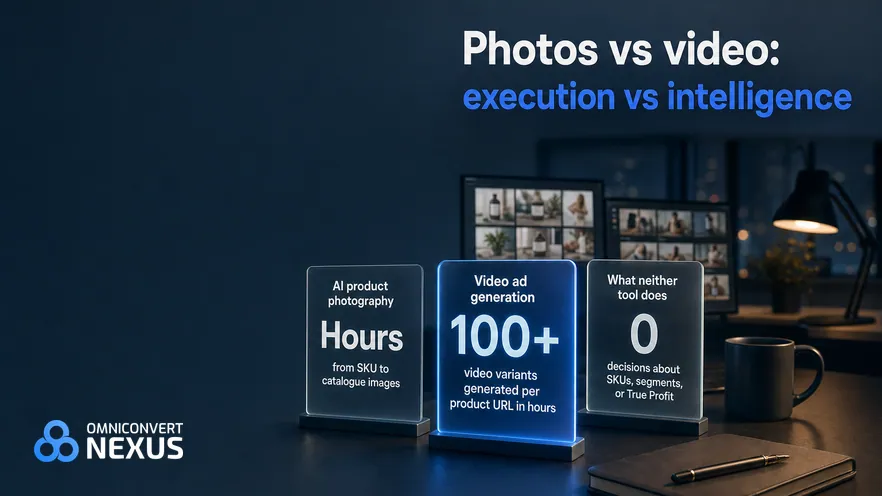
Caimera.ai and Creatify both generate ad creative for eCommerce brands: Caimera.ai produces AI product photography without a studio, Creatify produces AI video ads from a product URL. Neither decides which product, segment, or angle deserves the investment. Nexus by Omniconvert builds that brief from CLV data, NPS signals, and review intelligence, then tracks True Profit rather than ROAS. [Omniconvert, 2026]
- Caimera.ai is an AI product photography tool: it generates product images across contexts and styles without a physical shoot, but it does not choose which SKU deserves the render.
- Creatify is an AI video ad generator: 100+ UGC-style variants in hours from a single product URL, with a native Shopify pull straight into Meta and TikTok output.
- Both tools share the same blind spot: neither builds the brief from CLV, NPS, or review intelligence, and neither closes the loop on margin.
- Nexus by Omniconvert is the layer above both generators, building the brief from customer data and tracking True Profit rather than ROAS.
- DTC growth teams spend an average of 3 hours per day assembling data before any creative decision is made. [Omniconvert, 2026]
A DTC growth team comparing Caimera.ai vs Creatify is choosing between two production tools that solve different bottlenecks. Caimera.ai generates AI product photography from your catalogue without a photo studio. Creatify spins up 100+ video ad variants in hours from a product URL. Neither tool decides which SKU deserves the shot, which segment will respond, or whether the resulting creative moved True Profit. This page compares both against Nexus by Omniconvert, the layer that writes the brief before either generator opens its render queue.
What is Caimera.ai, and what is it actually good at?
Caimera.ai is an AI product photography platform for eCommerce brands. It generates product images without a photo studio, camera, or crew. If the bottleneck is time to shoot rather than time to strategise, Caimera.ai is aimed at that specific step. [Caimera.ai, 2026]
Caimera.ai positions itself as an AI product photography engine for eCommerce catalogues. Brands upload SKUs and the platform composes product images across backgrounds and styles, without booking a physical shoot. A traditional studio session might take a week and a five-figure production budget; an AI generation platform aims to compress that to hours.
The category is AI product photography and visual generation. The buyer is a DTC operator who is shipping product images weekly and cannot justify a rolling studio contract. The pitch is production economics: catalogue-ready images without a photographer, set, or agency.
Beyond image generation, Caimera.ai does not describe a CLV layer, a campaign management surface, or an ad analytics view. That is by design. It is a production tool for one input (SKUs) and one output (product images).
AI product photography is defined as image generation that composes a product visual (background, lighting, styling) from a product SKU, rather than capturing it with a physical camera and set. It replaces the photographer plus studio plus set-dresser labour cost with compute cost, at the trade-off of harder-to-brief creative direction.
Where Caimera.ai is genuinely strong
- Studio-replacement economics: product images produced without a physical shoot, a camera crew, or a set. The cost line moves from production budget to compute.
- Volume across contexts and styles: a single SKU rendered across multiple backgrounds and moods, useful for A/B testing product page hero images or seasonal refreshes.
- Catalogue-first workflow: the pipeline is built around SKUs, not around individual campaign briefs, which fits the way DTC catalogues are refreshed at scale.
Where Caimera.ai hits its ceiling
- No CLV or customer intelligence: Caimera.ai produces images. It does not tell you which SKUs are worth investing shoot time in based on customer value or margin.
- No campaign management or ad analytics: generated assets still need to be trafficked, tested, and measured elsewhere in the stack.
- Photography, not video: for scroll-stopping video ad volume, a specialist video engine like Creatify is the stronger pick.
Caimera.ai is a strong specialist for one specific job. The ceiling shows up when teams realise that more product images do not, by themselves, improve True Profit.
What is Creatify, and what is it actually good at?
Creatify is an AI video ad platform that generates UGC-style and spokesperson video ads from product URLs and scripts. It is built for DTC performance marketers who need volume, not bespoke production. Its core job is compressing the brief-to-asset cycle from weeks to hours. [Creatify, 2026]
Creatify takes a product URL or a short brief and produces dozens of video ad variants. The variants combine AI avatars, voiceover options, and templated structures aimed at paid social. The Shopify connection pulls product data automatically, so a marketer rarely retypes copy.
The category is AI video ad generation. The buyer is a performance marketer at a DTC brand, $1M to $50M ARR, testing creative weekly. The pitch is volume at production speed: 100+ video variants in hours, no film crew, no edit suite. Creatify Labs now also serves its own ad-optimised video generation models, Boreal and Boreal-H3, through Creatify's API, Model Playground and AdFlow.
Creatify holds a 4.5 out of 5 rating on G2 across 445 reviews as of 2026. The reviews praise speed and ad-format fit. They flag the limit every generator flags: the tool produces what you brief, and the brief is still yours. Its Performance Agent now integrates with Shopify and GA4 alongside six ad platforms, ingesting Shopify and Google Analytics for revenue and performance data, then rotating creative and reallocating budget toward whatever is driving the best return.
A UGC-style ad is defined as an ad that mimics the visual language of user-generated content (handheld camera, conversational delivery, mid-roll product mention) but is produced with paid talent or AI avatars. The format dominates Meta and TikTok performance in 2026 because it bypasses the polish penalty paid by studio-produced ads.
Where Creatify is genuinely strong
- Volume from a product URL: 100+ video ad variants generated in hours from a single product link, with no manual asset preparation.
- Realistic AI avatars and voiceovers: a library of avatars and voice options tuned for UGC-style content, suitable for Meta and TikTok testing.
- Native Shopify pull: product images, copy, and pricing flow into the generator without a separate brief document.
Where Creatify hits its ceiling
- Generation only: Creatify produces video assets, but it does not decide which angle to generate based on customer data.
- No analytics layer: the Performance Agent ingests Shopify and Google Analytics revenue and performance data and reallocates budget toward whatever is driving the best return, but Creatify still does not tell you up front which generated video is likely to perform best, or which segment it should target.
- No CLV or customer intelligence: every creative decision still depends on a human pulling CLV, NPS, and review data from elsewhere.
Creatify is a strong specialist for one specific job. The ceiling looks like Caimera.ai's in a different format: producing more variants does not, by itself, improve True Profit.
Caimera.ai vs Creatify vs Nexus: the capability comparison
Caimera.ai handles product photography without a studio. Creatify handles UGC-style video volume from a product URL. Nexus by Omniconvert handles the layer above both: which SKU deserves the shot, which segment gets the message, and whether the resulting creative moved True Profit, not just ROAS. [Omniconvert, 2026]
| Capability | Caimera.ai | Creatify | Nexus by Omniconvert |
|---|---|---|---|
| Primary function | AI product photography from SKUs, no studio required | UGC-style AI video ad generation from product URLs | Autonomous growth intelligence above any generator |
| Unified commerce data | No: no unified data layer across paid, email, CRO, retention | No: no unified data layer across paid, email, CRO, retention | Yes: single source of truth across the stack |
| AI-prioritised experiment queue | No: no ranked queue of next best actions | No: no ranked queue of next best actions | Yes: surfaces next best action by projected margin impact |
| Creative generation | Yes: AI product photography across backgrounds and styles | Yes: 100+ video variants in hours from a product URL, now rendered with Creatify's own ad-optimised video models, Boreal and Boreal-H3. | Yes: 100+ creative variants per hour, ranked by CLV-weighted angle |
| True Profit tracking | No: no margin layer, no return rate signal | No: no margin layer, no return rate signal | Yes: margin not ROAS, per campaign and per cohort |
| CLV and segment intelligence | No: no CLV input, no churn risk signal | No: no CLV input, no churn risk signal | Yes: RFM, cohorts, churn prediction, NPS signal |
| Autonomous action layer | No: human briefs every run | Partial: its Performance Agent rotates creative and reallocates budget toward whatever is driving the best return once connected, though a human briefs every generation run | Yes: removes the human middleware between data and action |
| AI creative briefing | No: brief is supplied by the marketer | No: brief is supplied by the marketer | Yes: brief is built from CLV, NPS, and review data |
| Pricing model | Pricing at caimera.ai | Usage-based SaaS | Revenue-based, see Nexus pricing |
| Best for | DTC brands needing product images without a studio | DTC brands needing high volume of video ad content quickly | eCommerce $1M+ ARR teams focused on margin, not just ROAS |
| Integrations | See caimera.ai | Shopify · Meta · TikTok · YouTube · GA4 (Shopify and GA4 feed the Performance Agent's revenue and performance data) | Shopify · Klaviyo · Meta · Google · TikTok · GA4 · Triple Whale |
| User rating | No public G2 rating | 4.5 out of 5 (G2, 445 reviews, as of 2026) | 5.0 out of 5 (Shopify App Store, 60 reviews, as of September 2026) |
Caimera.ai and Creatify columns reflect publicly available feature documentation as of September 2026. G2 rating for Creatify as cited in s2.
What Caimera.ai and Creatify cannot do
The shared blind spot is upstream of the asset. Both tools generate creative to a brief. Neither builds the brief from CLV data, NPS signals, review intelligence, or competitor angle scans. Neither closes the loop on whether the resulting image or video improved True Profit.
Caimera.ai generates professional product photography with AI. Nexus identifies which products and segments deserve the photography investment, connecting visual production to the customer segments that will convert at the highest margin. A hundred beautiful renders of the wrong SKU is still budget spent on the wrong customer.
Creatify generates the video. Nexus decides which product angle to script it around, based on which customer segment has the highest CLV and the lowest churn risk. The brief is what Creatify is missing. Without it, teams produce volume without direction.
Both Caimera.ai and Creatify are execution tools. They solve the same shared function in two formats: turning a brief into AI creative output at speed. They are also built on a shared assumption, that you already know which customer to target and which message to use. They optimise the execution of that assumption. Neither questions it.
What neither tool can tell you
- Which customers are worth acquiring more of. A 12-month CLV view, not last-click attribution, is what tells you which segments deserve the next round of paid spend.
- Which segments are 60 days from churning. The early signal lives in NPS scores, review sentiment, and support ticket patterns, not in any generator's UI.
- Whether the last campaign improved True Profit or just moved ROAS. ROAS can rise while net margin compresses; only a margin-first measurement loop catches the gap.
- What your highest-value customers actually respond to. Their own reviews, NPS verbatims, and support transcripts hold the angle that converts; pulling and synthesising them is still manual in a Caimera.ai-plus-Creatify stack.
Platforms like Nexus are built for this layer. Nexus synthesises CLV data, NPS signals, review intelligence, and competitor creative data into a ranked action queue, before a brief is written or a creative asset produced. The optimisation target is True Profit, not ROAS.
True Profit is defined as the net margin remaining after subtracting CAC, COGS, return rates, and the cost of customer acquisition from each cohort, not gross revenue or ROAS. It is what the business actually keeps. Nexus tracks this as the primary optimisation metric across all experiments.
AliveCor used Omniconvert to run a structured A/B testing programme and achieved +21% conversion rate, +5% revenue per visitor, and 94% statistical relevance across their experiments. [Omniconvert, AliveCor case study]
This is not a replacement for Caimera.ai or Creatify. Both still produce the visual asset. The intelligence layer above them is what decides which brief to send and whether the result moved the metric the business actually keeps.
Which tool is right for you?
Pick Caimera.ai if the bottleneck is product photography for the catalogue. Pick Creatify if the bottleneck is video ad volume for paid social. Add Nexus when ROAS looks fine but margin is not improving, and your team is spending hours assembling CLV, NPS, and review data before any brief can be written.
Choose Caimera.ai if
- Product photography is the bottleneck: you need product images across contexts and styles without booking studio time or a photographer.
- Budget beats bespoke: the constraint is production budget for physical shoots, not creative strategy or brand direction.
- Catalogue refresh cadence is high: new SKUs, seasonal restyles, and hero image swaps happen weekly and cannot wait for a shoot calendar.
Choose Creatify if
- Video volume is the bottleneck: you need to produce 50+ video ad variants per week without a production budget.
- Speed beats strategy this quarter: your current bottleneck is creative production speed, not creative strategy.
- UGC-style is your dominant format: you are running UGC-style video ads and want to scale without hiring creators.
Add Nexus if
- Data assembly eats your day: your team spends more than 2 hours a day pulling data from separate tools before a single decision is made.
- You optimise paid spend without a margin view: you are spending on paid media but have no reliable view of which customer segments drive the highest margin.
- You want experiments ranked before sprint planning: you want to know which tests are worth running before dev or creative sprints are assigned.
- ROAS hides a margin problem: ROAS looks fine but net margin is not improving quarter on quarter.
What each tool cannot do, honestly
Caimera.ai, Creatify, and Nexus each have real limits. Treating them as competing for the same job hides those limits. The honest framing is that the three sit at different layers of the same stack: two execution tools in two formats and one intelligence layer. Each is replaceable, none is a complete answer alone.
Where Caimera.ai will not stretch
- Not a strategy tool: Caimera.ai will not tell you which SKU to render or which segment the image should target.
- Not a video specialist: for high-volume UGC-style video output, Creatify is the stronger pick.
- Not a margin tool: Caimera.ai has no visibility into return rates, COGS, or CAC at cohort level.
Where Creatify will not stretch
- Not a product photography workhorse: Creatify is built for video; for AI product images across the catalogue, Caimera.ai is the stronger pick.
- Not a creative analytics layer: the Performance Agent uses Shopify and Google Analytics data to shift budget toward whatever is driving the best return, but Creatify does not surface up front which video will perform best or which segment it should run to.
- Not a CLV system: creative direction in Creatify is entirely manual, with no customer intelligence input.
Where Nexus has real prerequisites
- Not a product-photography engine: Nexus composes with the brand's existing product imagery. It does not shoot new product photography or render new SKU visuals from scratch.
- Not an AI actor studio: Nexus does not render AI avatars, clone voices, or film live footage. For UGC-style AI avatar video at scale, Creatify is the specialist.
- Data unification is the first 4 to 6 weeks: an intelligence layer is only as good as the data feeding it. Fragmented inputs produce unreliable ranked queues.
- Revenue stage threshold: the ROI compounds above $1M ARR, where data volume is sufficient and manual coordination cost is measurable. Earlier brands typically benefit more from a single execution tool first.
See where your store stands against real competitors in your category and country. Ecommerce Benchmark scores six areas free: Creative & Ads, Reviews & UGC, AI Visibility, Agentic Commerce, Competitor Synthesis, and CRO.
Benchmark Your Store FreeFrequently Asked Questions
The verdict
Caimera.ai is the specialist when product photography is the bottleneck: catalogue images across backgrounds and styles without a studio. Creatify wins on UGC-style video volume, 100+ variants in hours from a product URL. Neither generates the brief itself. From Omniconvert analysis of 7,000+ eCommerce sites, that decision layer is where 3 hours a day disappear. Add Nexus above either generator. [Omniconvert, 2026]
Caimera.ai and Creatify are both capable AI generators within their categories. If the primary need is AI product photography for the catalogue, Caimera.ai is the specialist. If the need is UGC-style video volume from a product URL, Creatify wins on speed and format fit.
The harder question is whether your team has a reliable way to know who to target, what to say, and whether it worked at the margin level. That is a different question, and it is what the third tool on this page, Nexus, is built to answer.
Stop assembling data.
Start supervising growth.
Nexus unifies your entire eCommerce data layer, detects revenue anomalies in under 15 minutes, and generates a prioritized action queue, so your team stops being human middleware and starts running the P&L.
5.0 out of 5 across 60 reviews, Shopify App Store , as of September 2026