Madgicx vs Motion vs Nexus by Omniconvert (2026): Actions vs analytics
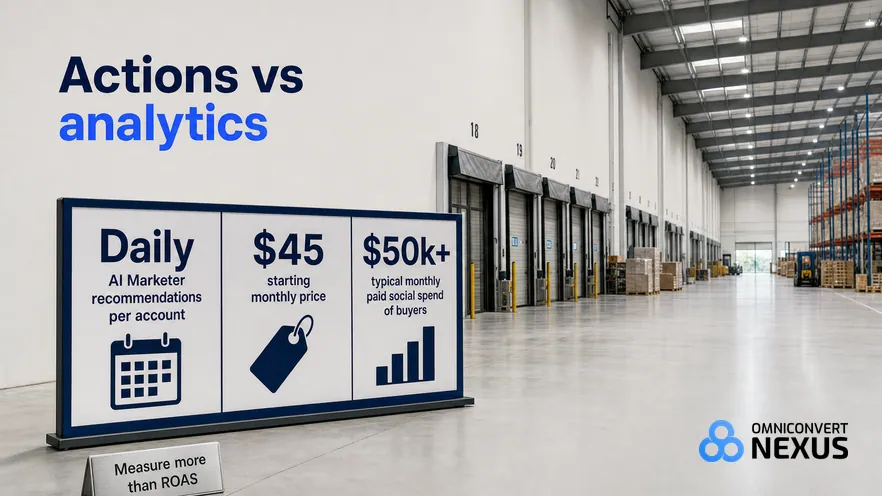
Madgicx and Motion both live inside paid social execution. Madgicx runs an AI Marketer that reviews Meta accounts daily and recommends specific actions. Motion reports concept-level creative performance across Meta and TikTok. Neither models CLV or measures True Profit. Nexus by Omniconvert adds the customer margin layer above either. [Omniconvert, 2026]
- Madgicx runs an AI Marketer that reviews Meta accounts daily and outputs specific pause, scale, and test recommendations.
- Motion reports concept-level creative performance across Meta and TikTok with hook rate, hold rate, and conversion metrics.
- Madgicx's recommendations use Meta ad-performance signal only; Motion's analytics stop at ad metrics; neither models customer lifetime value.
- Neither platform tracks True Profit or decides which customer segment is worth acquiring at margin.
- Nexus adds CLV segmentation, True Profit measurement, and the ranked action queue above either platform.
A DTC team comparing Madgicx vs Motion is usually choosing between acting on Meta campaign data and reading which creative concepts are winning. Madgicx wins on daily AI Marketer recommendations for Meta campaigns already running. Motion wins on concept-level analytics across Meta and TikTok. Neither tells you which customer segment is worth acquiring at margin, or whether the spend improved True Profit. That decision layer is what Nexus by Omniconvert is built to hold.
What is Madgicx, and what is it actually good at?
Madgicx is a Meta-focused advertising platform whose signature layer is the AI Marketer, an agent that reviews the ad account daily and outputs specific recommendations: pause this ad, redistribute budget here, test that audience. It also generates image ads and automates audience targeting for DTC brands running on Facebook and Instagram. [Madgicx, 2026]
Madgicx's distinguishing move is turning Meta campaign data into daily actions, not just dashboards. The AI Marketer reviews the account overnight and delivers a shortlist of things to change today, with the reasoning attached. Human approval is still required, but the analysis and the ranking of actions are handled by the platform. Madgicx MCP, a live Model Context Protocol server, now also connects AI assistants such as Claude and ChatGPT to a Madgicx account, pulling campaign performance and running full account audits as well as pausing underperforming ads, adjusting budgets and renaming ad sets from the chat.
The category is Meta campaign intelligence and optimisation. The buyer is a DTC brand or agency where Meta is the primary paid social channel and the bottleneck is translating campaign data into concrete next steps. Pricing starts at 45 dollars per month, which keeps it accessible for SMB and mid-market operators.
Madgicx holds a 4.5 out of 5 rating on G2 across 180 reviews as of 2026. Reviews highlight the AI Marketer's action-level guidance and the accessible price. The recurring caveat is the Meta-only scope: TikTok, Google, and other channels sit outside the recommendation loop.
The AI Marketer is defined as an automated review layer that inspects a Meta ad account each day and produces a ranked list of specific recommended actions (pause, scale, test, redistribute budget), with the underlying campaign data as evidence. It is Meta-account intelligence, not customer intelligence: the training set is ad performance, not CLV or segment behaviour.
Where Madgicx is genuinely strong
- Daily AI recommendations for Meta: the AI Marketer reviews your account and delivers specific next actions, not just charts.
- Audience targeting automation: Meta audiences are built and refined from account data without manual segment construction.
- Accessible pricing: starting at 45 dollars per month keeps the AI recommendation layer within reach of SMB and mid-market DTC brands.
Where Madgicx hits its ceiling
- Meta-only scope: TikTok, Google, and non-Meta channels sit outside the recommendation loop.
- Ad-performance signal only: recommendations use Meta data alone, no CLV, NPS, or customer lifetime signal enters the ranking.
- Image-ad generator, not full generative AI: the AI Ad Generator handles image variants, not the volume a specialist static or video tool would produce.
Madgicx is a strong specialist for one specific job. The ceiling shows up when teams need to know whether the recommended pauses and scales are actually improving margin, not just Meta ROAS.
What is Motion, and what is it actually good at?
Motion is a creative analytics platform built for performance marketing teams. It connects to Meta and TikTok ad accounts and breaks down performance by concept, hook rate, and hold rate rather than only at the individual ad level. [Motion, 2026]
Motion's distinguishing move is reporting creative at the concept level, not just the ad level. A single concept usually ships in a dozen variants; Motion rolls the results back up so a team can see which hook is actually working across the set. It is built for creative strategists and paid social leads who need that read without waiting on an analyst.
The category is creative analytics. The buyer is a DTC brand spending 50k to 500k dollars per month on paid social, running weekly creative cycles across Meta and TikTok. The pitch is clarity: no more guessing which concept moved the ROAS number.
Motion holds a 4.7 out of 5 rating on G2 across 312 reviews as of 2026. Reviews call out the speed of insight and the friendly dashboards. The consistent caveat is that the tool reports; it does not decide, brief, or generate.
Concept-level analytics is defined as the practice of grouping many ad variants that share a hook, angle, or format into a single concept, then measuring performance at that group. It answers the question "which idea is working" rather than "which specific asset is working", which is closer to how creative strategists plan the next round.
Where Motion is genuinely strong
- Concept-level breakdown: the fastest read on which hooks and concepts are actually driving performance across a paid social account.
- Direct Meta and TikTok integration: connects natively with no data lag, so the dashboard is current within the same session.
- Team-friendly dashboards: creative strategists and paid social leads use it without analyst support or training.
Where Motion hits its ceiling
- Analytics only, no action layer: Motion shows what happened; it does not decide what to do next, brief the next round, or ship the creative.
- No generation capability: teams still write briefs and produce assets in a separate tool or agency workflow.
- No CLV or customer layer: optimises for ad performance metrics like hook rate and ROAS, not for lifetime margin of the segment being reached.
Motion is a strong specialist for one specific job. The ceiling shows up when teams realise the report is only as useful as the decision that follows, and the decision still sits with a human.
Madgicx vs Motion vs Nexus: the capability comparison
Madgicx delivers daily AI recommendations for Meta campaigns already running. Motion reports concept-level performance across Meta and TikTok. Both optimise execution inside paid social. Nexus by Omniconvert is the intelligence layer above either: CLV, the brief, and the margin loop. The table reads as complementary, not competing.
| Capability | Madgicx | Motion | Nexus by Omniconvert |
|---|---|---|---|
| Primary function | AI Marketer with daily Meta campaign recommendations | Concept-level creative analytics across Meta and TikTok | Autonomous growth intelligence above any ad platform |
| Unified commerce data | No: Meta ad-performance data only | Partial: tracks creative performance across channels but not the full commerce data stack | Yes: single source of truth across the stack |
| AI-prioritised experiment queue | Partial: daily Meta campaign recommendations, limited to ad-level data, not customer segment prioritisation | No: reports what worked, does not queue what to do next | Yes: next best action by projected margin impact |
| Creative generation | Partial: generates image ad variants from existing creative, not full-volume generative AI | No: analytics only, no generation layer | Yes: 100+ variants per hour, ranked by CLV-weighted angle |
| True Profit tracking | No: no margin layer | Partial: ROAS and hook rate tracking, no margin or CLV layer | Yes: margin not ROAS, per campaign and per cohort |
| CLV and segment intelligence | No: audience automation, not lifetime value modelling | No: creative performance metrics only | Yes: RFM, cohorts, churn prediction, NPS signal |
| Autonomous action layer | Partial: AI Marketer automates Meta recommendations but human approval required for actions; Madgicx MCP lets connected AI assistants pause ads, adjust budgets and rename ad sets from the chat | No: dashboards only, no action layer | Yes: removes the human middleware between data and action |
| AI creative briefing | No: briefs come from operators, not from CLV or NPS data | Partial: suggests top-performing concepts but does not generate briefs from customer data | Yes: brief built from CLV, NPS, and review data |
| Pricing model | SaaS from 45 dollars per month | Seat-based SaaS, pricing on request | Revenue-based, see Nexus pricing |
| Best for | DTC brands and agencies running significant Meta campaigns who want daily AI-driven optimisation recommendations | DTC brands spending 50k to 500k dollars per month on paid social | eCommerce 1M dollar plus ARR teams focused on margin |
| Integrations | Meta, Google, Shopify | Meta, TikTok, YouTube | Shopify, Klaviyo, Meta, Google, TikTok, GA4, Triple Whale |
| User rating | 4.5 out of 5 (G2, 180 reviews, as of 2026) | 4.7 out of 5 (G2, 312 reviews, as of 2026) | 5.0 out of 5 (Shopify App Store, 60 reviews, as of September 2026) |
Competitor columns reflect publicly available feature documentation as of September 2026. G2 ratings as cited in s1 and s2.
What Madgicx and Motion cannot do
One delivers daily Meta campaign actions, one reads concept-level creative performance, and both optimise execution inside paid social. Neither carries the customer lifetime value layer. The decision about which segment is worth acquiring, and whether spend improved margin, sits with a human. That layer is where Nexus operates.
Madgicx's AI Marketer reviews your Meta account and tells you which campaigns to pause, scale, or test. Nexus provides the layer Madgicx cannot, CLV segmentation that shows which customer segments are worth acquiring and whether the campaigns Madgicx is optimising are actually improving True Profit.
Motion shows you what performed. Nexus decides what to do next, then executes it. The gap is not analytics depth; Motion is excellent at that. The gap is the absence of a customer intelligence layer: Motion optimises for ad performance metrics, not for which segment is worth acquiring at the highest lifetime margin.
What neither tool can tell you
- Which of your current customers are worth acquiring more of. A 12-month CLV view, not last-click attribution, is what tells you which segments deserve the next round of paid spend.
- Which segments are 60 days from churning. The early signal lives in NPS scores, review sentiment, and support ticket patterns, not in a Meta recommendation engine or a concept-level dashboard.
- Whether your last campaign improved True Profit or just moved ROAS. ROAS can rise while net margin compresses; only a margin-first measurement loop catches the gap.
- Which angle your highest-value customers respond to. A daily Meta account review and a concept-level creative report both miss the specific message your top-CLV cohort actually reacts to.
Platforms like Nexus are built for this layer. Nexus synthesises CLV data, NPS signals, review intelligence, and competitor creative data into a ranked action queue, before a brief is written or a creative produced. The optimisation target is True Profit, not ROAS.
True Profit is defined as the net margin remaining after subtracting CAC, COGS, return rates, and the cost of customer acquisition from each cohort, not gross revenue or ROAS. It is what the business actually keeps. Nexus tracks this as the primary optimisation metric across all experiments.
AliveCor used Omniconvert to run a structured A/B testing programme and achieved +21% conversion rate, +5% revenue per visitor, and 94% statistical relevance across their experiments. [Omniconvert, AliveCor case study]
Which tool is right for you?
If Meta is your primary channel and you want daily AI-driven action recommendations, choose Madgicx. If you want the clearest read on which concepts are actually winning across Meta and TikTok, choose Motion. If margin stays flat despite good ROAS, the missing layer is CLV, and that is Nexus.
- Choose Madgicx if Meta is your primary paid social channel and your bottleneck is translating campaign data into specific daily actions.
- Choose Motion if you need the fastest concept-level read on which creative is actually driving results across Meta and TikTok.
- Add Nexus if the spend is efficient but the open question is which segment is worth acquiring and whether it improved True Profit.
Madgicx and Motion sit at different jobs inside paid social execution, but both optimise within it. Nexus sits above both, deciding which customers the spend should chase and whether it improved margin. That is a different layer of the stack.
What each tool cannot do, honestly
A fair comparison names the limits. Madgicx is Meta-only, with recommendations based on ad-performance signal alone. Motion is analytics only, with no action or generation layer. Nexus does not run Meta campaigns or produce the concept report; it supplies the CLV and margin layer both platforms are missing.
- Madgicx: Meta-only scope, recommendations from ad performance signal not CLV, image-ad generator rather than a specialist creative volume tool.
- Motion: analytics only with no action layer, no creative generation, no CLV or customer lifetime signal in the ranking.
- Nexus by Omniconvert: not a Meta campaign optimiser and not a concept-level analytics dashboard. It defines and measures the margin goal; it relies on tools like either one to run the paid social execution.
The honest read: run Madgicx for daily Meta account actions, run Motion for the concept-level creative read, and run Nexus for the CLV signal and margin. The pairing closes the loop none of them can close alone.
See where your store stands against real competitors in your category and country. Ecommerce Benchmark scores six areas free: Creative & Ads, Reviews & UGC, AI Visibility, Agentic Commerce, Competitor Synthesis, and CRO.
Benchmark Your Store FreeFrequently Asked Questions
Should you add Nexus to your Madgicx or Motion stack?
Add Nexus if your paid social runs efficiently but margin is flat. Madgicx delivers daily AI Marketer recommendations for Meta campaigns already running. Motion reports concept-level creative performance across Meta and TikTok. Neither models which customers are worth acquiring or whether the campaign improved True Profit. Nexus ranks the next action by projected margin, then closes the loop. Teams losing hours to CLV, NPS, and review pulls are the highest-fit buyers. [Omniconvert, 2026]
Madgicx and Motion are strong at execution within their jobs: daily AI-driven action recommendations for Meta and concept-level creative analytics across paid social. If shipping the recommendations or reading the concept report is your live need, keep the tool that fits.
The harder question is whether your team has a reliable way to know who to target, what to say, and whether it worked at the margin level. That is a different question, and it is what Nexus is built to answer.
Stop assembling data.
Start supervising growth.
Nexus unifies your entire eCommerce data layer, detects revenue anomalies in under 15 minutes, and generates a prioritized action queue, so your team stops being human middleware and starts running the P&L.
5.0 out of 5 across 60 reviews, Shopify App Store , as of September 2026