Pacvue vs Sprinklr vs Nexus by Omniconvert (2026): Blind spots.
Pacvue is a retail media automation platform for Amazon, Walmart, and Instacart, handling AI bid management and digital shelf data. Sprinklr is an enterprise platform unifying paid social, organic, and customer care. Nexus by Omniconvert sits above both, connecting CLV segmentation and True Profit to every channel they manage. [Omniconvert, 2026]
- Pacvue is the retail media specialist: AI bid management and digital shelf analytics across Amazon, Walmart, and Instacart, with a Pacvue Agent that queries Amazon Marketing Cloud in plain language.
- Sprinklr is the enterprise unifier: paid social, organic, customer care, and market intelligence in one platform for global multi-brand operations.
- Both operate at the execution layer. Neither answers which customer segments justify current CAC or which cohorts are 60 days from churning.
- Nexus adds CLV segmentation, True Profit tracking, and a ranked action queue above whichever execution tool you already run.
- Choose Pacvue for Amazon and Walmart retail media; choose Sprinklr for enterprise social at scale; add Nexus when ROAS looks fine but margin is not improving.
Enterprise ecommerce teams often evaluate Pacvue vs Sprinklr when their operations sprawl across retail media, paid social, and customer care. Pacvue is the retail media specialist. Sprinklr is the unified enterprise platform. Neither answers which customer segments justify current CAC or which are about to churn.
What is Pacvue, and what is it actually good at?
Pacvue is an enterprise retail media platform automating advertising on Amazon, Walmart, Instacart, and other retail networks. It combines AI bid management, campaign automation rules, and digital shelf analytics that link ad performance to inventory, Buy Box status, and product content scores.
Pacvue automates retail media advertising across Amazon, Walmart, Instacart, and other retail networks. It combines AI bid management, rules-based campaign automation, and digital shelf analytics that connect ad performance to product content scores, inventory, and Buy Box status.
The Pacvue Agent adds a plain-language query layer on top of Amazon Marketing Cloud, generating visual campaign reports automatically. That combination of bid management and retail intelligence is where Pacvue is genuinely strong.
Where Pacvue is genuinely strong
- AI bid management at retail-network scale. Rules and bidding logic across Amazon, Walmart, Instacart, and other retail networks with custom automation.
- Digital Shelf Optimization. Connects ad performance to product content, inventory, and Buy Box status in one view.
- Pacvue Agent. Queries Amazon Marketing Cloud in plain language and generates visual campaign reports automatically.
Where Pacvue hits its ceiling
- Retail media specialist. Limited capability for paid social or non-retail digital advertising channels.
- Enterprise pricing. More expensive than alternatives like Skai for comparable retail media functionality.
- No CLV layer. Retail media automation runs without customer lifetime value informing ASIN prioritisation.
What is Sprinklr, and what is it actually good at?
Sprinklr is a broad enterprise customer experience platform. It combines paid advertising, organic social, customer care, and market intelligence in one unified system for large brands operating across dozens of channels and multiple global markets.
Sprinklr is a broad enterprise platform covering social media management, paid advertising, customer care, and market intelligence. Its advertising capability handles paid social campaign management alongside organic social, influencer programs, and customer service in one platform.
The pitch is unification. If your organisation has paid, organic, and care teams working in different tools, Sprinklr collapses them into a single workflow with governance, approvals, and cross-team visibility.
Where Sprinklr is genuinely strong
- Unified operations. Removes the operational gap between paid social, organic social, and customer care teams.
- Enterprise scale. Handles global multi-brand operations across dozens of social channels and markets.
- Market intelligence. Surfaces competitor and industry insights alongside campaign management.
Where Sprinklr hits its ceiling
- Depth vs breadth trade-off. Broad platform means depth on paid advertising is lower than specialist tools.
- Onboarding cost. Enterprise complexity and pricing require significant onboarding and implementation investment.
- No CLV layer. Optimises social performance, not customer lifetime value across the customer base.
Pacvue vs Sprinklr vs Nexus: the capability comparison
Pacvue automates retail media across Amazon and Walmart. Sprinklr unifies enterprise social and care at global scale. Nexus by Omniconvert operates a level above both, connecting the execution layers to CLV segmentation, ranked experiments, and True Profit measurement.
| Capability | Pacvue | Sprinklr | Nexus by Omniconvert |
|---|---|---|---|
| Unified commerce data | Partial retail media plus shelf, not customer CLV | Partial paid, organic, care, not commerce or CLV | Yes single source of truth across CLV, NPS, reviews, ads |
| AI-prioritised experiment queue | Partial bid rules for retail media, not CLV-driven ASIN prioritisation | No | Yes ranked next-best-action queue |
| Creative generation | No | Partial AI-assisted organic content, limited ad creative | Yes 100+ variants per hour, CLV-weighted angles |
| True Profit tracking | Partial ad spend to product level, not customer margin | No | Yes margin after CAC, COGS, returns |
| CLV and segment intelligence | No | No | Yes RFM, cohorts, churn prediction |
| Autonomous action layer | Partial bid and campaign rules, Pacvue Agent adds plain-language queries | No | Yes removes human middleware |
| AI creative briefing | No | No | Yes from CLV, NPS, reviews |
| Pricing model | Enterprise, pricing on request at pacvue.com | Enterprise, pricing on request at sprinklr.com | Revenue-based, see /nexus |
| Best fit | Enterprise Amazon and Walmart retailers | Global multi-channel social and care operations | eCommerce $1M+ ARR, margin-focused |
Capability notes reflect the vendor's own public product pages and documentation as of 2026. Cell values are qualitative, not scored.
What Pacvue and Sprinklr cannot do
Both tools optimise execution. Pacvue optimises retail media bidding on Amazon. Sprinklr optimises social operations across markets. Neither answers which customer segments are worth acquiring at current CAC, which are close to churning, or whether last quarter's spend actually improved margin.
Pacvue automates retail media bidding and tells you how your ASINs are performing on Amazon and Walmart. Nexus adds the CLV layer above the retail media layer, connecting product-level ad performance to which customer segments buying those ASINs have the highest lifetime value.
Sprinklr manages enterprise social and advertising operations at scale. Nexus provides the customer intelligence layer that connects those operations to the customers worth acquiring: CLV segmentation and True Profit measurement across every channel Sprinklr manages. Operational efficiency at scale is not the same as margin efficiency. Sprinklr optimises the former; Nexus ensures the latter.
Both Pacvue and Sprinklr assume the strategic decisions have already been made: which customers to target, which message to use, which experiment to run next. They optimise the execution of those decisions. Neither questions them.
What neither tool can tell you
- Which segments to acquire more of. Based on 12-month CLV, not last-click attribution.
- Which cohorts are 60 days from churning. And need a different message today.
- Whether the last campaign moved True Profit. Or only moved ROAS.
- What your highest-value customers actually respond to. Drawn from their own reviews, NPS scores, and support tickets.
Platforms like Nexus are built for this layer. Nexus synthesises CLV data, NPS signals, review intelligence, and competitor creative data into a ranked action queue, before a brief is written or a creative produced. The optimisation target is True Profit, not ROAS.
True Profit is defined as the net margin remaining after subtracting CAC, COGS, return rates, and the cost of customer acquisition from each cohort, not gross revenue or ROAS. It is what the business actually keeps. Nexus tracks this as the primary optimisation metric across every experiment.
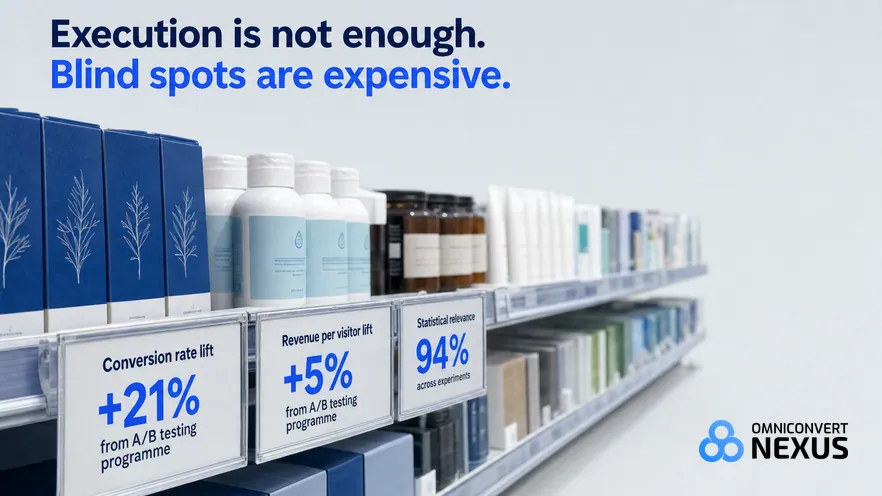
AliveCor used Omniconvert to run a structured A/B testing programme and achieved +21% conversion rate, +5% revenue per visitor, and 94% statistical relevance across their experiments. [Omniconvert, AliveCor case study]
Which tool is right for you?
Choose Pacvue if Amazon and Walmart are your primary revenue channels. Choose Sprinklr if unified social and care at enterprise scale is the priority. Add Nexus when ROAS looks healthy but net margin is not moving quarter on quarter.
Choose Pacvue if
- Retail media is your growth engine. You manage significant Amazon or Walmart advertising spend and need AI bid automation and campaign management.
- Digital shelf matters. You want retail media performance connected to inventory, Buy Box, and product content scores.
- Plain-language AMC access. You need querying of Amazon Marketing Cloud data through an AI agent, not a data team.
Choose Sprinklr if
- Unification is the priority. You need paid advertising, organic social, and customer care in one platform across global markets.
- Governance at scale. Your enterprise manages dozens of social channels and requires workflow and approval controls.
- Listening plus campaigns. Market intelligence and social listening are as important as campaign management.
Add Nexus if
- Your team is human middleware. More than two hours a day goes to pulling data from separate tools before any decision.
- You optimise spend without margin visibility. No reliable view of which customer segments drive the highest True Profit.
- Experiment prioritisation is guesswork. You want to know which tests are worth running before dev sprints are assigned.
- ROAS looks fine, margin does not. Net margin is flat quarter on quarter while ROAS numbers look healthy.
What each tool cannot do, honestly
Every tool on this page has a boundary. Pacvue is a retail media specialist, not a paid social platform. Sprinklr is a broad enterprise system, not a depth-first paid ads tool. Nexus is an intelligence layer, not a media buyer.
Pacvue's boundary
Pacvue optimises retail media on Amazon, Walmart, Instacart, and other retail networks. It does not manage paid social or search advertising, and it does not build direct-to-consumer customer intelligence. If your growth stack extends beyond retail networks, Pacvue is a specialist inside a broader operation, not the whole operation.
Sprinklr's boundary
Sprinklr covers a wide surface: paid social, organic, customer care, market intelligence. That breadth costs depth. On any single ad channel, a specialist tool often wins on advanced features and automation. Sprinklr is the platform when unification across teams matters more than best-in-class on a single channel.
Nexus's boundary
Nexus leaves the bid and campaign lifecycle to the ad networks, and does not run retargeting. It does not maintain product feeds or serve dynamic catalog ads. It does not render AI avatars or shoot product photography. Nexus is the intelligence and creative-briefing layer above whichever execution stack you already run.
See where your store stands against real competitors in your category and country. Ecommerce Benchmark scores six areas free: Creative & Ads, Reviews & UGC, AI Visibility, Agentic Commerce, Competitor Synthesis, and CRO.
Benchmark Your Store FreeFrequently Asked Questions
The verdict
If your revenue comes primarily from Amazon and Walmart, choose Pacvue for retail media automation and digital shelf intelligence. If you are running enterprise social and care operations at global scale, Sprinklr unifies them. Both operate at the execution layer. Neither tells you which customer segments justify the CAC. Add Nexus when ROAS looks fine but net margin is not improving quarter on quarter. [Omniconvert, 2026]
Pacvue and Sprinklr solve different execution problems. Pacvue is stronger on retail media, digital shelf data, and Amazon Marketing Cloud automation. Sprinklr is stronger on unified paid social, organic, customer care, and market intelligence at enterprise scale.
The harder question is whether your team knows which customers are worth acquiring, what they respond to, and whether the last campaign moved margin. That question runs above both platforms, and it is what Nexus is built to answer.
Stop assembling data.
Start supervising growth.
Nexus unifies your entire eCommerce data layer, detects revenue anomalies in under 15 minutes, and generates a prioritized action queue, so your team stops being human middleware and starts running the P&L.
5.0 out of 5 across 60 reviews, Shopify App Store , as of September 2026