Pencil vs Jointellos.com vs Nexus by Omniconvert (2026): Two creative tools, one strategic blind spot
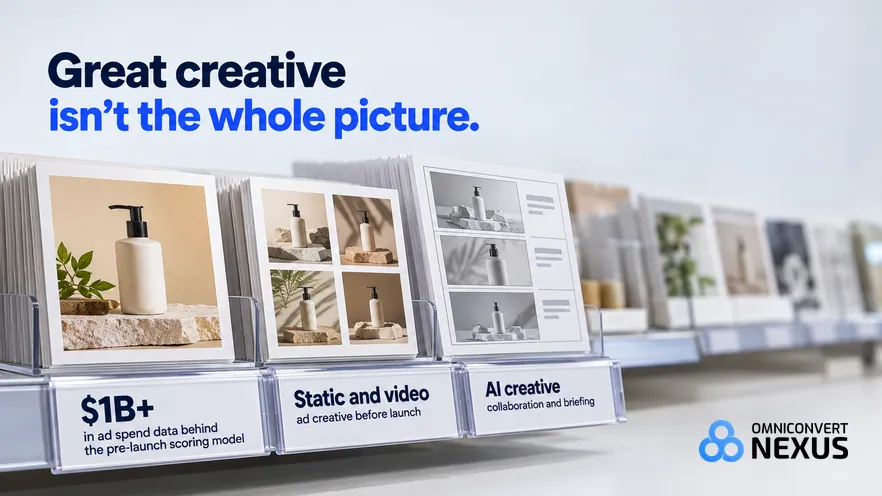
Pencil predicts which static and video ad creative will perform before launch, scored against patterns from over $1 billion in Meta spend. Jointellos.com sits in AI creative collaboration and briefing. Neither reads customer CLV, NPS, or segment data. Nexus by Omniconvert runs that intelligence layer and tracks True Profit, not ROAS. [Omniconvert, 2026]
- Pencil predicts which static and video ad creative will perform on Meta before launch, scored against patterns from over $1 billion in real ad spend.
- Jointellos.com positions itself in AI creative collaboration and briefing; public documentation is thin at the time of writing and should be verified at jointellos.com.
- Neither tool reads customer CLV, NPS, review intelligence, or margin, which is where the biggest spend decisions actually live.
- Nexus by Omniconvert sits above both: unified data, a ranked action queue, and True Profit as the optimisation target.
- The decision is a shape question, not a ranking: pre-launch creative scoring, briefing collaboration, and strategic supervision are different jobs.
A DTC growth lead weighing Pencil vs Jointellos.com is trying to spend less on creative that never works. Pencil predicts ad performance before launch; Jointellos.com positions itself in AI creative collaboration and briefing. Neither tool reads which customer segment is worth that spend or whether the last launch moved True Profit. This page separates what each tool does from the strategic layer that sits above both, which is what Nexus by Omniconvert is built to carry.
What is Pencil, and what is it actually good at?
Pencil is a predictive AI ad generation platform for Shopify DTC brands on Meta. It scores static and video creative against patterns from over $1 billion in real ad spend. The pre-launch ranking shows which concepts are likely to earn their test budget. [Pencil, 2026]
Pencil generates ad variations and attaches a predicted ROAS score to each one before launch. The scoring draws on real spend data from thousands of brands. Your team sees the pre-launch ranking first and tests only the top of the queue, not ten concepts in search of the one that converts.
The platform is built around Meta campaigns and the Shopify catalogue. That focus keeps setup fast for DTC brands already in that stack. It also sets the ceiling: teams running real TikTok or Google spend sit outside its scope.
Pencil holds a 4.5 out of 5 rating on G2 across 60 reviews as of 2026. Reviews praise the pre-launch scoring and the fast product-to-ad workflow. The recurring caveat: the prediction learns from other brands' ad performance, not from your customers.
Predictive ad scoring is defined as a model that forecasts the performance of a creative concept against patterns from past ad spend. The forecast lands before any budget is committed to the live test. It ranks the creative. It does not read who is on the other end of the ad, or whether the resulting customer is profitable.
Where Pencil is genuinely strong
- Pre-launch creative prediction: scores concepts against patterns from over $1 billion in real ad spend, so test budget flows to the concepts the model expects to work.
- Static and video variants with ROAS scores: generates both formats and attaches a predicted ROAS to every variant before launch.
- Shopify to Meta workflow: direct Shopify integration moves products into ad variants without the usual setup drag.
Where Pencil hits its ceiling
- Patterns from other brands: the prediction trains on aggregate ad performance, not on your specific CLV cohorts or margin profile.
- Narrow channel coverage: Meta and Shopify is the home turf; TikTok or Google-heavy brands sit outside its scope.
- No customer intelligence: predicts ad performance, not whether the ad brings in customers worth acquiring more of.
Pencil is a strong specialist for Shopify DTC teams on Meta. The ceiling shows up when the pre-launch scoring runs cleanly but the spend still chases the wrong customer segments.
What is Jointellos.com, and what is it actually good at?
Jointellos.com positions itself in AI creative collaboration and briefing, a category aimed at marketing teams that produce ad and content assets together. Public product detail is thin at the time of writing, so the comparison stays at the category level. [Jointellos.com, 2026]
AI creative briefing tools sit between the strategist and the designer. They help a team turn a loose idea into a structured brief that a creative or an AI generator can act on. The pitch is that less time is lost in Slack threads and more lands as something a producer can run with.
Where a tool like Jointellos.com fits depends on who holds the brief today. If the growth lead writes it in a doc and the designer interprets, a shared briefing layer compresses that loop. If the brief already arrives in detail, the gain is smaller.
Public documentation is limited. Prospective buyers should expect to scope a pilot rather than evaluate from a feature list. Confirm scope, pricing, and integrations directly at jointellos.com.
AI creative briefing is defined as a tool that structures the brief for an ad or content asset using prompts, templates, and AI assistance. The team moves from idea to production-ready brief without a long cross-channel thread. It compresses the briefing step. It does not read customer segment value or margin.
Where Jointellos.com positions itself
- Collaborative creative briefing: the category name is AI creative collaboration and briefing, a tool for teams running the brief-to-asset flow together rather than in silos.
- Early-stage product: public documentation is limited; prospective buyers should pilot the fit on a real workflow rather than read a feature list.
Where Jointellos.com hits its ceiling
- Briefing layer, not an intelligence layer: a better brief is only as good as the segment, offer, and insight feeding it; the tool does not read customer behaviour or margin.
- No CLV or customer segment data: the category sits upstream of execution but downstream of strategy; CLV cohorts, NPS trends, and churn signals come from a different system.
Scope, pricing, and integrations for Jointellos.com should be verified directly at jointellos.com before adoption. The comparison below reflects category-level positioning, not product-specific documentation.
Pencil vs Jointellos.com vs Nexus: the capability comparison
Pencil scores creative before launch. Jointellos.com helps teams brief it together. Nexus by Omniconvert handles the layer above both: which customer segment to brief for, which message the highest-margin cohort responds to, and whether the campaign earned True Profit after launch.
| Capability | Pencil | Jointellos.com | Nexus by Omniconvert |
|---|---|---|---|
| Primary function | Predict and generate static and video Meta ad creative before launch | AI creative collaboration and briefing for marketing teams | Autonomous growth intelligence above any ad platform |
| Unified commerce data | No: Meta and Shopify product data only, no CLV or NPS layer | No: briefing surface, not a commerce data platform | Yes: single source of truth across the stack |
| AI-prioritised experiment queue | Partial: pre-launch scoring prioritises which creative to test, based on ad patterns, not customer segments | No: not a prioritisation layer | Yes: next best action by projected margin impact |
| Creative generation | Yes: generates static and video ad variants with predicted ROAS scores before launch | Partial: category-level AI assistance within the brief-to-asset flow; detailed scope requires verification | Yes: 100+ variants per hour, ranked by CLV-weighted angle |
| True Profit tracking | No: predicts ROAS, no net margin signal | No: no measurement layer | Yes: margin not ROAS, per campaign and per cohort |
| CLV and segment intelligence | No: no CLV or customer-behaviour data | No: no CLV or customer-behaviour data | Yes: RFM, cohorts, churn prediction, NPS signal |
| Autonomous action layer | No: team runs the test, the model only scores | No: team runs the brief, the tool only structures it | Yes: operator approves every change |
| AI creative briefing | Partial: generates from product and brand data; brief quality depends on team input, not customer intelligence | Partial: the briefing layer is the core category, but the brief is only as good as the inputs the team supplies | Yes: brief built from CLV, NPS, and review data |
| Pricing model | SaaS, pricing on request at trypencil.com | Not publicly listed; verify at jointellos.com | Revenue-based, see pricing |
| Best for | Shopify DTC brands on Meta pre-filtering creative tests | Marketing teams running the brief-to-asset flow together | eCommerce 1M dollar plus ARR teams focused on margin |
| Integrations | Shopify, Meta | Verify at jointellos.com | Shopify, Klaviyo, Meta, Google, TikTok, GA4, Triple Whale |
| User rating | 4.5 out of 5 (G2, 60 reviews, as of 2026) | No public rating available | 5.0 out of 5 (Shopify App Store, 60 reviews, as of September 2026) |
Pencil detail reflects publicly available product documentation as of October 2026. Jointellos.com detail is limited by scarce public documentation and should be verified at jointellos.com before adoption.
What Pencil and Jointellos.com cannot do
The shared blind spot sits upstream of either tool. Pencil ranks creative; Jointellos.com helps teams brief it. Neither reads which customer segments are worth acquiring at today's CAC. Neither reads which message the highest-CLV cohort converts on, or whether the last launch earned True Profit.
Pencil predicts which creative will win based on patterns from other brands' ad spend. Nexus predicts from your customers, CLV cohorts, and NPS signals, showing which segment is worth targeting and which message converts your highest-margin buyers.
AI creative briefing tools like Jointellos.com help a team turn an idea into a structured brief. What they cannot do is tell the team which segment to brief for. They cannot say which offer the highest-CLV cohort responds to, or whether yesterday's launch earned margin or burned it.
Both Pencil and Jointellos.com are built around a shared assumption: that you already know which customers to target and which message to use. They optimise the execution of that assumption. Neither questions it.
What neither tool can tell you
- Which of your current customers are worth acquiring more of. A 12-month CLV view, not last-click attribution, is what tells you which segments deserve the next round of paid spend.
- Which segments are 60 days from churn. The early signal lives in NPS scores, review sentiment, and support ticket patterns, not in a pre-launch scoring model or a briefing surface.
- Whether your last campaign improved True Profit or just moved ROAS. ROAS can rise while net margin compresses; only a margin-first measurement loop catches the gap.
- What your highest-value customers actually respond to. The answer sits in their reviews, NPS scores, and support tickets, not in a brief template or an industry-wide ad training set.
Platforms like Nexus synthesise CLV data, NPS signals, review intelligence, and competitor creative data into a ranked action queue. That queue is built before a brief is written or a creative produced. The optimisation target is True Profit, not ROAS.
True Profit is defined as the net margin remaining after subtracting CAC, COGS, return rates, and the cost of customer acquisition from each cohort, not gross revenue or ROAS. It is what the business actually keeps. Nexus tracks this as the primary optimisation metric across all experiments.
AliveCor used Omniconvert to run a structured A/B testing programme and achieved +21% conversion rate, +5% revenue per visitor, and 94% statistical relevance across their experiments. [Omniconvert, AliveCor case study]
Which tool is right for you?
Pick Pencil if the pain is wasted creative test budget on Meta. Pick Jointellos.com if the pain is slow brief-to-asset flow across a team. Add Nexus when the pain shifts to ROAS looking fine while margin flatlines quarter after quarter.
- Choose Pencil if Meta is your paid-media centre of gravity on a Shopify catalogue, and you want pre-launch ROAS scoring before test budget is committed.
- Choose Jointellos.com if brief-to-asset flow is where your team loses the day, and a shared AI briefing surface would compress the loop between strategist, designer, and producer.
- Add Nexus if ROAS reads green while net profit stays flat quarter after quarter, and you want a ranked action queue of what to run next.
Pencil and Jointellos.com sit on different points of the creative workflow: one scores concepts before launch, the other structures the brief that produces them. Both optimise execution. The layer above both, deciding which customers the spend should chase and whether it improved margin, is a different job on a different layer.
What each tool cannot do, honestly
A fair comparison names the limits. Pencil predicts creative on Meta, trained on patterns from other brands' ad spend. Jointellos.com positions in AI creative briefing with limited public documentation. Nexus does not run retargeting, does not manage product feeds, does not render AI avatars, and does not shoot product photography.
- Pencil: prediction trained on aggregate ad data, not your CLV cohorts; narrow channel coverage limited to Meta and Shopify; no customer intelligence layer.
- Jointellos.com: limited public documentation at the time of writing; a briefing layer only as good as the inputs the team supplies; no CLV or margin signal.
- Nexus: works Meta and Google only, not TikTok or Pinterest as channels. Does not hand off, the operator approves every change. Composes with the brand's existing product imagery, it does not shoot it.
The honest read: run Pencil for pre-launch creative scoring on Meta. Scope a Jointellos.com pilot if briefing collaboration is the real bottleneck. Run Nexus for the CLV and margin layer that tells either tool which customer the spend should chase.
The pairing closes the loop none of them close alone.
See where your store stands against real competitors in your category and country. Ecommerce Benchmark scores six areas free: Creative & Ads, Reviews & UGC, AI Visibility, Agentic Commerce, Competitor Synthesis, and CRO.
Benchmark Your Store FreeFrequently Asked Questions
Should you add Nexus to your Pencil or Jointellos.com stack?
Add Nexus if your creative execution runs cleanly but margin is flat. Pencil predicts static and video Meta creative before launch, scored against over $1 billion in ad spend. Jointellos.com positions itself in AI creative collaboration and briefing. Neither reads which customers are worth acquiring or whether the spend improved True Profit. Nexus ranks the next action by projected margin, then closes the loop. [Omniconvert, 2026]
Pencil and Jointellos.com are capable in their shape of the problem. Pencil's pre-launch ROAS scoring reduces test waste on Meta; a briefing tool like Jointellos.com compresses the brief-to-asset loop. Neither reads customer behaviour, segment value, or margin, and that is not what they are built for.
The harder question for a growth lead is whether the team has a reliable way to know who to target, what to say, and whether it earned margin. That is a different question, and it is what Nexus is built to answer.
Stop assembling data.
Start supervising growth.
Nexus unifies your entire eCommerce data layer, detects revenue anomalies in under 15 minutes, and generates a prioritized action queue, so your team stops being human middleware and starts running the P&L.
5.0 out of 5 across 60 reviews, Shopify App Store , as of September 2026