ROI Hunter vs Sprinklr vs Nexus by Omniconvert (2026): Product margin vs enterprise scale.
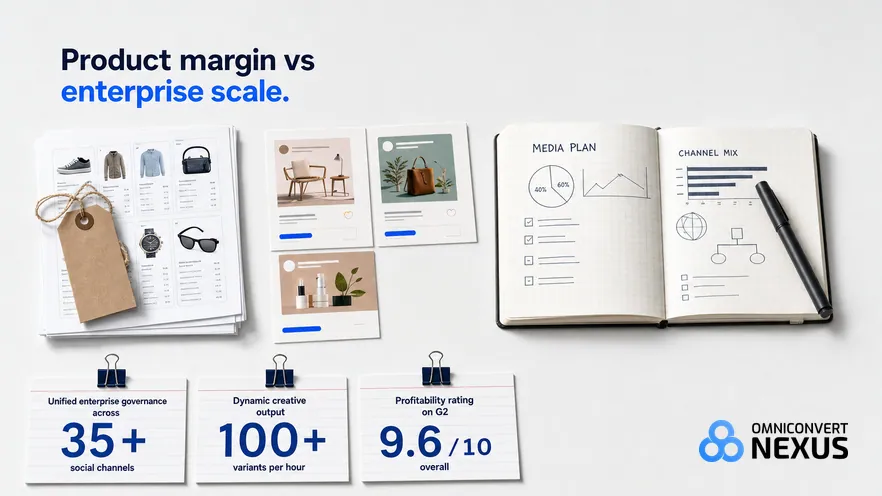
ROI Hunter connects product catalog data to advertising decisions using margin intelligence. Sprinklr unifies enterprise paid social, organic social, and customer care in one platform. Nexus by Omniconvert sits above both, ranking which customer segments to target from CLV data and measuring True Profit, not ROAS. [Omniconvert, 2026].
- ROI Hunter connects product catalog margin data to advertising decisions across Meta and Google, prioritising ad spend by product profitability rather than click volume.
- Sprinklr unifies paid advertising, organic social, customer care, and market intelligence in one enterprise platform across 35+ social channels globally.
- Neither tool has CLV segmentation, customer intelligence, or True Profit measurement. Both optimise for ad or social performance metrics, not customer margin.
- Nexus by Omniconvert adds the strategy layer above both: CLV cohorts, NPS signals, and True Profit tracking that tells the execution tool which segment deserves the spend.
- Choose ROI Hunter for catalog-heavy DTC brands, Sprinklr for global enterprise operations. Add Nexus when ROAS looks fine but net margin is not improving across cohorts.
ROI Hunter vs Sprinklr is the product-catalog-margin vs enterprise-social-operations question for brands running paid advertising at scale in 2026. ROI Hunter connects product margin data to advertising decisions across Meta and Google. Sprinklr manages paid social, organic social, and customer care in one enterprise platform. The page below compares both against a third layer: strategy intelligence built on customer CLV data.
What is ROI Hunter, and what is it actually good at?
ROI Hunter in one sentence: a product feed and performance creative platform connecting catalog data to paid advertising, with margin-aware campaign recommendations. It suits eCommerce brands with large catalogs that want to prioritise ad spend by product profitability, not just click volume.
ROI Hunter connects product catalog data to advertising performance, letting brands see which products are profitable to advertise based on margin data, not just which items generate clicks. It includes feed management, dynamic creative production, and product-level profitability views.
The platform is built for the catalog-margin problem specifically: which SKUs deserve paid spend and which quietly lose money once returns, COGS and CAC are counted. It integrates with Meta, Google, Shopify, WooCommerce and BigCommerce.
Where ROI Hunter is genuinely strong
- Product-level margin intelligence: identifies which catalog items are profitable to advertise, not just which get clicks.
- Category-leading G2 score: 9.6/10 overall on G2, the highest rating in the product feed and performance creative category.
- Dynamic creative from feed data: combines automated creative production with margin-aware campaign recommendations.
Where ROI Hunter hits its ceiling
- Product-centric, not customer-centric: strong on product margins but limited on customer CLV and segment-level data.
- Smaller ecosystem: less known than Smartly or Hunch, so fewer partner integrations and community resources.
- No CLV or churn signals: the product margin layer is real, but it does not connect to customer lifetime value or retention risk.
What is Sprinklr, and what is it actually good at?
Sprinklr in one sentence: an enterprise customer experience management platform that unifies paid advertising, organic social, customer care, and market intelligence in one system. It suits large brands managing complex multi-channel operations across dozens of channels and global markets.
Sprinklr covers social media management, paid advertising, customer care and market intelligence in a single enterprise platform. Its advertising capability runs alongside organic social, influencer programmes and customer-service workflows, so brand, media and service teams share one system.
The pricing model and onboarding complexity require an enterprise budget and a dedicated platform team. What Sprinklr delivers in return is governance across 35+ social channels and a single control surface for global multi-brand operations.
Where Sprinklr is genuinely strong
- Unified enterprise operations: removes the gap between paid social, organic social and customer care teams.
- Global scale: handles multi-brand operations across dozens of social channels and international markets.
- Market intelligence layer: surfaces competitor and industry signals alongside campaign management.
Where Sprinklr hits its ceiling
- Breadth over depth on paid: the platform is broad, so depth on paid advertising is lower than specialist tools.
- Enterprise complexity: significant onboarding investment and platform team required, not a self-serve stack.
- No CLV or customer margin view: optimises social performance, not customer lifetime value or True Profit.
ROI Hunter vs Sprinklr vs Nexus: the capability comparison
The one-line version: ROI Hunter tells you which products are profitable to advertise from margin data. Sprinklr unifies enterprise paid social, organic social, and customer care. Nexus by Omniconvert handles the layer above both: which customer segment deserves the spend and whether the campaign improved True Profit.
| Capability | ROI Hunter | Sprinklr | Nexus by Omniconvert |
|---|---|---|---|
| Primary function | Product feed and performance advertising | Enterprise social and CX management | Autonomous growth intelligence |
| Unified commerce data | Partial: product margin joined to ad performance, not full customer CLV | Partial: paid and organic social plus care, not commerce or CLV | Yes: single source of truth |
| AI-prioritised experiment queue | Partial: product-level margin prioritisation for ad decisions | No | Yes: surfaces next best action from CLV data |
| Creative generation | Partial: dynamic feed-driven templates, not generative AI | Partial: AI-assisted content for organic social, limited ad creative | Yes: 100+ variants per hour, ranked by CLV-weighted angle |
| True Profit tracking | Partial: product-level margin, customer CLV not included | No | Yes: margin, not ROAS |
| CLV and segment intelligence | No | No | Yes: RFM, cohorts, churn prediction |
| Autonomous action layer | No | No | Yes: removes human middleware |
| AI creative briefing | No | No | Yes: briefs from CLV, NPS, reviews |
| Pricing model | SaaS, pricing on request | Enterprise, pricing on request | Revenue-based |
| Best for | Catalog-heavy DTC brands | Global enterprise brands | eCommerce $1M+ ARR, margin-focused |
| Integrations | Meta · Google · Shopify · WooCommerce · BigCommerce | 35+ social channels · Meta · TikTok · LinkedIn · Twitter · YouTube | Shopify · Klaviyo · Meta · Google · TikTok · GA4 · Triple Whale |
Capability ratings evaluate each tool's built-in features. Third-party integrations may cover some gaps but require additional setup, cost, and ongoing maintenance.
What ROI Hunter and Sprinklr cannot do
The shared blind spot: both platforms optimise the execution of advertising and social operations. Neither knows which customer segments are worth acquiring at current CAC, which are 60 days from churning, or whether the last campaign built margin or just moved ROAS on a dashboard.
ROI Hunter tells you which products are worth advertising based on margin data, a meaningful step toward profitability-driven advertising. Nexus adds the customer CLV layer above the product margin layer, identifying which customers buying those products will come back and which are one-time buyers.
Sprinklr manages enterprise social and advertising operations at scale. Nexus provides the customer intelligence layer that connects those operations to the customers worth acquiring: CLV segmentation and True Profit measurement across every channel Sprinklr manages. Operational efficiency at scale is not the same as margin efficiency.
Both ROI Hunter and Sprinklr are built around a shared assumption: that you already know which customers to target and which message to use. They optimise the execution of that assumption. Neither questions it.
What neither tool can tell you
- Which current customers are worth acquiring more of. Based on 12-month CLV, not last-click attribution or product margin alone.
- Which segments are 60 days from churning. And need a different message today, not a retention discount next month.
- Whether the last campaign improved True Profit or just moved ROAS. Return rates, COGS and cohort economics do not appear in either dashboard.
- What your highest-value customers actually respond to. From their own reviews, NPS scores and support tickets, not from generic brand assumptions.
Platforms like Nexus are built for this layer, synthesising CLV data, NPS signals, review intelligence, and competitor creative data into a ranked action queue before a brief is written or a creative produced. The optimisation target is True Profit, not ROAS.
True Profit is defined as the net margin remaining after subtracting CAC, COGS, return rates, and the cost of customer acquisition from each cohort, not gross revenue or ROAS. It is what the business actually keeps. Nexus tracks this as the primary optimisation metric across all experiments.
AliveCor used Omniconvert to run a structured A/B testing programme and achieved +21% conversion rate, +5% revenue per visitor, and 94% statistical relevance across their experiments. [Omniconvert, AliveCor case study]
Which tool is right for you?
Decision framework: pick ROI Hunter if catalog margin drives advertising decisions. Pick Sprinklr if you run enterprise social and care operations across multiple markets. Add Nexus when ROAS looks fine but net margin is not improving across cohorts.
Choose ROI Hunter if
- You want to see which products are profitable to advertise based on margin data, not just ROAS or click volume.
- You need dynamic creative production from your product feed combined with product-level profitability insights.
- Your catalog has hundreds of products and you need to prioritise advertising budget by margin, not volume.
Choose Sprinklr if
- You need to unify paid advertising, organic social, and customer care in one platform across global markets.
- Your enterprise manages dozens of social channels and requires governance, workflow and approval controls at scale.
- Market intelligence and social listening are as important as campaign management in your advertising operation.
Add Nexus if
- Your team spends more than 2 hours a day pulling data from separate tools before making any decision.
- You are optimising paid spend but do not have a reliable view of which customer segments drive the highest margin.
- You want to know which experiments are worth running before dev sprints are assigned.
- ROAS looks fine but net margin is not improving quarter-on-quarter.
What each tool cannot do, honestly
Honest limits: no tool covers everything. ROI Hunter is product-centric without customer CLV intelligence. Sprinklr is enterprise scale with limited depth on paid-social specifics. Nexus does not manage media buying, tag creative at element level, or run enterprise multi-market creative adaptation.
ROI Hunter's honest limits
- Product-centric, not customer-centric: the margin layer is real, but there is no CLV or segment intelligence attached to it.
- Smaller ecosystem than category leaders: fewer partner integrations than Smartly or Hunch.
- Feed-driven creative only: dynamic templates from catalog data, not generative AI ad production.
Sprinklr's honest limits
- Enterprise-only reach: most DTC brands under $10M ARR cannot access the platform economically.
- Breadth over depth on paid: specialist advertising tools do more on the paid layer alone.
- No CLV or customer margin view: optimises for social and channel metrics, not customer lifetime value.
Nexus's honest limits
- Does not run the bid and campaign lifecycle: the execution layer stays with Meta, Google, TikTok, or platforms like Sprinklr.
- No product feed or dynamic catalog ads: Nexus does not run product feeds or produce DPA campaigns for large catalogs.
- No element-level creative tagging or DCO: generates and briefs from customer data, not from element-level performance dashboards.
- No enterprise multi-market creative adaptation: not built to version creative across 40 country markets in an enterprise agency workflow.
- Does not run organic social or care workflows: the strategy and True Profit layer, not a replacement for Sprinklr's care and market intelligence stack.
See where your store stands against real competitors in your category and country. Ecommerce Benchmark scores six areas free: Creative & Ads, Reviews & UGC, AI Visibility, Agentic Commerce, Competitor Synthesis, and CRO.
Benchmark Your Store FreeFrequently Asked Questions
The verdict
ROI Hunter suits catalog-heavy brands connecting margin data to ad spend. Sprinklr suits enterprise teams unifying paid social, organic, and customer care globally. Neither answers the harder question: which customer segments are actually worth acquiring at current CAC, and whether the last campaign improved True Profit or just moved ROAS on a dashboard. Add a strategy layer built on your own CLV data before scaling either execution tool further this quarter. [Omniconvert, 2026].
ROI Hunter and Sprinklr are both capable tools within their categories. If your primary need is product-level advertising profitability, ROI Hunter is the specialist. If it is enterprise social and advertising operations across global markets, Sprinklr wins.
The harder question is whether your team has a reliable way to know who to target, what message they respond to, and whether it improved margin at the cohort level. That is a different question, and it is what Nexus is built to answer.
Stop assembling data.
Start supervising growth.
Nexus unifies your entire eCommerce data layer, detects revenue anomalies in under 15 minutes, and generates a prioritized action queue, so your team stops being human middleware and starts running the P&L.
5.0 out of 5 across 60 reviews, Shopify App Store , as of September 2026