Zero-Click Commerce: What It Is and What Changes

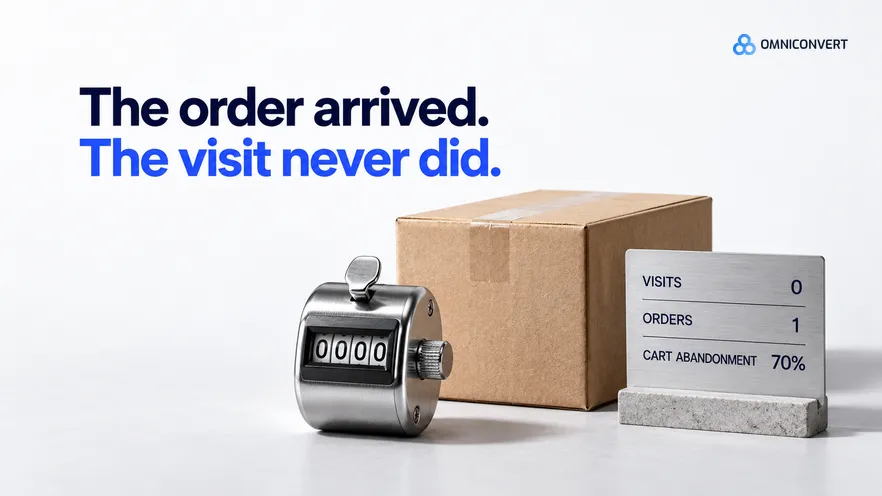
- Zero-click commerce is an order placed by an agent for a shopper, with no visit to the merchant's site.
- Zero-click search costs you a visit. Zero-click commerce can cost you the sale, because the agent compares your terms with other stores.
- For these orders the funnel, page tests and channel attribution go quiet, and the order arrives as direct or unassigned.
- Do not read flat orders and falling sessions as a tracking fault, and do not cut brand spend because unassigned orders look free.
- You keep control of what the agent reads: price, stock, delivery and return terms as fields, plus a checkout with no forced account.
- Measure the customer and the order, with True Profit as the yardstick, because attribution will not carry these orders.
Zero-click commerce is a purchase that finishes without the shopper ever visiting your store. An AI shopping agent finds the product, checks the terms and pays, and your first sign of it is the order itself. No session, no page view, no checkout step on your site. Last updated: October 2026.
I have spent 13 years in eCommerce studying the page between interest and purchase. For some orders, zero-click commerce removes it. I now read the CROBenchmark dataset of 7,000+ websites, assessed against 248+ audit criteria [CROBenchmark Report 2026, Omniconvert], with a new question: which facts would software need from a store, and are they fields?
For the whole field, read the agentic commerce complete guide. In one sentence, agentic commerce is commerce in which software acts for a buyer or a seller inside limits a person set. I also build for the merchant side. Omniconvert Commander (formerly Nexus) is the AI eCommerce growth engine for Shopify brands: it reads your store, ad and customer data, ranks growth opportunities by profit impact, and builds the campaigns to act on them, and you approve what goes live.
What is zero-click commerce?
Zero-click commerce is defined as a purchase in which software acting for a shopper selects the product and completes payment without a visit to the merchant's own site. The agent chooses, so your page is no longer the persuasion step. You still fulfil: in the Agentic Commerce Protocol, developed by Stripe and OpenAI, the business stays the merchant of record and keeps its customer relationship and its say over how orders are fulfilled.
I will not guess how many orders work this way today: see agentic commerce statistics for sourced figures, and agentic storefront for the store-side setup.
How does zero-click commerce differ from zero-click search?
In zero-click commerce the loss is the order. An agent that can read price, stock, delivery and return terms buys from the store that states them most clearly. The work overlaps with AI visibility and GEO, but being named is only a prerequisite. Being buyable is the job.
What disappears from your store when the click does?
| Dimension | Click-through order | Zero-click order |
|---|---|---|
| Who chooses the product | The shopper, on your page | The agent, from your data |
| What your analytics sees | Sessions, page views, funnel steps | The order and the customer record |
| Where the sale is persuaded | Copy, images, layout | Fields, terms, reviews |
| What a page test can learn | Which variant converts | Nothing, the page never loaded |
| How the order is credited | By channel and campaign | Often direct or unassigned |
| What you control | The whole experience | Data, terms, checkout rules, fulfilment |
The failure mode is easy to predict. A team sees orders hold steady while sessions slip and decides the analytics are broken, so it spends a month patching tags. Or it reads last-click ROAS, sees unassigned orders credited to nobody, and trims the brand and creative spend that got the store named. Both moves look careful. The first repairs a tool that works. The second cuts demand and calls it efficiency, and the cost arrives two quarters later as an order count nobody can explain.
What can you still influence in zero-click commerce?
- Facts as fields. Price, stock, delivery and return terms must match on the page, in the feed and in the markup. The guide to optimising for AI shopping agents gives the steps.
- Checkout rules. Guest checkout, total cost shown early, real discount rules. See the readiness FAQ.
- The promise after payment. Delivery and returns that work decide whether the order stays sold.
Click-through orders remain. Average documented cart abandonment is about 70% [Baymard Institute, 2026], mostly from extra costs, forced accounts and long forms (Baymard's list). Structured testing is how you keep winning those orders.
AliveCor used Omniconvert to run a structured A/B testing programme and achieved +21% conversion rate, +5% revenue per visitor, and 94% statistical relevance across their experiments. [Omniconvert, AliveCor case study]
How do you measure orders that arrive with no click?
True Profit is defined as what an order earns after every variable cost of winning and fulfilling it, including the advertising behind it. See what true profit is in eCommerce. It needs the order and its costs, not a click path.
This is the merchant-side work. Omniconvert Commander unifies store, ad and customer data, builds RFM segments and measures results in True Profit, not ROAS. It is not a shopping agent and does not manage your feed or checkout. It shows you what zero-click orders were worth.
Zero-click commerce: FAQs
What is zero-click commerce?
A purchase an AI agent completes for a shopper without a visit to the merchant's site. The agent finds the product, checks the terms and pays. The merchant receives an order, not a visit.
Is zero-click commerce the same as zero-click search?
No. Zero-click search ends a query on the results page, so you lose attention. Zero-click commerce ends a purchase without the visit, so you can win or lose the order itself.
Does zero-click commerce mean my website stops mattering?
No. The site still serves every shopper who visits, and it is where the facts an agent reads are published. It stops being the only place a sale is persuaded.
How do I prepare my store for zero-click commerce?
Publish price, stock, delivery and return terms as fields that match everywhere. Allow guest checkout and show total cost early. Then adopt agent checkout through your platform and payment provider, not custom builds.
How do I measure orders that arrive with no click?
Measure the customer and the order, not the journey. Track customer value and profit after every cost, and compare cohorts instead of channels. True Profit stays readable when attribution does not.
Is Omniconvert Commander a zero-click commerce tool?
No. Omniconvert Commander works on the merchant side: it unifies store, ad and customer data and measures results in True Profit, so you see what zero-click orders were worth. It is not a shopping agent and does not manage your feed or checkout. You approve what goes live.
Plan for the missing click
Zero-click commerce does not end your store. It moves the sale to a place your analytics cannot see. Write your terms as fields, keep checkout free of forced accounts, and keep testing the page for shoppers who still arrive. Then read customers and True Profit instead of click paths, and do not cut the demand that gets your store named because its orders arrive unassigned.